
On this page
Start here
Quick answer
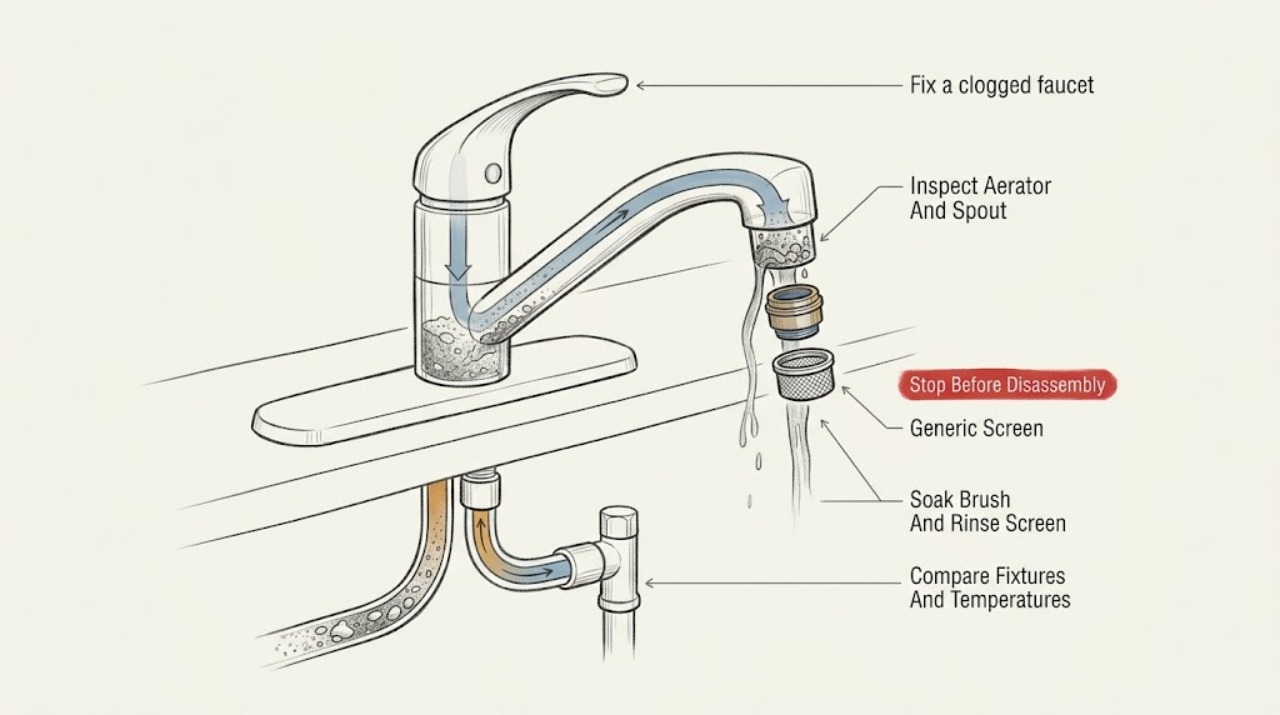
A faucet that has weak or uneven flow is often restricted at the small screen, or aerator, on the end of the spout. First compare this faucet with the other faucets and compare hot with cold: a problem at one faucet points toward its aerator or local plumbing, while reduced flow everywhere points toward a valve, filter, pressure, leak, or supply problem. If the aerator is accessible, protect the drain, remove it gently, soak and brush away scale or debris, rinse it, and reinstall it without over-tightening. Stop and call a qualified plumber if the aerator is corroded or stuck, water leaks under the sink, the faucet has no flow after cleaning, hot-only flow is affected, or several fixtures are affected.
Work through in order
Diagnostic checks
Use only checks that match the exact appliance or system and its official guide.
-
Check 1
Run this faucet briefly and compare its flow with another faucet, then compare the hot and cold positions. Do not remove parts yet; note whether the stream is weak, splashing, intermittent, or completely absent.
Expected result: Only this faucet is restricted, only hot or cold is restricted, several indoor faucets are restricted, or outside fixtures are restricted too.
Next step: For one faucet, inspect the aerator. For hot-only or whole-home symptoms, check only accessible valves and leaks and arrange qualified plumbing help if the cause is not obvious.
Stop if: Stop if water is leaking, the cabinet is wet, a connection is damaged, or flow suddenly changes at multiple fixtures.
Why this matters
Why: One-faucet restriction points toward a local aerator or faucet path. Hot-only restriction points toward hot-water equipment or plumbing. Reduced flow across fixtures suggests a valve, filter, leak, corroded pipe, pressure, or supply issue rather than one clogged spout screen.
-
Check 2
With the faucet off, inspect the end of the spout for a visible or recessed aerator and look for scale, rust, or loose particles. Cover the sink drain before touching it, and take a picture of the assembled parts if removal is appropriate.
Expected result: The screen is visibly scaled or dirty, the aerator is recessed, or there is no accessible screen and the spout appears damaged or blocked.
Next step: If the aerator can be removed by hand or with a finish-protected gentle tool, continue to cleaning. If it is seized, corroded, or would require force, stop and call a qualified plumber.
Stop if: Stop if the spout or threads begin to deform, the fitting will not turn with gentle force, or removal would require disconnecting plumbing.
Why this matters
Why: Visible buildup supports a local aerator cleaning. A recessed design needs the correct faucet key or model procedure. A damaged spout or inaccessible blockage is not a reason to pry or drill the faucet.
-
Check 3
Separate the accessible aerator only after photographing its order. Soak the pieces in white vinegar to loosen mineral buildup, brush the screen gently, and rinse every part under clean running water; do not use a hard tool that can damage the mesh.
Expected result: Scale or debris releases and the screen openings become visibly clear, or the screen remains damaged, blocked, or badly corroded.
Next step: Reassemble the pieces in the photographed order and reinstall by hand. If the screen is damaged or cannot be cleaned without force, keep the faucet off as needed and arrange plumbing help or identify the exact faucet model before selecting a replacement.
Stop if: Stop if parts cannot be identified, the screen breaks, or the cleaning would require opening the faucet body or supply lines.
Why this matters
Why: A clear, intact screen can explain a local flow restriction. A torn, crushed, missing, or heavily corroded screen may need a correctly matched replacement, while buildup that will not release may indicate a wider water-quality or pipe issue.
-
Check 4
Reassemble the aerator in its original order and screw it back onto the spout by hand. Open the faucet slowly while watching the stream and the joint around the aerator; tighten gently only if the joint seeps.
Expected result: The flow is even and improved with no spray or leak, or the flow remains weak or water leaks around the fitting.
Next step: If flow is normal, monitor it. If it remains weak, briefly compare with the aerator removed only if the faucet can discharge safely into the basin; if it leaks or sprays, turn the faucet off and arrange service.
Stop if: Stop immediately for a leak that does not stop when the faucet is closed, damaged threads, uncontrolled spray, or water reaching electrical equipment.
Why this matters
Why: Improved flow without leakage supports the aerator as the blockage. Persistent weak flow means the restriction may be upstream or the supply may be low; a leak means the screen, washer, or threads are not seated correctly or are damaged.
-
Check 5
If the aerator is clean but flow is still restricted, inspect only normally accessible shutoff valves, under-sink connections, and nearby surfaces for a valve that is not fully open, dampness, puddling, corrosion, or a running-water sound. Do not disconnect a supply line or adjust a pressure-reducing valve.
Expected result: The local valve is visibly closed or partly closed, there is a leak or damp connection, or all accessible valves and connections look normal while other fixtures are also weak.
Next step: Open only a clearly identified faucet shutoff valve if it turns normally and there is no leak; otherwise leave it alone. Call a qualified plumber or notify the property manager for leaks, whole-home symptoms, or any valve/pipe that needs repair.
Stop if: Stop for a leaking or seized valve, corroded pipe, wet electrical equipment, no water at all, or any need to cut pipe, remove a supply line, or adjust a PRV.
Why this matters
Why: A partly closed valve can restrict one faucet; a leak or wet connection needs prompt plumbing attention. Normal local connections with whole-home low flow point beyond the faucet to a filter, PRV, pipe corrosion, or water-service issue.
Use your observations
Decision map
Find the observation that best matches what you see, then follow the next safe action.
-
PATH 01Next step
What you see
Only one faucet has weak or uneven flow and its aerator contains scale, rust, or debris.
Do this next
Clean the accessible aerator with a drain cover, gentle vinegar soak, soft brushing, rinsing, and careful reassembly.
-
PATH 02Safety boundary
What you see
The aerator is recessed without the correct key, seized by corrosion, has damaged threads, or cannot be removed with gentle force.
Do this next
Do not pry, drill, over-tighten, or disconnect the faucet supply lines.
Why this path and its safety boundary
Safety stop: True
-
PATH 03Next step
What you see
Cold flow is normal but hot flow is weak at this faucet or several faucets.
Do this next
Do not assume the spout screen is the only blockage; compare other hot fixtures and inspect only for visible water-heater or connection problems.
-
PATH 04Next step
What you see
Flow is reduced at several faucets, including outside fixtures, or all cold faucets have no water.
Do this next
Treat it as a supply or whole-home plumbing problem rather than repeatedly cleaning one faucet.
-
PATH 05Safety boundary
What you see
Water leaks around the aerator, under the sink, at a supply connection, or near electrical equipment.
Do this next
Close the faucet and stop the cleaning or testing; do not keep tightening a damaged fitting.
Why this path and its safety boundary
Safety stop: True
Helpful context
Understand the symptom
Use the pattern of the low flow to narrow the blockage
A faucet aerator is the small screen at the spout tip. Scale, rust, or particles can restrict that screen and make the stream weak or uneven. Before taking anything apart, test the pattern: compare this faucet with another fixture, then compare its hot and cold positions. A single-faucet problem is more likely to be local; low flow at several fixtures points toward a valve, filter, leak, corroded supply pipe, or utility issue instead of one aerator.
Clean an accessible aerator without losing its parts
Turn the faucet off and cover or plug the sink drain before removing the aerator. Take a picture before separating its pieces. If the end piece turns by hand, remove it; if a wrench is necessary, protect the finish with masking tape and use only gentle force. A concealed screen may require the faucet's supplied key. The New Jersey Department of Health advises soaking mineral buildup in white vinegar, brushing the screen gently, rinsing each piece, and reassembling it in the photographed order. Reinstall by hand and tighten only enough to prevent a leak.
Treat a successful cleaning and a failed cleaning differently
After reinstalling the screen, open the faucet slowly and look for a full, even stream and for water spraying or leaking around the aerator. If flow improves, the screen was a plausible restriction; periodic scale inspection can help prevent recurrence. If the stream remains weak with the aerator removed or the screen is clean, the restriction is farther upstream or the supply itself is abnormal. Do not keep forcing the aerator or start disconnecting supply lines just to continue the diagnosis.
Recognize a plumbing problem rather than a faucet problem
Check for drips, puddles, damp cabinet surfaces, or running-water sounds around the accessible connections without reaching into wet electrical equipment. Low flow only on hot water can involve the water heater or hot-water plumbing; low flow at all faucets, including outside fixtures, can involve the main valve, pressure-reducing valve, whole-home filter, a leak, or the water service. Those are not fixed by repeatedly cleaning one aerator and may require a licensed or qualified plumber or property manager.
Safety boundary
Stop conditions
- Do not force, drill, or pry a stuck aerator, and do not disconnect supply lines merely to chase a blockage.
- Do not adjust a pressure-reducing valve, cut pipe, or open a water heater as a faucet-cleaning step.
- Stop for leaks, uncontrolled spray, water near electrical equipment, damaged threads, corroded pipe, or no water at multiple fixtures.
Only after diagnosis
Potential parts
- faucet aerator or screen
Consider this only when the existing aerator is damaged, missing parts, or remains obstructed after gentle cleaning and the faucet's thread/design is identified.
Confirm the exact faucet model or thread style and any flow-pattern requirements before choosing a replacement; do not assume a generic screen fits.
When checks do not resolve it
Need a professional?
The aerator is stuck, corroded, damaged, or recessed without the correct removal key., Flow remains weak after the aerator is clean, or the faucet has no flow while other fixtures are normal., Only hot water is weak, several fixtures are affected, or a valve, filter, pressure device, pipe, or water heater may be involved., There is a leak, wet cabinet, damaged connection, or water near electrical equipment.
Common questions
FAQ
What is the first thing to check when one faucet is clogged?
Compare the faucet with another fixture and compare hot with cold, then inspect the small aerator screen at the spout tip. If only this faucet is weak and the screen has scale or debris, clean it gently; if several fixtures are weak, the cause may be upstream.
How do I clean a faucet aerator?
Cover the sink drain, photograph the assembled pieces, remove the aerator gently, soak the pieces in white vinegar, brush the screen softly, rinse everything, and reassemble it in the photographed order. Reinstall by hand and tighten only enough to prevent a leak.
What if the faucet aerator will not unscrew?
Do not increase force until the finish, threads, or spout may be damaged. A recessed screen may need the correct faucet key, and corrosion may make removal unsafe; leave it in place and use a qualified plumber if gentle removal does not work.
Why is only the hot water from my faucet weak?
Hot-only low flow can involve the hot-water system or plumbing as well as a hot-side screen. Compare other hot fixtures and inspect only for visible leaks or failures; arrange qualified plumbing or property-manager help if the issue is not limited to a cleanable aerator.
When does a clogged faucet need a plumber?
Call a qualified plumber for a seized or corroded aerator, a leak, damaged threads or pipe, persistent weak flow after cleaning, no water at one fixture with normal flow elsewhere, or low flow at several fixtures. Do not disconnect supply lines or adjust pressure equipment as a first-line cleaning step.
Read the exact guide
Official sources
- Guidance for Cleaning Faucet AeratorsNew Jersey Department of Health · General kitchen and bathroom faucet aerator guidance; the faucet manufacturer's design instructions take precedence.
- Troubleshooting water pressure and flowCity of Portland Water Bureau · General residential plumbing guidance; local utility and building conditions may differ.
- Home MaintenanceU.S. Environmental Protection Agency WaterSense · General WaterSense home-maintenance guidance; follow the faucet manufacturer's instructions for specific products.
Community feedback
Share a repair observation
Share a plain-text repair observation. Accepted observations are published automatically; this page may take a moment to update.