
On this page
Start here
Quick answer
A bang that happens immediately when a faucet closes is usually a pressure shock in the water-supply piping, especially when a quick-closing valve stops moving water abruptly. First separate that trigger from a noise that occurs only while water is draining, then note whether the sound is limited to one faucet or affects several fixtures. Look only at accessible piping for movement, contact, leaks, or corrosion; do not open walls or dismantle a pressurized fitting. A forceful or recurring bang, visible pipe damage, or any leak is a reason to stop repeated testing and have a plumber check pressure, supports, the faucet valve, and whether a correctly selected water-hammer arrestor is needed.
Work through in order
Diagnostic checks
Use only checks that match the exact appliance or system and its official guide.
-
Check 1
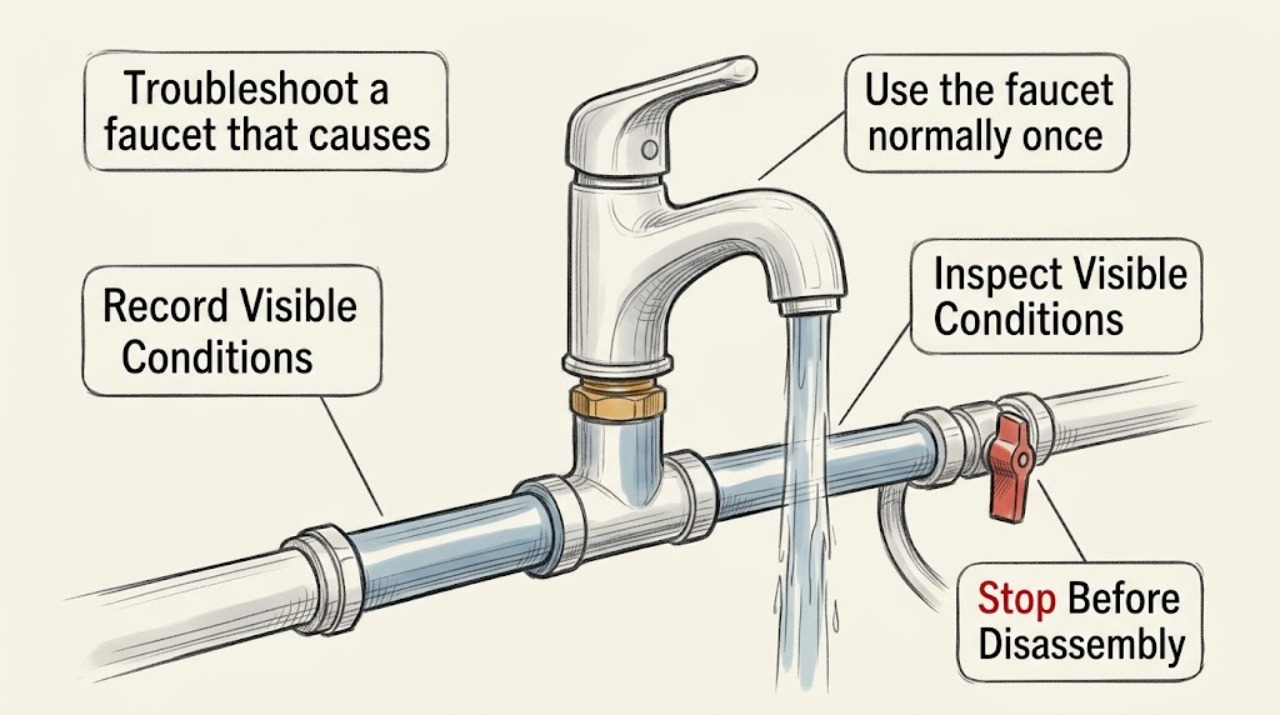
Without removing anything, close the faucet once in its normal way and write down the exact timing: an immediate bang at the handle, a delayed sound while water drains, or no repeatable sound. Note whether the sound is at the faucet, inside a wall, or at another visible section of pipe.
Expected result: An immediate bang as the supply flow stops supports a water-supply shock; a sound only during drainage points to a different drain or vent investigation; an inconsistent sound needs more context rather than more forceful tests.
Next step: If the sound is supply-timed, continue with the fixture-scope and visual checks. If it is drain-timed, stop treating it as faucet water hammer and arrange a plumbing assessment if it persists.
Why this matters
Why: The trigger separates likely water hammer from other plumbing noises before any part is chosen.
-
Check 2
Use the faucet normally once more, then close the handle more gradually only if the first test was quiet enough to do so safely. Do not repeatedly slam the valve or manipulate a hidden shutoff.
Expected result: If a slower close makes the bang noticeably smaller or removes it, the stop rate is an important clue. If the noise is unchanged, the cause may involve pressure, pipe support or contact, another valve, or the faucet valve itself.
Next step: Record the result for a plumber; do not adjust a regulator or add an arrestor based on this test alone.
Why this matters
Why: A change with closing speed is consistent with the sudden-stop mechanism, but it does not identify a safe pressure setting or prove which component needs replacement.
-
Check 3
From a dry, accessible area under the sink or in an open utility space, watch exposed supply tubing while the faucet is operated once. Look for pipe movement, contact with framing or a cabinet, a drip, rust, greenish deposits, or mineral buildup. Keep hands away from fittings and do not open walls or ceilings.
Expected result: Visible movement or pipe-to-surface contact supports a support or isolation issue; a drip, corrosion, or deposits indicates a separate leak or material condition; no visible change does not rule out a concealed or pressure-related fault.
Next step: Stop testing and call a plumber for any leak, damaged pipe, or forceful movement. If the exposed area is dry and stable, continue only by documenting the trigger and fixture scope.
Why this matters
Why: Supports and isolation can affect vibration, while leakage or corrosion raises the urgency beyond a harmless noise.
-
Check 4
Compare the symptom by fixture without provoking it repeatedly: note whether it occurs only at this faucet, at another faucet, or when a quick-closing appliance valve operates. Record whether nearby rooms or the whole home hear the same event.
Expected result: One faucet suggests a local valve, branch, or support clue; several fixtures or a whole-home pattern suggests a shared supply, pressure, or support condition; an appliance-only trigger points to that appliance valve as a possible source.
Next step: Give the plumber the fixture list and trigger sequence. Do not keep operating multiple valves just to reproduce a loud bang.
Why this matters
Why: The scope tells the service professional whether to start at the faucet branch or investigate shared supply conditions.
-
Check 5
Review what changed before the noise began, such as a faucet replacement, a shutoff or supply-line repair, or a new appliance. Keep the model and installation records for the affected fixture if available, without removing the fixture.
Expected result: A symptom that began after a valve or plumbing change gives the plumber a useful starting point; no recent change keeps pressure, supports, contact, and normal valve wear in the diagnostic set.
Next step: Share the change history and the earlier observations during service; do not order a replacement part until the faucet model and fault are confirmed.
Why this matters
Why: Timing is evidence about which valve or branch may now be closing differently, but it is not proof that the newest part is defective.
Use your observations
Decision map
Find the observation that best matches what you see, then follow the next safe action.
-
PATH 01Next step
What you see
The bang occurs immediately when this faucet closes and there is no leak.
Do this next
Limit further testing and have a plumber assess the supply branch, pressure, supports, and valve behavior before selecting any arrestor or replacement part.
Why this path and its safety boundary
Why it matters: This is the strongest water-hammer pattern in the set of observations, but the source can still be a local or shared valve, pressure, support, or pipe-contact condition.
-
PATH 02Next step
What you see
The bang becomes smaller when the faucet closes slowly.
Do this next
Use the observation as diagnostic information only; do not change pressure settings or install a device without professional sizing and placement.
Why this path and its safety boundary
Why it matters: The stop rate is likely contributing to the pressure shock.
-
PATH 03Next step
What you see
The sound occurs only while water drains, or it includes gurgling or a drain backup.
Do this next
Avoid repeated tests and arrange a plumber’s evaluation if the drainage noise persists, backs up, or is accompanied by leakage.
Why this path and its safety boundary
Why it matters: That timing is not enough to call it faucet water hammer and may indicate a drainage or vent issue.
-
PATH 04Next step
What you see
Exposed pipe moves hard, strikes a surface, leaks, shows corrosion or deposits, or the noise is forceful and recurring across fixtures.
Do this next
Stop provoking the symptom. If a local shutoff is clearly accessible and can be closed without force, close it; otherwise leave the system alone and contact a licensed plumber or qualified plumbing professional.
Why this path and its safety boundary
Why it matters: The condition may be damaging or may involve a shared plumbing problem rather than a minor isolated sound.
Helpful context
Understand the symptom
Start with the timing of the sound
Water hammer is a supply-side pressure event: moving water is stopped suddenly when a valve closes, and the resulting pressure change can make the piping vibrate or bang. A faucet is only one possible trigger; the same plumbing system can react to another quick-closing fixture or appliance. If the noise occurs only as water goes down a drain, treat it as a separate plumbing-noise clue rather than assuming the faucet is creating water hammer.
Keep the inspection visual and local
The useful homeowner evidence is a repeatable trigger, where the sound starts, whether nearby exposed pipe moves or touches a surface, and whether there is any leak or corrosion. Do not remove a faucet handle, open a wall or ceiling, loosen a fitting, adjust a pressure control, or try to install a device while the line is in service. Those steps can turn a noise investigation into a leak or injury hazard and require the right diagnosis and parts.
What a plumber may need to determine
If the sound is confirmed as supply-side, a plumber can determine whether excessive pressure or velocity, a quick-closing valve, inadequate support, pipe contact, or a worn faucet valve is the dominant clue. An arrestor is not a universal cure: its type and location depend on the confirmed piping condition and the valve that creates the shock. Persistent noise should be evaluated rather than repeatedly provoked, because water-hammer forces can damage valves, gaskets, pumps, or piping over time.
Only after diagnosis
Potential parts
- water-hammer arrestor
Consider this only if a plumber confirms a supply-side pressure shock and identifies the correct valve, location, and connection method; a slower faucet close alone does not establish fit or placement.
Confirm the plumbing configuration, connection type, installation location, and applicable code or manufacturer requirements with the professional before selecting a part. - faucet cartridge or valve service part
Consider this only if the diagnostic inspection shows the faucet valve itself is chattering, closing abnormally, or otherwise causing the symptom rather than the branch piping creating the shock.
Faucet service parts are model-specific; confirm the exact faucet identification and fit information before ordering or disassembling anything.
When checks do not resolve it
Need a professional?
Call when the noise is forceful, recurring, shared by several fixtures, paired with a leak or damage, or not clearly distinguishable from a drainage problem.
Common questions
FAQ
What causes a faucet to make a water-hammer bang?
When moving supply water is stopped suddenly by a closing valve, the pressure change can make the water line vibrate or bang. The timing matters: a bang right at faucet closure supports this path, while a drain-only noise needs a different assessment.
Why can the bang seem to come from a wall or another room?
The faucet can trigger a pressure event in connected supply piping, and vibration can travel through supported or contacting pipe. Check only accessible areas for movement or contact; do not open the wall to chase the sound.
Should I install a water-hammer arrestor myself?
Not based on the noise alone. An arrestor may be appropriate only after the supply-side cause, triggering valve, location, connection, and applicable requirements have been confirmed by a plumbing professional.
When is faucet water hammer urgent?
Stop repeated testing and call a plumber for a leak, visible damage or corrosion with moisture, strong pipe movement, repeated or worsening bangs, noise from several fixtures, or a drain backup. These clues can indicate more than an isolated nuisance sound.
Read the exact guide
Official sources
- Plumbing SystemsBay County, Michigan · Home plumbing guidance used for water-hammer clues, pipe anchoring, and visible leak or corrosion checks.
- Introduction to Continuing Education Class on What Can Go Wrong? [Common Plumbing Problems] for Utah Plumbers (Video)State of Utah · Technical explanation of moving water, sudden valve closure, vibration, supports, and possible damage; used for mechanism and safety boundaries, not as a universal repair prescription.
Community feedback
Share a repair observation
Share a plain-text repair observation. Accepted observations are published automatically; this page may take a moment to update.