
On this page
Start here
Quick answer
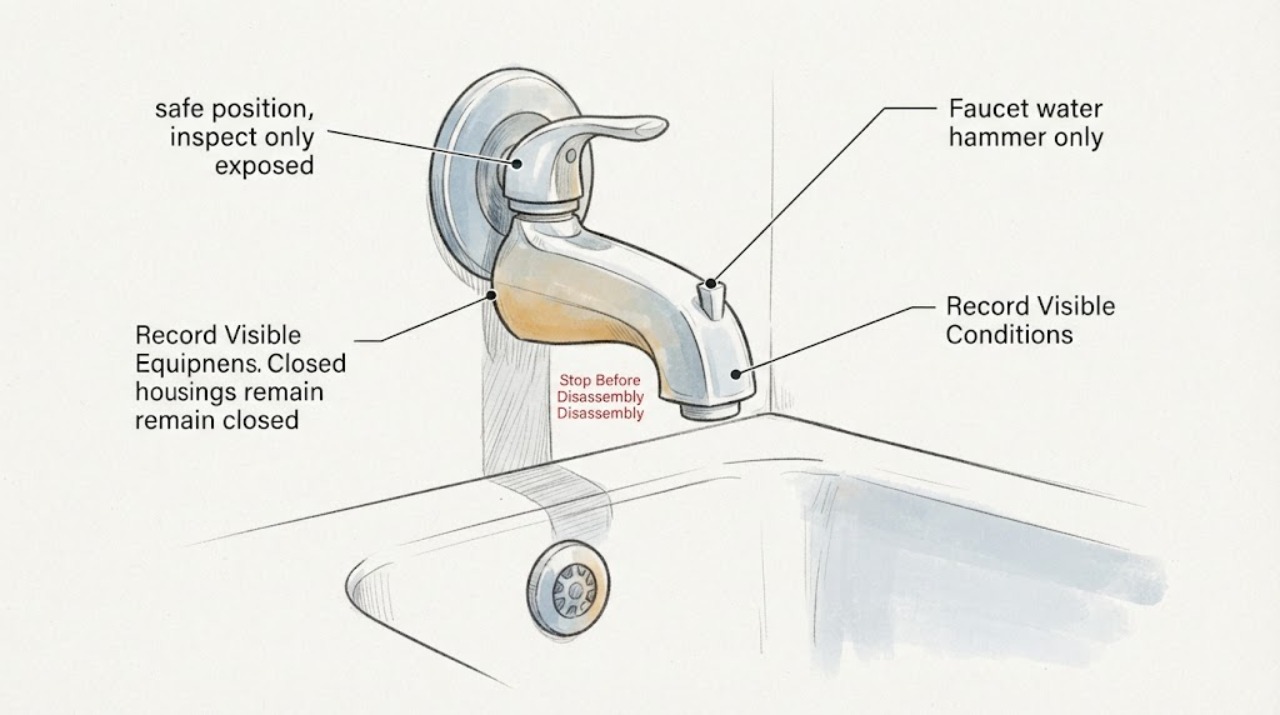
When a water hammer occurs only at the bathtub, first note whether one sharp knock happens as the faucet closes or whether the pipes keep vibrating. A quick valve closure, a loose local pipe support, a worn faucet washer or seal, a restriction, or a local pressure issue can all make a bathtub branch louder than the rest of the home. Use only accessible, dry observations; do not open the wall or loosen a pressurized valve. A leak, damp wall, persistent violent vibration, or electrical contact with water is a stop condition for a plumber.
Work through in order
Diagnostic checks
Use only checks that match the exact appliance or system and its official guide.
-
Check 1
From beside the tub, operate the faucet normally once and record whether the noise happens on opening, while the water is running, or immediately after closing; stop repeating the motion if the pipe shakes violently.
Expected result: One sharp knock immediately after closing supports a pressure-shock pattern. A rattle or vibration at a particular flow setting, especially if it eases at a fuller flow, points more toward a local valve, washer, seal, or pipe-support issue.
Next step: Use the timing and flow behavior to choose the local-faucet, pipe-support, or whole-home comparison branch; do not repeatedly recreate a severe bang.
Why this matters
Why: The sound timing separates a sudden flow interruption from a chattering faucet part or a loose branch. It also confirms that the condition is tied to the bathtub fixture rather than a distant appliance valve.
-
Check 2
Compare the bathtub's hot and cold handles or controls one at a time, using a gentle normal flow and avoiding contact with very hot water.
Expected result: Noise from only one side points toward that side's valve, washer, seal, or supply branch. Noise from both sides with similar timing supports a shared tub valve, local pipe support, or pressure condition.
Next step: Record which side and control position triggers the sound. A persistent single-side rattle or chatter needs faucet or plumber service; a matching bang on both sides merits a local pressure or pipe-support assessment.
Why this matters
Why: A hot-versus-cold difference narrows the affected branch without requiring the user to remove trim or touch a pressurized connection.
-
Check 3
From a dry, safe position, inspect only exposed pipe, trim, the tub spout, and any accessible service opening for movement, corrosion, fresh moisture, or a fitting that visibly shifts when the faucet is used.
Expected result: Visible pipe movement or a loose-looking support can explain a knock that is loud only at the tub. Dampness, a drip, staining, or movement at a connection indicates a leak risk rather than a noise-only nuisance.
Next step: Do not tighten, remove, or open a concealed or pressurized fitting. Close the local valve only if it is clearly identified and safe to reach, then call a plumber for any moisture, movement, or hidden-support concern.
Why this matters
Why: Water hammer can make loosely supported pipes bounce against nearby structure, while a worn faucet component can chatter at a low-flow setting. Concealed pipe work cannot be diagnosed safely from outside the wall.
-
Check 4
Check whether the sound is isolated to the bathtub by listening from a safe distance while another household faucet is used normally; do not create rapid on-off cycles to compare the fixtures.
Expected result: If only the tub branch knocks, a local valve, branch support, or tub-side restriction is more likely. If several fixtures knock, the home may have a broader pressure, support, or shock-absorption issue.
Next step: Keep the repair scope local when only the tub is affected. For whole-home noise, ask a plumber to assess pressure control, accessible supports, and the distribution layout.
Why this matters
Why: A fixture-by-fixture comparison tests the task's bathtub-only condition without opening walls or measuring pressure with unverified equipment.
-
Check 5
Review recent plumbing work, a new tub valve or cartridge, pressure-regulator work, or a period when the home's water was shut off, and note whether the noise began afterward.
Expected result: A new or recently disturbed fixture can expose a loose support, defective seal, trapped air, or changed flow condition. A new problem after pressure-control work or a main shutoff change is useful context for a plumber.
Next step: Provide the timing and affected tub control to the plumber. Do not remove the valve, purge pipes by opening multiple fixtures rapidly, or alter a pressure regulator yourself.
Why this matters
Why: Timing does not prove a cause, but it distinguishes a local installation or valve change from a long-standing pipe-layout issue.
-
Check 6
After the observations, use the bathtub normally and document the sound type, trigger, hot or cold side, visible movement, moisture, and whether other fixtures are affected; stop if the condition worsens.
Expected result: A repeatable single knock with no leak can be assessed as a local water-hammer or support issue. Chatter, continuous vibration, dampness, wall movement, loss of water, or damage indicates a fault that should not be repeatedly exercised.
Next step: Request plumbing service for persistent tub-only hammer, suspected valve or seal wear, hidden pipe movement, or any leak. Seek urgent help for a sudden major leak or water contacting electrical equipment.
Why this matters
Why: The record gives a plumber actionable evidence while keeping the user away from concealed pipes, pressurized valves, and unverified pressure adjustments.
Use your observations
Decision map
Find the observation that best matches what you see, then follow the next safe action.
-
PATH 01Next step
What you see
One sharp knock occurs immediately when the bathtub faucet closes, with no ongoing vibration.
Do this next
Arrange qualified service and follow the exact model guidance.
Why this path and its safety boundary
Why it matters: Treat it as a local pressure-shock or water-hammer pattern and have a plumber assess the tub branch, supports, and approved shock-absorption options.
-
PATH 02Next step
What you see
The sound is a rattle or chatter at one handle or partial-flow position and eases at fuller flow.
Do this next
Arrange qualified service and follow the exact model guidance.
Why this path and its safety boundary
Why it matters: A tub valve, washer, seal, or local restriction is more likely; keep observations external and arrange faucet or plumber service rather than opening the valve.
-
PATH 03Next step
What you see
Both hot and cold sides at the tub make a similar noise, or other fixtures also knock.
Do this next
Arrange qualified service and follow the exact model guidance.
Why this path and its safety boundary
Why it matters: Ask a plumber to assess the shared tub branch or whole-home pressure and pipe-support condition; do not alter the pressure regulator yourself.
-
PATH 04Next step
What you see
The noise is accompanied by a drip, wet wall, visible pipe movement, loss of water, violent vibration, or water near electrical equipment.
Do this next
Arrange qualified service and follow the exact model guidance.
Why this path and its safety boundary
Why it matters: Stop using the faucet, isolate water only if the shutoff is safely identifiable and dry to reach, keep clear of wet electrics, and call a plumber or emergency service as appropriate.
Helpful context
Understand the symptom
The condition matters: only in the bathtub usually points to the tub valve, its nearby supply branch, or how that branch is supported, rather than proving that the entire home's plumbing is faulty. The bathtub wall can also amplify a short pressure shock. A plumber may need to access the valve, secure concealed pipe, check a pressure regulator, or add an approved shock-absorbing device.
Do not chase a loud bang by opening a wall, removing a tub valve, changing a pressure-control setting, or loosening a fitting under pressure. Keep the area dry and stop if the sound is accompanied by a leak, dampness, a burst-like thump, loss of water, or damage to nearby electrical equipment.
Safety boundary
Stop conditions
- Stop immediately for a spreading leak, damp wall or ceiling, burst-like impact, loss of water, violent pipe movement, water near electrical equipment, or any condition that could damage the building.
- Do not open a wall, remove a tub valve, loosen a pressurized fitting, alter a pressure regulator, or install a shock device without qualified plumbing work. Avoid rapid repeated faucet cycling.
Only after diagnosis
Potential parts
- water-hammer arrestor or pipe-support hardware
Consider only if a plumber confirms that the local tub supply branch needs a code-compliant shock-absorption or support solution.
A plumber must select the device and installation location for the actual piping, pressure, access, and local requirements; do not infer fit from the faucet symptom alone. - faucet washer, seal, or cartridge
Consider only if the affected control chatters at a specific flow and a qualified diagnosis identifies a worn valve component.
Confirm the faucet design and exact model before ordering; a cartridge or seal is not interchangeable merely because the symptom is similar.
Common questions
FAQ
Why does water hammer happen only at my bathtub?
The tub valve and its nearby supply branch may close abruptly, chatter at a certain flow, or be supported in a way that makes the pressure shock louder there. The tub wall can also amplify the noise.
Is one bang when the bathtub faucet closes an emergency?
A single mild knock without a leak is usually a plumbing diagnosis issue, but repeated or violent impact, pipe movement, dampness, or loss of water should stop use and prompt a plumber.
Should I open the wall or adjust water pressure to stop the noise?
No. Concealed pipe support, valve work, and pressure-control changes should be assessed by a plumber. Record the trigger, hot or cold side, and whether other fixtures are affected instead.
Read the exact guide
Official sources
- Water Pressure HelpEast Valley Water District · Household fixture-versus-whole-home pressure troubleshooting
- Matching Terms and DefinitionsPacific Northwest National Laboratory for the U.S. Department of Energy · Water-hammer definition in residential plumbing terminology
- Plumbing SystemsBay County, Michigan, Citizen Corps · Residential plumbing supply, fixture shutoff, water-hammer, and leak observations
- Quieting in the HomeU.S. Environmental Protection Agency · Residential plumbing noise and water-hammer guidance
Community feedback
Share a repair observation
Share a plain-text repair observation. Accepted observations are published automatically; this page may take a moment to update.