
On this page
Start here
Quick answer
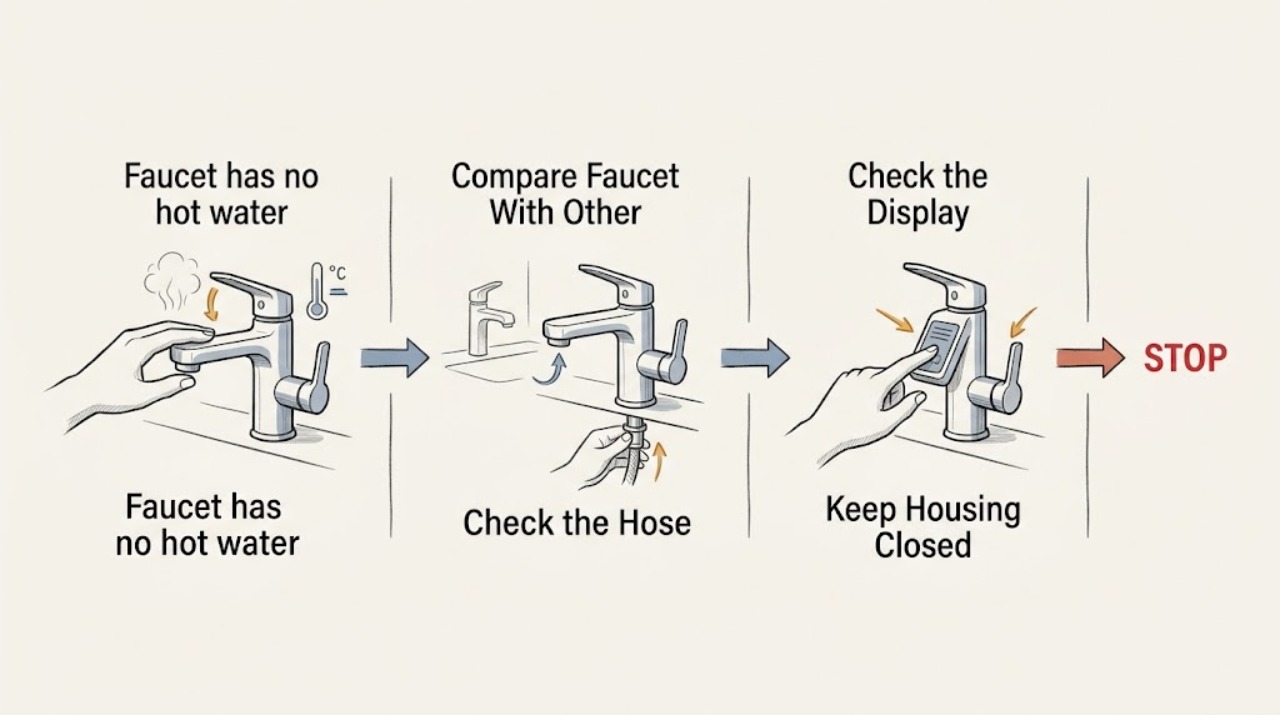
First compare the Kohler faucet with another hot-water fixture. If other fixtures are hot, the fault is likely at this faucet's hot angle stop, supply hose, kink, cartridge or valve, check valve, sensor, or mixing path; if the whole home is cold, troubleshoot the water heater or house hot-water supply instead. From a dry position, check that the hot stop is open, the hot hose is not kinked, and a touchless faucet has its required handle, sensor, or power state. For a two-handle faucet, briefly isolate the hot side only when the angle stop is clearly identified. Do not remove a cartridge or valve while water is connected, guess at a Kohler part by appearance, or raise a water-heater setting to compensate. Kohler's support guidance is model-specific: use the exact faucet model and its parts or maintenance instructions before cleaning or replacing a valve, cartridge, hose, screen, or check valve.
Before you begin
Safety first
- This article supports comparing fixtures, checking obvious visible stop and hose conditions, recording external control status, isolating clearly identified supplies, and following a matching Kohler model guide for permitted cleaning or adjustment. A qualified professional should open the valve or control enclosure, repair failed stops or concealed plumbing, handle wet electrical equipment, and diagnose internal cartridges, valves, check valves, or mixed-water crossovers.
Work through in order
Diagnostic checks
Use only checks that match the exact appliance or system and its official guide.
-
Check 1
Run the hot side briefly at the Kohler faucet and at another nearby fixture, comparing hot flow with cold flow; keep the water check short and do not touch water that is unexpectedly hot.
Expected result: Another fixture may be hot while the Kohler faucet is cold, all hot fixtures may be cold, or the Kohler hot flow may be weak while cold flow is normal.
Next step: Record the fixture pattern and proceed to the Kohler hot-side stop, hose, and visible control checks only if other fixtures confirm that hot water is available.
Stop if: Stop for scalding water, a leak, water near electrical equipment, steam, or a sudden temperature change.
Why this matters
Why: Hot water elsewhere makes a faucet-side hot supply, valve, cartridge, screen, or mixing-path issue more likely. Cold water throughout the home points toward the water heater or house hot-water supply. Weak hot-only flow supports a restriction rather than absence of hot water at the source.
-
Check 2
From a dry position under the sink, identify the hot angle stop and visually check that it is open and that the hot supply hose is not kinked, crushed, twisted, or disconnected; do not loosen the hose.
Expected result: The hot stop may be closed or partly closed, the hose may be kinked or strained, or both visible supply conditions may look normal.
Next step: Correct only an obvious, hand-operable stop position according to the installation instructions; if the stop is stuck, the hose is damaged, or the condition is uncertain, leave it as found and arrange plumbing service.
Stop if: Do not force a stuck stop, pull on a pressurized hose, remove a connection under water pressure, or work in a wet cabinet.
Why this matters
Why: A closed stop or kink can prevent or restrict hot water to the faucet even when the water heater is working. Normal visible supply conditions shift concern toward a screen, valve, cartridge, electronic control, or concealed plumbing problem.
-
Check 3
Identify whether the Kohler faucet is single-handle, two-handle, touchless, or electronic and record handle position, sensor response, power or indicator state, and any visible model-specific status without opening the control box.
Expected result: The handle may not be fully open, a sensor may not respond, a power indicator may be off, or the faucet may operate normally on cold but not on hot.
Next step: Follow only the exact Kohler model's user procedure for handle, sensor, battery, or power checks; if the faucet remains cold, photograph the model label and status for service.
Stop if: Do not bypass a sensor, open an electronic enclosure, touch wet wiring, or substitute a battery, adapter, or control part without model instructions.
Why this matters
Why: A control or sensor state can block flow before the hot valve is tested. A two-handle faucet that flows cold but not hot points toward the hot-side valve or supply; an electronic faucet with no status may have a power or control issue rather than a plumbing temperature issue.
-
Check 4
For a two-handle Kohler faucet, close the hot and cold angle stops one at a time only when clearly identified, then open the faucet briefly to release residual pressure; for a single-handle faucet, do not remove the handle or cartridge unless the model guide permits it.
Expected result: Closing the hot stop may stop the symptom, the faucet may still flow cold, both sides may remain active, or neither stop may isolate the faucet.
Next step: Leave the affected side closed, use the model guide to identify the valve or cartridge path, and arrange a plumber if the stop fails, the valve cavity is inaccessible, or the faucet still has no hot flow.
Stop if: Do not remove the cartridge, valve, check valve, hose, or aerator while water remains connected or the cabinet cannot stay dry.
Why this matters
Why: The isolation result identifies whether the hot branch is actually controlled by that stop and helps distinguish a hot cartridge or valve from a supply or stop problem. Failure to isolate means the next repair would be unsafe to perform at the faucet.
-
Check 5
Record the Kohler model number, faucet configuration, hot-versus-cold flow pattern, stop and hose observations, sensor or power state, any screen or cartridge cleaning allowed by the manual, and whether the hot flow returned; do not order a part from the symptom alone.
Expected result: Hot water may return after an obvious control or stop correction, remain absent with normal supply, flow at a hose but not at the spout, or change after a model-specific screen or valve check.
Next step: Use Kohler's product page and interactive parts diagram or provide the model and photos to a qualified plumber or service technician; close the hot stop again if the faucet leaks or the condition returns.
Stop if: Do not force a cartridge, reverse a hot or cold valve without model instructions, bypass a check valve, or leave a partially repaired faucet pressurized unattended.
Why this matters
Why: A model and result history can separate a supply restriction, debris, cartridge or valve, check valve, electronic control, or water-heater issue. Similar Kohler faucet appearances do not establish interchangeable parts.
Use your observations
Decision map
Find the observation that best matches what you see, then follow the next safe action.
-
PATH 01Safety boundary
What you see
Other hot fixtures work, but the Kohler faucet produces cold or weak hot water while cold flow is normal.
Do this next
Check the visible hot stop and hose, identify the Kohler model, and arrange model-specific faucet service if the restriction is not obvious.
Why this path and its safety boundary
Why it matters: A faucet-side hot stop, kinked hose, clogged screen, cartridge or valve, check valve, or mixing path is more likely than a water-heater failure.
Safety stop: Do not change the water-heater setting or open the faucet valve cavity without isolating the hot and cold supplies.
-
PATH 02Safety boundary
What you see
The Kohler faucet and other fixtures all lack hot water, while cold water is available.
Do this next
Troubleshoot the water heater and household hot-water supply, or arrange plumbing service; do not replace the faucet cartridge before hot water is restored elsewhere.
Why this path and its safety boundary
Why it matters: The water heater, house hot-water supply, recirculation, or a whole-house mixing device is more likely than the Kohler faucet.
Safety stop: Stop for a gas odor, carbon-monoxide alarm, active leak, scalding discharge, electrical hazard, or water-heater fault that requires trained service.
-
PATH 03Safety boundary
What you see
The hot angle stop is closed or partly closed, or the hot supply hose is kinked, twisted, strained, or disconnected.
Do this next
Restore only an obvious hand-operable stop position or correct hose routing under the exact installation instructions; if the hose or stop is damaged, arrange plumbing help.
Why this path and its safety boundary
Why it matters: The faucet is not receiving a normal hot-water supply; an internal cartridge diagnosis would be premature.
Safety stop: Do not force the stop, loosen the hose under pressure, or leave a damaged hose in service.
-
PATH 04Safety boundary
What you see
A touchless or electronic Kohler faucet has no hot flow and also has no expected sensor response, power indicator, or open-handle state.
Do this next
Follow the exact model's external sensor, handle, and power instructions; arrange service if the control remains inactive or water has reached the electronics.
Why this path and its safety boundary
Why it matters: A control, sensor, battery, adapter, or user-state issue may be blocking water before the hot branch is evaluated.
Safety stop: Do not bypass the sensor, open the control enclosure, handle wet wiring, or use an unapproved power source.
-
PATH 05Safety boundary
What you see
The hot supply is present and the faucet-side path has been safely isolated, but hot water does not reach the spout or sprayhead; a screen, valve, cartridge, or check valve may be restricted.
Do this next
Use the Kohler model's maintenance guide to inspect or clean only permitted screens or spray components, or arrange a technician for valve or cartridge diagnosis.
Why this path and its safety boundary
Why it matters: Debris or a model-specific valve or cartridge problem is more likely than a house hot-water outage, but the exact component cannot be identified from temperature alone.
Safety stop: Do not remove a valve, check valve, cartridge, or pressurized line without model-specific isolation and instructions.
-
PATH 06Safety boundary
What you see
The hot supply is available, stops and hoses look normal, and the faucet remains cold after the exact Kohler user checks.
Do this next
Close the affected stop if needed, provide the model, photos, flow pattern, and checks to a licensed plumber or Kohler service technician, and avoid repeated disassembly.
Why this path and its safety boundary
Why it matters: A concealed supply restriction, cartridge or valve failure, mixed-water crossover, electronic control, or another plumbing fault remains possible.
Safety stop: Stop for a concealed leak, failed isolation valve, wet electrical equipment, sudden hot surge, or any repair that requires opening the wall or control box.
Helpful context
Understand the symptom
Prove whether the faucet or the house is cold
Run a nearby hot tap, then the Kohler faucet. A hot shower or another sink while this faucet stays cold points toward the faucet's hot-side supply or valve. If every hot fixture is cold, the faucet may only be reporting a water-heater or house-plumbing problem. This comparison prevents replacing a cartridge when the source of hot water is the real issue.
A hot-side restriction can look like no hot water
A partly closed angle stop, kinked hose, clogged screen, reversed or interrupted supply, or a failed mixing component can limit hot flow enough to feel cold. Check visible, accessible conditions before removing anything. Kohler notes that hose, screen, valve, and cartridge causes vary with the faucet model.
Electronic and two-handle faucets need different evidence
A touchless or electronically controlled faucet may need a handle in the open position, a sensor response, or continuous power; a two-handle faucet can be narrowed by isolating the hot and cold stops. Do not apply the procedure for one Kohler family to another. Record the model and use its instructions.
Keep the temperature boundary conservative
Do not raise the water-heater temperature to compensate for a faucet-side fault, and do not assume a hot-water dispenser or shower valve has the same limits as a sink faucet. Hot water can burn. If the faucet suddenly produces dangerously hot water, stop testing and have the mixing or temperature-control path assessed.
Safety boundary
Stop conditions
- Stop faucet troubleshooting when hot water is unavailable throughout the home, a water-heater or whole-house plumbing fault is suspected, or a gas, electrical, leak, or scalding hazard appears.
- Do not remove a Kohler cartridge, valve, check valve, screen, hose, or supply connection until the hot and cold supplies are isolated and the exact model instructions permit the work.
- Do not bypass a touchless sensor, open an electronic enclosure, handle wet wiring, or use an unapproved power source. Keep electronic faucet components dry.
- Do not choose a Kohler cartridge or valve by appearance alone. Confirm the exact model and use its maintenance guide or interactive parts diagram; hot and cold valve parts may differ.
- Arrange licensed plumbing or Kohler service when an angle stop will not isolate the faucet, a hose or valve is damaged, the body or wall leaks, hot water remains absent after the model checks, or the diagnosis is uncertain.
Only after diagnosis
Potential parts
- Kohler model-specific cartridge or ceramic valve
Consider this only when hot water is confirmed at the faucet supply and a model-specific diagnosis identifies the cartridge or valve as the restriction.
Match the exact Kohler model, handle configuration, hot or cold side, valve family, and maintenance guide; do not reverse or substitute a valve by appearance. - Kohler hot-water supply hose or angle-stop connection
Consider this only when the hot hose or its connection is damaged, kinked, blocked, or unable to deliver normal hot flow.
Verify thread, length, routing, shutoff condition, and model installation requirements; a failed stop or pressurized connection should be handled by a plumber. - Kohler screen, check valve, or sprayhead component
Consider this only when the model guide and a safe flow comparison show debris or a failed screen, check valve, or sprayhead is blocking hot-side delivery.
Match the model and flow-path position; do not remove a check valve or open a pressurized line without the exact instructions. - Kohler touchless sensor, solenoid, or control assembly
Consider this only when an electronic or touchless faucet has a confirmed control, sensor, solenoid, or power fault after external checks.
Exact model, connector, power source, and installation procedure matter; keep the control dry and do not bypass safety or sensor functions.
When checks do not resolve it
Need a professional?
Arrange plumbing or Kohler service when the Kohler faucet remains cold despite hot water elsewhere and normal visible stops and hoses, a cartridge or valve needs removal, an angle stop will not isolate the faucet, an electronic control is wet or inactive, a hose or valve is damaged, or the faucet has a concealed or recurring problem. If every fixture is cold, troubleshoot the water heater or household hot-water supply instead. Stop immediately for a gas odor, electrical hazard, uncontrolled leak, or scalding water.
Safety scope: This article supports comparing fixtures, checking obvious visible stop and hose conditions, recording external control status, isolating clearly identified supplies, and following a matching Kohler model guide for permitted cleaning or adjustment. A qualified professional should open the valve or control enclosure, repair failed stops or concealed plumbing, handle wet electrical equipment, and diagnose internal cartridges, valves, check valves, or mixed-water crossovers.
Common questions
FAQ
Why does my Kohler faucet have cold water but no hot water?
If other fixtures are hot, check the Kohler hot stop and hose for a closed or kinked supply, then consider a model-specific screen, cartridge, valve, check valve, or electronic control. If the whole home is cold, the water heater or house hot-water system is more likely than the faucet.
Can a Kohler faucet cartridge cause no hot water?
Yes, a restricted or failed cartridge or valve can block the hot side, but only after hot water is confirmed at the faucet supply and the model guide identifies the part. Kohler valve and cartridge families vary, so do not buy a cartridge by appearance alone.
What should I check first on a Kohler touchless faucet with no hot water?
Confirm the handle is open, the sensor responds, and the supply stops under the sink are open, using only the external user checks for your model. If the sensor or power system is inactive, or hot water remains absent with normal supply, arrange service rather than opening the electronic control.
Should I turn up the water-heater temperature because my Kohler faucet is cold?
No. First compare another hot fixture and verify the faucet-side supply. Raising the heater setting will not repair a closed stop, kinked hose, cartridge, valve, screen, or control and can create a scalding risk.
Read the exact guide
Official sources
- Hot Water Dispenser Installation GuideKohler Co. · Opened Kohler's official dispenser manual only for general electrical and hot-water safety boundaries; it is not evidence about a standard sink faucet or the user's model.
- No Water Flow from Touchless FaucetKohler Assist · Opened Kohler Assist guidance for touchless kitchen faucets; sensor and power steps vary by model and are not assumed for every Kohler faucet.
- Low Flow from Hot and Cold WaterKohler Assist · Opened Kohler Assist guidance for kitchen faucets used for hot-side flow differentiation; the exact faucet model and guide control any removal or part choice.
- Change a Kohler Ceramic Valve Cartridge from Hot to ColdKohler Assist · Opened Kohler Assist guidance for ceramic bathroom faucet valves; it is used to establish that hot and cold valve behavior and orientation can differ, not as a universal repair procedure.
Community feedback
Share a repair observation
Share a plain-text repair observation. Accepted observations are published automatically; this page may take a moment to update.