
On this page
Start here
Quick answer
A Kohler sink faucet that keeps dripping after the handle is off usually has either a temporary spout drip from water or debris at the aerator, or a continuous leak because the valve or cartridge is no longer sealing. First identify exactly where the water appears: the end of the spout, under the handle, around the spout base, at a side sprayer or hose, or below the sink. If a drip lasts only briefly after shutoff and then stops, inspect and clean the aerator according to the faucet instructions. If it continues all day, leaks from under the handle or base, or returns after cleaning, shut off the hot and cold supply valves and have the exact Kohler model used to select the correct cartridge, valve, seals, or check-valve parts. Do not force a seized handle or disassemble the faucet without isolating water and protecting the drain; persistent leaks, damaged shutoff valves, or water reaching the cabinet or electrical equipment need a plumber.
Before you begin
Safety first
- Do not work with water pressurized, force trim or seized parts, disconnect corroded supply connections, or leave wet electrical equipment energized.
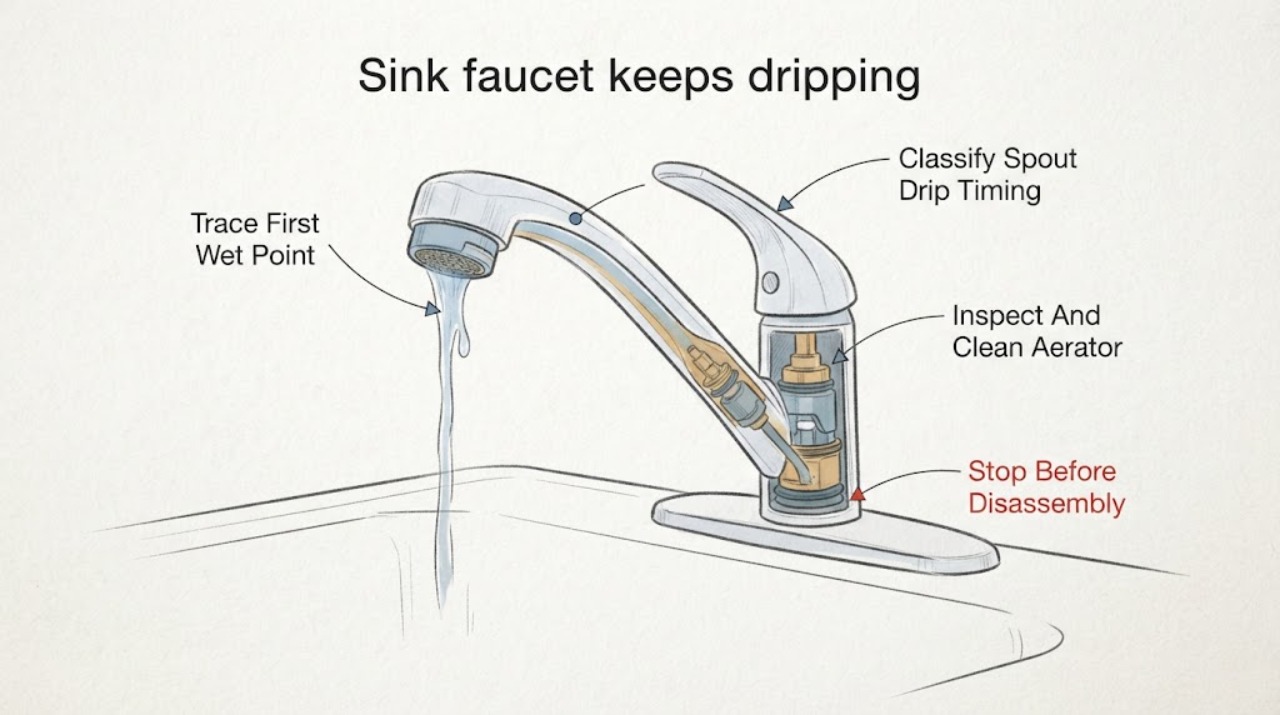
Work through in order
Diagnostic checks
Use only checks that match the exact appliance or system and its official guide.
-
Check 1
Dry the faucet, sink deck, and visible supply area, then turn the faucet off and watch from a safe position for the first new wet point: spout tip, under-handle area, spout base, spray hose, supply connection, or below the sink.
Expected result: The drip is at the spout tip, under the handle, around the base, from a hose or supply connection, or cannot be localized because water spreads across the deck or cabinet.
Next step: Photograph the first wet point and choose the matching branch. If the leak is active, reaches the cabinet or electrical equipment, or cannot be isolated, close the accessible shutoff valves and call a plumber.
Stop if: Do not keep operating the faucet to trace a large leak, touch wet electrical equipment, or remove a connection while water is not isolated.
Why this matters
Why: The wet point selects a different check. Spout-tip drips suggest aerator or valve behavior; under-handle or base leaks suggest seals, valve or cartridge, check-valve or spacer components; hose or supply leaks are connection problems rather than proof of a bad cartridge.
-
Check 2
If water is coming from the spout tip, close the handle fully and observe whether the drip stops after retained water drains or continues steadily with the faucet off; do not open the faucet body for this timing check.
Expected result: The drip stops after a short period, continues throughout the day, changes when the handle is moved, or the water is actually coming from under the handle or base.
Next step: Use the temporary-drip branch for an aerator check. For a continuous drip, record whether the faucet is single-handle or two-handle and proceed to model and water-isolation preparation before considering internal service.
Stop if: Do not repeatedly move a loose or stiff handle, force the cartridge, or disassemble the faucet while the supply remains pressurized.
Why this matters
Why: A brief post-shutoff drip can be aerator debris or retained water. A continuous drip with the handle off makes a valve or cartridge sealing problem more likely; a different wet point requires a different repair path.
-
Check 3
Only if the drip is brief and from the spout tip, remove the aerator only as the exact Kohler faucet instructions allow, inspect its screen for scale or debris, rinse it, and reinstall it without cross-threading or overtightening.
Expected result: The screen is visibly scaled or dirty, the aerator is damaged or seized, the drip stops after cleaning, or the drip continues all day after the aerator is clean.
Next step: If cleaning resolves the brief drip, monitor the faucet. If the drip persists, stop repeated cleaning and identify the faucet model before a valve or cartridge service; call a plumber if the aerator cannot be removed without force.
Stop if: Do not use a drill, knife, abrasive tool, chemical descaler that the faucet instructions do not allow, or force a stuck aerator against the faucet finish.
Why this matters
Why: A dirty aerator can explain a temporary post-shutoff drip. A continuous leak after a clean aerator points toward the valve or cartridge rather than the screen, while a damaged or seized aerator needs model-specific replacement or service.
-
Check 4
With the water supply isolated if tools or internal parts are involved, inspect the handle attachment, faucet body, spout base, and any visible weep opening for mineral residue, a loose handle, damaged finish, or a first wet point below the handle or base.
Expected result: Water appears under the handle while on or off, around the spout base, at a visible weep opening, or only at an external hose or supply connection.
Next step: Do not assume a cartridge is the answer for a hose or supply leak. For an internal handle or base leak, use the model-specific parts diagram or arrange plumbing service after the water is isolated.
Stop if: Do not tighten hidden retaining parts by guesswork, pry trim from the countertop, or continue if the shutoff valve, hose, or mounting hardware is corroded or moving.
Why this matters
Why: Kohler associates an under-handle leak while on with seals or O-rings and an under-handle leak while off with the valve or cartridge; base leaks can involve seals, O-rings, bearings, valve or cartridge, or a check-valve or spacer assembly depending on the model.
-
Check 5
Record the Kohler faucet model or series, whether it is single-handle or two-handle, and whether it has a pull-down, pull-out, sidespray, or touchless assembly; use the faucet documentation or model-identification resources without removing the faucet from the sink.
Expected result: The model and configuration are known, only a partial identity is available, or the faucet identity cannot be found without dismantling it.
Next step: Use the exact model to check Kohler's parts diagram and service instructions, or provide photos and the faucet identity to a plumber or Kohler support. Do not order by appearance alone.
Stop if: Do not remove internal components just to discover the model, and do not substitute a cartridge, O-ring, or hose without verified compatibility.
Why this matters
Why: Kohler replacement valves, cartridges, seals, check valves, spacers, aerators, and hoses are configuration-specific. An incomplete identity makes a generic part an unsafe compatibility assumption.
-
Check 6
After a model-approved aerator cleaning or documented water-isolation step, make one controlled leak check around the spout tip, handle, base, and under-sink connections; do not leave the cabinet unattended while testing.
Expected result: The drip is gone, returns only briefly after use, continues with the handle off, appears under the handle or base, or leaks from a hose, supply, or shutoff connection.
Next step: Keep the affected supply isolated when practical and arrange plumbing service for any continuous, active, inaccessible, or recurring leak. Give the plumber the wet-point location, timing, faucet model, and parts already inspected.
Stop if: Do not leave a cabinet wet, operate with a loose or leaking connection, force the handle, or continue internal repair when water cannot be isolated.
Why this matters
Why: A resolved brief spout drip supports an aerator or retained-water explanation. A continuous or connection leak requires the corresponding compatible seal, valve, cartridge, hose, fitting, or plumbing diagnosis; repeated tightening can damage the faucet or connection.
Use your observations
Decision map
Find the observation that best matches what you see, then follow the next safe action.
-
PATH 01Safety boundary
What you see
The drip is from the spout tip, lasts only briefly after shutoff, and stops once retained water drains.
Do this next
Clean the removable aerator only as the model instructions allow and monitor the next few uses. Replace it only after model compatibility is confirmed.
Why this path and its safety boundary
Why it matters: A temporary aerator or screen restriction is more likely than a continuously leaking valve.
Safety stop: Stop if the aerator is seized, the faucet finish is being damaged, or the drip becomes continuous.
-
PATH 02Safety boundary
What you see
The spout continues dripping with the handle fully off, including after the aerator is clean or the drip does not stop as retained water drains.
Do this next
Isolate hot and cold water, identify the exact Kohler model and handle configuration, and follow the model-specific valve or cartridge procedure or call a plumber.
Why this path and its safety boundary
Why it matters: A worn or contaminated valve or cartridge is more likely than an aerator-only problem.
Safety stop: Do not replace a generic cartridge, force the handle, or work with the supply pressurized.
-
PATH 03Safety boundary
What you see
Water first appears under the handle, around the spout base, or at a visible weep opening rather than at the spout tip.
Do this next
Close the supply valves, identify the model, and use its parts diagram or arrange a plumber for the compatible internal repair.
Why this path and its safety boundary
Why it matters: The relevant path may involve seals or O-rings, a valve or cartridge, bearings, or a check-valve or spacer assembly depending on the Kohler faucet design.
Safety stop: Do not pry trim, over-tighten retaining parts, or substitute a seal kit without the exact model.
-
PATH 04Safety boundary
What you see
Water appears at a pull-down or pull-out hose, supply connection, shutoff valve, faucet mounting point, or below the sink rather than in the valve path.
Do this next
Isolate the affected supply if possible, dry the cabinet, and call a plumber when the connection is active, corroded, inaccessible, or cannot be identified safely.
Why this path and its safety boundary
Why it matters: This is a connection, hose, mounting, or supply leak and is not proven to be a cartridge failure.
Safety stop: Do not disconnect hoses or valves while pressurized, and do not operate a wet faucet cabinet near electrical equipment.
-
PATH 05Safety boundary
What you see
The drip returns after cleaning or a model-approved repair, the model cannot be identified, the shutoff cannot isolate water, or the cabinet or countertop is being damaged.
Do this next
Keep the affected supplies closed when practical and arrange a licensed plumber, providing the timing, wet-point photos, faucet configuration, and any part information.
Why this path and its safety boundary
Why it matters: The leak needs a controlled plumbing diagnosis; continuing trial repairs can worsen finish, fittings, or water damage.
Safety stop: Do not leave the faucet unattended, keep tightening fittings, or conceal a leak under the sink.
Helpful context
Understand the symptom
Locate the drip before choosing a repair
Water at the end of the spout is a different fault path from water under the handle or around the spout base. A short-lived drip can be residual water or an aerator restriction, while a drip that continues after the faucet has been off points toward the valve or cartridge. Water below the sink may instead be a supply, hose, or mounting connection leak. Dry the area and use a clean towel to trace the first wet point rather than replacing a cartridge by guesswork.
Use the faucet's timing as a diagnostic clue
Kohler's faucet guidance separates a temporary drip that stops soon after shutoff from a continuous leak that persists. If the drip stops after the retained water drains, check the removable aerator and its screen for scale or debris. If the drip returns continuously with the handle off, the valve or cartridge is not controlling flow completely, and cleaning the aerator alone is unlikely to solve it.
Prepare for any water-side inspection
Before removing a handle, cartridge, hose, or aerator that requires tools, close the hot and cold shutoff valves under the sink and open the faucet to release pressure. Cover the drain so small screws do not disappear, and put a towel or container below the work area. If a shutoff valve will not close, a supply hose is corroded, or water cannot be isolated, stop and call a plumber rather than forcing it.
Parts are model-specific
Kohler says replacement valve, cartridge, seal, check-valve, spacer, and aerator parts vary by faucet model. Record the model or series from the faucet or its documentation before ordering. A single-control faucet may use one cartridge, while a two-handle faucet has separate hot and cold valves; a pull-out or pull-down kitchen faucet may add hose, diverter, or check-valve components.
Escalate when the leak is not a simple aerator issue
A continuous spout drip, a leak from under the handle, or water at the faucet base usually requires a compatible internal service part or a professional repair. Do not over-tighten trim, force a mineral-bound handle, use abrasive tools on the finish, or leave the cabinet wet. If the leak is active, the shutoff cannot isolate it, the countertop or cabinet is being damaged, or the faucet is loose at its mounting, arrange plumbing service promptly.
Safety boundary
Stop conditions
- Close the hot and cold supply valves and stop use for an active leak, water reaching the cabinet or electrical equipment, a loose faucet body, or a shutoff valve that cannot isolate the faucet.
- Do not force a seized handle or aerator, pry trim, use abrasive tools, or over-tighten a connection.
- Do not remove a cartridge, hose, valve, or supply connection while water is pressurized or without protecting the drain and cabinet.
- Arrange plumbing service for a continuous drip, leak below the sink, recurring leak after cleaning, unidentified model or leak path, corroded connections, or any water-damage concern.
Only after diagnosis
Potential parts
- faucet aerator
Consider only when a brief spout-tip drip or damaged, scaled aerator is confirmed and the exact faucet configuration supports that replacement.
Confirm the exact Kohler model, thread, screen, and finish requirements before ordering. - valve or cartridge
Consider only when a continuous spout drip or under-handle leak is diagnosed as a valve or cartridge sealing problem.
Single- and two-handle designs use different arrangements; verify the exact model and parts diagram rather than matching by appearance. - faucet seals, O-rings, or base bearing
Consider only when the leak is traced to the spout base or an under-handle seal and the model-specific repair instructions identify those components.
Seal size and material vary by faucet family; confirm exact model compatibility and water-isolation procedure. - pull-out or pull-down hose or check-valve assembly
Consider only when a pull-out or pull-down faucet leak is localized to its hose, diverter, or check-valve assembly rather than the cartridge or supply line.
Verify hose routing, connector style, and exact faucet model before ordering; do not disconnect a pressurized hose.
When checks do not resolve it
Need a professional?
Call a licensed plumber when the Kohler faucet drips continuously after shutoff, leaks under the handle or around the base, leaks from a hose or supply connection, damages the cabinet or countertop, or returns after a model-approved aerator check. Call promptly if a shutoff valve will not close or the leak cannot be isolated. Keep the faucet off for an active leak near electrical equipment and arrange emergency help when water damage is rapidly spreading.
Safety scope: Do not work with water pressurized, force trim or seized parts, disconnect corroded supply connections, or leave wet electrical equipment energized.
Common questions
FAQ
Why does my Kohler faucet keep dripping after I turn it off?
A brief drip from the spout can be retained water or aerator debris, but a drip that continues all day usually points toward the valve or cartridge. A leak under the handle or around the base follows a different seal, valve, check-valve, or spacer path depending on the model.
How long should a faucet drip after shutoff?
Kohler describes a temporary spout drip as one that stops after retained water drains, while a continuous leak persists after the faucet is off. If your drip does not stop or returns steadily, identify the model and arrange the appropriate internal or professional repair.
Can cleaning the aerator stop a Kohler faucet drip?
It can help when the drip is brief and comes from the spout tip because debris in the aerator can interfere with draining. It is unlikely to fix a continuous all-day drip or water under the handle or base. Clean or replace the aerator only as the exact faucet instructions allow.
Do I need a cartridge or a washer for a Kohler faucet that drips?
Do not choose from the symptom alone. Kohler faucet families can use different valves, cartridges, seals, O-rings, bearings, check valves, or spacers. Confirm the model and trace the first wet point before selecting a compatible part.
When should I call a plumber for a dripping Kohler sink faucet?
Call when the drip is continuous, the leak is under the handle or sink, a supply or shutoff connection leaks, the faucet cannot be isolated, the handle or aerator is seized, or water is damaging the cabinet or countertop. Keep wet electrical equipment de-energized and stop use for an active leak near it.
Read the exact guide
Official sources
- How to Fix a Leaky Sink FaucetKohler · Kohler sink faucet water isolation, pressure release, component identification, compatibility, and leak testing
- Leaking at Base of Faucet SpoutKohler Assist · Kohler kitchen faucet spout-base leak causes and model-specific repair guidance
- Leaking from End of SpoutKohler Assist · Kohler sink faucet spout-drip timing, aerator, and valve or cartridge guidance
- Leaking Under the HandleKohler Assist · Kohler kitchen faucet under-handle leak causes, seals, valve or cartridge, and check-valve guidance
Community feedback
Share a repair observation
Share a plain-text repair observation. Accepted observations are published automatically; this page may take a moment to update.