
On this page
Start here
Quick answer
First identify whether water is coming from the spray-wand connection, the braided hose, the spout receptor or faucet base, or the spray outlet after shutoff. With the handle off, wipe only the accessible area dry and avoid disconnecting a pressurized hose. Moen says a pull-down hose-to-wand seal uses a screen washer or O-ring that can be missing or compromised, and that a vacuum breaker inside the spout receptor can also leak. Check only the accessible connection and under-sink area, then use the exact faucet model to select a compatible service part or arrange plumbing or Moen service. Stop using the faucet and get professional help if water reaches the cabinet or electrical equipment, a shutoff will not stop flow, the leak is from the faucet body, or any repair would require opening the valve or receptor.
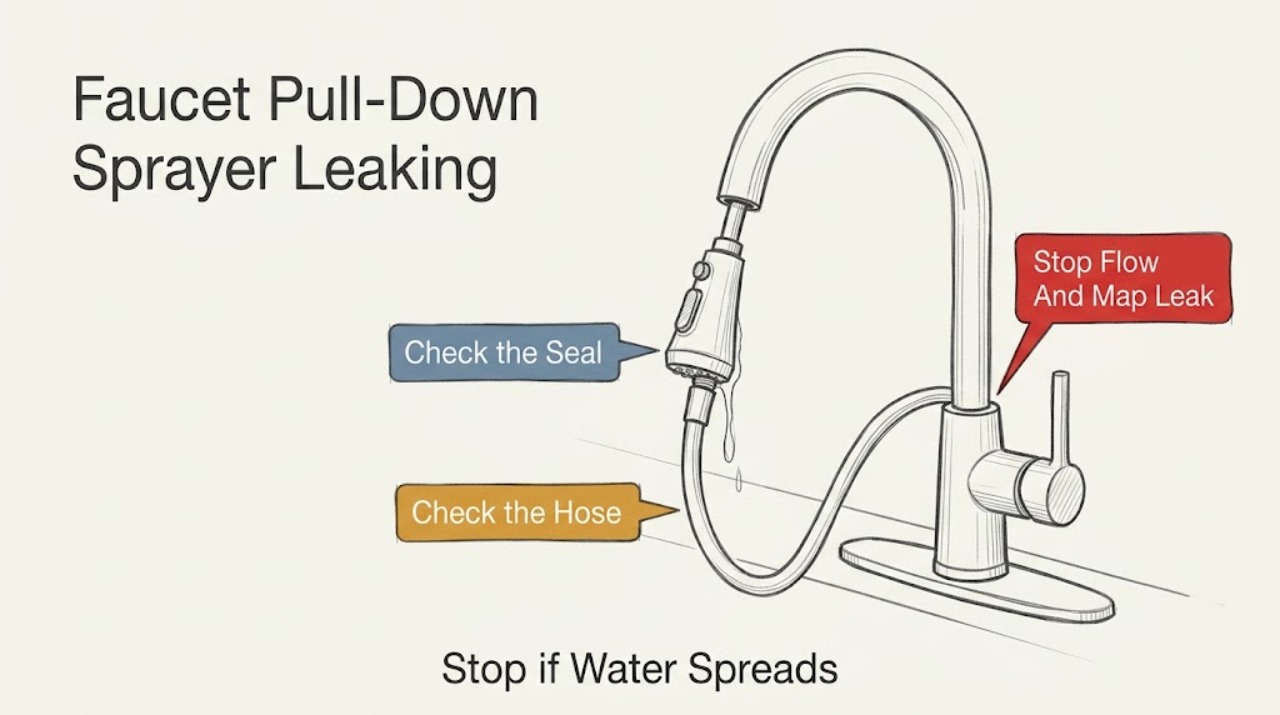
Work through in order
Diagnostic checks
Use only checks that match the exact appliance or system and its official guide.
-
Check 1
Turn the Moen faucet handle fully off. If water continues or the cabinet is getting wet, close the accessible hot and cold stop valves under the sink only if they turn normally; do not force a stuck valve. From a dry, safe position, wipe accessible surfaces and watch where the next drop appears without disconnecting any hose.
Expected result: Classify the first wet point as the spray outlet, wand-to-hose joint, braided hose, spout receptor or faucet base, under-sink connection, or an area that cannot be seen; note whether the leak stops when the faucet is isolated.
Next step: Leave the faucet off and photograph the wet point. Continue only with checks that stay on the accessible, unpressurized side; arrange prompt plumbing service when the source is hidden, the leak continues, or the stops do not isolate it.
Stop if: Stop immediately for uncontrolled flow, a failed or stuck shutoff, water near electrical equipment, a saturated cabinet, or any need to open the wall or faucet body.
Why this matters
Why: A drip only at the outlet after use may be residual water, while a joint, hose, receptor, base, or cabinet leak is an active sealing or faucet-body problem. Water that continues after the stops are closed suggests a stop-valve or upstream issue rather than a sprayer-only issue.
-
Check 2
With the handle off and the faucet isolated if needed, pull the spray wand out only far enough to inspect the hose-to-wand connection. Support the hose so it cannot snap back, and look for a loose connection, a missing screen washer or O-ring, a split seal, or mineral debris; do not pry the wand apart.
Expected result: The joint is dry and intact, or moisture begins exactly at the joint and the washer or O-ring is missing, flattened, cut, or displaced.
Next step: Record the faucet model and use its Moen instructions to identify the matching washer or O-ring procedure. If the connection will not release by the documented method, remains wet after a correct seal is installed, or the fitting is cracked, stop and arrange service.
Stop if: Do not cut the hose, stretch the seal, add unapproved sealant, or force a fitting or quick-connect apart.
Why this matters
Why: Moen identifies the hose-to-wand screen washer or O-ring as the seal for pull-down and pullout models. A damaged or missing seal makes that joint more likely than a cartridge problem, while a dry joint shifts attention to the hose, receptor, or faucet body.
-
Check 3
From the cabinet side, inspect the accessible braided spray hose and its visible route while the faucet remains off. Look for a wet hose length, kink, abrasion, a connection that is visibly loose, or stored items catching the hose or weight; move only loose items that can be removed without disturbing plumbing.
Expected result: Water beads along the hose body, appears at an under-sink connection, or the hose is dry while the wand or receptor is wet; note whether the hose is rubbing or unable to move freely.
Next step: Keep the cabinet clear and the faucet out of use. Use the exact model to identify a replacement hose or connection procedure, or give a plumber the leak location and photos; do not disconnect the line for a pressure test.
Stop if: Stop if the cabinet is flooding, the hose is under tension, a fitting is cracked, or access would require moving supply lines, wiring, or the faucet mounting hardware.
Why this matters
Why: A wet hose length can indicate hose damage, while a wet end fitting points to that connection. A dry hose with water above it makes the wand, receptor, or faucet body more likely. Obstructions can strain the pull-down hose but do not prove which seal has failed.
-
Check 4
If water appears at the top of the spout receptor, around the pull-down opening, or around the faucet base rather than at the wand joint, inspect only from the outside with the handle off. Check whether a handle leak is running onto the base, and do not remove the receptor or faucet body.
Expected result: The water starts at the receptor or pull-down opening, runs down from the handle, or emerges from the faucet body or base with no visible upper source.
Next step: Document the exact starting point and identify the complete Moen model. Contact Moen or a qualified plumber for the model-specific vacuum-breaker, seal, or faucet-body procedure; leave the faucet isolated if the leak continues.
Stop if: Do not open the receptor, bypass a vacuum breaker, remove the cartridge, or use force to separate the faucet body.
Why this matters
Why: Moen lists a leaking vacuum breaker in the spout receptor as a possible pull-down cause. A handle or body leak can mimic a base leak, and a leak from the body or base may require model-specific seals or professional service rather than a wand repair.
-
Check 5
Before obtaining a part or attempting any model-specific repair, photograph the full faucet, spray wand, hose connections, and model marking or installation paperwork; compare the observed leak point with the exact Moen support or product instructions.
Expected result: The leak location and model are clear enough to name a washer or O-ring, hose, spray wand, or vacuum-breaker category, or the model or source remains uncertain.
Next step: Use Moen support for product identification and model-specific instructions, or give a plumber the photos, isolation result, and leak timeline. Keep the water isolated until the repair path is confirmed when the leak is active.
Stop if: Do not install a universal part based only on appearance, test with the cabinet open while unattended, or continue using the faucet if water can reach electrical equipment or cabinetry.
Why this matters
Why: A confirmed location and model support a conditional, compatible part search. Uncertain identity, a faucet-body leak, a failed shutoff, or a leak that returns after a documented seal repair means the issue is not safely resolved by trial-and-error parts.
Use your observations
Decision map
Find the observation that best matches what you see, then follow the next safe action.
-
PATH 01Next step
What you see
The first wet point is exactly where the spray hose meets the pull-down wand, and the washer or O-ring is missing, flattened, cut, or displaced.
Do this next
Use the exact Moen model instructions to restore the specified screen washer or O-ring; if the joint is cracked or still leaks, leave the faucet off and arrange service.
Why this path and its safety boundary
Why it matters: The wand connection seal is more likely than a leak in the faucet body.
-
PATH 02Next step
What you see
The braided hose is wet along its length or water begins at an under-sink hose connection, while the wand joint is dry.
Do this next
Keep water isolated as needed and have the exact hose or connection procedure confirmed for the Moen model; do not disconnect a pressurized line or improvise a repair.
Why this path and its safety boundary
Why it matters: A damaged hose or end connection is more likely than a sprayhead seal; an obstruction may also be stressing the hose but does not identify the failed part.
-
PATH 03Next step
What you see
The wand joint and exposed hose are dry, but water starts at the spout receptor, pull-down opening, handle, or faucet base.
Do this next
Leave the faucet out of service and contact Moen or a qualified plumber with the model and leak photos for the correct service procedure.
Why this path and its safety boundary
Why it matters: A receptor vacuum breaker, handle seal, or faucet-body seal becomes more likely; these are model-dependent and cannot be distinguished reliably by tightening the wand.
-
PATH 04Next step
What you see
Only the spray outlet drips briefly after use, the handle is fully off, no joint or cabinet becomes wet, and the drip stops without continuing flow.
Do this next
Monitor from a dry, safe position during the next normal use; stop using the faucet if the drip persists or moves to the wand, hose, receptor, base, or cabinet.
Why this path and its safety boundary
Why it matters: Residual water in the wand may be present, but a drip that continues, returns while off, or wets another location is an active leak and should not be dismissed.
-
PATH 05Next step
What you see
Water cannot be controlled at the handle or stops, the cabinet is saturating, the faucet body is cracked, or water is near electrical equipment.
Do this next
Keep people away, close the main water supply only if it can be done safely, and obtain prompt qualified plumbing help; do not continue testing the faucet.
Why this path and its safety boundary
Why it matters: This is a water-damage or safety-control problem, not a routine sprayer-seal check.
Helpful context
Understand the symptom
Start with the leak location, not a replacement part
A pull-down sprayer can leave water at the wand, hose, receptor, faucet base, or sink cabinet, and those locations point to different next steps. Turn the handle off before inspecting. A few drops from the spray outlet immediately after use may be residual water, but water that continues with the handle off or appears at a connection is an active sealing problem. Do not loosen a hose or open the faucet body merely to see inside.
Why model identification matters on a Moen pull-down faucet
Moen describes more than one possible seal in this assembly: the hose-to-wand connection may use a screen washer or O-ring, while the spout receptor may contain a model-specific vacuum breaker. Take a photo of the complete faucet and any model marking before ordering a part. A generic washer, hose, or breaker may not match the connection, and repeated tightening or forcing can damage the seal.
Only after diagnosis
Potential parts
- screen washer or O-ring for the pull-down hose-to-wand connection
Only consider this category when the leak begins at the hose-to-wand joint and the installed seal is missing or damaged.
Confirm the complete Moen model and the manufacturer's part information; washer and O-ring sizes vary by model. - pull-down spray hose
Only consider a hose when the hose body or an identified hose end is wet while the wand connection is dry or the hose is visibly damaged.
Verify the exact model, connection style, length, and manufacturer's fit information before ordering. - vacuum breaker or model-specific conversion kit
Only consider this category when water starts in the spout receptor or pull-down opening and the wand-to-hose seal is not the source.
Vacuum-breaker parts vary with faucet age and model; use the model-specific procedure or qualified service. - pull-down spray wand or sprayhead
Only consider the wand when the wand housing or outlet is cracked or damaged after the connection has been ruled out.
Confirm the complete faucet model and connection compatibility; appearance alone does not establish fit.
When checks do not resolve it
Need a professional?
Call a qualified plumber or use Moen product support when the leak is from the receptor, faucet base, handle, or body; the model-specific repair requires opening the faucet; a shutoff will not isolate the water; the leak returns after the documented seal check; or water has reached cabinetry or electrical equipment. Stop using the faucet for uncontrolled flow, a cracked body, a saturated cabinet, or any condition that cannot be inspected safely.
Common questions
FAQ
Why does my Moen pull-down sprayer leak only when I pull it out?
Movement can expose a damaged hose, a hose-to-wand seal that is not seated, or a hose that rubs on an obstruction. With water off, identify the first wet point and check only the accessible wand connection and hose route; use the exact model instructions before replacing a part.
Can I replace the O-ring or washer on a Moen pull-down sprayer?
Only if the exact Moen model instructions identify that connection as user-serviceable and the water is isolated. Moen says the hose-to-wand seal may be a screen washer or O-ring, and the size and correct kit vary by model; stop if the fitting will not release by the documented method or the leak remains.
What if the water is leaking from the spout receptor or faucet base?
Treat it as a different branch from a sprayhead drip. Moen identifies a possible vacuum breaker inside the spout receptor on pull-down models and directs pulldown base leaks to Moen support; document the model and location rather than opening the receptor or faucet body.
Read the exact guide
Official sources
- Customer Support | MOENMoen · Moen product identification and customer support
- Kitchen Faucet: Leaking Around The BaseMoen Solutions · Moen kitchen faucet base, handle, pullout, and pulldown leak troubleshooting
- INS11736A.inddMoen · Moen pull-down faucet hose routing and under-sink clearance
- Kitchen faucet leaks at the bottom of the spoutMoen Solutions · Moen kitchen pull-out and pull-down faucet leak troubleshooting
Community feedback
Share a repair observation
Share a plain-text repair observation. Accepted observations are published automatically; this page may take a moment to update.