
On this page
Start here
Quick answer
If a Moen sink backs up when the garbage disposal runs, the first question is whether the disposal is moving water while the drain line cannot carry it away. Turn the disposal off, keep hands and tools out of the opening, and note whether the motor runs, the sink water swirls, the other basin rises, or water leaks below. A running disposal with a whirlpool and standing or rising sink water points more toward a blocked drain path downstream of the disposal than a motor fault. If the disposal only hums, will not move, or has a foreign object, treat it as a jam and disconnect power before any visible-object check. A gentle plunger attempt may clear a localized drain blockage, but persistent backup, leakage, sewage odor, a blockage farther down the line, or any need to disconnect plumbing or open the disposal calls for a licensed plumber.
Before you begin
Safety first
- Do not reach into the disposal, perform hardwired electrical work, remove the disposal, disconnect the trap or dishwasher hose, or use chemical drain cleaner as a test.
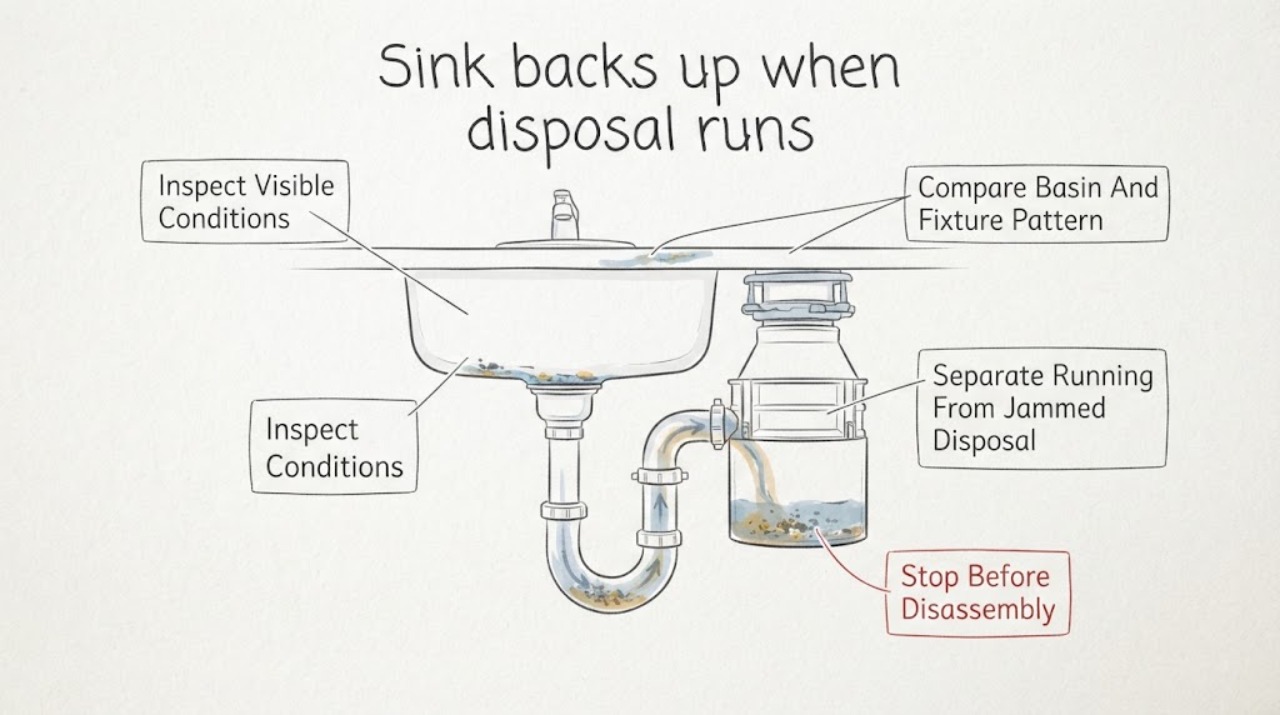
Work through in order
Diagnostic checks
Use only checks that match the exact appliance or system and its official guide.
-
Check 1
Turn the disposal switch off and keep hands, utensils, and drain tools out of the opening. From a safe position, note the standing-water level, whether the disposal had been running or only humming, and whether there is a leak, sewage odor, smoke, or electrical damage.
Expected result: The disposal is silent, turns normally, hums without turning, or has a visible hazard; water is clear, dirty, or mixed with food residue.
Next step: Keep the disposal off. For smoke, sparking, damaged wiring, or a strong sewage or gas odor, leave the area as appropriate and seek emergency or qualified help. Otherwise continue only with the matching safe observation below.
Stop if: Never put a hand or finger into the disposal, and do not operate it to test a leak, jam, or object.
Why this matters
Why: A running unit with water trapped in the sink is a drain-flow problem to separate from a motor jam. Humming, silence, a leak, or an electrical or odor hazard changes the response and makes repeated operation unsafe.
-
Check 2
Without adding more water, identify whether the sink has one bowl or two, and observe whether backup rises in the other bowl or whether nearby fixtures also drain slowly; do not remove a trap or disconnect a hose.
Expected result: Only the disposal bowl holds water, both sink bowls rise, a dishwasher or nearby fixture is affected, or the rest of the home drains normally.
Next step: Use the pattern to choose the drain-line or local-disposal branch; tell the plumber which fixtures rise and whether the backup begins only when the disposal runs.
Stop if: Do not run the dishwasher, add a full sink of water, or repeatedly activate the disposal while the line is backing up.
Why this matters
Why: A problem limited to the disposal bowl can be near the disposal or its outlet. Both bowls or multiple fixtures point more strongly to shared or downstream plumbing, while normal nearby fixtures make a local sink branch more plausible.
-
Check 3
With the disposal off, listen only to the prior symptom and check from above for a plainly visible object without reaching past the splash guard. If the disposal was humming or failed to turn, disconnect its power before any object inspection.
Expected result: The motor ran and created a whirlpool, the unit hummed, the unit was silent, or a spoon, bone, glass fragment, fibrous material, or other object is visibly lodged.
Next step: For a plainly loose visible object, use tongs or needle-nose pliers only after power is disconnected and only if it can be removed without force. For humming, an unreachable object, or uncertainty, stop and arrange qualified disposal service.
Stop if: Do not put hands in the disposal, probe with a knife or screwdriver, repeatedly reset a jammed unit, or work on hardwired connections.
Why this matters
Why: A whirlpool with no drainage supports a clogged drain line. Humming or failure to turn is consistent with a jam or power/protection issue, while a visible foreign object can obstruct rotation; none of these findings justifies reaching into the chamber.
-
Check 4
If the disposal runs normally, no object or electrical hazard is present, and the sink blockage appears localized, place a plunger over the disposal opening; on a double sink, seal the other opening first. Use gentle controlled plunging without chemicals or drain disassembly.
Expected result: Water begins to move and clears, the level does not change, water surges into the other bowl, or water appears below the sink.
Next step: If flow is restored, rinse with cold water and make one brief normal-use check. If it does not clear, affects both bowls, or leaks, stop and call a licensed plumber.
Stop if: Do not use chemical drain cleaner, use forceful pressure against a damaged fixture, plunge while the disposal is running, or loosen the trap as a next step.
Why this matters
Why: Clearing after controlled plunging supports a localized drain obstruction. No change, cross-bowl surging, or a leak suggests a deeper blockage, shared-pipe problem, or connection failure that plunging should not be forced to solve.
-
Check 5
From a dry, safe position under the sink, look for fresh water at the disposal body, discharge connection, trap, or visible drain piping, and note whether a dishwasher hose is visibly kinked or displaced; do not loosen any connection.
Expected result: The underside is dry, a leak appears at the disposal or drain connection, water is coming from another appliance connection, or the source cannot be identified.
Next step: Keep the disposal and affected sink off, place a container only if it can be done without touching electrical parts, photograph the location, and request a plumber for any leak or displaced connection.
Stop if: Do not reach around energized wiring, support or remove the disposal, disconnect a dishwasher hose, or open the trap with standing water.
Why this matters
Why: A dry underside keeps a blockage diagnosis in focus. A leak at a connection can allow water to escape instead of draining and may require a gasket, fitting, or installation correction; an unidentified leak needs controlled plumbing assessment.
-
Check 6
After a safe local correction has restored drainage, run cold water and make one brief disposal test with only an ordinary permitted amount of food waste; keep the area clear and observe the sink and visible connections.
Expected result: Water drains continuously, the other bowl stays clear, no leak appears, and the disposal runs normally; or the sink backs up again, the motor hums, or water leaks.
Next step: Use cold water during normal grinding and continue it briefly after grinding as the manufacturer's instructions specify. Stop use and arrange plumbing or disposal service when any symptom returns.
Stop if: Do not keep cycling the disposal against standing water, feed grease or fat into the drain, or treat a temporary clearing as proof that a deeper blockage is gone.
Why this matters
Why: A stable clear drain supports a resolved local obstruction or usage issue. An immediate repeat backup means the restriction remains or the line cannot carry the discharge; humming or leakage is a separate service condition.
Use your observations
Decision map
Find the observation that best matches what you see, then follow the next safe action.
-
PATH 01Safety boundary
What you see
The disposal motor runs and water swirls or forms a whirlpool, but the sink level stays high or rises when the disposal is used.
Do this next
Attempt one controlled plunge with the other bowl sealed when applicable. If flow does not return promptly or the backup recurs, have a licensed plumber clear and inspect the drain line.
Why this path and its safety boundary
Why it matters: The disposal is moving water but the drain path is restricted; a clog after the disposal or in shared sink plumbing is more likely than a disposal motor failure.
Safety stop: Do not add chemical cleaner, run the disposal repeatedly, or disassemble the trap while water is standing.
-
PATH 02Safety boundary
What you see
Both sink bowls rise, a dishwasher connection backs up, or nearby fixtures are also slow when the disposal discharges.
Do this next
Stop using the disposal and affected fixtures and request licensed plumbing service, reporting which fixtures are affected and when the backup begins.
Why this path and its safety boundary
Why it matters: The symptom reaches shared or downstream plumbing and is unlikely to be solved by changing the disposal's splash guard or motor.
Safety stop: Do not run additional water to test the extent of the blockage or disconnect a dishwasher or drain connection.
-
PATH 03Safety boundary
What you see
The disposal hums, is silent when commanded, does not turn, or has a visible object that cannot be removed without reaching or force.
Do this next
Disconnect power before any safe visible-object check and use only tongs for a plainly loose object. For a persistent jam, no-power symptom, or hardwired unit, use qualified disposal or electrical service.
Why this path and its safety boundary
Why it matters: A jam, overload protection event, power-control issue, or foreign object is more likely than a simple drain-line backup; repeated attempts can worsen the condition.
Safety stop: Never put hands into the disposal or bypass its switch, protection, or grounding arrangement.
-
PATH 04Safety boundary
What you see
Water appears at the disposal body, discharge elbow, trap, visible drain joint, or another under-sink connection during or after the disposal runs.
Do this next
Keep the disposal off, document the leak location, and request a plumber. Do not retighten or disconnect a fitting when the exact installation and spill control are uncertain.
Why this path and its safety boundary
Why it matters: A leak can be a loose or damaged connection, gasket, disposal mounting seal, or pipe problem; continued operation risks cabinet and electrical damage.
Safety stop: Stop immediately for water near electrical components, a falling disposal, or an unidentified active leak.
-
PATH 05Safety boundary
What you see
A plainly loose object was safely removed or one controlled plunging attempt restores continuous drainage, with no leak, hum, or repeat backup.
Do this next
Use cold water during grinding and continue it briefly afterward, avoid grease and unsuitable waste, and monitor the next normal use without repeated stress testing.
Why this path and its safety boundary
Why it matters: The immediate obstruction or use-related condition may be resolved, but a recurrence indicates the line remains restricted or the disposal is not clearing waste properly.
Safety stop: Stop and call a plumber or qualified disposal technician if backup, humming, foreign-object noise, or leakage returns.
Helpful context
Understand the symptom
Separate a drain backup from a disposal jam
The word backs up can describe two different failures. If the disposal motor is actually running and water swirls but does not leave the sink, the restriction is more likely in the drain path after the disposal. If the unit only hums, is silent, or cannot turn, material may be jammed inside or power may be interrupted; that is not fixed by repeatedly switching it on. On a double-bowl sink, watch whether the second bowl rises, because shared piping can make a downstream blockage show up in both basins.
Use safe access around the disposal
Never put a hand or fingers into the disposal. Before looking for an object or attempting any unjamming procedure, switch the disposal off and disconnect its power in the manner allowed by the installation. Moen's instructions describe using tongs or needle-nose pliers for a plainly visible object, not hands. Do not use the sink backup as a reason to reach past the splash guard, probe the grinding chamber, or run the disposal with a tool in the opening.
Try only a limited drain-clearance step
When the disposal runs normally, no electrical or sharp-object hazard is present, and the blockage appears localized to the sink drain, a plunger can be a reasonable first attempt. On a double sink, seal the other opening before plunging so pressure is directed toward the blocked drain. Use gentle, controlled strokes; do not add chemical drain cleaner, disassemble the trap, or force a tool into the disposal. If the water does not clear or immediately returns, stop and have the drain path assessed.
Restore flow without creating a new blockage
Moen's operating instructions call for cold water while grinding and continued water flow after grinding so particles can flush through the trap and drain. Feed only waste that the exact disposal instructions allow, and keep grease, fat, large hard pieces, and fibrous material out of the drain unless the product instructions specifically allow them. These habits may reduce repeat backups, but they cannot clear a blockage that is already farther down the line.
Know when the sink needs a plumber
A backup that persists after one safe plunging attempt, affects both bowls or nearby fixtures, leaks at the disposal or drain connections, or returns as soon as the disposal runs needs plumbing diagnosis. If the disposal hums, trips its protection, remains jammed, or makes a foreign-object noise, stop cycling it and use qualified service. Do not loosen the trap or disposal discharge connection while water is standing unless you are prepared to control the spill and the exact installation procedure is known; a plumber is the safer boundary when the restriction is not plainly accessible.
Safety boundary
Stop conditions
- Never place hands or fingers into the disposal; disconnect power before any safe visible-object inspection.
- Stop using the disposal for smoke, sparks, damaged wiring, a strong sewage or gas odor, an active leak near electrical parts, or a disposal that hums or will not turn.
- Do not use chemical drain cleaner, run the disposal against standing water, or loosen the trap or discharge connection as an improvised next step.
- Arrange licensed plumbing service for persistent or recurring backup, both-bowl or multi-fixture backup, an unreachable obstruction, or any blockage farther down the line.
Only after diagnosis
Potential parts
- disposal splash guard
Consider only if the exact Moen disposal's splash guard is visibly damaged, missing, or no longer seats correctly after the drainage cause is addressed; it is not a cure for a downstream clog.
Confirm the exact disposal model and manufacturer fit information before ordering. - disposal discharge gasket or drain connection seal
Consider only when a plumber confirms the leak is at the disposal discharge connection or its gasket rather than in the trap or drain line.
Seal shape and connection design vary; verify the exact model and installation before selecting a part. - sink drain trap or branch drain fitting
Consider only after a plumber identifies a cracked, damaged, or incompatible drain component, or a blockage location that requires replacement rather than clearing.
Confirm pipe size, material, layout, local requirements, and the existing disposal connection; do not order from a symptom alone.
When checks do not resolve it
Need a professional?
Call a licensed plumber when the sink still backs up after one controlled plunging attempt, the other bowl or nearby fixtures are affected, water leaks below, the blockage appears farther down the line, or the backup returns on the next use. Use qualified disposal or electrical service when the Moen unit hums, will not turn, has an unreachable foreign object, or repeatedly trips its protection. For smoke, sparks, damaged wiring, or strong gas or sewage odor, stop use and seek appropriate emergency help from a safe location.
Safety scope: Do not reach into the disposal, perform hardwired electrical work, remove the disposal, disconnect the trap or dishwasher hose, or use chemical drain cleaner as a test.
Common questions
FAQ
Why does my Moen sink back up only when the disposal runs?
If the disposal motor runs and water swirls but the sink does not drain, the drain path after the disposal may be restricted. If the unit hums or does not turn, investigate a jam or power issue instead. Both require stopping repeated operation while you separate the symptoms.
Can I plunge a sink with a garbage disposal?
A controlled plunger attempt can be reasonable for a localized drain blockage when the disposal is off and safe. On a double sink, seal the other opening first. Do not use chemical drain cleaner, plunge against a damaged fixture, or continue if the blockage does not clear.
Should I put my hand into the Moen disposal to find the clog?
No. Never place a hand or finger into the disposal. Disconnect power before any visible-object check and use tongs only for an object that is plainly visible and can be removed without force; otherwise call qualified service.
Why does the other sink bowl fill when the disposal runs?
Two bowls commonly share downstream piping, so a restriction after the branch can make water rise in the other bowl when the disposal discharges. Stop using both affected bowls and have a licensed plumber assess the shared drain path if one controlled plunge does not restore flow.
How can I reduce repeat disposal backups?
Use cold water during grinding and briefly afterward as the manufacturer's instructions specify, avoid grease and fat, and follow the exact disposal's accepted-waste guidance. These practices do not clear an existing or deeper blockage, so call a plumber if backup returns.
Read the exact guide
Official sources
- GROUNDING INSTRUCTIONS (CORDED INSTALLATION)Moen · Moen garbage disposal operation, water use, flushing, and safety instructions
- How to Unjam a Garbage DisposalMoen Solutions · Moen garbage disposal jam safety and foreign-object guidance
- Choosing A Garbage DisposalMoen Solutions · Moen garbage disposal configurations, sink-drain connection context, and model-specific compatibility
- Fixing a Clogged Garbage DisposalInSinkErator · Manufacturer guidance applicable to a sink that backs up when a disposal runs
Community feedback
Share a repair observation
Share a plain-text repair observation. Accepted observations are published automatically; this page may take a moment to update.