
On this page
Start here
Quick answer
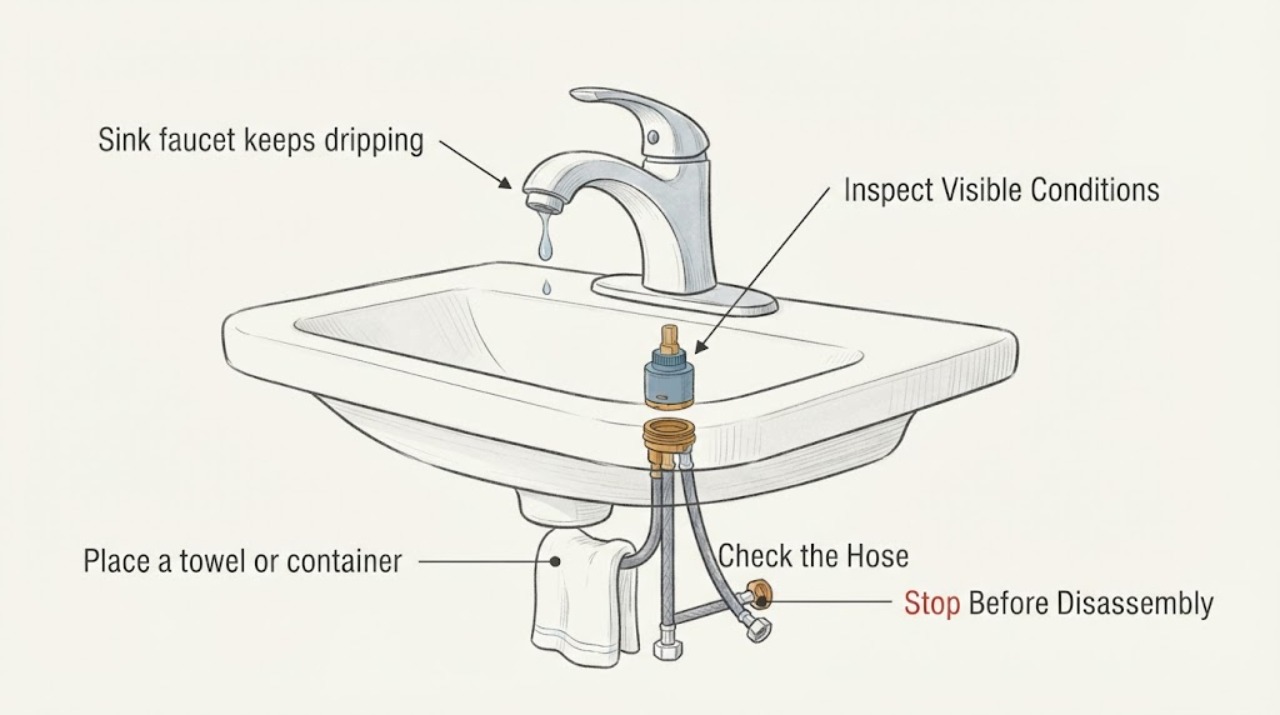
If a Moen sink faucet keeps dripping after it is turned off, first determine whether water comes from the spout, around the handle or base, or from a connection below the sink, and whether it drips only after use or continuously. Moen says a spout that will not shut off is usually related to the cartridge, but its cartridges are not interchangeable; the model and handle style must be confirmed. A leak below the sink can instead involve a shutoff valve, supply line, or faucet connection hose. Place a towel or container under the leak, close the accessible water supply before any disassembly, and use the exact Moen product guide. Do not force a handle, remove a cartridge under pressure, over-tighten fittings, or guess a part. If water is spraying, the shutoff will not isolate the faucet, the body or hose is split, or the leak threatens cabinetry or electrical equipment, use the main shutoff if safe and call a licensed plumber.
Before you begin
Safety first
- The homeowner scope is limited to observing the leak, protecting the cabinet, closing a clearly identified supply stop that turns normally, reading model information, and inspecting visible connections. Do not work on a pressurized line, force a shutoff or handle, remove an internal valve without the exact guide, overtighten fittings, expose electrical equipment to water, or guess a replacement part.
Work through in order
Diagnostic checks
Use only checks that match the exact appliance or system and its official guide.
-
Check 1
Dry the spout, handle, faucet base, underside of the deck, shutoff valves, and supply lines. With the faucet fully off, observe where the first drop appears and whether it happens only while running, shortly after use, or continuously.
Expected result: The spout drips while off; water appears around a handle or base; or the first wet point is a hose, shutoff valve, threaded fitting, or faucet connection below the sink.
Next step: Follow the branch that matches the first wet point, keep the cabinet dry, and photograph the location and timing. Do not order a part from the symptom alone.
Stop if: Stop if water sprays, the leak is rapidly increasing, the faucet body or hose is split, or water is reaching electrical equipment.
Why this matters
Why: A persistent spout drip makes the internal cartridge or seal more likely. A handle or base leak may be a seal or body connection. A below-sink leak points more toward a supply, shutoff, or connection-hose problem and can damage the cabinet even when the spout is dry.
-
Check 2
Place a towel or container below the leak and close the clearly identified hot and cold faucet supply stops only if they turn normally. If one stop isolates the drip, leave it closed; if both are needed or a stop will not close, use the main water shutoff according to local plumbing guidance.
Expected result: The drip stops with one supply closed, stops only when both supplies are closed, continues after the faucet stops are closed, or the shutoff itself leaks or will not move.
Next step: Keep the isolated supply closed and arrange plumbing service if the stop leaks, is seized, or the main shutoff was required. Do not remove a pressurized hose, cartridge, or valve.
Stop if: Stop for flooding, a seized or corroded stop, active spray, water near electrical equipment, or any fitting that remains pressurized.
Why this matters
Why: A one-sided result can identify the hot- or cold-side valve or supply path. A drip that stops only with both supplies isolated can still be internal to the faucet. A failed local shutoff increases flooding risk during repair.
-
Check 3
Identify the faucet without dismantling it: note single- or dual-handle construction, kitchen or bathroom sink use, deck layout, pullout or pull-down hose if present, and any model marking or paperwork. Compare the model-specific Moen parts sheet or repair guide before selecting a cartridge, O-ring, grommet, or hose.
Expected result: The model is confirmed, the model is unknown, the faucet has one handle, or it has two handles and separate valve controls.
Next step: Use the confirmed model guide or provide the model and photos to a plumber or Moen support channel. Do not substitute a cartridge based only on color, handle shape, or a generic part description.
Stop if: Stop if the model cannot be confirmed, the available guide does not match the installed faucet, or repair would require force or cutting.
Why this matters
Why: Moen states that single-handle and dual-handle faucets use different cartridge counts and that its cartridges are not interchangeable. An unknown model prevents a reliable part match even when the symptom sounds familiar.
-
Check 4
With the supply isolated, inspect only visible connections below the sink and the faucet base for wetness, a split hose, a leaking shutoff, or water tracking from the handle onto the deck. If the spout stream is weak as well as dripping, clean the aerator only according to the exact faucet guide; do not treat aerator cleaning as a cartridge diagnosis.
Expected result: A shutoff, supply line, or connection hose is wet; water begins at the handle and runs onto the base; the faucet base is wet but the handle is dry; or the external surfaces are dry and the spout still drips.
Next step: Follow the exact model guide for a clearly identified connection or keep the water isolated and call a licensed plumber for internal valve work. Reopen a supply slowly only after the repair is complete and the area can be watched.
Stop if: Stop for a cracked body or hose, a fitting that spins or will not seal, a seized handle, or active leakage after a normal gentle correction.
Why this matters
Why: A visible below-sink wet point is an external connection or valve path. A handle-to-base path can be a handle seal. A dry exterior with a spout drip makes the cartridge or internal seal more likely. An aerator issue affects flow and does not by itself explain a valve that will not shut off.
-
Check 5
After an exact model-specific repair or a plumber's work, reopen the isolated supply slowly while watching the spout, handles, base, hoses, shutoffs, and cabinet. Operate the faucet normally, turn it fully off, and wait long enough to see whether a drip returns.
Expected result: The faucet remains dry when off; drips only when a handle moves; leaks immediately at a connection; or the original drip returns after a short period.
Next step: Close the supply again for any returning leak, record the exact location and timing, and arrange licensed plumbing service rather than repeatedly tightening or replacing parts by guesswork.
Stop if: Stop immediately for spraying water, cabinet damage, a cracked body, or a supply stop that cannot isolate the faucet.
Why this matters
Why: A dry complete cycle supports that the repair addressed the leak. A movement-related drip suggests a handle or dynamic seal issue. An immediate connection leak suggests an assembly or fitting problem. Recurrence suggests a mismatched or damaged part, debris, or a faucet-body problem.
Use your observations
Decision map
Find the observation that best matches what you see, then follow the next safe action.
-
PATH 01Safety boundary
What you see
The Moen spout drips or streams with the handle fully off, while the base and below-sink connections are dry.
Do this next
Isolate the water, confirm the faucet model and handle configuration, and use the model-specific guide to assess the cartridge or internal seal; arrange a plumber if the procedure is unclear.
Why this path and its safety boundary
Safety stop: Do not remove a cartridge under pressure, force the handle, or assume Moen cartridges are interchangeable.
-
PATH 02Safety boundary
What you see
Water appears around the handle or base above the sink deck, especially while the faucet is running or immediately afterward.
Do this next
Dry and retest the handle and base separately, isolate the supplies, and use the exact model guide or a plumber to distinguish a handle seal, cartridge seal, O-ring, or body connection.
Why this path and its safety boundary
Safety stop: Do not pry trim, force a seized handle, or overtighten a retaining part to suppress the leak.
-
PATH 03Safety boundary
What you see
Water is continuously present below the sink around a shutoff valve or the house-side supply line, while the faucet itself is dry.
Do this next
Keep a container in place, close the main water supply if the local stop will not isolate the leak, and arrange licensed plumbing service for the shutoff or supply line.
Why this path and its safety boundary
Safety stop: Do not dismantle a pressurized connection or continue using a stop that sprays or leaks when moved.
-
PATH 04Safety boundary
What you see
The leak occurs below the sink only while the faucet is being used or shortly afterward, and the wet point is a faucet connection hose or supply line.
Do this next
Identify the hose or connection style from the exact model guide and have the correct line or seal installed; leave the water isolated if the leak continues.
Why this path and its safety boundary
Safety stop: Do not substitute a hose by appearance, kink or cut a line, or keep operating a connection that is visibly split.
-
PATH 05Safety boundary
What you see
The model is unknown, the available guide does not match, or a cartridge or seal replacement stopped the drip only briefly.
Do this next
Leave the supply isolated as needed and arrange a plumber or manufacturer-supported identification using the faucet model clues, configuration, photos, and drip location.
Why this path and its safety boundary
Safety stop: Do not order, modify, or stack parts based solely on brand, color, or a generic cartridge listing.
-
PATH 06Safety boundary
What you see
The faucet body or hose is cracked, water is spraying, the cabinet is flooding, or no shutoff can safely isolate the leak.
Do this next
Use the main water shutoff if safe, protect the area from further damage, and obtain urgent licensed plumbing help.
Why this path and its safety boundary
Safety stop: Do not operate electrical equipment exposed to water or attempt a pressurized fitting repair.
Helpful context
Understand the symptom
Start with location and timing, not a replacement part
Dry the spout, handle, faucet deck, and cabinet area, then watch where the first new drop appears with the handle fully off. Moen separates leaks above the sink deck from leaks under the sink and asks whether the water appears during use, shortly afterward, or continuously. A spout drip is a different starting point from water around a shutoff valve or supply hose.
Identify the Moen faucet before touching the cartridge
Moen states that a faucet that continues to drip or stream from the spout is usually controlled by its cartridge, but single-handle faucets have one cartridge, dual-handle faucets have two, and the cartridge styles are not interchangeable. Record the model number if available and compare the exact product or repair guide. Handle appearance alone is not enough to establish compatibility.
Protect the cabinet before isolating the water
Put a towel or container below the leak and locate the hot and cold shutoff valves. Close a clearly identified valve only if it turns normally; a corroded or seized stop can leak when disturbed. If the faucet continues to supply water after the local stops are closed, or the stops themselves leak, use the home's main water shutoff if safe and get plumbing help rather than dismantling a pressurized connection.
A leak under the sink may be a hose or shutoff problem
Moen distinguishes a steady leak around the shutoff valve, a split or torn line between the shutoff and faucet, and an intermittent leak from a connection hose between faucet valves and the spout. These symptoms do not justify replacing the cartridge automatically. Inspect only visible, accessible connections and identify the exact hose or valve type before a replacement is considered.
Only after diagnosis
Potential parts
- Moen model-specific faucet cartridge
Consider this category when the faucet drips from the spout while fully off, the water is isolated, and the exact model guide identifies a cartridge as the correct repair.
Moen says cartridge styles are not interchangeable; match the exact model, handle configuration, cartridge design, retaining method, and revision before selecting a part. - Moen model-specific O-ring, grommet, or seal
Consider this category only when the exact guide or a plumber identifies a worn or damaged handle, base, spout, or valve seal.
Use the specified material, dimensions, and placement; do not stack washers, substitute an unknown seal, or overtighten the retaining hardware. - Moen faucet connection hose or supply line
Consider this category only when the leak is visibly below the sink at a faucet hose or supply line and the connection style is confirmed from the model documentation.
Confirm the exact hose type, connection ends, length, routing, and shutoff condition before replacement; isolate water first.
When checks do not resolve it
Need a professional?
Escalate for a persistent spout drip, handle or base leak, wet supply connection, failed shutoff, split hose, unidentified model, mismatched part, cabinet damage, or any repair requiring internal valve or pressurized fitting work.
Safety scope: The homeowner scope is limited to observing the leak, protecting the cabinet, closing a clearly identified supply stop that turns normally, reading model information, and inspecting visible connections. Do not work on a pressurized line, force a shutoff or handle, remove an internal valve without the exact guide, overtighten fittings, expose electrical equipment to water, or guess a replacement part.
Have this ready
- Provide the faucet model if available, single- or dual-handle configuration, sink layout, exact drip location, whether it occurs with the faucet off or during use, which supply stops isolate it, photos of the faucet and underside, visible part markings, and recent repair history.
Common questions
FAQ
Why does my Moen sink faucet drip when it is turned off?
If the water forms at the spout while the handle is off and the base and below-sink connections are dry, Moen says the cartridge is usually the starting point. Isolate the water, confirm the model, and use its repair guide; Moen cartridges are not interchangeable.
What if my Moen faucet is leaking under the sink?
Dry the area and identify whether water starts at a shutoff valve, house supply line, faucet supply line, or a connection hose, and whether it leaks continuously or only during use. Close the affected supply if it turns normally and arrange plumbing service for a failed valve, split line, or hose.
Do all Moen faucets use the same cartridge?
No. Moen states that cartridge styles are not interchangeable, and single-handle and dual-handle faucets use different cartridge counts. Confirm the exact model and parts guide before buying or removing one.
Could an O-ring or grommet cause a Moen faucet drip?
Yes, Moen lists scratched or torn cartridges, O-rings, and grommets among general causes, but the leak location and faucet model determine which seal is relevant. Do not substitute an unknown O-ring or stack washers.
When should I call a plumber for a Moen sink faucet drip?
Call when a shutoff will not isolate the leak, water is spraying or reaching the cabinet or electrical equipment, a hose or faucet body is split, the model cannot be confirmed, the drip returns after a model-specific repair, or the work requires internal valve removal or a pressurized fitting.
Read the exact guide
Official sources
- Bathroom Faucet: Leaking Around the Base of the FaucetMoen Solutions · Moen consumer guidance for bathroom sink faucets; exact parts and steps depend on the faucet style and model.
- Bathroom Faucet: Leaking Under The Sink BaseMoen Solutions · Moen consumer guidance for bathroom sink faucet leaks; similar under-sink patterns should still be matched to the installed model.
- Kitchen Faucet: Leaking From The SpoutMoen Solutions · Moen consumer guidance for kitchen sink faucets; exact cartridge and repair procedure depend on model and installation.
- What causes a Moen faucet or valve to leak or drip?Moen Solutions · Moen general consumer guidance; without a specific model number, the exact cause and part cannot be established.
- Fix a Leak WeekU.S. Environmental Protection Agency WaterSense · General U.S. household leak guidance; local plumbing requirements and the faucet manufacturer's instructions control a specific repair.
Community feedback
Share a repair observation
Share a plain-text repair observation. Accepted observations are published automatically; this page may take a moment to update.