
On this page
Start here
Quick answer
When a Moen sink faucet has low flow, first compare it with another nearby fixture and compare hot with cold. If only this faucet is weak, check the removable aerator, spray wand screen, or side-spray path for debris, then test flow at the hose or spout only as the Moen model instructions permit. Moen says different faucet designs use different aerators and that overall low flow can also come from a cartridge, diverter, wand, or supply line. Confirm the accessible hot and cold shutoff valves are open and the hoses are not kinked or leaking. If several fixtures are weak, check for a leak or service-pressure problem instead of changing the Moen faucet. Do not disconnect pressurized hoses, force a seized valve, remove a cartridge under pressure, defeat a flow device, or use harsh chemicals in the outlet. Stop and call a plumber when the body, hose, valve, wall connection, or cabinet leaks, a valve will not close, the faucet remains weak with its end device off, or whole-home pressure is abnormal.
Before you begin
Safety first
- This article supports comparing fixtures, identifying and rinsing a removable aerator or screen, checking dry accessible valves and hoses without force, testing a wand or side-spray path only as the model permits, and observing household pressure or leak clues. A qualified plumber must handle pressurized disconnection, cartridge, diverter, valve-body, corroded-valve, pressure-regulator, wall-connection, and leak repair.
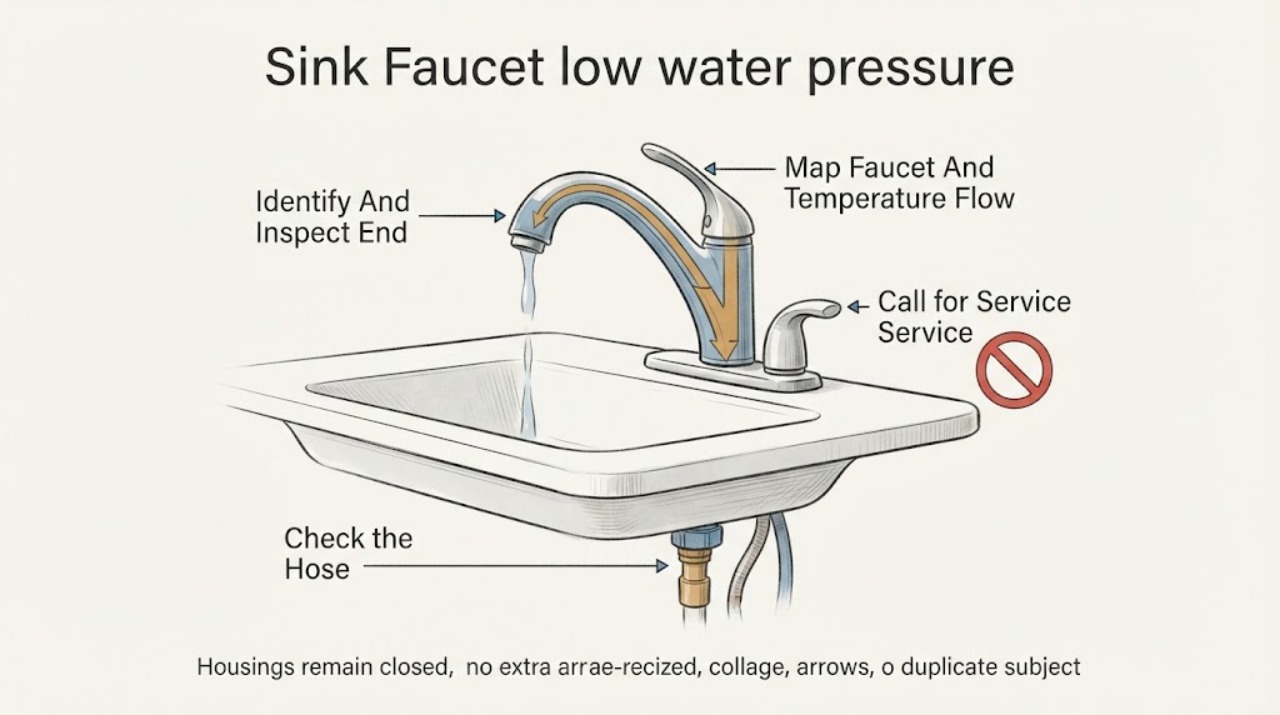
Work through in order
Diagnostic checks
Use only checks that match the exact appliance or system and its official guide.
-
Check 1
Open the Moen sink faucet briefly with one temperature at a time, then compare it with one nearby fixture under similar conditions. Look under the sink from a dry position for a wet cabinet, active connection leak, or hose that moves when the handle is opened.
Expected result: Record weak hot only, weak cold only, weak hot and cold at this faucet, weak flow at several fixtures, pulsing flow, normal flow elsewhere, or a leak under the sink.
Next step: If the cabinet is wet or several fixtures are weak, limit water use and arrange plumbing help. If only this Moen faucet is weak and dry, continue with the model-appropriate aerator or spray-wand check.
Stop if: Do not keep running water into a leaking cabinet, loosen a wet connection, or ignore sudden pressure loss or a shutoff that will not close.
Why this matters
Why: A single weak outlet points toward its aerator, wand, diverter, cartridge, shutoff, or hose. A hot-only result narrows the path to hot supply or inlet components. Several weak fixtures point upstream to service pressure, a leak, a pressure-regulating device, or utility conditions; a leak changes the task to water-loss control.
-
Check 2
Turn the handles off and place a cloth over the sink drain. Identify whether the Moen spout has an exposed aerator, concealed aerator, spray wand, side spray, or no visible aerator. Remove only an end device that is designed to release and follow the exact Moen model instructions; keep its screen, seal, insert, and removal tool together.
Expected result: Record scale, grit, a blocked screen, a missing seal, a damaged insert, debris between a wand and hose, a side-spray symptom, a concealed device with no tool, or a clean end device.
Next step: Rinse loose debris with clean water and reinstall the same parts in the same order. If the model uses a concealed or non-accessible device, stop at identification and use the model guide or service branch rather than forcing it.
Stop if: Do not pry a concealed aerator, scrape with a sharp tool, use harsh chemical in the outlet, or discard a flow-control insert.
Why this matters
Why: Debris or scale at the outlet, wand screen, or side-spray path can restrict one faucet while other fixtures remain normal. A clean or inaccessible end device shifts attention to the supply, cartridge, diverter, or model-specific service path.
-
Check 3
For a Moen pullout or pulldown faucet, secure the hose with a towel and separate the wand only when the model instructions permit; direct the hose into the sink for a brief test. For a faucet with a side spray, compare the side spray with the main spout without forcing the trigger or repeatedly cycling the handle.
Expected result: Record good flow from the hose with a blocked wand screen, low flow from the hose, good side-spray flow but weak spout flow, shared flow between spout and side spray, or low flow from both paths.
Next step: Rinse a removable screen with clean water and reinstall it as directed. If flow is low at the hose or remains shared after the side-spray check, stop and use the cartridge, diverter, or professional-service branch for the exact model.
Stop if: Do not disconnect a pressurized hose, pull on a weighted hose, open the valve body, remove a diverter, or leave water spraying under the sink.
Why this matters
Why: Good flow from the hose makes the wand screen or spray head the leading restriction. Good side-spray flow with weak spout flow makes a diverter or spout path more likely. Low flow before the wand or from both paths points toward the cartridge, valve body, supply, or household pressure.
-
Check 4
Under the sink, identify the hot and cold shutoff valves and inspect the visible Moen supply lines from a dry position. Confirm each valve is in its normal open position without force, and look for a sharp kink, crushed hose, corrosion, wet connection, or hose that was recently moved.
Expected result: Record one valve partly closed, both valves open, a kinked or crushed line, a wet connection, a valve that turns but does not change flow, or a corroded or seized valve.
Next step: Open only a simple, dry, non-seized valve as its design permits, then make one brief comparison. If the valve will not close, the connection leaks, or both sides remain weak, close the nearest safe control and arrange plumbing service.
Stop if: Do not use pliers on a seized valve, disconnect a supply line, tighten a corroded fitting, or continue when water sprays or the cabinet becomes wet.
Why this matters
Why: A partly closed valve or kink can reduce one temperature side or both locally. A dry, open supply with weak flow moves suspicion toward the faucet cartridge or inlet. A wet, corroded, or non-working valve creates a leak and pressurized-connection boundary.
-
Check 5
If multiple fixtures are weak, stop all water use and check for an obvious running fixture, a meter that moves with no use, or a known utility interruption. If a hose-bibb pressure gauge is already available, follow EPA guidance to test with all water use stopped; do not adjust or remove a pressure-regulating valve.
Expected result: Record normal nearby flow with one weak Moen faucet, weak hot and cold flow throughout the home, meter movement with no use, a suspected service interruption, an abnormal pressure result, or no safe way to test.
Next step: For whole-home low flow, an unexplained leak, or abnormal pressure, contact the water utility or a qualified plumber. Do not change the home's pressure setting to make one faucet stronger; return to the local Moen checks only when upstream conditions are normal.
Stop if: Do not access a street-side valve, adjust a pressure regulator, open a wall, or continue testing while a leak is active or water is discolored after plumbing work.
Why this matters
Why: A single weak faucet with normal nearby fixtures remains a local faucet or supply problem. Whole-home low flow, unexplained meter movement, or abnormal service pressure points to a leak, regulator, supply, or utility condition rather than the Moen end device.
-
Check 6
Record the Moen faucet model if safely visible, handle type, hot-versus-cold result, end-device condition, wand or side-spray result, shutoff and hose observations, nearby-fixture comparison, and any leak or discoloration. Keep the cabinet dry and the faucet unused if a fitting or body leaks.
Expected result: Provide whether flow improved after rinsing the end device or wand screen, stayed weak with the device or hose path open, changed when a shutoff was moved, was weak throughout the home, or was accompanied by a pulse, noise, leak, or color change.
Next step: Arrange a qualified plumber or Moen product-service diagnosis for persistent local low flow, weak flow at the hose, suspected cartridge or valve-body restriction, a non-working valve, or any leak. Provide the model and comparison results so service starts at the correct branch.
Stop if: Do not remove the cartridge, open the valve body, adjust the pressure regulator, disconnect hoses, or order a part from a generic low-pressure description.
Why this matters
Why: These observations separate an aerator or wand restriction from a diverter, cartridge, local supply, household-pressure, or leak problem. They do not establish that a replacement cartridge, wand, diverter, or aerator fits without the exact Moen model.
Use your observations
Decision map
Find the observation that best matches what you see, then follow the next safe action.
-
PATH 01Safety boundary
What you see
Only the Moen faucet is weak, both temperatures are affected similarly, and flow improves when the aerator is rinsed or when a pullout or pulldown hose has good flow before the wand is reattached.
Do this next
Clean the removable end device or screen with clean water and reinstall the exact seals and inserts. If the restriction returns or the device is concealed, identify the faucet model and arrange model-specific service or parts diagnosis.
Why this path and its safety boundary
Why it matters: Scale, grit, a blocked aerator, wand screen, or spray head is more likely than low household pressure or a cartridge fault.
Safety stop: Do not drill out the screen, discard a flow-control insert, or force a concealed device.
-
PATH 02Safety boundary
What you see
A Moen faucet has a side spray, the side spray has good flow while the spout is weak, or flow is shared between the spout and side spray after the end device is clear.
Do this next
Use the model-specific Moen service path for the diverter or side-spray assembly. If the side spray itself is weak or a trigger is damaged, arrange service rather than dismantling the valve body.
Why this path and its safety boundary
Why it matters: A stuck or blocked diverter or side-spray path is more likely than an aerator alone. If both branches are weak, continue upstream to supply or cartridge checks.
Safety stop: Do not remove the diverter under pressure, disconnect a side-spray hose, or substitute a diverter without the exact model.
-
PATH 03Safety boundary
What you see
Only hot or only cold flow is reduced, nearby fixtures do not show the same temperature-specific problem, and the affected shutoff and hose do not have an obvious safe correction.
Do this next
Keep the affected connection dry and arrange model-specific service to isolate the supply from the cartridge. A plumber can verify the valve, hose, inlet, cartridge, and upstream hot-water path before selecting a part.
Why this path and its safety boundary
Why it matters: The affected supply valve or hose, faucet inlet, or cartridge is more likely than the shared aerator. Moen's guidance treats temperature-specific reduction as a cartridge or temperature-side path issue.
Safety stop: Do not disconnect the hose, open the cartridge, or force a valve to compare pressure.
-
PATH 04Safety boundary
What you see
Several fixtures have weak hot and cold flow, the meter moves with all water use stopped, or the home has an abnormal service-pressure or utility pattern.
Do this next
Limit water use, contact the water utility for a possible service issue, and arrange a qualified plumber to locate leaks or evaluate the regulator. Leave the Moen faucet intact until the upstream condition is known.
Why this path and its safety boundary
Why it matters: A leak, service-pressure, pressure-regulating, shared supply, or utility condition is more likely than a Moen faucet restriction. Replacing the aerator will not correct the upstream problem.
Safety stop: Do not adjust the pressure-regulating valve, access a street-side valve, or open walls as a faucet repair.
-
PATH 05Safety boundary
What you see
Water appears at the Moen faucet body, handle, wand hose, shutoff, wall connection, or cabinet; a valve will not close; a connection sprays; or water is suddenly discolored after work.
Do this next
Stop using the faucet, close the nearest safe shutoff if it operates without force, protect the cabinet from water, and arrange prompt plumbing service. Use the main shutoff only when the local valve cannot control an active leak and it can be operated safely.
Why this path and its safety boundary
Why it matters: A fitting, hose, valve, cartridge seal, or supply connection may be failing. Continued flow tests can damage the cabinet and increase water loss.
Safety stop: Do not tighten corroded fittings, disconnect pressurized hoses, use sealant as a substitute for diagnosis, or continue testing over wet electrical or cabinet areas.
Helpful context
Understand the symptom
Separate a weak faucet from weak house pressure
Low flow at one Moen sink faucet usually starts at the outlet, spray path, cartridge inlet, shutoff, or supply hose. If other fixtures have normal flow, changing a household pressure device is the wrong first move. If hot and cold are both weak at several fixtures, the useful boundary moves upstream to a leak, service pressure, pressure-regulating device, or utility condition.
Moen end devices differ by faucet design
Moen says its aerators vary in design, flow rate, spray shaping, and attachment. A concealed aerator may need the supplied removal tool, while some spouts have no visible aerator and use an in-line filter. Pullout and pulldown models can also restrict flow at the wand screen, hose, or diverter. Identify the exact faucet before selecting a cleaning method or part.
Hot-only and overall low flow are different branches
Moen's kitchen-faucet guidance treats a hot-only or cold-only reduction differently from low flow with both handles open. A temperature-specific result points toward that side's cartridge or supply path. Overall low flow starts with the outlet device, then the wand or side-spray branch where fitted, and only then a cartridge or valve-body service path.
Do not defeat the faucet's flow control
Moen explains that flow devices follow water-efficiency requirements and that removing a pressure-compensating regulator can reduce performance. EPA also notes that faucets and aerators are designed around flow and low-pressure performance criteria. The goal is to clear a verified restriction or repair the correct model-specific part, not to drill out or discard the flow device.
Safety boundary
Stop conditions
- Stop using the faucet and obtain prompt plumbing help for an active leak at the Moen body, hose, shutoff, wall connection, or cabinet, or for a valve that will not close.
- Do not force corroded fittings, disconnect pressurized hoses, open the cartridge or valve body, defeat a flow-control device, adjust a pressure regulator, or use harsh chemicals or sharp tools in the outlet.
- For weak flow throughout the home, meter movement with no use, a suspected utility interruption, or abnormal service pressure, limit water use and contact the water utility or a qualified plumber.
- Stop immediately for sudden discoloration, spray near electrical equipment, a damaged faucet body, or a pressure change after plumbing work; keep the area dry and arrange diagnosis before further testing.
Only after diagnosis
Potential parts
- Moen faucet aerator or spray-wand screen
Consider this category only when flow improves before the end device is attached or inspection finds scale, grit, a blocked screen, damage, or a missing insert.
Confirm the exact Moen faucet model, exposed or concealed attachment style, seal arrangement, and specified flow before selecting an aerator, screen, or wand part. - Moen faucet diverter or side-spray assembly
Consider this category only when a side spray has good flow but the spout is weak, or flow is shared after the aerator and supply checks are normal.
Verify the exact Moen model, hose and diverter arrangement, seals, and service procedure; do not disconnect or replace a diverter under pressure. - Moen faucet cartridge or valve-body service component
Consider this category only after the end device, wand or side-spray path, shutoffs, hoses, and upstream pressure have been checked and qualified diagnosis identifies an inlet or cartridge restriction.
Confirm the exact Moen faucet model, handle configuration, cartridge geometry, seals, and flushing or service procedure; do not open a pressurized faucet body. - faucet supply hose or shutoff valve
Consider this category only when inspection finds a kinked, crushed, leaking, corroded, seized, or non-functioning local supply component and water is safely isolated.
Verify connection type, length, valve arrangement, material, and local plumbing requirements; a corroded or pressurized connection should be handled by a qualified plumber.
When checks do not resolve it
Need a professional?
Arrange qualified plumbing or Moen product-service help when flow stays low with the aerator, spray head, or wand path checked; when a cartridge, diverter, inlet, or valve-body restriction is suspected; when a shutoff or supply hose is wet or seized; when the faucet body leaks; or when several fixtures are weak. Contact the water utility for a possible service interruption and treat an active leak, unsafe connection, sudden discoloration, or a valve that will not close as a prompt service boundary.
Safety scope: This article supports comparing fixtures, identifying and rinsing a removable aerator or screen, checking dry accessible valves and hoses without force, testing a wand or side-spray path only as the model permits, and observing household pressure or leak clues. A qualified plumber must handle pressurized disconnection, cartridge, diverter, valve-body, corroded-valve, pressure-regulator, wall-connection, and leak repair.
Common questions
FAQ
Why is only my Moen sink faucet low pressure?
If nearby fixtures are normal, the restriction is more likely at the Moen aerator, wand screen, side-spray path, cartridge inlet, shutoff, or supply hose than at household pressure. Compare hot and cold, then check the model-appropriate end device before considering a deeper faucet service path.
Can a dirty Moen aerator cause low flow?
Yes. Moen says mineral deposits and debris can restrict an aerator and that aerator designs differ. Rinse the installed device as the model instructions permit, preserve its seals and insert, and match any replacement to the exact faucet model.
What if my Moen faucet has low hot flow but normal cold flow?
A temperature-specific result points toward the affected shutoff, supply hose, faucet inlet, cartridge, or upstream hot-water path rather than the shared outlet alone. Check only for a clear, dry valve or hose issue; a wet, seized, or corroded connection needs a plumber.
Should I remove the flow regulator to increase Moen faucet flow?
No. Moen says flow rates are regulated and that removing a pressure-compensating flow device can reduce performance. Find the verified restriction or have the exact model diagnosed instead of defeating the end device.
When should I call a plumber for a Moen faucet with low flow?
Call when flow remains low after the model-appropriate aerator, wand, or side-spray check; when a cartridge, diverter, inlet, or valve-body restriction is suspected; when a shutoff or supply hose is wet or seized; when the body leaks; or when several fixtures are weak. Keep the cabinet dry and avoid pressurized disassembly.
Read the exact guide
Official sources
- SupportMoen · Official Moen support page; the installed model is required to determine a compatible service path.
- Home MaintenanceU.S. Environmental Protection Agency · Official EPA home-maintenance guidance for household faucets and incoming water pressure; local plumbing arrangements vary.
- Bathroom FaucetsU.S. Environmental Protection Agency · Official EPA WaterSense guidance focused on private lavatory and bar-sink faucets; kitchen and other faucet types have different scope.
- Low water flow from spout- BOTH hot and cold water on sink faucetsMoen Solutions · Official Moen troubleshooting guidance; it requires identifying the installed faucet model before service or parts selection.
- Is there an adjustment that I can make to my faucet to increase the flow of the water?Moen Solutions · Official Moen quality guidance about faucet flow limits and likely low-flow causes; model-specific service instructions still apply.
- Faucet Aerator CleaningMoen Solutions · Official Moen aerator guidance; aerator type, attachment, and flow vary by faucet.
- Kitchen Faucet: Low FlowMoen Solutions · Official Moen Solutions guidance for kitchen faucets; exact steps vary by faucet design and model.
Community feedback
Share a repair observation
Share a plain-text repair observation. Accepted observations are published automatically; this page may take a moment to update.