
On this page
Start here
Quick answer
If a Pfister faucet has no hot water, first determine whether the problem affects only that faucet or every hot-water fixture. A closed or restricted hot angle stop, kinked supply line, clogged inlet screen or aerator, stuck or incorrectly installed cartridge, temperature-limit setting, cross-connection, or a water-heater problem can all produce cool water at the spout. Run a nearby hot tap, check the hot shutoff and visible hose, and clean an accessible aerator or screen only after closing the water and following the Pfister model instructions. If other fixtures have hot water but the Pfister faucet does not, the local cartridge, supply line, valve, or faucet body is more likely. Stop for a leak, a shutoff that will not close, scalding water, or a cartridge that requires force, and arrange qualified plumbing service.
Before you begin
Safety first
- A plumber should handle seized or leaking angle stops, concealed hot-side restrictions, cross-connections, internal faucet-body work, cartridge extraction that requires force, mixing valves, water-heater faults, and any pipe alteration. Keep homeowner work to fixture comparison, visible supply checks, gentle aerator or screen cleaning, and one leak-checked retest with water isolated during disassembly.
Work through in order
Diagnostic checks
Use only checks that match the exact appliance or system and its official guide.
-
Check 1
Stop using the faucet and close its hot and cold angle stops if water is spraying, the cabinet is flooding, the handle or cartridge is seized, the water is unexpectedly scalding, or the shutoff cannot control flow; keep towels and a container ready before any line is loosened.
Expected result: There is an active leak, uncontrolled flow, scalding water, a seized part, a missing shutoff, or the faucet is dry and safe to inspect.
Next step: Use qualified plumbing help for a stuck or missing shutoff, active leak, or unsafe temperature. Otherwise close the angle stops before disconnecting an aerator, screen, hose, or cartridge.
Why this matters
Why: A supply-line or cartridge check can turn a small fault into water damage or a burn when water cannot be isolated or a part must be forced.
-
Check 2
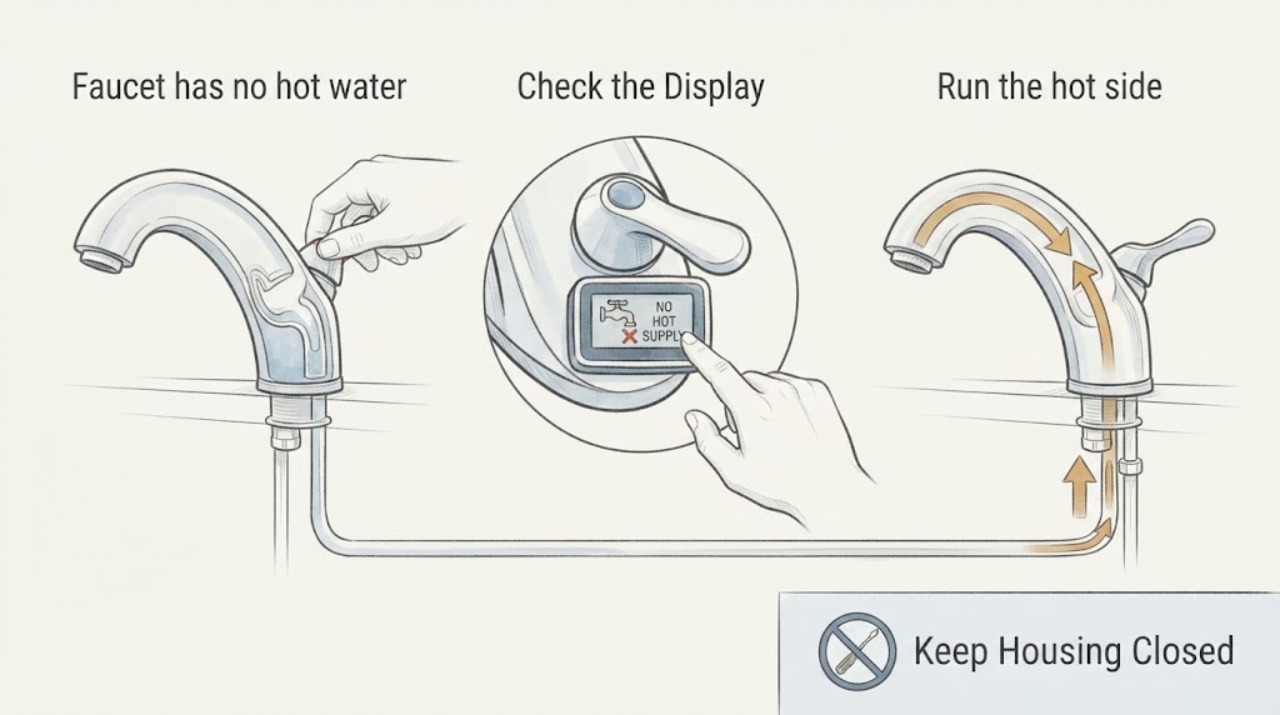
Run the hot side at another nearby fixture, then run the Pfister faucet's hot side and compare temperature and flow without changing the heater setting or mixing-valve adjustment.
Expected result: Other fixtures also lack hot water, other fixtures are hot but the Pfister faucet is cool, the Pfister hot flow is weak, or the Pfister hot flow is normal but the water remains cool.
Next step: Use the whole-home result to choose a water-heater or plumber assessment. If the fault is local, continue with the hot angle stop, line, aerator, screen, and cartridge checks.
Why this matters
Why: A whole-home problem points upstream to the water heater or building supply. Hot water elsewhere with a weak local stream points to the Pfister stop, supply line, screen, cartridge, or body. Normal local hot flow with cool delivery keeps a cartridge, mixing path, crossover, or fixture-specific temperature limit in consideration.
-
Check 3
Look under the sink or behind the fixture at the Pfister hot angle stop, flexible supply line, connectors, and any accessible inlet screen for a partly closed valve, kink, crush point, corrosion, wetness, or debris; do not tighten a leaking compression connection blindly.
Expected result: The hot stop is partly closed, the line is kinked or damaged, a connector is wet, a screen is visibly dirty, or the local hot supply path looks open and dry.
Next step: Open a clearly identified stop gently only if it moves normally; route a sound line without bending it and close the stop for any leak. Clean an accessible screen only as Pfister's model guidance permits, then recheck for leaks.
Why this matters
Why: A restricted or leaking hot supply can eliminate hot flow before water reaches the faucet. A clear dry path shifts attention to the aerator, cartridge, internal faucet passage, or upstream hot-water condition.
-
Check 4
With the angle stops closed, clean the Pfister aerator or sprayhead and flush the accessible faucet hose or supply-line screen only according to the faucet's support instructions; keep the open hose pointed into a container and reinstall every screen and seal.
Expected result: Debris or scale is found, hot flow improves after cleaning, hot and cold flow are equally restricted, or the flow and temperature do not change.
Next step: Reopen the stops slowly and verify dry connections. If the hot side remains cool with normal flow, continue with the model-specific handle and cartridge decision; do not use a chemical cleaner or sharp tool that can damage the mesh.
Why this matters
Why: Debris at the aerator or screen can restrict both volume and apparent temperature. No change after a clear flow path makes the hot cartridge, faucet body, local supply, crossover, or heater more likely.
-
Check 5
Operate the Pfister handle through its normal hot-to-cold range and note whether it stops early, turns freely without changing temperature, feels loose, or is difficult to move; do not force the handle or remove a retaining part until the model is identified and water is off.
Expected result: The handle has limited travel, the hot position produces no temperature change, the handle is loose or self-closes, or the handle and temperature response feel normal.
Next step: Use Pfister's model-specific documentation to identify the cartridge and any temperature-limit procedure. Stop if a retainer, stem, or cartridge resists normal removal; do not substitute a visually similar part.
Why this matters
Why: Limited travel, incorrect cartridge orientation, a temperature-limit stop, debris, or cartridge wear can prevent the hot port from opening. A normal handle with cool water shifts attention toward the hot supply, mixing path, crossover, or heater.
-
Check 6
After the documented cleaning or supply correction, reopen the stops slowly and perform one attended hot-water test while checking the connections, spout, spray hose, handle, and cabinet for leaks or temperature change.
Expected result: Hot water returns, flow improves but the water stays cool, the faucet remains cold with normal pressure, or a leak appears after reassembly.
Next step: Close the stops for any leak and arrange service if temperature remains wrong after the documented external checks. Provide the fixture pattern and what changed rather than replacing the faucet body by guesswork.
Why this matters
Why: A return of hot water supports a local flow restriction or stop condition. Normal pressure with no heat keeps the cartridge, mixing path, cross-connection, or upstream heater in focus. A new leak indicates a gasket, connection, screen, or cartridge-seal problem.
-
Check 7
If other fixtures have hot water and the Pfister faucet still does not after the stop, line, screen, aerator, and handle checks, record the faucet style, model markings, cartridge or handle behavior, and whether hot flow is weak or normal before requesting service.
Expected result: The problem is isolated to the Pfister faucet, the model cannot be identified, the cartridge is seized or damaged, the hot line is blocked, or the whole home has no hot water.
Next step: Arrange qualified faucet or plumbing service and keep the water isolated if leaking. Give the technician the model, fixture results, flow comparison, and every cleaning or shutoff check already completed.
Why this matters
Why: An isolated fault needs faucet or branch diagnosis, and exact model identification controls cartridge compatibility. An unidentified or seized component is not safely solved by trial-and-error parts. A whole-home outage belongs to the heater or building supply path.
Use your observations
Decision map
Find the observation that best matches what you see, then follow the next safe action.
-
PATH 01Next step
What you see
No nearby fixture has hot water, while the Pfister faucet behaves like the rest of the house.
Do this next
Stop changing the faucet and arrange water-heater or plumbing diagnosis; provide whether cold water and all hot fixtures are affected.
Why this path and its safety boundary
Why it matters: A water-heater, whole-house supply, recirculation, or building-side issue is more likely than a Pfister cartridge fault.
-
PATH 02Next step
What you see
Other fixtures have hot water, but the Pfister faucet has weak hot flow and the hot stop, line, aerator, or screen shows a restriction.
Do this next
Correct only a clearly safe stop or hose route and clean the model-approved screen or aerator. Arrange service for a damaged line, leaking stop, or restriction that does not clear.
Why this path and its safety boundary
Why it matters: A local supply or flow restriction is more likely than a whole-home heater problem.
-
PATH 03Next step
What you see
Other fixtures are hot and the Pfister faucet has normal hot-side flow, but the water remains cool or the handle never reaches a true hot response.
Do this next
Identify the exact Pfister model and follow its cartridge or handle documentation. Stop for resistance or uncertainty and arrange qualified faucet service rather than forcing the cartridge.
Why this path and its safety boundary
Why it matters: A cartridge, temperature-limit stop, internal mixing passage, cross-connection, or faucet-specific installation issue is more likely.
-
PATH 04Next step
What you see
Water leaks under the sink, a supply stop cannot close, a connector or cartridge is damaged, or the water is unexpectedly scalding.
Do this next
Close the nearest reliable main or fixture shutoff if safe, protect the area, and arrange qualified plumbing service. Do not force a seized stop or continue testing.
Why this path and its safety boundary
Why it matters: Further disassembly risks flooding, burn injury, or loss of control of the supply.
-
PATH 05Next step
What you see
Cleaning the aerator or screen and correcting a visible supply restriction does not restore hot water, or the faucet cannot be identified by model.
Do this next
Arrange qualified diagnosis and provide model markings, fixture comparisons, flow observations, and photos of the supply connections and handle.
Why this path and its safety boundary
Why it matters: A cartridge, internal faucet passage, concealed branch, cross-connection, or upstream hot-water problem remains possible; the correct part cannot be selected by appearance alone.
Helpful context
Understand the symptom
First find out whether the fault is local
Run hot water at another nearby faucet or fixture. If hot water is absent everywhere, the water heater, whole-house shutoff, recirculation, or building supply needs attention; a Pfister cartridge will not fix that. If other fixtures are hot, concentrate on the Pfister faucet's hot stop, supply line, inlet screen, cartridge, or mixing path.
A hot-side restriction can look like a temperature problem
A partly closed angle stop, kinked flexible line, mineral-filled screen, clogged aerator, or debris in the cartridge can reduce hot flow so much that the stream feels cold or never reaches a useful temperature. Compare hot and cold flow separately and observe whether the handle moves through its normal range.
Pfister cartridges and temperature limits are model-specific
Pfister uses different cartridge and handle designs across faucet families. A cartridge may control hot, cold, mixing, sealing, and sometimes a temperature-limit stop. Do not order a cartridge from appearance alone or adjust a limit stop without the exact model instructions; identify the faucet first.
Clean the easy flow points before opening the faucet
Pfister's support guidance starts with the aerator, sprayhead, hose, or supply-line screens for reduced flow, then moves to the cartridge if flushing does not help. Remove only the part your model identifies, keep debris out of the open line, and restore every seal before reopening the shutoff.
Keep concealed plumbing and heater work professional
A hot-water crossover, concealed leak, failed mixing valve, blocked branch, or water-heater fault can leave one or several fixtures cool. Do not cut walls, disconnect a water heater, alter a tempering valve, or force a faucet cartridge to prove a theory.
Safety boundary
Stop conditions
- Stop and close the faucet supply for an active leak, a shutoff that will not control water, a damaged hose or connector, or water accumulating under the sink.
- Do not force a seized handle, retainer, cartridge, angle stop, or compression connection. Do not cut pipe, remove a wall, alter a water-heater or tempering valve, or continue with an unidentified model.
- If hot water is unexpectedly scalding, keep the faucet out of use until the temperature control and mixing path are assessed; do not adjust a temperature-limit stop by guesswork.
- Arrange qualified plumbing service when other fixtures have hot water but the Pfister faucet remains cool after safe external checks, or when the whole home lacks hot water and the heater or building supply needs diagnosis.
Only after diagnosis
Potential parts
- Pfister faucet cartridge
Consider this only when a qualified or model-directed diagnosis confirms that the local cartridge is blocking or misrouting hot water; a similar-looking cartridge may not match the valve body or temperature control.
Identify the exact Pfister model, cartridge family, orientation, seals, retaining hardware, and temperature-limit configuration before replacement. - Pfister faucet aerator or sprayhead
Consider this when the aerator or sprayhead is damaged, permanently scaled, or still restricts flow after safe cleaning and the faucet has normal hot supply upstream.
Match the exact Pfister faucet style, thread or connection, flow-control design, and model instructions. - hot-water faucet supply hose
Consider this when the hot hose is cracked, leaking, internally restricted, or cannot be routed without a kink.
Match the exact connection ends, length, gasket, pressure rating, and installation requirements; do not patch a pressurized hose. - faucet angle stop
Consider this only when the hot stop is seized, leaking, damaged, or fails to pass water after a plumber confirms the upstream supply is present.
Match the existing pipe, outlet, connection, and local plumbing configuration; replacement may require shutting down a larger water supply.
When checks do not resolve it
Need a professional?
Safety scope: A plumber should handle seized or leaking angle stops, concealed hot-side restrictions, cross-connections, internal faucet-body work, cartridge extraction that requires force, mixing valves, water-heater faults, and any pipe alteration. Keep homeowner work to fixture comparison, visible supply checks, gentle aerator or screen cleaning, and one leak-checked retest with water isolated during disassembly.
Common questions
FAQ
Why does my Pfister faucet have no hot water but other faucets do?
The local hot angle stop or supply hose may be restricted, or the aerator, inlet screen, cartridge, temperature-limit setting, or faucet body may be blocking or misrouting hot water. Compare hot flow at the faucet, check visible supply parts, and follow Pfister's exact model guidance before opening the cartridge.
How can I tell if the problem is the Pfister faucet or the water heater?
Run hot water at another nearby fixture. If all hot fixtures are cool, investigate the water heater or whole-house supply. If other fixtures are hot but the Pfister faucet is not, the fault is more likely local to its stop, hose, screen, cartridge, mixing path, or branch plumbing.
Can a clogged Pfister aerator cause no hot water?
A clogged aerator or screen usually restricts flow rather than changing the heater's temperature, but a weak hot stream can feel like no hot water. Clean the accessible aerator or screen with water isolated and compare hot and cold flow again; if temperature remains wrong with normal flow, inspect the cartridge or call a plumber.
Should I replace the Pfister cartridge first?
No. Confirm that hot water exists elsewhere, the hot stop is open, the hose is sound, and the aerator or inlet screen is clear. Pfister faucet families use different cartridges, so identify the exact model and follow its instructions before selecting a part.
When should I call a plumber for a Pfister faucet with no hot water?
Call for a leak, a shutoff that will not close, scalding or unstable temperature, a seized cartridge, normal hot flow with no hot temperature after the external checks, or a whole-home hot-water outage. Keep the faucet isolated when water cannot be controlled.
Read the exact guide
Official sources
- My Kitchen Handle is not Working ProperlyPfister · Pfister kitchen faucet support guidance; exact handle and cartridge construction varies
- I Have a Leak (kitchen)Pfister · Pfister kitchen faucets; exact connections and repair steps vary by model
- Bathroom - Getting Less Water or Flow Seems LowPfister · Pfister bathroom faucets; handle, cartridge, and screen access vary by model
- Genuine Replacement Part: Ceramic Disc Reversible CartridgePfister · The specific Pfister cartridge shown on the page; not a universal cartridge or fit claim for an unidentified faucet
Community feedback
Share a repair observation
Share a plain-text repair observation. Accepted observations are published automatically; this page may take a moment to update.