
On this page
Start here
Quick answer
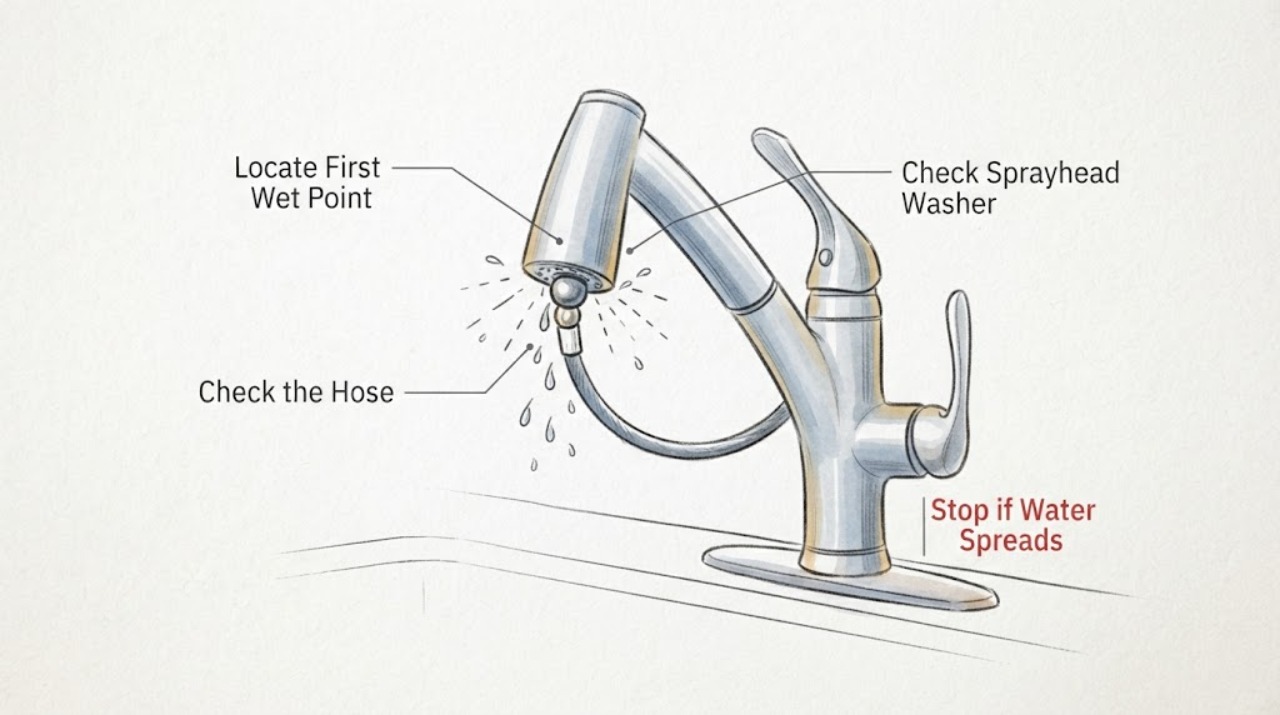
A Pfister pull-down sprayer leak is easiest to diagnose by location. Water at the sprayhead or ball joint can come from a missing or displaced washer, a loose ball-joint piece, or a sprayhead that needs replacement. Water under the sink usually points to a frayed hose, a loose quick-connect or threaded connection, or a connection at the faucet body. Close the angle-stop valves under the sink before disconnecting or inspecting a hose, dry the area, and observe the exact joint where water first appears. You may hand-tighten a clearly identified sprayhead-to-hose connection only when Pfister's model guidance supports it; do not force fittings, twist the hose, remove an unknown connector, or work on a pressurized connection. Replace parts only after identifying the exact faucet model, and arrange plumbing service if the hose lining, faucet body, supply connection, shutoff valve, or leak source remains uncertain or will not stop.
Work through in order
Diagnostic checks
Use only checks that match the exact appliance or system and its official guide.
-
Check 1
Dry the sprayhead, spout, counter, hose, and cabinet area, then run water briefly into the sink while watching from a safe position; if water is under the cabinet, close both angle-stop valves before touching a connection.
Expected result: The first wet point is at the sprayhead or ball joint, along the flexible hose, at the under-sink quick-connect or thread, at the faucet body, or at a supply or shutoff connection.
Next step: Use the location branch below. Keep the water supply closed for any under-cabinet leak, and stop if the first wet point cannot be identified without loosening a pressurized fitting.
Why this matters
Why: A sprayhead or ball-joint leak follows a different repair path from a hose-lining leak or an underbody connection leak. Water at the supply or shutoff is outside the sprayer path and can continue even when the faucet is off.
-
Check 2
With the water supply off and the sprayhead cool and dry, inspect the accessible sprayhead-to-hose or ball-joint seam for a missing, displaced, or damaged washer; do not force the sprayhead or remove parts that do not match the model guidance.
Expected result: Water starts behind the sprayhead, a flat washer or screen is absent, the ball joint looks loose, or the sprayhead seam is dry.
Next step: Use the exact Pfister model instructions to restore an identified washer or gently secure a documented ball-joint piece. If the seam still leaks or the sprayhead itself leaks, identify the model and arrange the appropriate part or service.
Why this matters
Why: A missing washer after installation or a loose ball-joint piece can let water escape at the sprayhead connection. A dry seam shifts attention toward the hose, underbody connection, faucet body, or supply line.
-
Check 3
With the angle-stop valves closed, pull out only enough of the spray hose to inspect its accessible length for fraying, a kink, rubbing, bulging, or water emerging through the hose lining; do not stretch it, cut it, or pull the hose through the faucet body.
Expected result: The hose lining is wet or frayed, the hose is kinked or rubbing, the hose looks dry and intact, or its route cannot be inspected without dismantling the faucet.
Next step: Keep the supply closed for a wet or damaged hose and identify the exact faucet model before selecting a replacement. Arrange service if routing requires faucet disassembly or the hose is not the leak source.
Why this matters
Why: Water through the hose lining or visible fraying supports hose replacement rather than a sprayhead washer repair. A kink or rubbing point can damage a sound hose over time. A dry hose does not clear a quick-connect, threaded fitting, faucet body, or supply leak.
-
Check 4
With the angle-stop valves closed and a towel below the fitting, look at the connection where the pull-down hose meets the faucet body for a visibly separated quick-connect, loose threaded coupling, or missing connector piece; do not loosen a threaded connection or force a quick-connect that is not clearly identified.
Expected result: Water appears at the faucet-body hose connection, the quick-connect is visibly disengaged, the threaded connection is loose, the hose lining leaks elsewhere, or the fitting is dry.
Next step: Re-seat or hand-tighten only the clearly identified connection according to the exact Pfister instructions, then keep the supply closed until it is secure. If the connector will not seat, the hose still leaks, or water is at the faucet body, arrange plumbing service.
Why this matters
Why: A separated or loose hose connection can leak independently of the sprayhead, while a leak through the hose lining requires a hose path. A dry fitting makes the faucet body, supply lines, or another location more likely.
-
Check 5
Record the Pfister faucet style and model from accessible product information or the faucet finder, along with the leak location and connector type; do not order a hose or sprayhead from appearance alone.
Expected result: The exact model is identified, only a style family is known, the model is discontinued, or no model information can be found.
Next step: Use Pfister's model-specific support or have a service representative identify the faucet from its information or photographs. Keep the water closed if the leak is under the cabinet.
Why this matters
Why: An exact model gives the best chance of matching the sprayhead, washer, hose, quick-connect, and weight arrangement. A style-only or unknown identification leaves compatibility uncertain, and older or discontinued faucets may use different hose designs.
-
Check 6
After an identified washer or connection has been corrected according to the model guidance, reopen the angle-stop valves slowly while watching the dry joint and then run water into the sink; stop immediately if water sprays, the leak returns, or the hose pulls tight.
Expected result: The joint stays dry, a slow drip returns at the same location, water appears at a different connection, or the hose strains during pull-down movement.
Next step: Close the angle-stop valves again for any recurring or moving leak and arrange qualified service. Do not keep cycling the water supply to test an unstable connection.
Why this matters
Why: A dry retest supports the corrected connection, but a returning drip indicates a damaged seal, hose, sprayhead, or fitting. A new leak point or hose strain means the original diagnosis was incomplete and continued use can worsen cabinet or supply damage.
Use your observations
Decision map
Find the observation that best matches what you see, then follow the next safe action.
-
PATH 01Next step
What you see
Do this next
Follow the exact Pfister model guidance for the washer or ball-joint check. If the seam still drips, identify the model for a compatible sprayhead or arrange service; do not force the joint.
-
PATH 02Next step
What you see
Do this next
Keep the angle stops closed, identify the exact faucet model and hose arrangement, and fit only a documented compatible replacement through appropriate service.
-
PATH 03Next step
What you see
Do this next
Keep the water supply closed. Re-seat or hand-tighten only a clearly identified connection according to model guidance; for a supply, valve, body, or uncertain fitting, arrange qualified plumbing service.
-
PATH 04Next step
What you see
Do this next
Keep the supply closed if the hose is wet or strained and have the model-specific routing and weight arrangement checked. Do not pull harder or dismantle the faucet to free it.
-
PATH 05Next step
What you see
Do this next
Close the nearest reliable upstream water shutoff if it can be reached safely, contain the water, and arrange qualified plumbing service. Do not work on a pressurized or unidentified fitting.
Helpful context
Understand the symptom
The first drop location matters
A pull-down sprayer has a sprayhead at the end of a moving hose and a second hose connection at the faucet body below the counter. Water at the sprayhead or ball joint is a different path from water seeping through the hose lining or dripping under the cabinet. Dry the area and watch for the first wet point rather than assuming every leak needs a new sprayhead.
Why the hose can leak after years of use
Pfister notes that pull-down and pull-out nylon hoses move repeatedly and can eventually fray, kink, or wear. A hose that rubs against the cabinet, catches on its weight, or is pulled at an angle can also make a connection appear to leak. Routing and model-specific connector checks should come before choosing a replacement part.
Shutoff and service boundary
Close the angle-stop valves under the sink before disconnecting a hose or opening a connection, and keep a towel or container under the work area. Do not loosen a pressurized fitting, force a quick-connect, remove the faucet body, or continue using a hose that is spraying under the cabinet. A leak from the faucet body, supply line, shutoff valve, or an unidentified connection needs qualified plumbing service.
Only after diagnosis
Potential parts
- pull-down sprayhead
Consider a sprayhead only when the leak originates from the sprayhead itself or remains at that assembly after the documented washer and ball-joint checks.
Confirm the exact Pfister faucet model and connection before ordering; do not assume sprayheads are interchangeable by appearance. - pull-down faucet hose
Consider a hose only when water emerges through its lining, the hose is frayed or damaged, or Pfister's connection checks do not resolve a leak along the hose assembly.
Pfister uses multiple hose and connector arrangements; match the exact faucet model, hose type, and weight arrangement. - sprayhead washer or gasket
Consider a washer or gasket only when the leak is at the sprayhead or ball-joint seam and the model-specific assembly calls for that seal.
Confirm the exact model and seal location; do not substitute an unverified washer that could prevent the connection from seating. - pull-down hose connector or faucet seal
Consider a connector or faucet-body seal only after the leak is localized to that fitting and a qualified or model-specific inspection confirms the failed piece.
Under-sink connections vary by model and may require shutoff, tools, or faucet access; use qualified plumbing service when uncertain.
When checks do not resolve it
Need a professional?
Arrange qualified plumbing service if the hose lining is damaged, the leak is from the faucet body, supply, or shutoff valve, a quick-connect or threaded fitting will not seat, the model is unknown, the leak persists after an identified washer or connection check, or water sprays under the cabinet. Close the angle-stop valves for an under-cabinet leak when they operate safely; use an upstream shutoff if needed, and do not work on a pressurized or unidentified fitting.
Common questions
FAQ
Why is my Pfister pull-down sprayer leaking behind the sprayhead?
Pfister points to a missing or displaced washer in the sprayhead or ball-joint assembly, a loose ball-joint piece, or a hose or sprayhead problem. Shut off water before inspecting, identify the exact seam, and follow the model-specific assembly guidance without forcing the connection.
What should I do if the pull-down hose leaks under the sink?
Close the angle-stop valves under the sink, dry the area, and determine whether water is coming through the hose lining or from its faucet-body connection. A frayed hose may need replacement, while an uncertain quick-connect, threaded fitting, faucet body, or supply leak should be handled by qualified plumbing service.
Can I tighten a Pfister pull-down sprayhead connection?
Only hand-tighten a clearly identified sprayhead or ball-joint connection when the exact Pfister guidance supports it and the water supply is controlled. Do not force a fitting, twist the hose, or use tools on an unknown connection; a persistent drip needs the correct model-specific part or service.
How do I know which Pfister hose or sprayer part to order?
Identify the exact faucet model first, then match the leak location and connector or sprayhead arrangement to Pfister's model-specific parts information. Older or discontinued faucets can use different hose designs, so appearance alone is not enough.
When should I stop using a leaking pull-down faucet?
Stop and close the water supply for a spray under the cabinet, a hose leak, a faucet-body or supply leak, an angle stop that will not shut off, or any source you cannot identify safely. Arrange plumbing service rather than repeatedly pressurizing an unstable connection.
Read the exact guide
Official sources
- Pull-down, Pull-out HosePfister Faucets · Pfister kitchen pull-down and pull-out faucet support; exact model instructions control connector and part differences.
- Pull-Down Kitchen FaucetPfister Faucets · Pfister pull-down kitchen faucet support-category page; choose the exact model before applying repair instructions.
- I Have a Leak (kitchen)Pfister Faucets · Pfister kitchen faucet leak troubleshooting; the Canadian support page describes the same pull-down hose and sprayhead connection paths, with exact model differences.
Community feedback
Share a repair observation
Share a plain-text repair observation. Accepted observations are published automatically; this page may take a moment to update.