
On this page
Start here
Quick answer
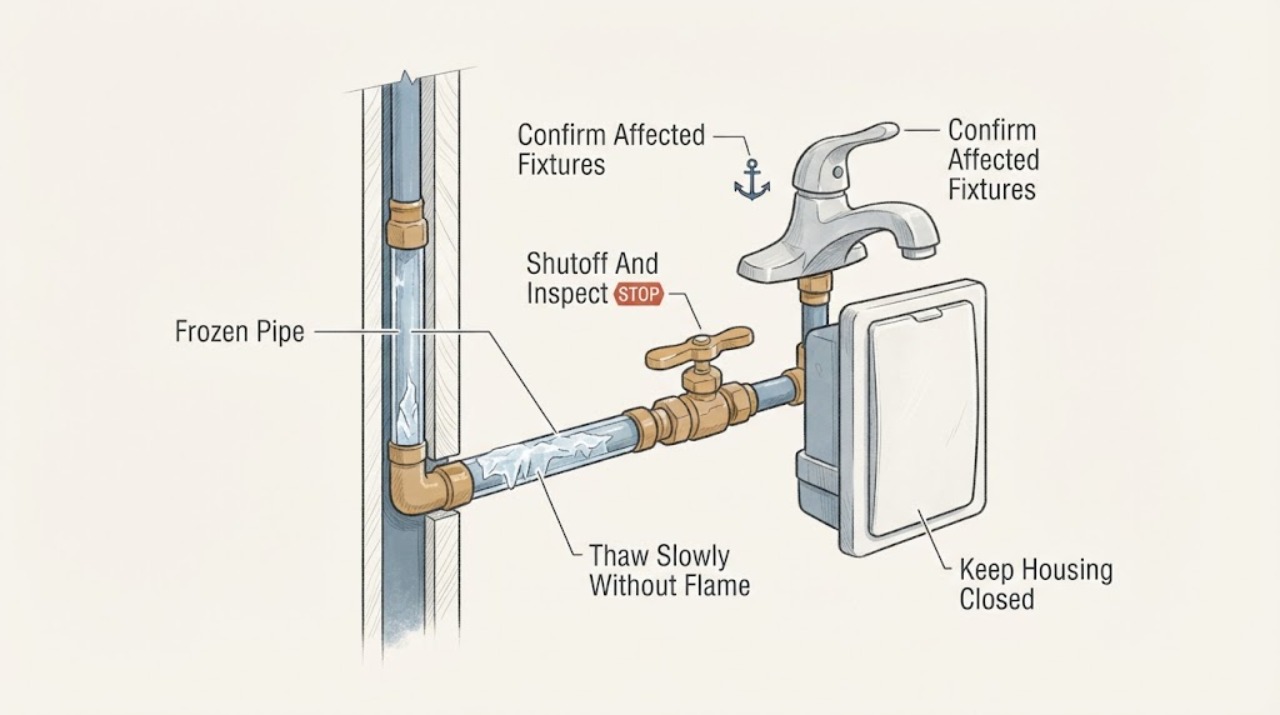
A faucet that gives only a trickle during freezing weather may be served by a frozen pipe. Find out whether one fixture or the whole home is affected, locate the most exposed accessible section, and know where the local and main water shutoffs are before thawing. If a pipe has split, water is already leaking, the frozen section is inside a wall or otherwise inaccessible, there is standing water near electricity, or you cannot safely control the water, shut it off and call a licensed plumber. Never use a torch or other open flame; thaw slowly and be ready for a leak to appear as the ice melts.
Before you begin
Safety first
- Do not use an open flame, apply uncontrolled heat, thaw an inaccessible line, open walls as a first step, use electrical heat in standing water, or repressurize a line that is leaking.
Work through in order
Diagnostic checks
Use only checks that match the exact appliance or system and its official guide.
-
Check 1
Open the affected cold-water faucet slightly and compare it with other cold-water fixtures in the home. Check whether the flow is a trickle, absent, or normal, and whether hot and cold sides differ. Do not force a frozen handle or disconnect a fitting.
Expected result: Only one fixture is restricted, several fixtures on one area are restricted, the whole home has little or no water, or flow is normal elsewhere.
Next step: Leave the affected faucet slightly open only while you can supervise it and know the shutoff location. Move to the most likely accessible pipe section; if the freeze is widespread or location is unclear, call a plumber rather than opening walls.
Stop if: Stop if there is no safe access to the shutoff, water is near electricity, or a fitting or pipe is visibly split.
Why this matters
Why: A localized restriction favors a branch pipe near the affected fixture; several affected fixtures suggest a shared line or service-entry section. Normal flow elsewhere does not prove the isolated pipe is intact, and no flow throughout the home may require utility or plumber assessment.
-
Check 2
Locate the local branch shutoff or main water shutoff before applying heat. Inspect exposed pipe, joints, the area under cabinets, and the water-entry point for bulging, splits, ice, dampness, or a leak that may be hidden behind the frozen section.
Expected result: The pipe is visibly cracked or leaking, the exposed section is intact but iced, the freeze is inaccessible, or no likely frozen section can be found.
Next step: If damage or leakage is present, close the appropriate shutoff and call a plumber. If the section is inaccessible or uncertain, keep water controlled and arrange professional thawing; do not open walls as a first step.
Stop if: Stop for a split pipe, active leak, standing water, concealed freeze, or any inability to close the water supply.
Why this matters
Why: A crack or leak requires water control and repair, not continued thawing. An intact accessible section may be thawed slowly if the surroundings are dry and safe. An inaccessible or unknown location increases the risk of thawing a concealed break without being able to respond.
-
Check 3
For an accessible, intact pipe in a dry area, warm the frozen section gradually with room-temperature or warm air while the faucet remains slightly open and you can watch the pipe. Follow the pipe from the faucet toward the frozen area. Never use a torch, blowtorch, kerosene or propane heater, charcoal stove, or any other open flame.
Expected result: Water flow gradually increases without leakage, no flow returns, a joint begins to drip, or the area becomes wet or unsafe.
Next step: Keep the shutoff immediately available and continue only while the pipe remains dry and stable. For a drip, stop heating and close the shutoff; for no progress or an unsafe area, call a licensed plumber.
Stop if: Stop for any open flame, standing water near electrical equipment, smoke, a burst or dripping joint, or a pipe that cannot be observed along its length.
Why this matters
Why: Increasing flow indicates ice is clearing, but it does not prove the pipe survived intact. A drip as thawing progresses can expose a break that was sealed by ice. No progress suggests the freeze is elsewhere, inaccessible, or beyond a safe homeowner thaw.
-
Check 4
Once the pipe is fully flowing and no leak is visible, restore water slowly while watching the entire accessible section, nearby joints, cabinets, ceilings, and floors. Keep the faucet open briefly to clear air and observe pressure; do not leave the property while a recently frozen line is being repressurized.
Expected result: Water remains dry and pressure returns, a joint or wall begins to leak, or flow remains restricted after thawing.
Next step: If a leak appears, close the shutoff and call a plumber. If flow remains restricted, stop repeated heating and have the line located. Dry accessible materials and protect the area from further water damage.
Stop if: Stop for any new leak, ceiling or wall staining, flooring damage, uncontrolled water, or water near an electrical outlet or panel.
Why this matters
Why: A dry line with restored flow supports a temporary freeze, but continued monitoring is needed because damage can be revealed by restored pressure. A leak or persistent restriction indicates repair is required and may involve a concealed or damaged section.
-
Check 5
After the line is repaired or confirmed dry, inspect the area that froze for cold drafts, missing insulation, an open garage door, an exterior-wall cabinet, an outdoor hose connection, or a heat source that is not reaching the pipe. Add only code-appropriate insulation or listed heat products according to their instructions, and keep harmful chemicals away from opened cabinets.
Expected result: The pipe is exposed in an unheated area, a hose or outdoor branch was left connected, cabinet doors or access paths block household heat, or the area is already protected.
Next step: Winterize outdoor hose branches as directed, allow safe household heat to reach vulnerable pipes, and use model- or product-specific insulation guidance. Do not add antifreeze to water lines unless the manufacturer or a qualified professional specifically directs it.
Stop if: Stop if prevention requires rewiring, combustion heat, opening a wall, moving a water heater, or installing heat tape without its listed instructions.
Why this matters
Why: The observed exposure explains why that section froze and gives a targeted prevention step. If no exposure is visible, the line may be concealed or affected by a building or heating condition that needs professional assessment.
Use your observations
Decision map
Find the observation that best matches what you see, then follow the next safe action.
-
PATH 01Next step
What you see
One fixture has a trickle or no flow and an intact frozen section is visible in a dry, accessible area.
Do this next
Open the affected faucet slightly, keep the shutoff ready, and thaw gradually with safe warm air while watching the full pipe.
-
PATH 02Next step
What you see
Several fixtures are affected, the service-entry line may be frozen, or the frozen section is inside a wall or otherwise inaccessible.
Do this next
Keep the main or local shutoff location ready and arrange a licensed plumber or qualified service-line professional.
-
PATH 03Next step
What you see
A split, bulge, drip, spray, wet wall, or floor leak appears during inspection or thawing.
Do this next
Close the local or main water shutoff immediately and keep people away from standing water near electrical equipment.
-
PATH 04Next step
What you see
The pipe is near electricity, the area is wet, an open flame would be required, or the line cannot be observed safely.
Do this next
Stop DIY thawing, keep the water controlled if possible, and use a licensed plumber; use emergency help if water threatens electrical equipment or a life-safety system.
-
PATH 05Next step
What you see
Flow and pressure return without a leak, and the freeze location or exposure is known.
Do this next
Correct the specific cold exposure with appropriate insulation, heat access, hose winterization, or professional rerouting rather than relying on repeated thawing.
Helpful context
Understand the symptom
Do not treat a frozen pipe as merely a water-pressure inconvenience. Ice blocks flow while expansion can stress the pipe, and a crack may remain hidden until thawing restores pressure. The useful sequence is to identify the affected branch, control the water, thaw slowly only where safe, and watch every exposed joint as flow returns.
One fixture with a trickle often points to a local branch, while several fixtures without water can involve a shared line or service entry. Pipes in exterior walls, crawl spaces, attics, garages, cabinets, and other unheated areas are common exposure points, but a concealed freeze cannot be diagnosed safely by guessing at the wall location.
Keep people away from standing water near electrical equipment, and do not place electrical heat sources where a thawed leak could wet them. A plumber is the right next step for concealed, inaccessible, damaged, or repeatedly freezing lines.
Safety boundary
Stop conditions
- A pipe, fitting, wall, floor, or ceiling is actively leaking, split, bulging, or wetting building materials.
- The frozen section is inside a wall, crawl space, attic, service line, or other inaccessible or unsafe location.
- Standing water is near an electrical outlet, panel, appliance, heater, or other energized equipment.
- Thawing would require a torch, open flame, combustion heater, uncontrolled heat, or an unattended electrical appliance.
- You cannot locate or close the local or main water shutoff, or the water cannot be controlled.
- Flow remains restricted after a safe thaw, the pipe freezes repeatedly, or the line may have concealed damage.
Only after diagnosis
Potential parts
- Damaged section of water supply pipe and fittings
Consider only after thawing or inspection confirms a split, bulge, or leaking joint and a plumber identifies the repair section.
Pipe material, diameter, joining method, access, and local requirements must be confirmed by a qualified plumbing professional. - Pipe insulation sleeve
Consider only for an exposed vulnerable pipe after the line is dry, intact, and the insulation will not hide an active leak or interfere with a valve.
Use a product suited to the location and keep shutoffs, inspection points, and required clearances accessible. - Listed pipe heat cable or heat tape
Consider only when a qualified professional or the product instructions identify it as suitable for the specific exposed line and environment.
Follow the complete listing and installation instructions; do not use it in wet or unsafe conditions or with an improvised extension or heat source.
When checks do not resolve it
Need a professional?
Call a licensed plumber for a burst or leaking pipe, inaccessible freeze, no safe shutoff, widespread loss of water, or a line that will not thaw., Arrange plumbing service when a pipe freezes repeatedly or the cause appears to be concealed insulation, routing, or a service-entry condition., Use emergency electrical or fire-safety assistance when thaw water reaches electrical equipment or threatens a pilot light, furnace, or water heater power area.
Safety scope: Do not use an open flame, apply uncontrolled heat, thaw an inaccessible line, open walls as a first step, use electrical heat in standing water, or repressurize a line that is leaking.
Common questions
FAQ
How do I know if a water pipe is frozen?
A faucet that produces only a trickle or no water during freezing weather is a useful clue. Compare other fixtures to see whether the problem is local or widespread, then inspect accessible pipes near exterior walls, cabinets, garages, attics, crawl spaces, and the water-entry point.
Should I shut off the water before thawing a frozen pipe?
Know and be ready to use the local or main shutoff before thawing. If the pipe is cracked, leaking, concealed, or the area is unsafe, close the water and call a plumber rather than continuing to heat it. A break may become visible when ice melts.
Can I use a torch to thaw a frozen pipe?
No. Red Cross, CDC, and fire-safety guidance prohibit open-flame thawing because it can damage the pipe and create a fire hazard. Use a licensed plumber for inaccessible or unsafe lines; any limited homeowner thaw should use only a safe, gradual method in a dry, observable area.
What should I do if the pipe starts leaking as it thaws?
Close the local or main shutoff immediately, keep people away from water near electrical equipment, and call a licensed plumber. Do not restore pressure or continue heating a pipe that has begun to drip or spray.
Read the exact guide
Official sources
- Safety Guidelines: During & After a Winter StormCenters for Disease Control and Prevention · CDC winter-storm pipe-freeze prevention, safe thawing, no-torch warning, and alternate-water guidance
- Frozen Water PipesFairfax County Fire and Rescue Department · Fire-safety guidance for frozen pipes, shutoff before thawing, leak after thaw, no torch, and electrical-water hazard escalation
- Preventing & Thawing Frozen PipesAmerican Red Cross · Frozen water pipe signs, vulnerable locations, prevention, shutoff awareness, slow thawing, open-faucet guidance, and plumber escalation
Community feedback
Share a repair observation
Share a plain-text repair observation. Accepted observations are published automatically; this page may take a moment to update.