
On this page
Start here
Quick answer
First establish what “filter” means: an accessible strainer or screen, a filter in an appliance or water system, or an upstream part that is not meant for homeowner removal. A single slow fixture usually points to a local restriction; several slow fixtures, gurgling, or wastewater at a low drain can indicate a larger sewer or main-line problem. Stop adding water when backup is possible. Do not mix drain chemicals, open a pressurized filter, dismantle a pipe after chemicals were added, or use blind high-pressure flushing. A plumber should handle an inaccessible filter, repeated blockage, wastewater backup, chemical history, leaks, or any pipe near gas or electrical equipment.
Work through in order
Diagnostic checks
Use only checks that match the exact appliance or system and its official guide.
-
Check 1
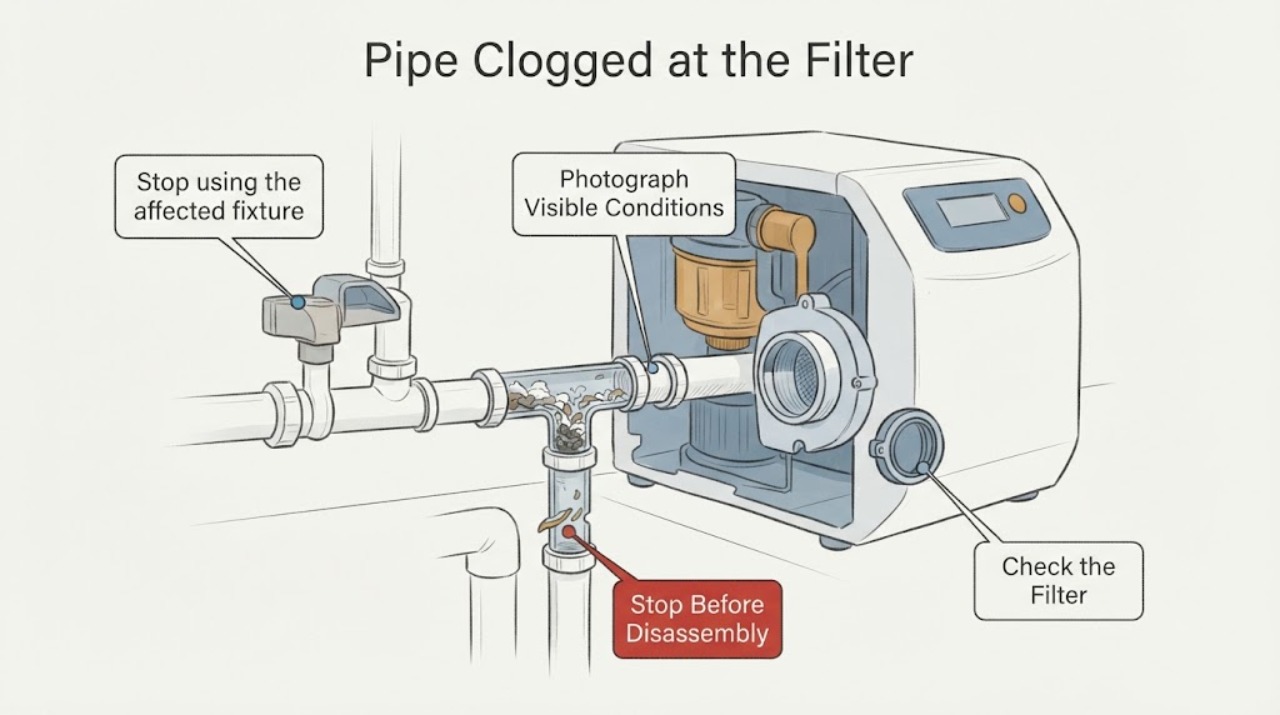
Stop using the affected fixture and note whether the problem is slow flow, no flow, gurgling, a visible overflow, or wastewater returning. Check other nearby fixtures without adding significant water, and identify the lowest affected drain.
Expected result: Only one fixture is affected, several fixtures are slow, wastewater rises at a low drain, or water is already flooding the area.
Next step: For multiple affected fixtures, wastewater backup, or flooding, stop all water use and arrange urgent utility or plumber assistance. Do not try to force the blockage through the filter.
Why this matters
Why: A single fixture is more consistent with a local restriction; several fixtures or a low-point backup can indicate a larger sewer line or main-line issue. Flooding and wastewater create a health and electrical risk.
-
Check 2
Trace the visible pipe from the fixture and identify what the claimed filter is: a removable screen, a cleanout, an appliance filter, a cartridge housing, or a sealed or pressurized fitting. Photograph the label and connections without loosening anything.
Expected result: The part is clearly an accessible screen, is an appliance-specific filter, is a capped cleanout, or cannot be identified or is under pressure.
Next step: If identity, isolation, pressure status, or the manual procedure is unclear, stop and call a plumber. Do not remove a cap, cartridge, or pipe joint to discover what is inside.
Why this matters
Why: Only a clearly identified, manual-approved access point can be considered for a low-risk inspection. A cleanout is an access point for trained clearing work, not proof that the homeowner should open it; an unknown or pressurized filter can release water or contaminated contents.
-
Check 3
Inspect only visible pipe, filter-housing, and connection areas for a kink, crushed section, loose cap, leak, corrosion, or filter indicator, keeping hands away from wastewater and not moving the pipe.
Expected result: The visible pipe is kinked or damaged, the housing leaks, the filter indicator shows restriction, or no external issue is visible.
Next step: Do not bend, cut, tighten, or open the line as a test. Isolate water only through a clearly labeled, accessible valve if it can be done safely; otherwise leave the area undisturbed and request service.
Why this matters
Why: A visible restriction or leak may explain reduced flow, but a normal exterior view cannot rule out a concealed obstruction, failed filter element, trap, or main-line issue.
-
Check 4
Check the product and area history before any cleaning: ask whether a drain opener, bleach, acid, solvent, or other cleaner was poured into the pipe, whether a previous attempt used pressure, and whether gas, electrical, or appliance lines are nearby.
Expected result: No chemical or pressure attempt occurred, a chemical may remain, a line was pressure-flushed, or a gas or electrical hazard is nearby.
Next step: If any chemical or pressure history is present, do not open or flush the line; provide the product name and timing to the plumber. If gas or electrical equipment may be affected, keep the area clear and obtain the appropriate qualified service.
Why this matters
Why: Chemical residue can burn anyone opening the filter or pipe, and pressure work can damage a line or force contaminated water into the room. Nearby utilities increase the consequence of blind clearing.
-
Check 5
If the filter is a clearly accessible screen and the exact manual permits inspection, isolate the supply or appliance as instructed, protect the area from residual water, and inspect without mixing products or using tools that can damage the screen. Stop if water is contaminated, hot, pressurized, or uncontrolled.
Expected result: The screen has visible debris and the area remains dry and controlled, or the filter cannot be accessed safely or the restriction remains after a permitted inspection.
Next step: Follow only the exact manual for refitting or replacing an accessible screen. For an unknown filter, persistent clog, wastewater, leak, or damaged housing, stop and call a licensed plumber.
Why this matters
Why: A visible screen restriction can explain a local flow reduction, but it does not establish that the pipe itself is clear or that the filter is the correct part. Persistent or wider blockage needs a plumbing diagnosis.
Use your observations
Decision map
Find the observation that best matches what you see, then follow the next safe action.
-
PATH 01Next step
What you see
One fixture is slow or blocked, there is no wastewater backup, and the filter is a clearly identified accessible screen.
Do this next
Follow the exact equipment or plumbing manual for safe isolation and screen inspection. Do not use chemicals or high-pressure flushing, and stop if the screen housing is pressurized, damaged, or difficult to identify.
-
PATH 02Next step
What you see
Several fixtures are slow, toilets or drains gurgle, or wastewater rises at a low drain.
Do this next
Stop using water throughout the property and call the utility or a plumber for sewer or main-line assessment. Do not open a cleanout or attempt to stop wastewater flow without professional direction.
-
PATH 03Next step
What you see
A chemical cleaner may be in the pipe, or different cleaners were used.
Do this next
Do not add anything else, open the filter, disconnect a trap, or pressure-flush the line. Keep people away from fumes or splashes and tell the plumber the product and approximate time used.
-
PATH 04Next step
What you see
The filter is sealed, pressurized, buried, connected to an appliance, or its isolation procedure is unknown.
Do this next
Stop at external observation and arrange a qualified plumbing or appliance service visit. Do not loosen a cartridge housing, cap, fitting, or pipe joint to see whether the clog is behind it.
-
PATH 05Next step
What you see
There is a leak, contaminated water, flooding near electrical equipment, a possible gas-line conflict, or structural damage around the pipe.
Do this next
Keep people clear, stop water only from a safe dry position if possible, and obtain urgent qualified help. Do not enter contaminated or electrically unsafe water and do not continue clearing work.
Helpful context
Understand the symptom
Do not assume the filter is the blockage
A filter can mean a removable screen, a strainer in a fixture, an appliance filter, or a service-only component in a pressurized water or wastewater line. The task changes with that identity. Start with the fixture and pipe behavior, then use the model or installation guide to identify whether the filter is meant to be accessed. If the part is sealed, pressurized, buried, or connected to wastewater, stop at observation and call a plumber.
Scope matters more than force
One blocked fixture can be local. Several fixtures that slow or back up together, especially at a lower drain, can indicate a side sewer or main-line problem. Utilities advise stopping water use during a backup because more water can worsen the overflow. A filter replacement or pipe flush cannot safely be chosen until the restriction location and any chemical history are known.
Chemical and water boundaries
Drain openers can burn skin and eyes and produce dangerous fumes, and residues can injure anyone who later opens a trap, filter, or cleanout. Never add a second product to a line that may contain a cleaner. Keep children and pets away from wastewater, and treat water near electrical equipment as an electrical hazard.
Safety boundary
Stop conditions
- Stop immediately for wastewater backup, flooding, sewage exposure, uncontrolled water, or water near electrical equipment; stop using water and obtain qualified help.
- Do not open a filter, trap, cleanout, cartridge housing, or pipe after drain chemicals were added or when the contents are unknown.
- Do not mix drain openers, bleach, acids, solvents, or other cleaners, and do not blindly pressure-flush a blocked line.
- Stop for a pressurized or unidentified filter, a leaking or damaged pipe, a possible gas-line conflict, structural damage, fumes, skin or eye exposure, or a blockage affecting multiple fixtures.
Only after diagnosis
Potential parts
- pipe strainer or filter screen
Consider this only if the exact system documentation identifies an accessible screen and inspection confirms that the screen is damaged or restricted.
Confirm pipe size, system type, pressure rating, and manufacturer documentation before selecting a replacement; do not infer fit from appearance. - filter housing seal
Consider this only if a qualified plumber confirms that a documented, isolated filter housing is leaking because its seal is damaged.
Seal material and fit depend on the exact housing and service conditions; do not open a pressurized or contaminated housing to check it.
When checks do not resolve it
Need a professional?
Call a plumber for an inaccessible or unidentified filter, a persistent local blockage, a leak, repeated clogging, chemical history, or any pipe that may require opening or pressure work. Treat multiple affected fixtures, wastewater backup, flooding, gas-line risk, and electrical exposure as urgent.
Common questions
FAQ
How do I know whether the filter is causing a clogged pipe?
First identify whether it is an accessible screen, an appliance filter, a cleanout, or a sealed or pressurized fitting. One affected fixture may be local; several affected fixtures or a low-point backup can indicate a larger sewer restriction. Do not dismantle an unknown filter.
Can I use a drain opener before opening the filter?
Do not use a drain opener as a default step. Never mix products, and never open a filter, trap, or pipe when chemicals may remain inside. Tell the plumber what product was used and when.
What should I do if several drains are clogged?
Stop using water and treat gurgling, wastewater at a low drain, or several slow fixtures as a possible sewer or main-line problem. Keep people away from wastewater and arrange utility or plumber help rather than forcing the blockage through one filter.
Read the exact guide
Official sources
- Drain opener poisoningMedlinePlus, U.S. National Library of Medicine · General exposure warning for drain-opening chemicals; use emergency medical or poison-control guidance for an actual exposure.
- Side Sewer BackupsSeattle Public Utilities · General homeowner triage for multiple drains, wastewater backup, stopping water use, safe power isolation, and plumber or utility escalation.
- How to Care for Your Septic SystemU.S. Environmental Protection Agency · Conditional guidance for homes with septic systems on water use, wastewater, and avoiding chemical drain openers; municipal plumbing may follow different local rules.
- Spring TipsHealth Resources and Services Administration · General safety for household cleaners: follow labels, ventilate, avoid mixing products, and treat drain openers as corrosive hazards.
Community feedback
Share a repair observation
Share a plain-text repair observation. Accepted observations are published automatically; this page may take a moment to update.