
On this page
Start here
Quick answer
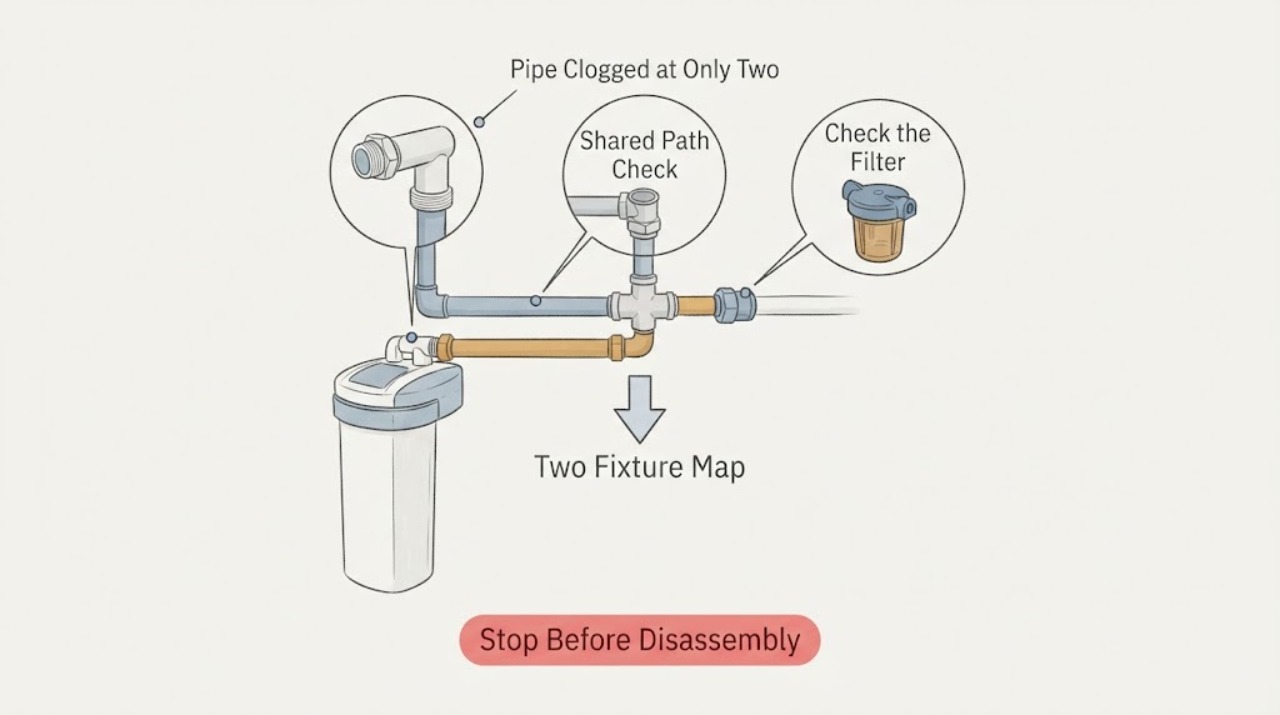
When a clog affects exactly two fixtures, compare their locations and symptoms before opening any pipe. If the fixtures are close together or share a branch, the restriction may be in that branch or in one shared strainer, trap, or accessible filter; if other fixtures drain normally, a whole-building main blockage is less likely. Stop using both affected fixtures if water rises, wastewater returns, or a low drain starts to fill. Do not mix drain chemicals, open a filter after chemicals were used, loosen a sealed or pressurized housing, or use blind high-pressure flushing. A plumber should trace the branch when the filter is not clearly accessible, the two fixtures are not on an obvious shared line, the blockage returns, or any wastewater or leak is present.
Work through in order
Diagnostic checks
Use only checks that match the exact appliance or system and its official guide.
-
Check 1
Stop using the two affected fixtures, then note each fixture's location, whether it is slow or fully blocked, any gurgle, and whether water or wastewater rises. Without adding water, check whether nearby fixtures and the lowest drain are normal.
Expected result: Only the two fixtures are slow and there is no rise elsewhere; or both are fully blocked, a lower drain fills, or several fixtures also respond.
Next step: For a local pattern, continue only with external identification. For a wider pattern or any rising wastewater, stop all water use and arrange plumbing or utility help.
Why this matters
Why: Two nearby slow fixtures support a shared branch or common restriction. A lower drain, wastewater return, or wider pattern points toward a downstream building line or sewer backup and is not a safe filter-cleaning task.
-
Check 2
From outside the pipework, compare the two fixtures' route, height, and nearest visible junction. Look for an obvious shared branch, common trap connection, appliance discharge point, or labeled screen/filter; do not remove a cover or disturb a connection just to test the theory.
Expected result: The fixtures clearly join near one visible branch or screen; or no shared route is visible and the two fixtures are far apart.
Next step: Photograph labels and fittings for the plumber. Only inspect a removable screen in the next action if the exact manual identifies it as homeowner-accessible and no chemical or pressure history exists.
Why this matters
Why: A clear shared route makes a local branch restriction plausible. No visible common route means the word filter may refer to two local components or an upstream part, so guessing a location can cause a leak or expose a pressurized section.
-
Check 3
If the filter is plainly an accessible screen or strainer and the equipment instructions permit inspection, first isolate the applicable water supply or appliance as instructed, protect the area, and look for lint, hair, scale, or other visible material without scraping or forcing it.
Expected result: The screen is clean, visibly obstructed, damaged, or still wet and under pressure after the permitted isolation step.
Next step: Refit only as the exact instructions describe and stop if anything does not seat normally. Have a plumber trace the shared branch or service the filter housing when the screen does not explain both symptoms.
Why this matters
Why: A visible obstruction may explain both fixtures only when that screen is genuinely upstream of both. A clean screen, damaged mesh, continuing pressure, or uncertainty about the route means the filter is not proven to be the cause.
-
Check 4
Ask everyone who used the fixtures whether drain opener, bleach, acid, detergent, or a pressure device was used, and record the product and approximate time. Do not add another product or pressure, and do not open the trap, filter, cleanout, or coupling if the answer is yes or unknown.
Expected result: No chemical or pressure product was used; or a chemical, pressure device, or unknown product was involved.
Next step: With no history, keep water use low and finish the location notes. With any history, keep the affected area clear, follow the product label's exposure guidance, and call a qualified plumber or poison service for chemical exposure advice.
Why this matters
Why: A clear no-history answer leaves low-risk external mapping possible. Any chemical or pressure history creates splash, fumes, and stored-pressure risk, so the blockage needs a plumber with that history disclosed.
-
Check 5
After a qualified person confirms there is no backup, chemical history, leak, or pressure hazard, perform only the model- or fixture-specific low-risk check that the instructions allow, such as observing whether a small normal use at one fixture changes the other fixture's level. Stop immediately if flow worsens.
Expected result: The second fixture responds at the same time, remains unchanged, or begins to rise or return dirty water.
Next step: Give the plumber the timing, fixture locations, filter photos, and any chemical history. Do not use a pressure washer, force a blockage downstream, or keep repeating the test.
Why this matters
Why: A coordinated response supports a shared restriction; no response supports separate local restrictions. A rise or dirty return means the path is not clearing and continued water use could turn a two-fixture problem into a backup.
Use your observations
Decision map
Find the observation that best matches what you see, then follow the next safe action.
-
PATH 01Next step
What you see
Both fixtures are close together, other fixtures are normal, and no water is rising.
Do this next
Treat a shared branch, trap connection, or accessible upstream screen as possible, not proven. Provide the route and photos to a plumber; inspect a screen only when its instructions permit and it is isolated.
-
PATH 02Next step
What you see
The fixtures are far apart, several fixtures are slow, or a lower drain reacts.
Do this next
Stop adding water and request professional diagnosis. The pattern may be a downstream private line or public sewer issue rather than either fixture's filter.
-
PATH 03Next step
What you see
Wastewater, sewage, or dirty water rises from either fixture or a floor drain.
Do this next
Keep people and pets away, stop water use, and contact the appropriate utility or plumber. Do not try to hold back the flow or work in contaminated standing water.
-
PATH 04Next step
What you see
Drain chemicals, mixed cleaners, or a pressure device was used, or the history is unknown.
Do this next
Do not open the pipe, filter, trap, or cleanout. Keep the area ventilated without placing yourself in fumes, preserve the product information, and obtain qualified plumbing or poison-exposure guidance.
-
PATH 05Next step
What you see
The filter is sealed, pressurized, damaged, corroded, attached to equipment, or not clearly upstream of both fixtures.
Do this next
Do not guess at the component or force a cap. Schedule a plumber to isolate the line and trace the restriction with the correct equipment.
Helpful context
Understand the symptom
Why two fixtures changes the first check
Two affected fixtures can point to a shared branch, a nearby common connection, or two separate local restrictions that appeared together. Their distance, whether they drain at the same speed, and whether another fixture changes when one is used are more useful than guessing that the visible filter is the blockage. Treat the word filter cautiously: it may mean a removable screen, an appliance filter, a cartridge housing, or an upstream component that is not safe for a homeowner to open.
Keep water and chemicals out of the decision
If either fixture is holding water or sending dirty water back, stop adding water while the path is identified. Wastewater can carry germs, and electrical equipment near standing water creates a shock hazard. Never combine drain opener, bleach, acids, or other cleaners; if any chemical was already added, record the product and time and do not open the line or filter yourself.
What a useful service call includes
Tell the plumber that only two fixtures are affected, whether they are adjacent, which one is lower, when the symptoms began, and whether the restriction is slow or complete. Share photos of any label or accessible screen without removing a cap. This lets the professional distinguish a local branch or filter issue from a private building line or public sewer problem.
Safety boundary
Stop conditions
- Stop all water use if wastewater, sewage, or dirty water rises or a lower drain begins to fill.
- Keep away from standing water near electrical equipment and do not touch electrical devices while wet.
- Do not mix cleaners or drain products; do not open a line after chemical use or unknown chemical history.
- Do not open a sealed or pressurized filter, use blind high-pressure flushing, or force a cap, trap, or cleanout.
- Stop if a pipe leaks, a fitting shifts, fumes appear, someone is burned, or the blockage worsens.
Only after diagnosis
Potential parts
- pipe strainer or filter screen
Consider this category only if the exact accessible screen is confirmed to sit upstream of both affected fixtures and the screen is damaged or obstructed after safe isolation.
Confirm the pipe size, connection, pressure rating, material, and manufacturer instructions before selecting any replacement. - filter housing seal
Consider this category only if a qualified inspection identifies a failed seal at the common filter housing rather than a downstream blockage.
Match the exact housing design and approved seal material; do not assume a generic seal is safe for the line.
When checks do not resolve it
Need a professional?
Call a plumber when both fixtures remain blocked after safe external identification, when they are not clearly on one accessible branch, when the filter is sealed or pressurized, when the blockage returns, or when there is a leak, wastewater, chemical history, or standing water near electrical equipment. Contact the local sewer utility first when wastewater backs up without using fixtures or when a public main may be involved.
Have this ready
- Report that only two fixtures are affected; give their locations, relative height, slow-versus-complete behavior, any gurgling or wastewater return, whether other fixtures are normal, the suspected filter type, photos of visible labels, and any chemical or pressure history.
Common questions
FAQ
If only two fixtures are clogged, is the main sewer blocked?
Not necessarily. Two nearby fixtures with normal other drains more often justify checking a shared branch or common connection first, while a lower drain filling or several fixtures reacting points farther downstream. A plumber or local utility should decide the line boundary when wastewater returns or the pattern is unclear.
Can I pour drain cleaner into both fixtures?
Do not mix drain products or add a second product. EPA advises avoiding chemical drain openers for a clogged drain, and poison-safety guidance warns that mixed cleaners can create poisonous gas and that drain openers can burn skin. If a product was already used, do not open the pipe or filter yourself.
What does the filter mean in a pipe-clogged report?
It may be a removable screen, an appliance cartridge, a filter housing, or an upstream component that is sealed or pressurized. Confirm its exact location and whether it feeds both fixtures before considering inspection; if that cannot be confirmed safely, give the label and photos to a plumber.
Read the exact guide
Official sources
- Spring TipsHealth Resources and Services Administration Poison Help · cleaner-mixing and drain-opener exposure safety
- Wastewater FAQFairfax County Public Works and Environmental Services · facility-use timing, private-line versus main-line triage, and wastewater backup precautions
- Utility EmergenciesNewport Department of Utilities · sewer backup water-use shutoff and public-versus-private blockage triage
- Guidelines for Septic and Onsite Wastewater SystemsCenters for Disease Control and Prevention · sewage-contaminated water, slow drains, overflow signs, and professional wastewater service
- Sewer BackupNew York City Department of Environmental Protection · sewer backup causes, wastewater exposure, and public sewer response
- How to Care for Your Septic SystemU.S. Environmental Protection Agency · clogged-drain chemical avoidance and responsible drain use
Community feedback
Share a repair observation
Share a plain-text repair observation. Accepted observations are published automatically; this page may take a moment to update.