
On this page
Start here
Quick answer
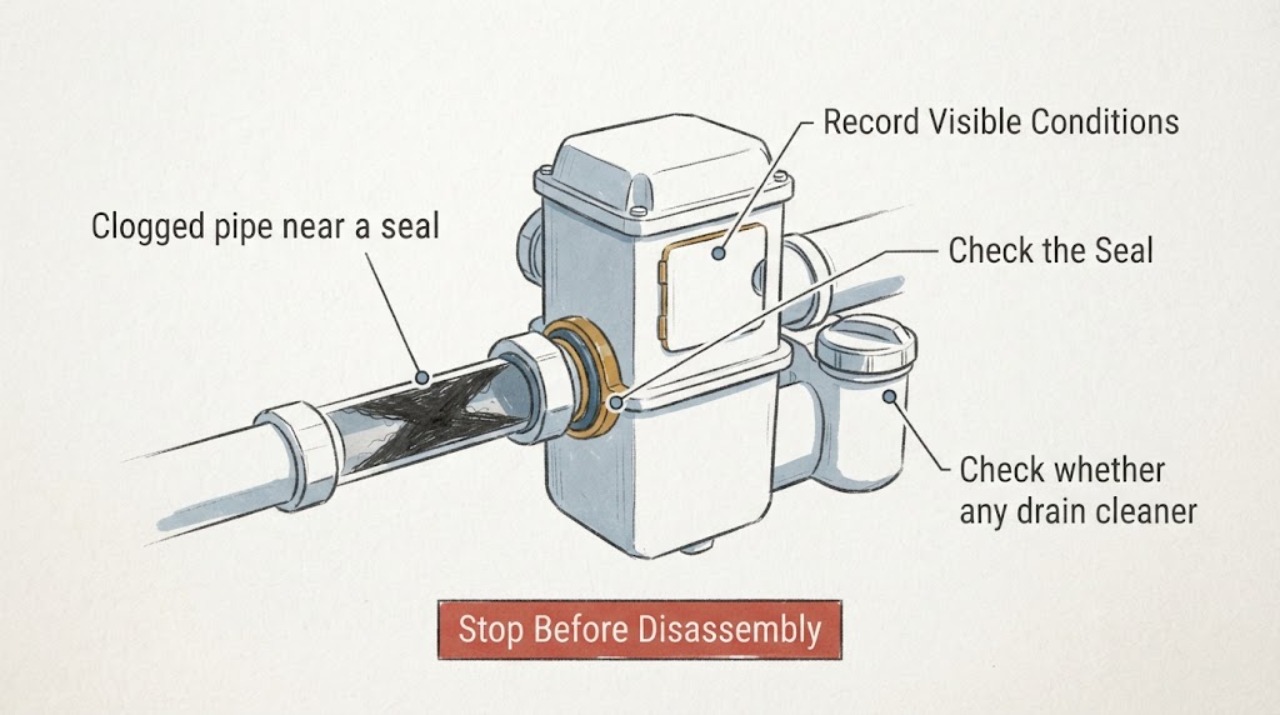
A pipe that seems clogged near a seal may have two different faults: restricted flow, a leaking or deformed joint seal, or both. First establish whether flow is slow or completely stopped and whether the problem is isolated to one fixture. Then inspect only accessible pipe and seal areas for the first wet point, swelling, corrosion, or sewage backup. Do not mix or add chemical drain cleaners, open a joint after chemicals were used, or force a pressurized seal; standing sewage, spreading water, chemical exposure, or water near electrics requires immediate stop and professional plumbing help.
Work through in order
Diagnostic checks
Use only checks that match the exact appliance or system and its official guide.
-
Check 1
Stop adding water and record whether the pipe is slow, fully blocked, gurgling, backing up, or leaking around a seal; note which fixture or branch is affected and whether other fixtures still flow.
Expected result: One fixture or branch with normal flow elsewhere suggests a local restriction. Several fixtures backing up together suggests a shared or main drain problem. A wet joint with normal flow suggests a seal leak that is not necessarily the blockage.
Next step: Continue with the dry external inspection for a localized symptom. If multiple fixtures back up, sewage rises, or the main line is suspected, stop using water and call a plumber.
Why this matters
Why: Scope and symptom timing separate a local pipe or fixture fault from a larger drainage problem and prevent treating a leaking seal as the sole cause.
-
Check 2
Dry the accessible pipe, coupling, trap, or fitting with a towel, then watch from a safe position while the affected fixture is used only enough to identify the first returning wet point; do not loosen the seal or connection.
Expected result: Water appearing at the seal or coupling points to a leak boundary. Water arriving from above or from inside the wall points elsewhere. No visible water with a slow drain supports a restriction without confirming that the seal is sound.
Next step: If the seal or joint is wet, stop using that fixture and arrange plumbing service. If the area stays dry but flow is poor, continue only with a non-chemical, accessible blockage check.
Why this matters
Why: The first wet point is more useful than the largest puddle and distinguishes a seal problem from water migrating along a pipe or cabinet surface.
-
Check 3
Check whether any drain cleaner, solvent, bleach, or other chemical was poured into the blocked pipe, and whether the product may still be present; do not touch pooled liquid or add another product.
Expected result: A chemical history changes the task from an ordinary clog to a chemical-exposure risk. Burning eyes or skin, breathing difficulty, fumes, or a container without a readable label requires immediate fresh-air and emergency or poison guidance.
Next step: Stop all mechanical opening attempts and tell the plumber the exact product and approximate time used. Seek immediate medical or poison assistance for exposure; do not try to neutralize the pipe yourself.
Why this matters
Why: EPA warns that household hazardous products can be corrosive or toxic and should not be poured down drains or mixed. MedlinePlus warns that drain cleaners can injure through swallowing, breathing, skin, or eye contact.
-
Check 4
If no chemical was used and the water level is safe, use only a gentle plunger on the accessible fixture opening with the correct cover or seal in place; stop if the joint, seal, or surrounding pipe starts to move or leak.
Expected result: Improved flow without new moisture supports a nearby soft blockage. No change, sudden backup, or a seal that distorts suggests a deeper restriction or a joint that needs professional handling.
Next step: Do not keep plunging a completely blocked shared line, a pipe with chemical history, or a leaking or moving seal. Call a plumber for a deeper blockage or joint repair.
Why this matters
Why: A plunger can address a simple accessible obstruction without opening the pipe, but force can worsen a weak seal or push contaminated water into an unwanted area.
-
Check 5
Inspect only exposed pipe and seal surfaces for corrosion, mineral deposits, swelling, a split gasket, displaced joint, or a recurring drip after the flow check; do not dismantle the pipe or apply a new seal over an active pressurized connection.
Expected result: A visible damaged seal can explain the leak but not necessarily the clog. A clean, dry seal with slow flow points more toward an internal restriction. A corroded or distorted joint may fail when disturbed.
Next step: Photograph the exposed condition and call a plumber for seal replacement, joint access, or pipe clearing. Do not open a concealed or pressurized section to prove the diagnosis.
Why this matters
Why: Seal condition and flow condition must be diagnosed separately; replacing a seal without clearing the restriction, or clearing a clog without repairing a leaking joint, leaves the problem unresolved.
-
Check 6
After the safe observations, document the affected fixture, flow result, first wet point, chemical history, and whether other fixtures back up; leave the pipe unused until the next step is clear.
Expected result: A local slow flow with a dry seal is an ordinary plumbing restriction branch. A local wet seal needs joint or fixture service. Multiple backups, sewage, or a recurring leak indicates a shared or main-line problem.
Next step: Call plumbing service for a persistent clog, damaged seal, recurring leak, or shared-line symptom. Treat chemical exposure, sewage contact, spreading water, or water near electrics as an urgent stop condition.
Why this matters
Why: A concise record gives the plumber the decision-changing facts without requiring the user to breach a seal or expose contaminated water.
Use your observations
Decision map
Find the observation that best matches what you see, then follow the next safe action.
-
PATH 01Next step
What you see
Only one fixture or pipe branch is slow, with normal flow elsewhere and no chemical history.
Do this next
Arrange qualified service and follow the exact model guidance.
Why this path and its safety boundary
Why it matters: Use one gentle, accessible plunger attempt if the seal is stable and dry; a persistent restriction needs a plumber.
-
PATH 02Next step
What you see
The seal or coupling becomes wet, drips, swells, or shifts while flow is used.
Do this next
Arrange qualified service and follow the exact model guidance.
Why this path and its safety boundary
Why it matters: Stop using the fixture and arrange plumbing service for the seal or joint; do not tighten or dismantle a pressurized connection.
-
PATH 03Next step
What you see
Several fixtures back up, sewage rises, or the main drain appears affected.
Do this next
Arrange qualified service and follow the exact model guidance.
Why this path and its safety boundary
Why it matters: Stop using water and call a plumber for a shared or main-line blockage; avoid pushing contaminated water through the system.
-
PATH 04Next step
What you see
A drain chemical was used, or fumes, burns, breathing difficulty, or an unknown pooled liquid is present.
Do this next
Arrange qualified service and follow the exact model guidance.
Why this path and its safety boundary
Why it matters: Do not plunge, open, mix, or neutralize the pipe. Keep people and pets away and obtain emergency or poison guidance and qualified plumbing help.
-
PATH 05Next step
What you see
Water reaches electrical equipment, the pipe or wall is moving, a leak spreads, or the blockage cannot be safely observed.
Do this next
Arrange qualified service and follow the exact model guidance.
Why this path and its safety boundary
Why it matters: Stop immediately, keep clear of wet electrics, isolate water only if safely identifiable, and request urgent professional help.
Helpful context
Understand the symptom
The word seal describes the leak boundary, not the cause of a clogged pipe. A softened, split, displaced, or corroded seal can let water escape while a separate restriction slows the flow. Conversely, a blocked pipe can raise local water or sewage levels and make an intact joint appear to leak. Find the first wet point before deciding which fault comes first.
Chemical drain products can leave a caustic liquid in a blocked pipe and make later opening unsafe. Keep the product container and tell the plumber what was used. Do not mix products or try to neutralize them with another household chemical.
Safety boundary
Stop conditions
- Stop immediately for sewage backup, spreading water, a wet wall or ceiling, a moving or split seal, water near electrical equipment, chemical fumes or burns, breathing difficulty, or an unknown liquid in the pipe.
- Do not mix drain chemicals, add a neutralizer, open a joint after chemicals were used, dismantle a pressurized pipe, force a seal, or use a chemical cleaner as a first response.
Only after diagnosis
Potential parts
- pipe joint gasket or seal
Consider only after a plumber identifies the leaking or deformed seal as the actual leak boundary.
Confirm pipe material, joint design, dimensions, and local requirements before selecting a seal; a generic part is not proven compatible by the symptom. - drain cleaning or access fitting
Consider only when a plumber confirms that an access point is appropriate for the pipe layout and blockage location.
Access fittings and installation methods depend on the existing pipe system and code; they are not a user-directed substitute for diagnosis.
Common questions
FAQ
Can a bad pipe seal cause a clog?
A damaged seal mainly explains leakage, while the clog may be a separate restriction. A distorted joint can also narrow the passage or collect debris, so diagnose the wet boundary and flow symptom separately.
Should I pour drain cleaner into a pipe with a leaking seal?
No. Chemical products can remain in a blocked pipe, injure people, damage materials, and make opening the seal dangerous. Do not mix products or open the pipe after chemical use; call a plumber.
How do I know whether the blockage is in the main line?
Several fixtures backing up together, sewage rising, or a shared drain failing points beyond one local fixture. Stop using water and arrange plumbing service instead of forcing the local seal or drain.
Read the exact guide
Official sources
- How to fix a faucet leakPortland Water Bureau · Finding a faucet-side leak and shutting off local water safely
- Drain cleaner poisoningMedlinePlus, U.S. National Library of Medicine · Drain-cleaner exposure and immediate safety guidance
- Household Hazardous Waste (HHW)U.S. Environmental Protection Agency · Household drain-cleaner and chemical handling guidance
- Water Pressure HelpEast Valley Water District · Localized fixture versus whole-home plumbing symptom isolation
Community feedback
Share a repair observation
Share a plain-text repair observation. Accepted observations are published automatically; this page may take a moment to update.