
On this page
Start here
Quick answer
A pipe that clogs again after the second rain may have a partial blockage that only becomes apparent during high flow, a private lateral or low-point restriction, or rainwater entering an overloaded or defective sewer system. First stay out of floodwater and record whether one indoor fixture, several low fixtures, the yard, or the street is affected. Do not open a manhole, enter a flooded area, use electrical equipment in standing water, or pour/mix chemical drain cleaners. Keep water use low, report suspected public sewer or storm-drain problems to the local utility, and arrange a licensed plumber for a private line, recurring backup, or any concealed blockage.
Before you begin
Safety first
- Do not enter floodwater, open manholes or cleanouts, dig or excavate saturated ground, use electricity in wet areas, touch sewage, mix or pour chemical drain products, or attempt to clear a pressurized, contaminated, unstable, or public pipe.
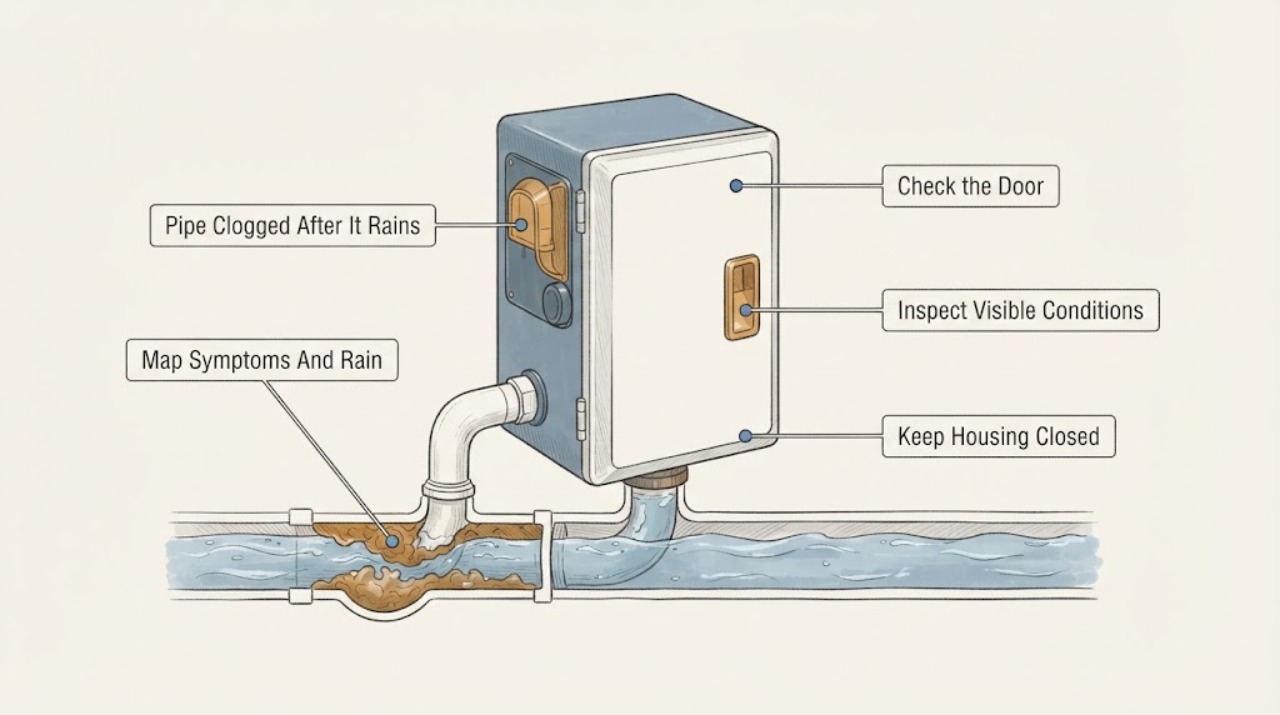
Work through in order
Diagnostic checks
Use only checks that match the exact appliance or system and its official guide.
-
Check 1
From dry, stable ground, record the time of the second-rain recurrence and map which fixture, floor level, yard drain, or street area is slow, blocked, or backing up; do not enter water.
Expected result: Classify the pattern as one indoor fixture, several fixtures on one branch, multiple low fixtures, exterior-only pooling, or indoor and exterior symptoms together; note whether it began during rain or after it stopped.
Next step: Stop unnecessary water use, photograph the pattern from a safe position, and contact a plumber and/or local utility according to whether the pattern is private or public.
Stop if: Do not walk into floodwater, touch sewage, enter a basement or low area with unknown water depth, or approach an open or submerged utility structure.
Why this matters
Why: One fixture supports a local branch or trap check. Several or low fixtures during rain raise a private lateral, shared sewer, surcharge, or flood-inflow concern; exterior-only pooling may be stormwater rather than a sanitary pipe clog.
-
Check 2
From a dry accessible position, look at sink, toilet, floor-drain, cleanout, and appliance drain points for standing water, reverse flow, visible overflow, or a dry fixture that is the first affected point; do not remove a cover.
Expected result: Record whether water rises when another fixture is used, a floor drain is the lowest overflow, a cleanout is wet, or only one fixture is blocked while the rest of the home drains normally.
Next step: Keep fixtures unused, isolate only known safe water sources if an active leak is present, and provide the location map to a licensed plumber or utility.
Stop if: Do not remove cleanout caps, enter a flooded basement, use a powered pump, or touch wet electrical equipment or contaminated water.
Why this matters
Why: Cross-fixture movement suggests a shared branch or downstream restriction. A low-point or cleanout overflow during rain is consistent with sewer backup or lateral surcharge; a single fixture points more locally but still may require a plumber if recurrent.
-
Check 3
From public space or your own dry property, observe whether a yard drain, catch basin, downspout, driveway, or street is ponding or flowing toward the building; do not lift a grate or enter the roadway.
Expected result: Record exterior-only pooling, a blocked visible grate, water flowing toward the foundation, sewage odor, water emerging from a cleanout, or no exterior abnormality.
Next step: Photograph the direction and location from a safe distance and report public assets to the local utility; ask a plumber to assess private drainage or service-line conditions.
Stop if: Do not remove a manhole or catch-basin grate, wade into moving water, enter a roadway, or work near submerged electrical equipment.
Why this matters
Why: Exterior-only ponding may be a stormwater or surface-drain problem. Water at a sanitary cleanout or foul backup during rain may involve a private lateral or public sewer; rainwater entering defective or inappropriate sewer connections can overload the system.
-
Check 4
Reduce water use while the line is blocked: postpone laundry, showers, dishwashing, and flushing unless necessary, and keep children and pets away from any backup.
Expected result: Record whether the level stabilizes when water use stops, continues rising, changes with neighborhood rain, or has sewage odor, solids, discoloration, or a chemical odor.
Next step: Report raw sewage or repeated rain-linked backup promptly, preserve photos and timing, and follow local public-health or cleanup guidance rather than attempting a chemical or electrical workaround.
Stop if: Do not touch sewage or chemical water, pour floodwater into another drain, use electrical equipment in wet areas, or mix drain products.
Why this matters
Why: A stable level after water use stops may limit immediate overflow but does not clear the restriction. Continuing rise or sewage characteristics increases the urgency for utility/plumber response and cleanup controls.
-
Check 5
Only from a safe, dry position, inspect visible interior pipe joints, under-sink traps, and accessible cleanout surroundings for a leak, displacement, root intrusion at an opening, or recent plumbing change; do not loosen or cut the pipe.
Expected result: Classify the visible path as dry and intact, leaking, displaced, blocked at a visible opening, recently altered, or concealed/unsafe to assess.
Next step: Keep the line unused and give the photos to a licensed plumber; ask whether a camera or non-invasive line assessment is appropriate for the exact property.
Stop if: Do not enter an excavation, dig into saturated soil, open a sewer cleanout under pressure, or work around gas, electrical, or structural damage.
Why this matters
Why: A visible private defect may explain a local recurring clog, but rain-linked recurrence can also be farther downstream or public. A concealed or unstable line needs professional locating rather than a guess at the obstruction.
-
Check 6
Give the local sewer or stormwater utility and a licensed plumber the recurrence date, rainfall timing, fixture map, photos, and whether neighbors or public areas show the same symptom; do not open public infrastructure yourself.
Expected result: Record whether the utility confirms a main, catch basin, or surcharge issue, whether the plumber identifies a private service-line or branch restriction, or whether the cause remains unconfirmed.
Next step: Follow the utility's incident instructions and the plumber's safe access plan; retain work records, photos, and any public report number for recurrence tracking.
Stop if: Do not promise that a public report clears private responsibility, excavate, open a manhole, or use a chemical or electrical workaround while waiting.
Why this matters
Why: A confirmed public issue and a private service-line issue have different responsible parties and repair paths. An unconfirmed cause after a second rain still warrants professional assessment because intermittent loading can hide a partial blockage or defect.
-
Check 7
After qualified service or a utility response, document which line or structure was cleared or repaired, the rain and flow conditions when it was tested, and whether any contaminated material contacted the building.
Expected result: Record no recurrence during comparable rain, recurrence at one indoor point, recurrence across low fixtures, or a new leak/backup after the intervention.
Next step: Escalate a second recurrence with the previous work record and exact rainfall timing to the same plumber and utility; arrange professional cleanup for sewage or flood contamination.
Stop if: Do not re-enter contaminated or structurally unsafe areas to inspect the result, restore electricity to wet equipment, or repeat an unapproved chemical treatment.
Why this matters
Why: No recurrence supports the identified cause but does not prove a permanent solution; recurrence may indicate an unresolved private lateral, public surcharge, inflow connection, root/structural defect, or inadequate capacity.
Use your observations
Decision map
Find the observation that best matches what you see, then follow the next safe action.
-
PATH 01Safety boundary
What you see
Only one indoor fixture is slow or blocked, other fixtures drain normally, and there is no sewage overflow or unsafe water.
Do this next
Keep use low and arrange a licensed plumber for a recurring or concealed clog; use only a safe, model-appropriate visible check and do not mix chemicals.
Why this path and its safety boundary
Why it matters: A local trap, branch, fixture, or private pipe restriction is more likely than a public sewer surcharge, although the rain timing may expose a partial downstream clog.
Safety stop: Stop for rising water, sewage, a leak, or any need to loosen a concealed or pressurized connection.
-
PATH 02Safety boundary
What you see
Several fixtures, a floor drain, or a basement/low-level outlet backs up during or after rain.
Do this next
Stop unnecessary water use, keep people away, contact the local utility and a licensed plumber, and provide the rain-linked fixture map.
Why this path and its safety boundary
Why it matters: A private lateral, shared sewer, public surcharge, blockage, break, or rainwater inflow is plausible; continued water use can worsen the backup.
Safety stop: Do not enter floodwater, remove cleanout or manhole covers, use electricity in the area, or touch sewage.
-
PATH 03Safety boundary
What you see
Only the yard, street, catch basin, or surface drain ponds while indoor sanitary fixtures continue to drain normally.
Do this next
Report a public blockage to the local utility and observe from safe ground; ask a plumber or drainage professional to assess private yard or foundation drainage if water reaches the building.
Why this path and its safety boundary
Why it matters: The immediate issue may be stormwater conveyance or surface drainage rather than an indoor sanitary pipe clog.
Safety stop: Do not lift a grate, enter moving water, block a public drain, or work near submerged electrical equipment.
-
PATH 04Safety boundary
What you see
Raw sewage, foul backup, solids, contaminated floodwater, or a chemical product is present indoors or near the pipe.
Do this next
Keep people and pets away, stop water use, contact the utility/plumber and appropriate public-health or emergency guidance, and arrange professional cleanup.
Why this path and its safety boundary
Why it matters: This is a health and exposure event, not a normal drain-clearing task; sewage can carry pathogens and chemical water can injure anyone opening a line.
Safety stop: Do not touch, pump, plunge, mix chemicals, use electrical equipment in wet areas, or enter contaminated water.
-
PATH 05Safety boundary
What you see
The pipe clogs again after the second rain or after a prior clearing, especially with no clear indoor obstruction.
Do this next
Give the prior work record and exact rain timing to the plumber and utility and ask for a professional line assessment; do not keep repeating chemical or improvised clearing.
Why this path and its safety boundary
Why it matters: A partial or structural private-line restriction, rainwater inflow, root/defect, public surcharge, or capacity issue may remain.
Safety stop: Stop for rising sewage, structural movement, an unsafe excavation, or any need to open a public or flooded structure.
Helpful context
Understand the symptom
Treat the second rain as a timing clue, not proof of one cause
A recurrence after rainfall suggests that flow, groundwater, surface runoff, or a partially restricted line may be changing the symptom, but the condition alone cannot identify a clog. A single sink, toilet, or floor drain that slows while other fixtures work is more consistent with a local branch or trap. Several fixtures, especially at a low level, backing up at the same time as heavy rain points toward a private lateral, shared sewer, or surcharge. A wet yard or street with normal indoor drainage can instead be a stormwater or surface-drain issue.
Separate private plumbing from public sewer or stormwater problems
EPA lists blockages, breaks, and stormwater or groundwater entering defective sewer lines among causes of sanitary sewer overflows. A public utility can determine whether the main or a catch basin is affected; a licensed plumber can assess the private service line and indoor branch. Do not assume that a public report replaces private diagnosis, and do not open a cleanout or manhole when it is flooded, unstable, contaminated, or not clearly yours.
Floodwater and sewage change the safe response
Rain-related backup can contain sewage and germs. If water is brown, foul-smelling, or coming from a floor drain or low fixture, keep people and pets away, reduce water use, and avoid direct contact. Do not use electricity or powered pumps in standing water, and do not send floodwater through sinks or toilets. Photograph conditions from dry ground and provide the timing, locations, and rain event to the utility, insurer, or plumber.
Only after diagnosis
Potential parts
- drain cleanout cap or seal
Consider only after a licensed plumber confirms a damaged or missing private cleanout cap or seal is contributing to the recurrence or leak.
Confirm pipe size, thread/seal design, location, and local plumbing requirements; do not open a flooded or pressurized cleanout yourself. - private drain-line section or fitting
Consider only after professional locating confirms a cracked, collapsed, displaced, or improperly routed private section.
Material, diameter, pitch, bedding, venting, access, and permits are site-specific; a recurring rain-linked clog is not enough to select a replacement. - backwater protection device
Consider only after a qualified professional and local authority determine that backflow protection is appropriate for the property's system and drainage conditions.
Sizing, location, maintenance, permits, and compatibility with private and public drainage must be confirmed for the exact property.
When checks do not resolve it
Need a professional?
Arrange a licensed plumber when one pipe repeatedly clogs after rainfall, when a partial or concealed blockage is suspected, when multiple fixtures or a low-level drain back up, or when a private service line needs assessment. Contact the local sewer/stormwater utility for public-area flooding, catch-basin or main issues. Treat sewage, floodwater, water near electricity, structural instability, or a chemical-exposed line as urgent safety conditions.
Safety scope: Do not enter floodwater, open manholes or cleanouts, dig or excavate saturated ground, use electricity in wet areas, touch sewage, mix or pour chemical drain products, or attempt to clear a pressurized, contaminated, unstable, or public pipe.
Have this ready
- Provide the exact condition (after it rains for the second time), rainfall timing, fixture and floor-level map, first overflow point, indoor/outdoor photos from safe ground, whether neighbors or the street are affected, recent plumbing work, prior clearing records, chemical exposure, and any electrical or structural warning.
Common questions
FAQ
Why does a pipe clog after it rains for the second time?
The repeat timing may expose a partial private blockage, a low-point or lateral restriction, rainwater entering a defective connection, or a public sewer surcharge. Timing is a clue, not proof; map which fixtures are affected and involve the utility and a licensed plumber.
How can I tell a local pipe clog from sewer backup?
One fixture with normal drainage elsewhere points more locally. Several fixtures or low-level drains backing up during rain, especially with outdoor or neighbor symptoms, raises a private-lateral or public-sewer concern. Do not open a cleanout or manhole to confirm.
Should I enter standing water to clear the pipe?
No. Stay out of floodwater or sewage, keep people and pets away, and avoid electricity or powered equipment in wet areas. Photograph from dry ground and arrange utility, plumbing, and cleanup help.
Can I open a manhole or cleanout after heavy rain?
No. A flooded, pressurized, unstable, corroded, public, or unknown structure should be handled by a licensed plumber or utility. Opening it can expose you to sewage, moving water, structural hazards, or a sudden release.
What information should I give the plumber or utility?
Give the second-rain timing, affected fixtures and floor levels, first overflow point, indoor/outdoor and neighbor observations, photos from a safe position, recent work, previous clearing, and any sewage, chemical, electrical, or structural warning.
Read the exact guide
Official sources
- Sanitary Sewer Overflow (SSO) Frequent QuestionsU.S. Environmental Protection Agency · General U.S. sanitary-sewer guidance; not a site-specific diagnosis.
- Sanitary Sewer Overflows (SSOs)U.S. Environmental Protection Agency · General U.S. sewer-system context; local utility rules and property boundaries vary.
- Sewer BackupsNew York City Department of Environmental Protection · New York City example of utility/private responsibility; use the local authority for the property location.
Community feedback
Share a repair observation
Share a plain-text repair observation. Accepted observations are published automatically; this page may take a moment to update.