
On this page
Start here
Quick answer
If a household drain pipe is clogged, stop adding water and first determine whether one fixture is slow or several fixtures are backing up. For a single sink, tub, or utility drain with no chemical already added, remove accessible debris and use the correct plunger while covering an overflow opening. Do not mix drain products, plunge or open a pipe that may contain corrosive cleaner, or keep using a fixture that is backing up with sewage. If more than one fixture is affected, water rises elsewhere, the blockage returns, there is a leak, or safe external checks fail, stop and arrange qualified plumbing service.
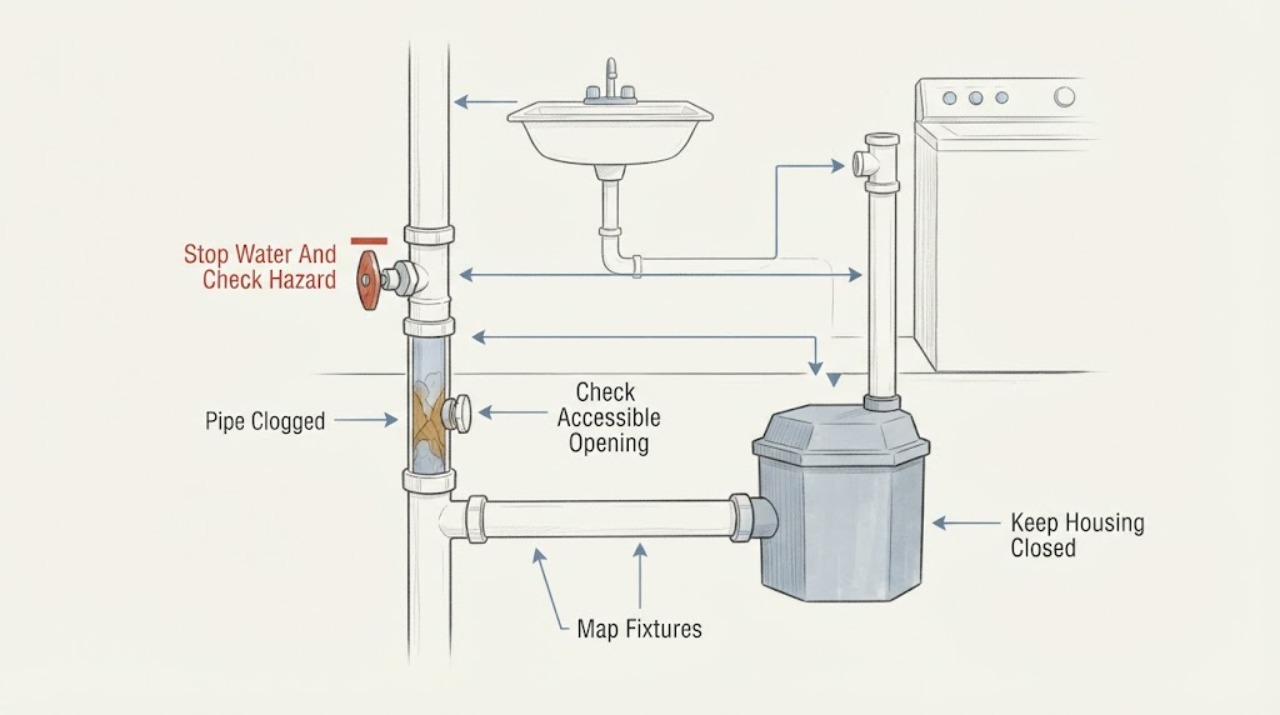
Work through in order
Diagnostic checks
Use only checks that match the exact appliance or system and its official guide.
-
Check 1
Stop using the affected fixture and look from a dry, safe position for sewage, rapidly rising water, a leak, chemical residue, strong fumes, or water near electrical equipment. Do not touch standing water if its contents are unknown.
Expected result: There is sewage, uncontrolled water, a visible leak, chemical residue or fumes, or water near electricity; or the blockage is contained and no immediate hazard is visible.
Next step: If a hazard is present, keep people away, stop adding water, and arrange emergency, utility, poison-center, or qualified plumbing help as appropriate. If no hazard is visible, continue without opening the pipe.
Stop if: Stop immediately for chemical fumes, skin or eye exposure, sewage overflow, uncontrolled leakage, or water near electrical equipment.
Why this matters
Why: A backup or chemical exposure can spread contamination or cause injury, and water near electricity adds a shock risk. A contained, non-chemical blockage permits only low-risk external checks.
-
Check 2
Without running more water than needed, check whether the problem is limited to one sink, tub, shower, or utility drain, or whether other fixtures are slow, gurgling, or backing up. Ask whether a toilet changes when another fixture drains.
Expected result: Only one fixture is affected; several fixtures share the symptom; or water appears at a lower drain when an upper fixture is used.
Next step: For one fixture, continue with the external strainer and plunger checks. For multiple fixtures, stop water use and arrange qualified plumbing assessment for the shared line.
Why this matters
Why: A single affected fixture is more consistent with a local blockage. Several connected symptoms or a lower drain backup suggest a shared or farther-downstream obstruction and are not a good target for repeated plunging at one fixture.
-
Check 3
At a single affected drain, remove only a loose, visible stopper or strainer that can be lifted without tools, and look for hair, food, wipes, or other material at the opening. Do not poke deeper, disassemble a trap, or remove a fitting if any chemical opener may be present.
Expected result: An obstruction is visible at the opening; the opening is clear; or chemical product was used and the pipe contents are uncertain.
Next step: If safe, remove only the loose visible material and refit the strainer. If the opening is clear or chemical use is uncertain, do not escalate to pipe removal; use the service branch.
Why this matters
Why: A visible local obstruction may explain a slow drain, but a clear opening does not rule out a deeper blockage. Unknown chemical residue makes splash and contact hazards more important than further home clearing.
-
Check 4
For a single sink or similar drain with no chemical product present, remove excess standing water if it can be done safely, seal the overflow opening with a wet cloth, and place the appropriate plunger over the drain. Use controlled strokes according to the tool instructions; do not use force that could damage the fixture.
Expected result: Water begins to move and then drains; the level does not change; water appears at another fixture; or splash exposes an unknown substance.
Next step: If flow returns, flush only with a modest amount of clean water and watch for leakage or recurrence. If there is no improvement, another fixture backs up, or chemical residue is possible, stop and arrange qualified service.
Stop if: Do not plunge after using a chemical opener or if the water may be corrosive.
Why this matters
Why: Improvement supports a local, movable blockage but does not prove the pipe is fully clear. No movement or a new backup elsewhere suggests a deeper or shared obstruction. Chemical splash changes the task to exposure safety.
-
Check 5
If the fixture is a single drain, no chemical has been used, and the tool instructions support it, consider a suitable hand drain snake only from the accessible opening. Do not force the tool, drill into a wall, enter a cleanout you cannot identify, or use powered equipment without training.
Expected result: The snake meets light resistance and flow improves; it stops immediately or cannot reach the obstruction; or the blockage returns after a temporary improvement.
Next step: Stop at resistance or recurrence, protect the area from discharge, and provide the result to a qualified plumber. Do not combine mechanical work with a chemical opener.
Why this matters
Why: A hand tool may reach a local obstruction, but resistance, an inaccessible line, or recurrence can indicate a deeper blockage, damaged pipe, root intrusion, or a shared-line issue that cannot be diagnosed from the opening.
-
Check 6
After a safe mechanical attempt, add only a small amount of clean water while watching the fixture, nearby joints, cabinet, floor, and any lower drain. Do not run a full appliance cycle or release a large volume of water to test a questionable line.
Expected result: The water drains normally with no leak; it drains slowly or returns; a joint leaks; or water backs up at another fixture.
Next step: Stop using the line and arrange qualified plumbing service for any leak, recurrence, or cross-fixture backup. If flow is normal, use a strainer and avoid grease, solids, wipes, and other unsuitable waste.
Why this matters
Why: A normal, leak-free result supports a temporary local clearance but does not guarantee the line will stay open. Slow return, leakage, or cross-fixture backup indicates unresolved plumbing work and possible property or sanitation damage.
-
Check 7
If a drain-opening product was poured into the pipe or splashed during an attempt, stop all clearing work, move to fresh air if fumes are present, and follow the product label and local emergency or poison-center guidance. Do not add vinegar, bleach, another opener, or any neutralizing mixture.
Expected result: There is eye or skin contact, breathing difficulty, severe pain, vomiting, or no exposure symptom but chemical remains in the pipe.
Next step: For exposure symptoms, seek urgent medical help and provide the product name if known. For residue without symptoms, isolate the fixture and tell the plumber exactly what product and amount were used; do not continue mechanical clearing.
Stop if: Stop all hands-on plumbing work after chemical use until a qualified professional confirms a safe approach.
Why this matters
Why: Exposure symptoms need medical guidance; an apparently symptom-free drain can still contain corrosive liquid that may splash during plunging or disassembly.
Use your observations
Decision map
Find the observation that best matches what you see, then follow the next safe action.
-
PATH 01Next step
What you see
There is sewage overflow, uncontrolled water, chemical fumes or residue, exposure symptoms, or water near electrical equipment.
Do this next
Keep people away, stop adding water, move to fresh air if fumes are present, and use emergency, poison-center, utility, or qualified plumbing help as appropriate; do not plunge or open the pipe.
-
PATH 02Next step
What you see
One fixture is slow or blocked, no chemical was used, and there is no leak or immediate hazard.
Do this next
Use the appropriate plunger with the overflow covered, or a suitable hand snake only within its instructions; stop if flow does not improve or the blockage returns.
-
PATH 03Next step
What you see
Several fixtures are affected, a lower drain backs up, or one fixture changes when another is used.
Do this next
Stop water use and arrange qualified plumbing assessment for the shared or downstream line instead of repeating a local plunger attempt.
-
PATH 04Next step
What you see
Any drain opener or other chemical product has been used and the pipe may still contain it.
Do this next
Do not mix products, plunge, snake, or remove a trap; isolate the fixture and disclose the product to a qualified plumber. Use medical or poison-center help for exposure symptoms.
-
PATH 05Next step
What you see
Flow returns after a safe mechanical check and no leak or cross-fixture backup appears.
Do this next
Use the fixture cautiously, monitor for recurrence, and prevent new debris or grease from entering. Recurrence still warrants a plumbing assessment.
-
PATH 06Next step
What you see
The pipe remains blocked, drains only temporarily, leaks at a joint, or the obstruction cannot be reached safely.
Do this next
Stop using the fixture and request qualified plumbing service; do not escalate to powered equipment, wall access, or fitting removal.
Helpful context
Understand the symptom
First identify the kind of blockage
A slow sink, tub, shower, or utility drain may have a local obstruction near that fixture. If several fixtures are slow, a toilet backs up when another fixture runs, or water appears at a floor drain, the obstruction may be farther along the shared waste line. A clogged water-supply pipe is a different problem; this guide is for a household drain or waste pipe, not for cutting into a pressurized water line.
Use mechanical checks before chemicals
Do not mix drain products, add another product after a chemical opener, or put your face over a drain. If a drain opener has already been poured in, keep people away from splash and fumes and do not plunge, remove a trap, or snake the pipe until a qualified professional gives safe instructions. Drain-opening agents can burn skin, eyes, throat, and airways.
What to record for a plumber
Record which fixture is affected, whether it is slow or fully blocked, whether other fixtures change when water runs, what entered the drain, whether a chemical product was used, whether there is standing water or sewage, and whether the problem returns after clearing. Photos taken from a dry, safe position and the pipe or fixture location help establish scope without opening the plumbing.
Safety boundary
Stop conditions
- Do not mix drain products, add chemicals to a blocked line, plunge or dismantle a pipe after chemical use, enter a crawlspace or wall, or use powered drain equipment without appropriate training.
- Stop for sewage, uncontrolled water, chemical fumes, breathing difficulty, eye or skin exposure, water near electricity, or any unsafe access condition.
When checks do not resolve it
Need a professional?
Use qualified plumbing service when the blockage is shared, deep, recurrent, leaking, contaminated, chemically treated, or not safely reachable from the fixture opening.
Have this ready
- Provide the affected fixture and location, single-versus-multiple-fixture pattern, slow or complete blockage, water or sewage behavior, visible leaks, what entered the pipe, any chemical product used, and which safe mechanical checks changed the flow.
Common questions
FAQ
Should I use a chemical drain opener on a clogged pipe?
Do not make it the first step, and never mix products. Chemical openers can cause serious burns and breathing injury; if one has already been used, do not plunge, snake, or open the pipe until a qualified professional gives safe instructions.
Why does a clogged pipe affect more than one fixture?
Several slow drains, a lower drain backup, or one fixture changing when another runs can indicate an obstruction in a shared or downstream line rather than only at one drain opening. Stop water use and arrange plumbing assessment.
Can I plunge a single clogged sink?
For a single sink or similar drain with no chemical product present, an appropriate plunger and a covered overflow opening are reasonable low-risk checks. Stop if there is no improvement, another fixture backs up, a leak appears, or the water may contain a chemical.
What should I do if a drain opener splashes on me?
Move away from fumes and seek urgent medical guidance. For skin or eye contact, flush with plenty of water as directed by medical or poison-center guidance; do not induce vomiting after swallowing unless a medical professional tells you to.
Read the exact guide
Official sources
- Advice about blocked sinks and toiletsCity of York Council · Council household plumbing guidance on blocked sinks, plunger use, and distinguishing one fixture from a wider issue
- Drain opener poisoningMedlinePlus, U.S. National Library of Medicine · Government health guidance on drain-opening chemical exposure and first-response boundaries
- How to Care for Your Septic SystemU.S. Environmental Protection Agency · EPA septic and household drain guidance, including avoiding chemical drain openers for a clogged drain and using a drain snake; septic-specific applicability is stated
Community feedback
Share a repair observation
Share a plain-text repair observation. Accepted observations are published automatically; this page may take a moment to update.