
On this page
Start here
Quick answer
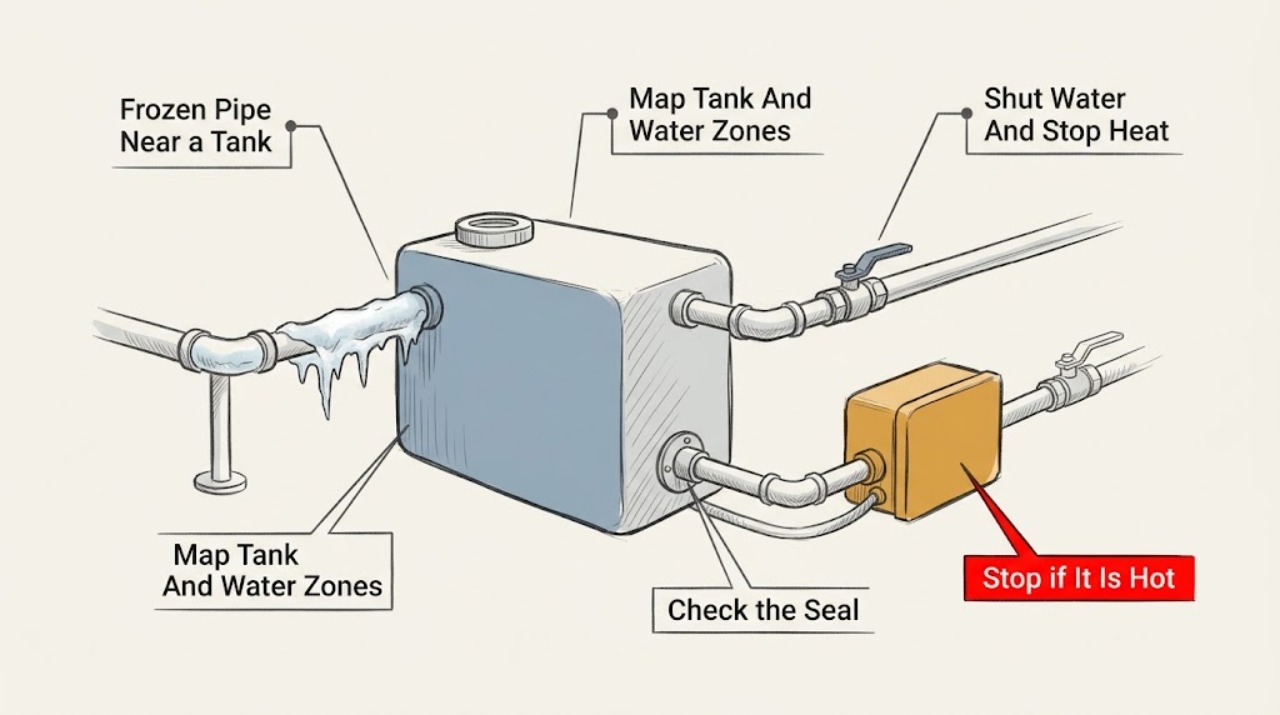
If a pipe serving or near a tank is frozen, shut off the water before attempting any thawing and keep the tank and pipe area under observation. A dry floor does not prove the pipe is intact: ice can hide a split until water begins moving again. Separate a tank inlet or outlet pipe from the tank itself, and separate one frozen fixture from a whole-building loss of water. Do not use a torch, open flame, heat gun, boiling water, or a powered device near standing water; do not heat a sealed section or restore pressure abruptly. If the pipe is hidden, the tank or its controls have been wet, the shutoff cannot be operated safely, a crack or leak appears, or the freeze is on a service line or meter, stop and call a licensed plumber or the water provider. When a known, exposed section has thawed safely and remains dry, restore water very slowly while watching every accessible tank connection.
Before you begin
Safety first
- This article supports dry, ordinary-access observation and safe isolation only. It does not authorize flame or concentrated heat, electrical equipment near water, tank or meter access, pressurized fitting work, wall access, or internal tank service.
Work through in order
Diagnostic checks
Use only checks that match the exact appliance or system and its official guide.
-
Check 1
Stop all active thawing, shut off the water at the main or the known local isolation valve from a dry position, and keep clear of any tank controls, electrical equipment, fuel-burning heater, or open flame.
Expected result: Record whether the water is isolated, whether the floor or tank area is dry, whether standing water is present, and whether the prior heat source was a torch, flame, heat gun, boiling water, hair dryer, heater, heating pad, or other device.
Next step: Leave the area for smoke, fire, gas or fuel odor, or electrical danger; otherwise keep the water off and prepare a dry, visual inspection only.
Stop if: Do not resume open-flame thawing, use a heat gun or boiling water, operate a powered device in standing water, or touch wet electrical or tank controls.
Why this matters
Why: A pipe may already be cracked even when frozen, and standing water can create electric-shock risk. Open flame or concentrated heat can cause fire or pipe damage; an unsafe or unavailable shutoff means the freeze is not a safe ordinary-access project.
-
Check 2
From a safe, dry position, compare water at other fixtures and identify whether the suspected pipe is a tank inlet, tank outlet, nearby branch, main service, or a line feeding one fixture; do not disturb the tank or meter.
Expected result: Classify the outage as one faucet or one side of a fixture, one room or branch, the tank-adjacent area only, or the whole building; note whether other cold and hot outlets have normal flow, a trickle, or no flow.
Next step: Use the affected zone and tank relationship to guide the plumber or water provider, and inspect only exposed, reachable pipe sections.
Stop if: Do not open a tank enclosure, disturb a meter, enter a wet crawl space, or create wall or ceiling access to chase the freeze.
Why this matters
Why: A single fixture or one side supports a local branch or nearby freeze. A room or branch outage supports a shared line. Whole-building loss points toward the main service, meter, building shutoff, or utility; it is not established as a tank-connection fault.
-
Check 3
Inspect exposed pipe, valve, and tank-connection surfaces without removing insulation, fittings, covers, or panels; use a flashlight from outside the wet area and do not touch a wet electrical enclosure.
Expected result: Look for frost, a split or bulged section, a displaced joint, damp insulation, staining, a drip, or no visible abnormality at the tank inlet, outlet, nearby valve, and accessible branch.
Next step: Photograph the condition and call a plumber for any damage, inaccessible section, wet tank control, or uncertain connection; do not apply more heat to improve visibility.
Stop if: Do not cut walls, strip insulation, loosen tank fittings, squeeze pipe, move the tank, or test live electrical components.
Why this matters
Why: Frost or no visible moisture does not rule out a hidden break. A crack, bulge, or seep indicates that water should remain isolated while the damaged section is repaired; a normal-looking surface moves the issue toward a hidden freeze, valve, meter, or internal tank fault.
-
Check 4
Observe the tank exterior, drain pan, floor, visible controls, and supply connections from a dry position; keep the tank's power or fuel controls in the state specified by its manual and do not open access covers.
Expected result: Record whether the tank is wet, its pan contains water, insulation or controls show water exposure, the inlet or outlet is frozen, the tank is empty or pressure appears abnormal, or there is no external tank symptom.
Next step: Keep the water and any affected energy supply isolated as the equipment manual or professional directs, and request tank or plumbing service for any wet, leaking, empty, or abnormal condition.
Stop if: Do not energize a tank that is empty or wet, remove access covers, adjust a thermostat or relief device, relight fuel equipment, or drain a hot tank.
Why this matters
Why: Water exposure, a wet control area, a leaking tank, or an empty tank can create separate equipment and scald or electrical hazards. No tank symptom with a local dry pipe supports a branch-line freeze rather than proving the tank is unaffected internally.
-
Check 5
After the heat has stopped and the accessible area is cool and dry, observe whether the pipe warms naturally or the flow changes; do not add concentrated heat, pressurize the line, or leave a faucet or drain open without supervision.
Expected result: Note whether flow remains absent, returns as air or a trickle, returns normally, or is followed by water at a pipe, valve, tank connection, wall, ceiling, or floor.
Next step: Keep the water off for a leak or uncertain result and call a plumber; only a known, exposed, intact section with stable dry surroundings may proceed to a slow restoration check.
Stop if: Do not restore pressure to a leaking or unknown line, leave the area while thawing, or continue if water approaches electrical equipment.
Why this matters
Why: A returning trickle may indicate a partially clearing restriction, not a sound pipe. A leak after warming supports a burst or split; no flow can mean a second freeze or inaccessible blockage. Any abnormal result requires isolation and service.
-
Check 6
Only when the known exposed line is thawed, the tank area is dry, no damage is visible, and the shutoff operates safely, open the water supply a small amount and watch the pipe, tank joints, floor, pan, and adjacent surfaces continuously.
Expected result: Record whether pressure and flow return without seepage, a joint begins to drip, a split opens, the tank pan fills, water appears from a hidden area, or the faucet remains dry.
Next step: Close the supply again for any leak or hidden moisture and call a plumber; if stable, leave the area protected from refreezing and monitor for recurrence.
Stop if: Do not fully reopen the supply abruptly, leave a leak unattended, operate a wet tank, or use a temporary clamp or seal as a permanent repair.
Why this matters
Why: Dry stable restoration supports a temporary freeze, but continued monitoring is still needed. Any seepage confirms damage or a failed connection; persistent no flow points to another freeze, valve, meter, or tank fault.
-
Check 7
Prepare a service record with the tank type and location, affected fixtures, pipe route, freeze conditions, heat method already used, shutoff status, flow changes, photographs, and every leak or safety symptom.
Expected result: Confirm whether the frozen section is hidden, in a service line or meter area, inside a wall, close to tank controls, or suspected to be cracked; note whether the property is a single dwelling or shared building.
Next step: Call a licensed plumber or water provider with the record and keep the water isolated until the professional confirms a safe restoration sequence.
Stop if: Do not make a new access opening, apply more heat, remove a tank panel, or keep reopening the shutoff to repeat the symptom.
Why this matters
Why: An inaccessible or shared-system freeze needs the responsible plumber, property manager, or water provider. A suspected cracked line or wet tank equipment should not be repeatedly tested by the occupant.
Use your observations
Decision map
Find the observation that best matches what you see, then follow the next safe action.
-
PATH 01Safety boundary
What you see
Only one faucet, one side of a fixture, or one tank-adjacent branch has no water while other fixtures work.
Do this next
Inspect only exposed dry pipe and joints, keep the shutoff ready, and call a plumber if the line is damaged, hidden, or still blocked.
Why this path and its safety boundary
Why it matters: A local supply line, valve, tank inlet or outlet, or nearby frozen section is plausible.
Safety stop: Do not open tank fittings or apply concentrated heat to the local branch.
-
PATH 02Safety boundary
What you see
The tank and multiple fixtures, a whole building, or the main service have no water.
Do this next
Keep water isolated if damage is suspected and contact the water provider, property manager, or licensed plumber without disturbing the meter or service line.
Why this path and its safety boundary
Why it matters: A building shutoff, service line, meter, shared system, or utility condition is more likely than a single tank connection.
Safety stop: Do not thaw or access a meter, main service, or shared line yourself.
-
PATH 03Safety boundary
What you see
Water is in the tank pan or around controls, a tank connection is split, or a tank or its insulation has been exposed to water.
Do this next
Keep the water and affected energy supply isolated as safely directed and arrange qualified plumbing or tank service.
Why this path and its safety boundary
Why it matters: The equipment may have a leak, electrical or fuel hazard, or damage beyond a simple frozen branch.
Safety stop: Do not energize, relight, open, drain, or reset wet or damaged tank equipment.
-
PATH 04Safety boundary
What you see
A crack, seep, drip, or flooding appears as the pipe or tank connection warms or water pressure returns.
Do this next
Close the main or local shutoff if it can be operated safely from a dry position and call a plumber; keep clear of wet electrical equipment.
Why this path and its safety boundary
Why it matters: The freeze likely caused or revealed a failed pipe, joint, valve, or tank connection.
Safety stop: Do not reopen the supply, continue thawing, or rely on tape, clamps, or sealant as a permanent repair.
-
PATH 05Safety boundary
What you see
A known exposed section is thawed, the tank and joints are dry and intact, and slow restoration produces stable flow with no leak.
Do this next
Monitor the line and tank area, protect exposed piping from cold, and call a plumber if flow falls again or any moisture appears.
Why this path and its safety boundary
Why it matters: The immediate blockage may have cleared, but another freeze or hidden damage can still develop.
Safety stop: Do not leave the supply unattended during the first restoration or use the result as proof that hidden pipe damage is impossible.
-
PATH 06Safety boundary
What you see
The frozen section is hidden or inaccessible, the shutoff is seized or unreachable, standing water is present, or flame, fuel, fire, or electrical risk exists.
Do this next
Leave the hazard area and contact emergency services, a licensed plumber, the water provider, or the property manager from a safe location.
Why this path and its safety boundary
Why it matters: The situation exceeds safe ordinary-access troubleshooting.
Safety stop: Do not apply heat, open walls, enter wet spaces, touch electrical equipment, or restore water.
Helpful context
Understand the symptom
A tank connection changes the leak risk, not the safe sequence
A tank may be a water heater, storage tank, expansion tank, or another vessel supplied by a pipe. The frozen part may be the inlet, outlet, nearby branch, or a line in an unheated space rather than the tank shell. Identify the pipe relationship from the outside and use the equipment manual for any tank-specific control. Do not open the tank, remove insulation, or energize equipment that has been exposed to water.
Why the pipe can leak only after it warms
Freezing water expands and can stress metal or plastic pipe. Ice can block flow while also keeping a crack from visibly releasing water. Once the line warms or the main supply is reopened, water may escape at a split, joint, valve, or tank connection. That is why the main shutoff must be ready before thawing and why the first returning flow should be treated as a controlled leak check.
Unknown and inaccessible freezes belong with a plumber
If the frozen section is behind a wall, in a ceiling, under a slab, in a meter area, or close to tank controls, do not create access or apply concentrated heat. Safe public guidance consistently points to professional help when the location cannot be found or accessed, and to caution around standing water and electrical equipment.
Safety boundary
Stop conditions
- Stop for a burst or leaking pipe, flooding, water near electrical equipment, a wet tank control, smoke, fire, gas or fuel odor, or a hot or damaged device.
- Never use a torch, open flame, kerosene or propane heater, charcoal stove, heat gun, boiling water, or other concentrated heat to thaw a pipe.
- Do not use powered equipment in standing water, enter an inaccessible wet space, or touch electrical equipment while standing in water.
- Do not open a tank, meter, wall, ceiling, or pressurized fitting; do not remove insulation, tank panels, relief devices, or service-line components.
- Do not restore water abruptly or leave a thawing line unattended; a frozen pipe may reveal a crack only after it warms.
- Do not energize, relight, drain, or reset a tank that is empty, wet, damaged, or exposed to water.
When checks do not resolve it
Need a professional?
Call a licensed plumber when the frozen section is hidden or inaccessible, the tank or its connections are wet or damaged, water is absent from multiple fixtures, the main service or meter may be frozen, the shutoff cannot be operated safely, or any leak appears during thawing or slow restoration. Contact the water provider or property manager for a shared or service-line problem. Use emergency services for fire, gas or fuel odor, flooding, or immediate electrical danger.
Safety scope: This article supports dry, ordinary-access observation and safe isolation only. It does not authorize flame or concentrated heat, electrical equipment near water, tank or meter access, pressurized fitting work, wall access, or internal tank service.
Common questions
FAQ
Can a frozen pipe near a tank be cracked even if there is no leak yet?
Yes. Ice can block water and hide a split until the line warms or water pressure returns. Keep the shutoff ready, inspect only exposed dry sections, and watch the tank connections carefully during any safe slow restoration.
Can I use a torch, heat gun, or boiling water to thaw a tank pipe?
No. Do not use open flame or concentrated heat, and do not use powered equipment near standing water. Stop the heat treatment, isolate water, and call a plumber when the line is inaccessible, damaged, or close to electrical or tank controls.
How do I know whether the tank or the pipe is the problem?
Compare other fixtures and identify whether the outage is local, one branch, or whole-building. Inspect the tank exterior and accessible inlet or outlet only from a dry position. A wet tank, empty tank, damaged connection, or whole-system outage needs qualified plumbing or equipment service rather than a guessed pipe repair.
What should I do when water returns after a freeze?
Restore water slowly only after the known exposed section and tank area are dry and intact, and watch every joint, pan, floor, wall, and ceiling continuously. Close the shutoff again and call a plumber at the first sign of seepage, a split, or hidden moisture.
Read the exact guide
Official sources
- Cold Weather TipsAltoona Water Authority · Official water-authority residential cold-weather guidance.
- Frozen Pipe Prevention and RemediesCity of Independence, Missouri · Official municipal water-department guidance for residential frozen pipes.
- Preventing or Thawing Frozen Water PipesMaine Emergency Management Agency · Official state emergency-management guidance for household frozen water pipes.
- Preventing & Thawing Frozen PipesAmerican Red Cross · American Red Cross emergency-preparedness guidance for residential frozen water pipes.
- Preventing Frozen Water PipesCity of Somerville, Massachusetts · Official city water and sewer guidance for residential frozen pipes.
Community feedback
Share a repair observation
Share a plain-text repair observation. Accepted observations are published automatically; this page may take a moment to update.