
On this page
Start here
Quick answer
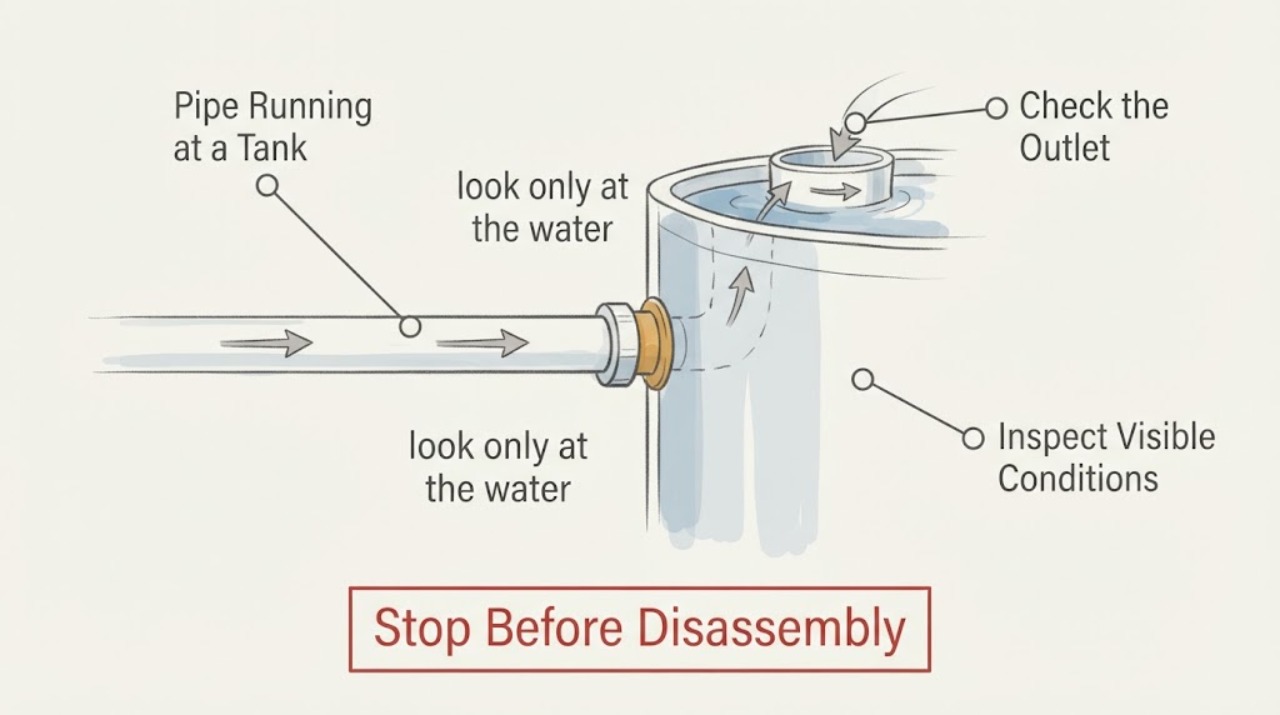
A pipe that seems to be running at a tank usually means water is still being supplied, refilling, overflowing, or escaping through a downstream leak; the sound alone does not identify which one. First determine whether the flow is at a toilet or cistern tank, a storage or pressure tank, an appliance tank, or an exposed pipe. From a dry, safe position, look for the first wet point, the tank level, an overflow or discharge path, and whether the home's meter still moves when fixtures are idle. If water is spreading, a tank is bulging or hot, a relief discharge is active, sewage is backing up, or water is near electricity, use the accessible local or main shutoff only if it can be operated safely and arrange urgent qualified plumbing service. Do not open pressurized or hot tanks, loosen fittings, add chemicals, or dismantle a pipe to chase the sound.
Work through in order
Diagnostic checks
Use only checks that match the exact appliance or system and its official guide.
-
Check 1
From a dry, safe position, identify where the running sound or visible flow starts: the pipe entering the tank, the tank itself, an overflow or relief discharge, a drain connection, a fixture outlet, or a nearby floor, wall, or ceiling; do not reach behind a tank or touch hot, pressurized, or contaminated water.
Expected result: Flow is visibly entering the tank, leaving through an overflow or discharge, appearing at a connection, or not visible despite the sound.
Next step: Photograph or describe the location and stop there if water is hot, pressurized, contaminated, rapidly spreading, or near electricity. Otherwise continue with the meter and accessible shutoff observations without dismantling anything.
Why this matters
Why: An inlet flow suggests a valve or downstream loss of water, an overflow or discharge suggests a level or pressure branch, and a wet connection or building surface suggests a leak. An unseen flow may be inside a wall, drain, or fixture.
-
Check 2
When no one is intentionally using water and it is safe to remain in the home, observe the water meter or the home's existing flow monitor without changing valves or turning on fixtures; compare the reading with the home at rest, following the meter maker's instructions.
Expected result: The meter continues to register flow at rest, becomes still, or shows an intermittent change.
Next step: If flow continues and the source is not obvious, use the accessible shutoff only if it is cool, dry, clearly identified, and safe to operate, then arrange plumbing service. Do not remove covers, enter a crawlspace, or break open a wall to trace a hidden pipe.
Why this matters
Why: Continuous flow supports an active leak, running fixture, or open valve somewhere after the meter. A still meter does not rule out an intermittent tank or fixture leak that occurs only during refill or use.
-
Check 3
If the tank is visibly a toilet cistern and its lid lifts normally without force, look only at the water level and the visible overflow path; do not force the lid, reach into the tank, adjust an unknown mechanism, or apply cleaner or dye when the tank type is not confirmed.
Expected result: Water is entering the overflow, the tank repeatedly refills after the fixture is idle, the level is stable, or the tank is not a toilet-type cistern.
Next step: For a toilet-type tank, use the clearly labeled local stop valve only if dry and safe, and arrange a plumber if the flow continues. For any other tank or an unclear tank, stop user diagnosis and provide the tank type and model to a qualified plumber.
Why this matters
Why: A toilet overflow or repeated refill points to a tank-level or seal branch, while a stable toilet tank shifts attention to a pipe, connection, or another fixture. A storage, pressure, or hot-water tank needs its own model and safety procedure.
-
Check 4
With water use stopped, inspect only exposed pipe joints, tank fittings, the floor, and the ceiling or wall below for a first wet point, mineral trail, corrosion, swelling, staining, or water damage; do not tighten, loosen, cut, or cover a leaking connection.
Expected result: A joint or tank fitting is wet, only a downstream surface is wet, water appears below the tank, or all exposed surfaces are dry.
Next step: Keep the area protected from further water and arrange a plumber for any repeatable wet point, staining, or concealed-flow suspicion. If the tank is hot, pressurized, corroded, bulging, or discharging, do not touch it and request urgent service.
Why this matters
Why: The first wet point helps distinguish a supply or tank connection leak from water traveling from a hidden source. Dry surfaces do not exclude an internal, intermittent, drain, or concealed-pipe leak.
-
Check 5
If an accessible local or main water shutoff is clearly identified, cool, dry, and reachable without stepping in water, operate it only as its labeling or utility instructions describe; do not operate a street-side utility valve, a relief valve, a gas control, or an unknown valve.
Expected result: The flow stops, slows, does not change, or the valve cannot be safely identified or operated.
Next step: If flow does not stop, is rapidly spreading, or the valve is unsafe or inaccessible, leave it for a qualified plumber or water utility. Do not force the handle, remove a valve, or open the tank to compensate.
Why this matters
Why: A stopped flow ties the affected section to that shutoff; unchanged flow suggests another supply, a different branch, stored water, drainage, or an ineffective valve. An unknown or stuck valve increases the chance of damage if forced.
-
Check 6
Prepare a plumber handoff with the tank type and model if known, pipe purpose, exact first wet point, whether flow enters or leaves the tank, meter behavior, local shutoff result, temperature or pressure clues, water damage, and whether sewage or electrical equipment is involved.
Expected result: The evidence points to a toilet-style refill, an exposed supply or fitting leak, an overflow or pressure discharge, a hidden pipe, or an unresolved tank system.
Next step: Arrange qualified plumbing service for continuous or unexplained flow. Use urgent service for active flooding, sewage backup, a hot or pressurized tank, structural water damage, or a shutoff that will not control the flow.
Why this matters
Why: This information lets the plumber select a safe isolation and inspection path instead of guessing at a valve, seal, tank, or pipe component.
Use your observations
Decision map
Find the observation that best matches what you see, then follow the next safe action.
-
PATH 01Next step
What you see
A confirmed toilet cistern keeps filling or visibly sends water through its overflow after the fixture is idle.
Do this next
Use the clearly labeled toilet stop valve only when it is dry and safe, and arrange a plumber if the flow persists. Do not force the lid, adjust unknown parts, or treat this branch as proof about another tank type.
Why this path and its safety boundary
Why it matters: The tank-level or sealing path may be allowing water to pass through, so the pipe is running to replace lost water.
-
PATH 02Next step
What you see
The first visible moisture is at a joint, tank fitting, valve connection, or exposed pipe rather than at an overflow.
Do this next
Protect the area, use a safe accessible shutoff if necessary, and call a plumber. Do not tighten or dismantle a fitting because the pipe purpose, pressure, and tank condition are not yet confirmed.
Why this path and its safety boundary
Why it matters: A connection, seal, tank wall, or nearby supply path may be leaking, and water can travel before it reaches the floor.
-
PATH 03Next step
What you see
The water meter continues to register flow when no fixture, appliance, irrigation, or tank refill should be operating.
Do this next
Use only safe, clearly identified shutoffs and arrange plumbing service. Do not excavate, open walls, or assume the tank is the source without isolating the branch professionally.
Why this path and its safety boundary
Why it matters: An active or intermittent leak, open valve, concealed line, or running fixture is likely somewhere after the meter.
-
PATH 04Next step
What you see
Water exits an overflow or relief path, the tank or pipe is hot or pressurized, the tank is corroded or bulging, or water is rapidly spreading.
Do this next
Stay clear, use a safe accessible shutoff only if it is explicitly identified and reachable without contact with the hazard, and request urgent qualified plumbing service. Do not touch the relief device or tank.
Why this path and its safety boundary
Why it matters: The system may involve pressure, temperature, structural failure, or scalding and cannot be safely diagnosed by opening or loosening components.
-
PATH 05Next step
What you see
Water reaches electrical equipment, sewage backs up, a ceiling or wall is swelling, flooring is unstable, or the leak is active and severe.
Do this next
Keep people away, do not enter contaminated or electrically unsafe water, and obtain emergency or urgent plumbing help. Use electrical service for affected wiring and do not restore power in a wet area yourself.
Why this path and its safety boundary
Why it matters: The immediate risk includes shock, contamination, structural damage, or uncontrolled flooding, not only wasted water.
Helpful context
Understand the symptom
“Running” can describe several different flows
A continuous hiss, trickle, or visible stream near a tank can be supply water entering, water passing through an overflow or discharge line, a fixture slowly refilling after a seal leak, or water escaping at a fitting. A storage or pressure tank, water-heater tank, toilet cistern, and appliance tank do not share the same service procedure. Keep the article's identity at the pipe-and-tank symptom level until the tank type and the first wet point are known.
Localize the first wet point before touching a valve
Look from a dry, well-lit position at the tank, exposed pipe, connections, floor, ceiling below, and any visible overflow or discharge. A wet connection is not always the source because water can travel along a pipe or tank surface. If the water is hot, pressurized, contaminated, rapidly spreading, or near electrical equipment, stop the inspection and use qualified help. Never loosen a fitting or open a tank to release pressure.
Use flow evidence, not a guessed replacement part
When no fixture is deliberately using water, a changing meter reading or a flow monitor alert supports an active leak or an unintended running fixture. For a toilet-type tank, a visible overflow stream or silent bowl flow is a different branch from a wet supply connection. For any other tank, the model, pressure, temperature, and purpose of each pipe must be confirmed before a plumber decides whether the issue is a valve, seal, discharge, tank, or hidden line.
Safety boundary
Stop conditions
- Stop the inspection for rapidly spreading water, sewage, water near electrical equipment, a hot or pressurized tank, bulging or badly corroded tank, ceiling or wall damage, unstable flooring, or a valve that cannot be safely identified.
- Do not open a pressurized or hot tank, loosen or cut pipe fittings, remove a relief device, force a stuck valve, add chemicals, enter a crawlspace or flooded area, or dismantle a wall or floor to trace the sound.
- Do not assume a toilet-tank explanation applies to a storage, pressure, water-heater, appliance, or other tank. Confirm the tank type and follow its exact manual or qualified plumber's guidance.
- If sewage, active flooding, structural damage, shock, smoke, or an electrical hazard is present, keep clear and obtain urgent plumbing, electrical, utility, or emergency help as appropriate.
When checks do not resolve it
Need a professional?
Call a qualified plumber for continuous or unexplained pipe flow, a wet tank or connection, a tank that refills or overflows, a meter that runs with fixtures idle, a concealed leak, or a shutoff that does not control the flow. Request urgent service for active flooding, sewage, a hot or pressurized tank, structural damage, or water near electricity; use qualified electrical help for affected wiring and do not enter unsafe water.
Common questions
FAQ
What does a running pipe at a tank usually mean?
It may be supply water entering a tank, a fixture refilling through an overflow or seal leak, water leaving through a discharge path, or a leak at a pipe or fitting. Find the first wet point and identify the tank type before choosing a repair path.
How can I tell whether water is still flowing when I cannot see the pipe?
When no one is using water, observe the home's existing meter or flow monitor according to its instructions. Continued movement supports an active leak or running fixture, while a still meter does not exclude an intermittent refill or leak.
Should I close the main water valve?
Only use a clearly identified, accessible consumer shutoff when it is dry, cool, reachable, and safe to operate. Do not force an unknown or stuck valve, operate a street-side utility valve, or approach a hot, pressurized, contaminated, or electrically unsafe area.
When is a running tank a plumbing emergency?
Escalate urgently for active flooding, sewage, a hot or pressurized tank, bulging or badly corroded equipment, structural water damage, water near electricity, or a shutoff that will not control the flow. Keep people clear while arranging qualified help.
Read the exact guide
Official sources
- Home MaintenanceU.S. Environmental Protection Agency WaterSense · General residential water-efficiency and maintenance guidance used for flow localization; tank-specific manuals and qualified plumbing service take priority.
- Fix a Leak WeekU.S. Environmental Protection Agency WaterSense · General household leak-detection guidance used for safe visual branches; it does not authorize opening pressurized or hot tanks.
- How to Turn off Your WaterOtay Water District · One utility's consumer shutoff guidance used as an example; valve locations and designs vary, and utility-side valves should not be operated by consumers.
- Water LeaksCobb County Water System · Municipal consumer guidance used for non-invasive leak localization and escalation; local valve layouts and plumbing codes vary.
- Frequently Asked Questions on LeaksSan Francisco Public Utilities Commission · Municipal leak-alert guidance used to distinguish continuous from intermittent household flow; thresholds are program-specific and are not a universal diagnosis.
Community feedback
Share a repair observation
Share a plain-text repair observation. Accepted observations are published automatically; this page may take a moment to update.