
On this page
Start here
Quick answer
A bang or thump when a faucet, appliance valve, or toilet valve closes is usually a pressure surge caused by fast-changing water flow. First identify the exact valve and whether the sound is on cold water, hot water, or both. A pressure-reducing valve, water-hammer arrestor, or expansion tank may be relevant, but each has a different job and must match the whole system. Do not adjust a pressure valve, drain or charge a tank, cut pipe, or open a wall from the sound alone. If the pipe moves, a fitting leaks, hot water vents, pressure repeatedly rises, or the source is concealed, shut off water only if it is safely reachable and call a licensed plumber.
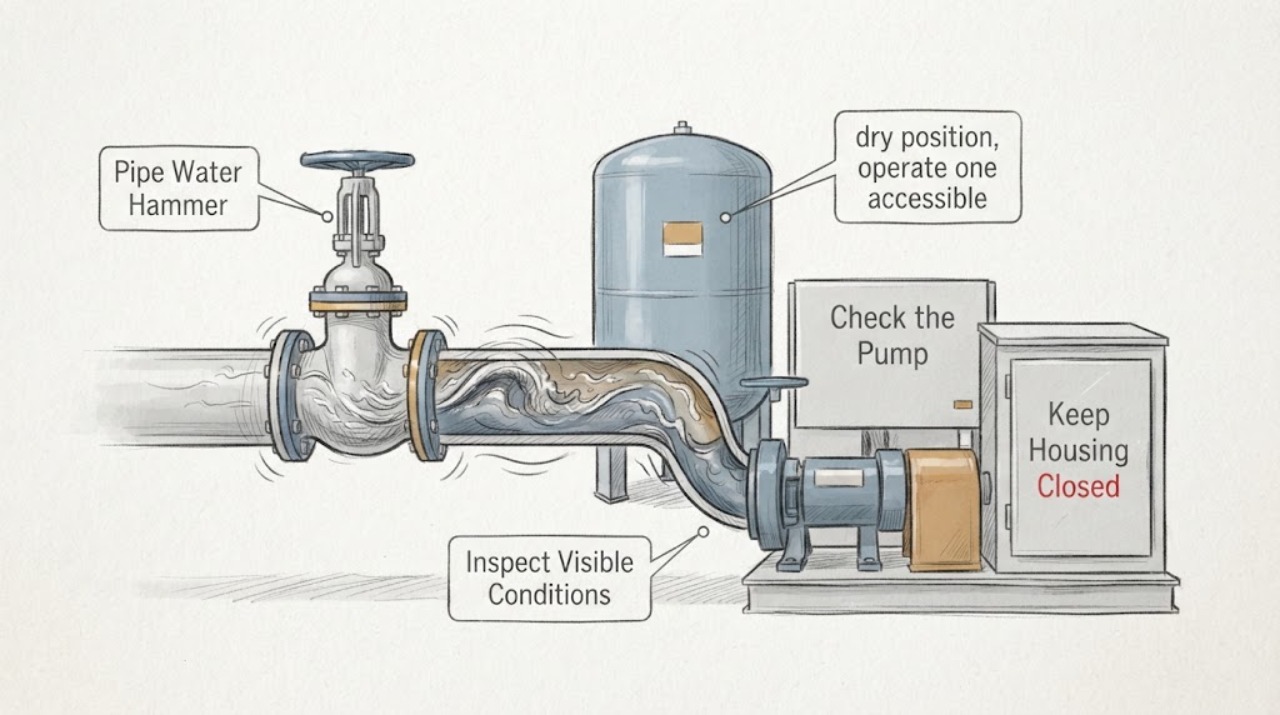
Work through in order
Diagnostic checks
Use only checks that match the exact appliance or system and its official guide.
-
Check 1
From a safe, dry position, operate one accessible fixture normally and note the exact instant of the noise, which valve action preceded it, whether the sound is a sharp bang or sustained vibration, and whether it is on hot, cold, or both lines.
Expected result: The bang follows one quick-closing valve, occurs whenever any fixture closes, follows hot-water heating, or continues while water is flowing.
Next step: Stop deliberately repeating the trigger if the pipe moves or a leak appears. Record the fixture, valve type, temperature side, and timing for a plumber, then use the matching branch below.
Stop if: Stop immediately for pipe movement, active leakage, hot discharge, ceiling or wall moisture, flooding, or water near electrical equipment.
Why this matters
Why: A valve-triggered bang supports a water-hammer path; a system-wide or flow-continuous noise may involve pressure regulation, thermal expansion, loose support, air, or another plumbing fault.
-
Check 2
Inspect only exposed pipe, valve bodies, supports, and fittings from outside the wall or cabinet; look for movement marks, corrosion, wetness, staining, or a pressure valve that is visibly damaged without turning an adjustment screw.
Expected result: The pipe jumps or taps a framing surface, a joint is wet, a valve is corroded or damaged, or all visible parts remain dry and stable.
Next step: Keep the affected fixture off when a defect is visible and arrange plumbing service. Do not tighten fittings, open a wall, or adjust the pressure valve as a trial.
Stop if: Stop for a spray, fast-growing wet area, hot pipe or discharge, structural staining, or any need to reach behind a panel or into a concealed cavity.
Why this matters
Why: Movement or a wet joint can turn a noise complaint into an active pipe-support or leak repair. A dry visible run does not rule out a concealed arrestor, valve, tank, or pipe problem.
-
Check 3
Map the water-pressure arrangement without changing it: note whether the building has a pressure-reducing valve, check valve, pump, water heater or hot-water tank, expansion tank, and a visible pressure gauge, using labels and external observation only.
Expected result: The noise appears after a water heater heats, after a pressure valve or check valve was installed, when a pump starts or stops, or there is no known pressure-control equipment.
Next step: Give the arrangement and timing to a plumber. Have the professional measure static and flowing pressure and decide whether the system needs regulation, an expansion tank, an arrestor, or another correction.
Stop if: Do not remove a check valve, open a tank, alter a relief path, or adjust a pressure setting without the required measurement and qualified plumbing procedure.
Why this matters
Why: Heating in a closed section can increase water pressure, while a pressure-reducing valve or check valve can change how that expansion is contained. A pump or high incoming pressure can add a separate system condition.
-
Check 4
If one quick-closing fixture is implicated, inspect only the exposed supply connection and identify whether an arrestor is already installed near that source; do not cut, solder, crimp, or disconnect a pressurized line.
Expected result: The fixture has no visible arrestor, an existing device is far from the shock source, the device or connection leaks, or the noise is not localized to that fixture.
Next step: Ask a plumber to verify the source, local code, line arrangement, and manufacturer instructions before installing or relocating an arrestor. Keep the fixture off if the connection is wet.
Stop if: Stop for a pressurized leak, inaccessible connection, hot-water risk, damaged tubing, or any work that would require cutting or heating pipe.
Why this matters
Why: An arrestor is intended to absorb a pressure shock close to the source, but the required type, size, orientation, and access depend on the installation and local requirements. A leaking or incorrectly installed device needs service.
-
Check 5
Compare the event across hot and cold fixtures without deliberately slamming valves: note whether only hot water, only cold water, or both sides produce the noise, and whether the water heater or recirculation equipment was active.
Expected result: Only the hot side produces the event, only one cold fixture produces it, or the entire supply reacts when several valves close.
Next step: Stop any fixture with leakage or abnormal heat and provide the side-by-side pattern to a licensed plumber. Do not drain or recharge a tank or bypass a relief device to test the theory.
Stop if: Stop for hot water discharge, a relief outlet that runs continuously, steam, scalding risk, or visible tank or pipe damage.
Why this matters
Why: A hot-side-only pattern raises a thermal-expansion or hot-water branch question; a single cold fixture points toward its local quick valve; a system-wide response calls for pressure and flow assessment rather than a local part guess.
-
Check 6
If the noise is accompanied by a leak and the main or local shutoff is clearly reachable from a dry location, close the supply only as far as the valve operates normally; do not force a seized valve or enter standing water.
Expected result: Water stops or slows safely, or the valve cannot isolate the leak without force or exposure to water, heat, or structural damage.
Next step: Keep people away from the affected area, protect belongings without touching wet electrical equipment, and contact a plumber for emergency isolation and repair.
Stop if: Do not handle electrical equipment in water, enter a flooded or contaminated area, use tools on a pressurized fitting, or open a wall to chase the leak.
Why this matters
Why: Isolation can limit property damage, but a failed or inaccessible shutoff is itself a plumbing-service condition. Water hammer can coexist with a leaking fitting, pressure valve, tank connection, or concealed pipe.
-
Check 7
Prepare a service record with the fixture and valve, hot or cold side, single bang or continuing noise, exact location, time pattern, water-heater or pump status, pressure-control equipment, visible movement or leakage, and any recent plumbing work.
Expected result: The event is repeatable at one valve, affects several branches, started after a valve or tank change, or cannot be localized from exposed piping.
Next step: Leave any leaking or hazardous branch isolated if safely possible and schedule a licensed plumber to measure pressure and inspect the system. Do not buy a generic pressure valve, tank, or arrestor from the sound alone.
Stop if: Stop user troubleshooting when diagnosis requires pressure adjustment, pipe disassembly, tank service, concealed access, or repeated high-pressure testing.
Why this matters
Why: This history helps the plumber distinguish a local arrestor placement issue from pressure regulation, thermal expansion, support, pump, or concealed piping work.
Use your observations
Decision map
Find the observation that best matches what you see, then follow the next safe action.
-
PATH 01Next step
What you see
A single quick-closing fixture creates one sharp bang at the moment its valve closes.
Do this next
Have a plumber verify the valve, pipe support, and the need and location of an approved water-hammer arrestor near the shock source.
Why this path and its safety boundary
Why it matters: A local water-hammer path is likely, especially if the noise is near that fixture.
-
PATH 02Next step
What you see
The noise occurs on the hot side after water heating, or follows pressure-reducing or check-valve work.
Do this next
Ask a plumber to measure pressure and verify the hot-water tank, valve, relief path, and expansion-tank suitability. Do not drain, charge, or bypass the tank yourself.
Why this path and its safety boundary
Why it matters: Thermal expansion in a restricted or closed section may be increasing pressure; the pressure-reducing valve and expansion-tank arrangement need professional assessment.
-
PATH 03Next step
What you see
Several fixtures cause banging, or the sound is present when water is flowing rather than only at shutoff.
Do this next
Keep the system under observation without deliberately triggering surges and arrange a whole-system plumbing inspection.
Why this path and its safety boundary
Why it matters: The issue may involve system pressure, flow velocity, supports, a pump, air, or another fault rather than a single arrestor.
-
PATH 04Next step
What you see
An arrestor, pressure valve, tank, or connection is visibly leaking, damaged, corroded, or inaccessible.
Do this next
Use a safe local or main shutoff only if reachable without force, heat, or standing water, then call a licensed plumber.
Why this path and its safety boundary
Why it matters: The component or surrounding pipework may be unsafe to operate and needs service, regardless of whether it caused the original noise.
-
PATH 05Next step
What you see
A pressure-reducing valve is present but pressure readings are unknown or the valve setting has been changed.
Do this next
Have a plumber measure and document pressure upstream and downstream and verify the valve, strainer, relief path, and system compatibility.
Why this path and its safety boundary
Why it matters: The valve cannot be judged by appearance or sound; incorrect pressure or valve wear can affect the whole system.
-
PATH 06Next step
What you see
There is pipe movement, active water, hot discharge, ceiling or wall damage, flooding, or water near electricity.
Do this next
Stop operating the triggering fixture, isolate water only from a safe dry location if possible, keep clear, and request urgent plumbing or other emergency help.
Why this path and its safety boundary
Why it matters: The event has become a property-damage, scald, structural, or electrical hazard.
Helpful context
Understand the symptom
What the timing tells you
Water hammer is most convincing when a single, sharp bang occurs immediately after a fast-closing valve shuts. A washing machine, dishwasher, ice maker, solenoid faucet, toilet fill valve, or other quick valve can create the event, but the responsible fixture must be identified rather than assumed. A rumble that continues while water flows, a hiss, or a bang that follows water-heater heating can point to pressure regulation, thermal expansion, a loose support, or a different plumbing fault.
Pressure valve and tank are not interchangeable
A pressure-reducing valve controls excessive incoming or downstream pressure. A water-hammer arrestor absorbs a rapid pressure shock near the valve that creates it. An expansion tank accommodates water expansion in a closed hot-water system. One device cannot be selected as a universal substitute for the others, and a tank connected to the wrong water line or a valve adjusted without a pressure reading can create leaks or poor fixture performance.
Use observation before intervention
From dry, safe locations, note the room, fixture, hot or cold side, valve action, and whether the sound is a single bang or repeated vibration. Look at exposed pipe and fittings without touching a moving or hot line. The useful handoff to a plumber is the trigger, location, timing, pressure history, water-heater or pump arrangement, and any visible leak—not a guessed replacement part.
When the noise becomes urgent
A one-time noise with no movement or leak can be investigated methodically. Repeated hammer with visible pipe movement, leaking joints, a damaged pressure valve, hot discharge, ceiling or wall moisture, or an inability to isolate the water supply needs prompt plumbing service. Do not reproduce a dangerous surge just to verify the diagnosis.
Only after diagnosis
Potential parts
- water-hammer arrestor
Consider only when a plumber confirms that a quick-closing valve is the shock source and selects an arrestor suitable for the line, pressure, water temperature, location, and local requirements.
Arrestors vary by connection, capacity, and installation requirements; do not choose a size or fit from the noise alone. - pressure-reducing valve
Consider only when measured system pressure or a failed regulator warrants pressure reduction and a plumber confirms the correct device and location.
The valve must suit the water system and remain accessible for inspection and maintenance; local plumbing rules and pressure readings control the choice. - domestic hot-water expansion tank
Consider only when a closed hot-water arrangement and measured pressure behavior show that thermal expansion needs accommodation.
Tank volume, precharge, connection, potable-water approval, and placement are system-specific; installation and charging belong to qualified plumbing service.
Common questions
FAQ
Why do my pipes bang when a faucet or appliance turns off?
A fast-closing valve can stop water abruptly and create a pressure shock. Identify the valve and have a plumber check pipe support, pressure, and whether a properly selected arrestor belongs near that source.
Will a pressure-reducing valve always fix water hammer?
No. A pressure-reducing valve controls system pressure, while an arrestor absorbs a rapid shock and an expansion tank accommodates thermal expansion in a closed hot-water arrangement. The correct remedy depends on measured pressure and the plumbing layout.
Does a hot-water tank make water hammer worse?
Heating water can increase pressure in a restricted or closed section, particularly when pressure-control or check equipment is present. A plumber should verify the pressure and the expansion-tank arrangement instead of draining or adjusting it as a test.
Where should a water-hammer arrestor be installed?
Manufacturer guidance generally places it close to the valve or fixture that creates the shock, but the device, connection, sizing, access, and local requirements must be confirmed for the actual system.
When should I call a plumber for water hammer?
Call promptly for repeated or system-wide banging, pipe movement, leaks, hot discharge, unknown pressure, recent plumbing changes, or any pressure valve, tank, or arrestor that is damaged or concealed. Leave a leaking branch unused when safe.
Read the exact guide
Official sources
- Water hammer arresterCaleffi · Water-hammer arrester mechanics, placement, potable-water considerations, and expansion-vessel alternatives
- Installation InstructionsWatts · Watts LF150A water-hammer arrestor operation and safety instructions
- Installation GuidelinesWatts · Watts Series 05 and LF05 water-hammer arrestor placement and installation limits
- Installation recommendationsCaleffi · Caleffi pressure-reducing valve installation, water-hammer risk, thermal expansion, and service guidance
- CW 03 Maximum static water pressure within a buildingBuilding and Plumbing Commission · Government guidance on building water pressure, pressure-limiting devices, and qualified plumber decisions
- LF150AWatts · Watts residential water-hammer arrestor purpose and operating principle
Community feedback
Share a repair observation
Share a plain-text repair observation. Accepted observations are published automatically; this page may take a moment to update.