
On this page
Start here
Quick answer
Water hammer is usually a sharp bang, knock, or pipe vibration when moving water stops or changes direction quickly, often as a valve closes. Note which faucet, toilet, washer, dishwasher, or automatic valve triggers it, try closing a manual valve more slowly, and inspect only accessible pipe supports and joints for movement or leaks. Repeated or severe hammering, a leaking or damaged pipe, or a problem inside a wall needs a licensed plumber; a water hammer arrestor is conditional on the valve, layout, sizing, and installation instructions.
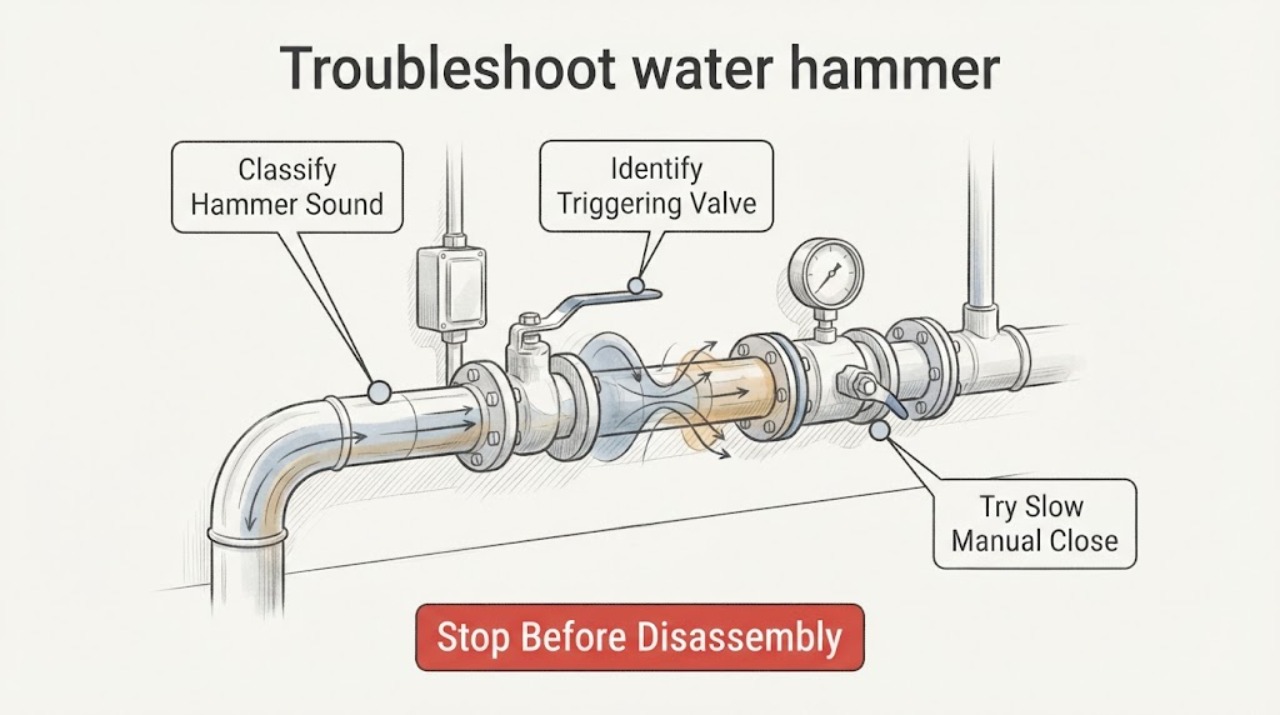
Work through in order
Diagnostic checks
Use only checks that match the exact appliance or system and its official guide.
-
Check 1
From a safe location, listen to the timing and character of the noise: a single bang immediately after flow stops, a series of knocks, vibration while water is flowing, or a steady hiss without a closing event.
Expected result: The noise is a sharp post-shutoff bang or knock, continues as vibration during flow, or is mainly a hiss or hum.
Next step: Record the sound and timing before changing anything. Continue only if a clear valve or fixture trigger can be observed without entering a hazardous area.
Stop if: Stop for a new leak, spraying water, a rapidly worsening bang, a ceiling or wall stain, or pipe movement that could damage a joint.
Why this matters
Why: A bang tied to a rapid flow change is consistent with water hammer; vibration or a hiss may instead indicate pipe movement, turbulence, a valve problem, or another plumbing fault.
-
Check 2
One at a time, note whether the bang follows a manually operated faucet, toilet refill, washing machine, dishwasher, irrigation valve, pump, or another automatic valve; do not rapidly cycle the controls to reproduce the noise.
Expected result: One fixture or fast-closing valve consistently triggers the bang, several fixtures do, or no trigger can be isolated.
Next step: Leave the trigger identified for service notes and use that fixture gently. Have a plumber assess automatic valves, pipe support, pressure, and any needed arrestor near the shock source.
Stop if: Stop operating the trigger if the noise is accompanied by a leak, violent pipe movement, loss of water, or a valve that will not close normally.
Why this matters
Why: A repeatable single trigger points toward that valve, appliance connection, or nearby pipe run; several triggers or no clear source suggest a shared pressure, support, or piping-layout issue.
-
Check 3
If a cool, dry, accessible manual faucet is the trigger and it operates normally, close it slowly once instead of snapping it shut, keeping hands clear of any loose pipework.
Expected result: The bang is reduced or absent with a slow closure, or it remains just as strong.
Next step: Use gentle closures as a temporary comfort measure only and arrange a plumbing assessment if the hammer returns or is strong. Do not treat a quieter test as proof that the installation is sound.
Stop if: Do not force a stiff handle, adjust hidden valves, or continue if the pipe or fitting moves, leaks, or rattles violently.
Why this matters
Why: A change with slower closure supports a flow-change cause; no change suggests the valve, pipe support, pressure, or another part of the system may need assessment.
-
Check 4
Inspect visible pipe runs, fittings, appliance hoses, and supports for rubbing against framing, a loose strap, missing isolation at a penetration, corrosion, dampness, or a joint that shifts when the fixture operates normally.
Expected result: A pipe or fitting visibly moves or contacts the building, a support is loose, a joint is wet, or accessible pipework looks stable and dry.
Next step: Do not add improvised restraints or remove insulation around concealed pipework. Photograph the finding and have a plumber correct supports, isolation, or damaged joints as appropriate.
Stop if: Stop if you see active leakage, a bulging or split pipe, a loose fitting, or water near electrical equipment.
Why this matters
Why: Unrestrained or contacting pipe can make a pressure event sound louder; moisture or corrosion may indicate damage that needs repair rather than a noise-only fix. A stable visible run does not rule out movement inside a wall.
-
Check 5
Note whether hammering began after a plumbing alteration, appliance installation, valve replacement, pressure change, or pump work, and whether it occurs on hot, cold, or multiple branches.
Expected result: The problem follows a recent change or one branch, or it affects multiple branches without a recent change.
Next step: Give the timing and affected branches to a plumber. Ask for the cause and application to be assessed before anyone selects a pressure control or water hammer arrestor.
Stop if: Stop using the affected fixture or pump if the hammer is severe, causes leaks, or is accompanied by loss of pressure or water damage.
Why this matters
Why: A recent change can point to a newly introduced fast-closing valve, altered support, or changed flow path; a system-wide pattern may involve pressure, pump, valve, or layout conditions beyond one fixture.
Use your observations
Decision map
Find the observation that best matches what you see, then follow the next safe action.
-
PATH 01Next step
What you see
A single faucet or appliance valve causes a short bang immediately after closing.
Do this next
Use slow manual closure where practical and arrange a plumber's assessment of that valve, nearby pipe support, and whether a correctly selected arrestor is appropriate.
-
PATH 02Next step
What you see
The noise is reduced by a slow manual closure.
Do this next
Treat slower closure as a temporary observation, not a repair; persistent hammer still needs evaluation of valve behavior, pressure, and support.
-
PATH 03Next step
What you see
Visible pipework moves, contacts framing, or has a loose support but no active leak.
Do this next
Have a plumber secure or isolate the pipe using an appropriate method; do not improvise a restraint around a pressurized line.
-
PATH 04Next step
What you see
A joint leaks, a pipe is damaged, or the noise is accompanied by water damage.
Do this next
Close the nearest safe shutoff or main water shutoff as needed, protect the area, and call a licensed plumber promptly.
-
PATH 05Next step
What you see
Several branches, a pump, or automatic valves produce hammering.
Do this next
Stop repeated testing and arrange a system assessment covering pressure, valve timing, pipe support, and layout.
-
PATH 06Next step
What you see
An arrestor is being considered after a confirmed fast-closing valve.
Do this next
Use the exact piping, valve, sizing, placement, and local-code requirements or have a plumber select and install the device near the shock source.
Helpful context
Understand the symptom
What water hammer sounds like
Water hammer is different from a steady hiss or a pump hum. It is commonly a sharp bang or knock immediately after a faucet, toilet fill valve, appliance valve, or other flow control closes. The pressure wave can make piping vibrate and, if the condition is persistent or strong, can stress pipes, fittings, valves, and connected equipment. The sound may travel, so the loudest point is not always the source.
Keep the first checks safe
A homeowner can observe the trigger, operate an accessible manual faucet or shutoff gently, and look for movement or moisture where pipework is visible. Do not open walls, remove a pressurized fitting, change a pressure-control setting without a qualified assessment, or install an arrestor by guessing at its connection or location. A wet joint, split pipe, ceiling stain, or water near electrical equipment changes the problem from noise control to leak response.
Only after diagnosis
Potential parts
- water hammer arrestor
Only consider this after a fast-closing valve or appliance branch has been identified and a plumber or the exact installation guidance confirms that an arrestor is suitable.
Confirm connection type, pipe material, sizing, placement, local requirements, and the manufacturer's installation instructions; no generic arrestor is proven to fit every pipe.
When checks do not resolve it
Need a professional?
Call a licensed plumber for severe or repeated hammering, active leakage, damaged or moving pipe, a concealed source, water damage, a pump or automatic-valve problem, or any repair involving pressurized fittings, pressure controls, pipe supports inside a wall, or water hammer arrestor selection and installation.
Common questions
FAQ
What causes a water hammer bang in a pipe?
It usually occurs when moving water is forced to stop or change direction quickly, often when a faucet, appliance valve, pump, or automatic valve closes. The resulting pressure wave can vibrate the pipe and connected fittings.
Will closing a faucet more slowly stop water hammer?
It may reduce a bang caused by rapid manual closure, but that is only a temporary observation. Persistent hammer still needs assessment of the valve, pressure, pipe support, and layout.
Do I need a water hammer arrestor?
Possibly, but not every noisy pipe needs the same device. An arrestor must match the fast-closing valve, pipe application, connection, sizing, and placement, so have a plumber or the exact manufacturer guidance determine whether and where it belongs.
Read the exact guide
Official sources
- Water Quality in Small Community Distribution Systems: A Reference Guide for OperatorsU.S. Environmental Protection Agency · EPA technical guidance describing pressure surges from sudden valve or pump changes and potential pipe, fitting, and valve damage
- PEX Piping Systems Installation GuideUponor · Manufacturer installation guidance on domestic-piping water hammer, fast-closing valves, pressure or velocity reduction, and arrestors
- Water Hammer ArrestorsWatts Water Technologies · Manufacturer guidance explaining arrestors absorb shock from suddenly stopping flow at fast-closing valves and appliances
Community feedback
Share a repair observation
Share a plain-text repair observation. Accepted observations are published automatically; this page may take a moment to update.