
On this page
Start here
Quick answer
A bang, thump, or pipe movement exactly when an irrigation zone or pump stops is usually a water-hammer or surge event: moving water is stopped or changes speed too quickly, creating a pressure wave. From a dry, safe location, note which zone, valve, or pump action triggers it, where the sound is loudest, whether pipes move or leak, and whether the event occurs at every shutoff or only one zone. Use the irrigation controller or a clearly accessible valve control to stop watering if there is a leak or pipe movement, but do not open pressurized fittings, dig to a buried valve, or alter a pressure regulator. Slower valve action, flow control, suitable pipe support, air-relief equipment, or a surge arrester may reduce the event, but sizing and placement belong to a qualified irrigation or plumbing professional. Stop the system and request service for a burst, active leak, unstable pipe, repeated severe impact, unsafe pressure, or water near electrical equipment.
Before you begin
Safety first
- Keep the irrigation system off for a burst, active leak, unstable pipe, severe impact, unsafe pressure, or water near electrical controls. Do not open pressurized equipment, dig into a suspected line, alter pump wiring, or bypass backflow protection.
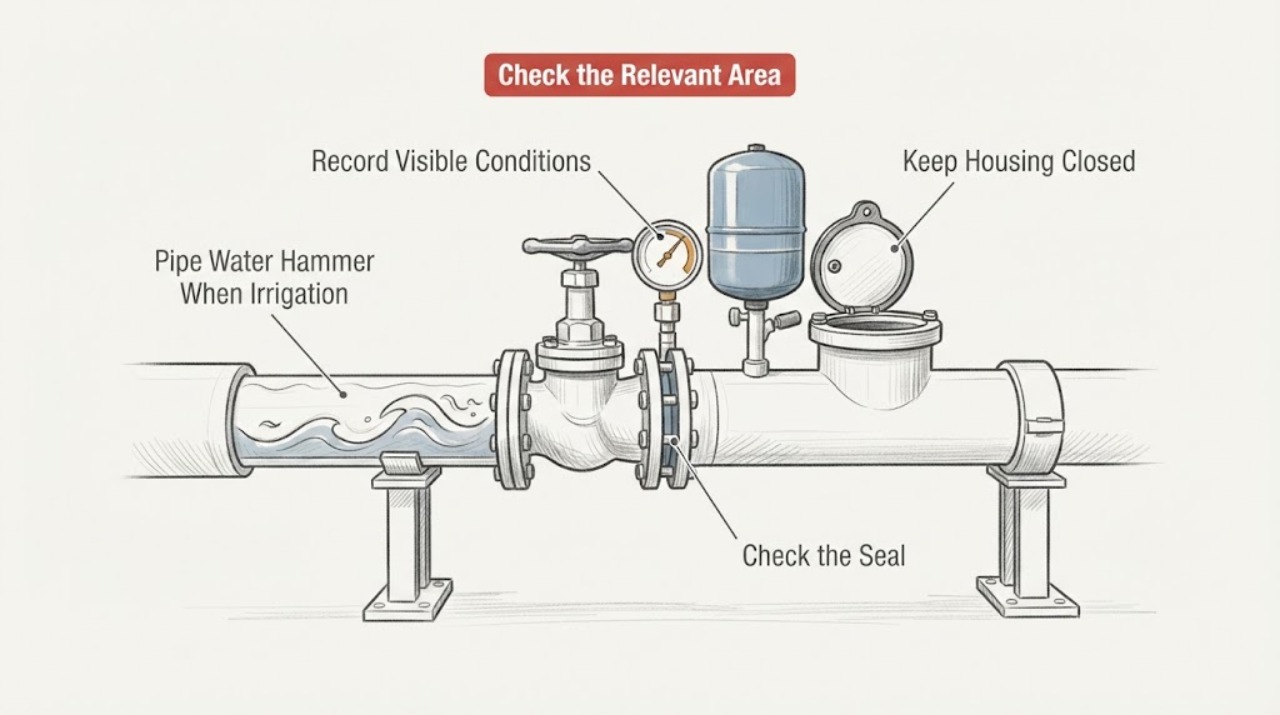
Work through in order
Diagnostic checks
Use only checks that match the exact appliance or system and its official guide.
-
Check 1
Stop the irrigation program from the normal controller if a pipe is moving, water is escaping, or the sound is severe. From a dry, safe position, record the time, zone name, whether a pump or master valve stopped, the loudest location, and whether the event happened at shutoff only or also during startup.
Expected result: The impact occurs only as one zone closes, follows every zone shutoff, happens when a pump stops, or is accompanied by a visible leak, pipe movement, wet electrical box, or loss of water.
Next step: Leave the affected irrigation cycle off and arrange plumbing or irrigation service for severe impact, movement, leakage, or wet controls. Do not restart solely to reproduce the noise.
Why this matters
Why: A shutoff-only event supports a flow-surge path; a single-zone pattern points toward that valve or branch, while a whole-system pattern points toward common control, pump, pressure, or pipe-layout conditions. A leak or wet electrical area is an urgent damage and safety condition.
-
Check 2
Compare the controller sequence without opening any valve or electrical enclosure: note whether the sound follows one station, the master valve, a pump relay, or the final shutdown of the entire system. Record whether the controller is programmed for automatic operation or the event follows a manual valve closure.
Expected result: Only one station produces the bang, several stations do, the pump stops before or after a valve, or the event follows a quick manual closure.
Next step: Do not change valve timing, pump wiring, or control settings beyond a normal stop command unless the equipment manual clearly documents it. Give the sequence to a qualified professional for flow-control and valve-timing review.
Why this matters
Why: The affected sequence helps separate a local valve or branch issue from common pump and pressure behavior. University irrigation guidance identifies rapid valve changes and pump starting or stopping as separate surge triggers.
-
Check 3
Inspect only exposed, dry pipe and valve areas for a loose support, pipe striking framing, a visibly damaged valve body, a wet joint, a broken fitting, or a line that has shifted. Keep hands away from moving parts and do not remove a valve box cover or dig to reach buried piping.
Expected result: The pipe visibly moves, a support is loose, a joint drips or sprays, a fitting is cracked, the valve body is damaged, or all exposed components look stable and dry.
Next step: Stop the system for any leak, crack, shifting pipe, or repeated hard impact and arrange service. If the exposed area is stable, continue only with non-invasive timing and pressure observations.
Why this matters
Why: Surge can reveal weak support or fittings even when the original trigger is a fast valve change. A dry exterior does not prove that buried piping or internal valve parts are sound.
-
Check 4
If a pressure gauge is already installed in a dry, accessible location, observe its reading during normal irrigation and immediately after the affected shutoff without touching the gauge connection. Record a rapid needle swing, an unusual static reading, or no visible change; do not install a gauge or alter a regulator for this check.
Expected result: The gauge swings sharply at shutoff, shows pressure outside the equipment documentation, stays steady while the pipe bangs, or no gauge is present.
Next step: Stop for a damaging event or an unsafe-looking pressure condition and have a professional measure the system. Do not adjust the regulator or open a pressurized connection based on a generic reading.
Why this matters
Why: A pressure change supports a surge or control problem, but gauge behavior alone cannot determine the correct regulator, valve, or arrester. The absence of a gauge only means pressure evidence is unavailable.
-
Check 5
Map the irrigation layout for the service visit: note the water source, pump if present, backflow device, master valve, zone valves, high points, long runs, pipe material if known, and any air-relief or surge-control equipment already visible. Use the installation plan or controller labels rather than tracing buried pipe by digging.
Expected result: The event occurs near a high point or long run, the layout has no visible air relief, the pipe route is unsupported, a pump or pressure device is common to all zones, or the layout is unknown.
Next step: Give the map and event pattern to an irrigation or plumbing professional. Ask them to assess valve closing behavior, flow and pressure, supports, air relief, backflow protection, and surge mitigation as one system.
Why this matters
Why: Elevation, trapped air, pipe length, flow velocity, pump behavior, and common control devices can change surge severity. Equipment location must be chosen from the actual layout, not from the sound location alone.
-
Check 6
After the system is dry and the cause has been reviewed, use only the controller's documented normal schedule or a professional-approved gradual sequence for one observation. Do not repeatedly cycle a suspected bad valve, restart a pump against a closed line, or make an improvised bypass.
Expected result: A gradual sequence reduces the impact, the same bang returns at one valve, the event worsens on restart, or water damage or instability appears.
Next step: Stop the system for a returning or worsening event and arrange service. Provide the professional with the zone, timing, pressure observation, layout, supports, and leak history; do not keep testing.
Why this matters
Why: A change with sequence supports valve or pump timing as a contributor, but it does not establish that a valve, arrester, regulator, or pipe is correctly sized. Worsening impact or damage means the system should not be operated.
Use your observations
Decision map
Find the observation that best matches what you see, then follow the next safe action.
-
PATH 01Next step
What you see
The bang happens only when one irrigation zone or valve shuts off.
Do this next
Keep that zone off if the impact is severe and have an irrigation professional inspect valve action, flow, supports, and the branch layout.
Why this path and its safety boundary
Why it matters: The local valve, branch flow, support, elevation, or downstream air condition is more suspicious than a whole-system control alone.
-
PATH 02Next step
What you see
The sound occurs when a pump stops or when the master control ends the entire irrigation cycle.
Do this next
Stop repeated cycles and request a system assessment covering pump control, pressure, flow, valve sequence, and surge protection.
Why this path and its safety boundary
Why it matters: Pump stopping and a common valve or pressure event can create system-wide surge; the source is not proven to be a single sprinkler valve.
-
PATH 03Next step
What you see
The pipe moves, a fitting leaks, a valve box fills with water, or the soil becomes wet after the shutoff impact.
Do this next
Stop irrigation, close the accessible irrigation isolation valve only if it is safe and dry to reach, and arrange plumbing or irrigation service. Keep water away from electrical controls.
Why this path and its safety boundary
Why it matters: The surge may already have damaged a joint, valve, or buried line, and continued pressure can increase water loss or property damage.
-
PATH 04Next step
What you see
The system has a gauge and shows a sharp pressure swing, or pressure is outside the equipment documentation.
Do this next
Leave the system off for a damaging or unsafe event and have a qualified professional measure and size the corrective equipment.
Why this path and its safety boundary
Why it matters: Pressure evidence supports a flow-control or surge problem but cannot select a regulator, valve, or arrester without system data.
-
PATH 05Next step
What you see
The event is mild, happens only at a normal transition, and there is no leak, movement, damage, or unusual pressure observation.
Do this next
Record the baseline and have it reviewed during irrigation maintenance. Do not add a generic arrester or change a valve without a layout-based assessment.
Why this path and its safety boundary
Why it matters: A brief transition can be less urgent, but repeated or worsening impact can still fatigue pipe, fittings, and valves.
-
PATH 06Next step
What you see
The noise remains after a documented gradual sequence, occurs at several zones, or no safe external cause is visible.
Do this next
Stop using the irrigation system if the impact is severe and arrange qualified plumbing or irrigation service. Do not open pressurized equipment or keep cycling it.
Why this path and its safety boundary
Why it matters: A common pressure, pump, valve-control, trapped-air, or pipe-support condition needs professional diagnosis.
Helpful context
Understand the symptom
A shutoff-only event points to flow change
If the bang happens as an irrigation zone, master valve, or pump stops, the timing is useful evidence. Water moving through a closed pipe has momentum; a rapid change in velocity can send a pressure wave through the line. The same symptom can be made worse by trapped air, a long run, high flow, poor support, or a fast-closing automatic valve. It does not identify one failed part by sound alone.
Keep observations outside the pressurized system
Use the controller display and visible, dry areas to record the affected zone, valve sequence, pump state, pipe movement, and any leak. Do not loosen a fitting, remove a valve cover, dig around a buried line, or touch wiring in a wet control box while the system is pressurized. If water is escaping or a pipe is striking hard enough to risk damage, stop irrigation from the normal control and arrange service.
Mitigation is a system-design decision
Air-relief valves at suitable high points, pressure-reducing or automatic flow controls, slower valve action, properly supported piping, and surge arrestors can be appropriate in different irrigation layouts. Their location and rating depend on the pipe material, flow, pressure, elevation, pump, and zone arrangement. A plumber or irrigation professional should select and install them for the actual system rather than treating a generic device as a universal fix.
Safety boundary
Stop conditions
- Stop irrigation for a burst, active leak, pipe movement, cracked fitting, repeated severe impact, unsafe-looking pressure, standing water near electrical controls, or a valve that cannot stop flow.
- Do not loosen pressurized fittings, remove valve or backflow covers, dig to a buried line, adjust a pressure regulator, change pump wiring, or install a surge device without system-specific professional assessment.
- Do not restart a pump against a closed line, repeatedly cycle a suspected valve, or run a test when water is reaching electrical equipment or the ground is unstable.
- Keep the irrigation isolation valve accessible for emergencies, but do not force a stuck or brittle valve. Arrange plumbing or irrigation service when the isolation point cannot be operated safely.
Only after diagnosis
Potential parts
- slow-closing irrigation valve or valve control
Consider this only after a professional confirms that valve closing behavior is the surge trigger and identifies a compatible control approach.
Valve type, flow, pressure, controller, and zone layout determine suitability. Do not select a valve from the sound symptom alone. - air-relief valve
Consider this only when a layout-based assessment finds trapped air or a high-point condition where air relief is appropriate.
Location, pressure rating, pipe material, and irrigation design control compatibility. Installation should follow the system design and local requirements. - surge arrester or pressure-control device
Consider this only after measured flow and pressure show that surge mitigation is required and a professional selects the device and location.
Arrestors, pressure controls, and tanks are not interchangeable. Confirm the actual line, pump, valve, pressure, and pipe ratings before installation.
When checks do not resolve it
Need a professional?
Request qualified service for water hammer that persists after safe controller observations, any leak or pipe movement, a pressure or pump event, or a valve that closes abruptly or cannot stop flow.
Safety scope: Keep the irrigation system off for a burst, active leak, unstable pipe, severe impact, unsafe pressure, or water near electrical controls. Do not open pressurized equipment, dig into a suspected line, alter pump wiring, or bypass backflow protection.
Common questions
FAQ
Why do pipes bang when an irrigation zone shuts off?
A rapid change in water velocity can create a pressure wave called water hammer or surge. A fast-closing valve, pump stop, trapped air, high flow, long pipe run, or weak support can contribute. Record which zone and control action triggers it, then arrange service for a severe or recurring event.
Should I add a water-hammer arrester to the irrigation line?
Not as a blind fix. Surge arrestors, air-relief valves, pressure controls, and slower valve action can be appropriate, but location and rating depend on the actual flow, pressure, pipe, pump, elevation, and zone layout. Have a qualified professional assess the system first.
Can a pressure regulator stop irrigation water hammer?
It may help in a system with a pressure or flow-control problem, but a regulator cannot be selected from the noise alone. A professional should measure the system and review valve timing, pipe supports, air conditions, pump behavior, and the required pressure for each zone.
What can I safely check when irrigation shuts off with a bang?
From a dry location, identify the zone, valve or pump sequence, sound location, pipe movement, visible leaks, and any pressure gauge behavior that is already available. Do not open pressurized equipment, dig to a buried line, remove covers, or alter wiring or a regulator.
When is irrigation water hammer an emergency?
Stop irrigation for a burst, active leak, shifting pipe, severe repeated impact, water near electrical controls, or a valve that cannot stop flow. Keep clear of wet electrical equipment and arrange qualified plumbing or irrigation help rather than restarting the system.
Read the exact guide
Official sources
- CIR828/AE066: Water Hammer In Irrigation SystemsUniversity of Florida IFAS Extension · University of Florida irrigation guidance; system-specific pressure and device selection require site data.
- Irrigation GuideUSDA Natural Resources Conservation Service · USDA NRCS irrigation design guidance; component placement and sizing are system-specific.
- How to Operate the Non-Potable Water ValveCity of Fort Lupton, Colorado · City of Fort Lupton non-potable irrigation requirements and guidance; local rules and installed equipment can differ.
Community feedback
Share a repair observation
Share a plain-text repair observation. Accepted observations are published automatically; this page may take a moment to update.