
On this page
Start here
Quick answer
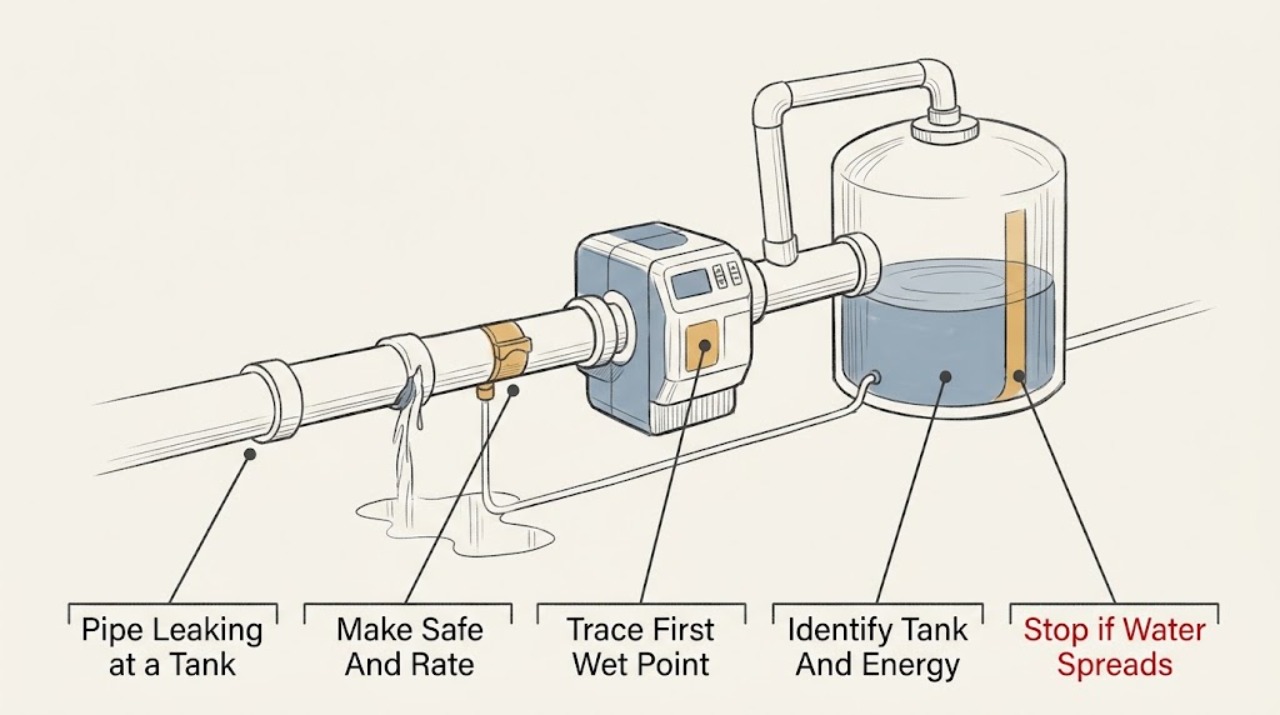
A leak reported at a tank may come from the tank wall or base, an inlet or outlet connection, a drain or overflow path, a temperature-and-pressure relief discharge, condensation, or water running down from above. If water is hot, flowing quickly, reaching electrical equipment, or accompanied by a gas odor, smoke, or a carbon-monoxide alarm, stop and use the appropriate emergency path. If it is safe to reach a clearly labeled water shutoff from a dry area, close it; do not block a relief valve, open a pressurized tank, remove gas or electrical covers, or patch a tank as a test. A plumber should identify whether the tank itself has failed or only a connected pipe or valve is leaking.
Work through in order
Diagnostic checks
Use only checks that match the exact appliance or system and its official guide.
-
Check 1
From a dry, safe position, stop using fixtures that feed the tank or connected line. Look without touching hot surfaces for the leak rate, water temperature, color or odor, and whether water is reaching an outlet, appliance, pump, or control.
Expected result: The leak is a few drops, a steady stream, or a rapid flow; the water is cool or hot; and the area is dry or has standing water near electrical equipment.
Next step: If the area is dry and the correct water shutoff is reachable without crossing water, close it. Otherwise keep away and call a plumber or emergency service from a safe location.
Why this matters
Why: A rapid or hot leak can cause burns and property damage. Standing water near electrical equipment is an electrical hazard, while an odor, smoke, or gas indication may be an emergency rather than a plumbing check.
-
Check 2
Without removing insulation or covers, use a dry cloth or paper held from a safe position to compare visible points: the tank seam or base, inlet and outlet joints, drain connection, relief discharge pipe, overflow, and the space above the tank. Follow the first point that becomes wet rather than the lowest drip.
Expected result: Water starts at a pipe joint or valve, exits a relief or overflow path, appears at the tank seam or base, or arrives from above with no visible tank source.
Next step: Photograph the first wet point and label from a safe distance. Do not tighten, pry, seal, or remove any part to confirm the source; arrange a plumber when the source is not obvious.
Why this matters
Why: A joint or valve points to a connected plumbing part; a relief discharge can indicate a pressure or temperature condition; a seam or base leak can mean tank corrosion or vessel failure; water from above is not evidence that the tank is leaking.
-
Check 3
Read the external label from a dry position and record whether the equipment is a storage water heater, pressure tank, treatment tank, or another vessel, plus whether its energy source is electric, gas, oil, or unknown. Do not remove access panels or operate a gas control to investigate.
Expected result: The tank type, model information, energy source, and visible isolation valves are clear; or one or more are unknown.
Next step: Give the label, photos, and valve locations to the plumber. For electric water-heater maintenance, the city guidance says heating elements must be off first; a professional should handle gas, fuel, controls, and unknown systems.
Why this matters
Why: Tank and energy type change the safe isolation procedure and whether a relief discharge, condensate path, pump, or fuel system may be involved. Unknown identity makes a generic shutoff or repair instruction unsafe.
-
Check 4
Visually follow the relief-valve discharge pipe and any overflow from the tank to its outlet. Check only whether the pipe is visibly open, directed downward, leaking, capped, or discharging; do not lift a lever, block an outlet, remove a discharge pipe, or change a pressure setting.
Expected result: The discharge is dry, dripping, flowing, capped or obstructed, or the valve and pipe are damaged or corroded.
Next step: Keep clear of hot discharge and call a plumber with the observed state. Do not plug or clamp the path even if it is inconveniently located.
Why this matters
Why: A discharge can be a protective response to excessive pressure or temperature, while a blocked or altered path removes a safety function. A valve or discharge problem requires professional diagnosis and must not be treated as an ordinary joint leak.
-
Check 5
If the source is a reachable cold-water inlet or other clearly labeled water isolation valve, close it from a dry position and observe whether the leak slows. Do not drain the tank, loosen fittings, disconnect fuel, remove electrical covers, or reopen the supply to repeat the test.
Expected result: The leak slows, stops, or continues after the water isolation is closed; or the valve will not move normally.
Next step: Keep the valve in the safe state and call a plumber. Provide the leak rate, first wet point, tank type, energy source, valve position, and whether the relief or overflow path was involved.
Why this matters
Why: A change after isolation supports a pressurized water path, but does not prove the tank or a particular pipe has failed. Continued flow can be stored water, a separate supply, a relief path, or a tank rupture and needs professional assessment.
Use your observations
Decision map
Find the observation that best matches what you see, then follow the next safe action.
-
PATH 01Next step
What you see
The first wet point is a tank seam, base, crack, bulge, or corrosion-through rather than a replaceable external connection.
Do this next
Keep the water supply isolated if it was safely closed, keep away from hot or unstable equipment, and arrange a plumber to assess vessel failure and replacement. Do not patch, drill, drain, or open the tank as a homeowner test.
-
PATH 02Next step
What you see
The first wet point is an accessible inlet, outlet, drain connection, or valve while the tank wall and base stay dry.
Do this next
Photograph the connection and keep water isolated when safe. A plumber can determine whether the connection, gasket, valve, or upstream pipe needs service without assuming the tank itself failed.
-
PATH 03Next step
What you see
Water is coming from the temperature-and-pressure relief discharge or overflow path.
Do this next
Do not block, cap, clamp, or operate the valve. Keep clear of hot discharge and obtain prompt plumbing service to determine the pressure, temperature, or equipment cause.
-
PATH 04Next step
What you see
Water reaches the tank from above, a wall, ceiling, condensate path, or another pipe and no tank source is visible.
Do this next
Stop the upstream water source only if its shutoff is clearly identified and safely reachable. Do not assume the tank is defective; have the plumber trace the upstream path and check for hidden damage.
-
PATH 05Next step
What you see
There is rapid uncontrolled water, hot water or steam, standing water near electrical equipment, gas odor, smoke, flame, carbon-monoxide alarm, or a bulging tank.
Do this next
Leave the hazard area, keep people and pets away, and use the appropriate emergency, utility, gas, electrical, or plumbing response from a safe location. Do not return to inspect or retry the equipment.
Helpful context
Understand the symptom
Treat tank as a description, not a diagnosis
Tank can mean a storage water heater, pressure tank, treatment tank, or another vessel in a plumbing system. A pipe can leak at a threaded connection while the vessel remains sound, or water can travel from a higher fitting and make the tank look like the source. The first wet point, leak rate, water temperature, and the tank's energy source determine the safe next step.
Relief and overflow paths are safety equipment
A relief valve or overflow may discharge because of pressure, temperature, or another system condition. Do not cap, plug, clamp, or disable its discharge path. Visual observation is enough for a homeowner; a plumber must diagnose the cause and verify any replacement or expansion equipment for the exact system.
Protect people and the water system
Hot water can burn, and a leak near a heater, pump, outlet, or control can create an electrical hazard. Leaks can also provide a path for contaminants or cause backflow when pressure is abnormal. Keep children and pets away, avoid standing water, and do not enter a service space that is wet, cramped, unstable, or contaminated.
Safety boundary
Stop conditions
- Stop immediately for gas odor, smoke, flame, a carbon-monoxide alarm, hot water or steam, or a bulging or ruptured tank.
- Do not touch electrical equipment or switches while standing in water, and do not enter a wet service space to reach a control.
- Do not block, cap, clamp, lift, or remove a temperature-and-pressure relief valve or its discharge path.
- Do not open a pressurized tank, remove gas or electrical covers, disconnect fuel, or force a stuck isolation valve.
- Do not patch, drill, drain, or repeatedly reopen the supply to test a leaking tank.
Only after diagnosis
Potential parts
- tank-side shutoff valve
Consider this category only if inspection confirms that an external isolation valve is leaking or cannot isolate the tank and the exact system connection is identified.
Match the pipe material, connection type, pressure and temperature rating, and local installation requirements; do not select a valve from the symptom alone. - temperature-and-pressure relief valve
Consider this category only after a qualified diagnosis confirms a relief-valve fault or an approved replacement for the exact tank system.
Relief protection is safety-critical; the professional must match the tank, pressure, temperature, discharge arrangement, and applicable code.
When checks do not resolve it
Need a professional?
Call a plumber for any leak whose first wet point is unclear, any tank seam or base leak, a relief-valve discharge, a stuck or damaged isolation valve, a recurring leak, water from above or behind the tank, or any system with unknown tank type or energy source. Use an emergency or utility response for gas odor, smoke, flame, carbon-monoxide alarm, hot discharge, rapid flooding, or water near energized equipment.
Have this ready
- Report the first wet point, leak rate, water temperature and color, tank type and energy source if known, valve positions, relief or overflow behavior, photos from a dry safe position, and whether water reached electrical equipment or a gas appliance.
Common questions
FAQ
Does a wet tank mean the storage tank itself has failed?
No. Water can run from an inlet, outlet, drain, relief path, overflow, condensate line, ceiling, or another pipe. Find the first wet point from a safe position; a seam or base leak is more concerning for vessel failure and needs prompt professional assessment.
Can I cap a leaking relief or overflow pipe?
No. A relief path protects against unsafe pressure or temperature conditions, and official guidance says its discharge must remain unobstructed. Keep clear of hot discharge and have a plumber diagnose the cause.
Should I turn off the water or energy first?
If the correct water shutoff is clearly identified and reachable from a dry, safe position, closing it may limit damage. Do not cross standing water, touch wet electrical equipment, operate gas controls when there is gas odor, or open covers. A plumber should handle unknown, fuel-fired, pressurized, or damaged systems.
Read the exact guide
Official sources
- Maintaining your water heaterCity of Portland, Oregon · water-heater tank leaks, relief-valve symptoms, hot-water safety, and plumber escalation
- Section 890.1230 Safety DevicesIllinois General Assembly · hot-water storage safety devices, relief-valve separation, and unobstructed discharge
- Guidelines for Septic and Onsite Wastewater SystemsCenters for Disease Control and Prevention · standing water contaminated with sewage, electrical precautions around flooding, and professional wastewater service
- Maintaining Pipes & Storage TanksMaine CDC Drinking Water Program · pipe and storage-tank leak signs, pressure changes, contamination pathways, and tank inspection
- Consumer Water HeatersU.S. Department of Energy · consumer water-heater storage, gas, electric, and heat-pump categories
Community feedback
Share a repair observation
Share a plain-text repair observation. Accepted observations are published automatically; this page may take a moment to update.