
On this page
Start here
Quick answer
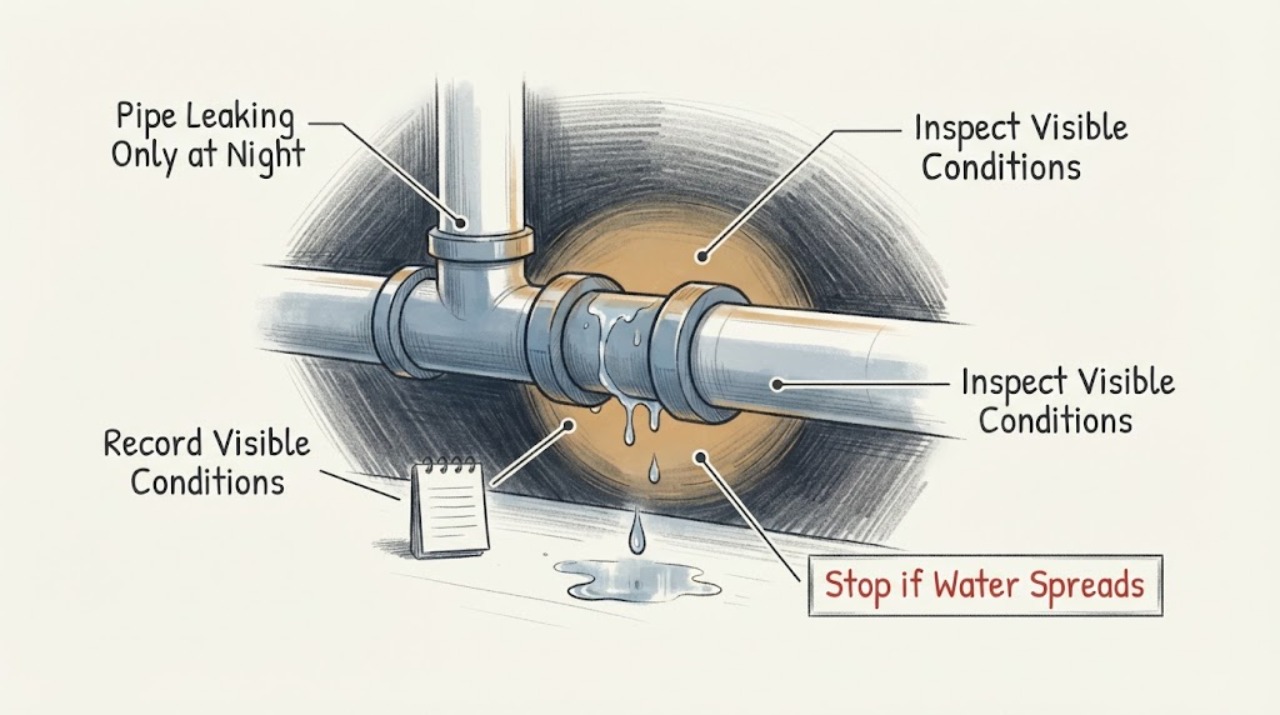
Five drops at night still deserve a controlled diagnosis because the water may be a pressurized pipe leak, condensation, a drain or appliance event after evening use, or a slow leak hidden behind a wall. Do not loosen a fitting or open a pipe under pressure. Dry the area, place a clean piece of paper beneath the first wet point, photograph or mark its position, and record whether the drops return after all water use stops. Check the water meter only if it is safely accessible and no one needs water during the observation. If the paper wets again, the meter moves with all use stopped, the wall or floor is damp, moldy, soft, or discolored, or water is near electricity, close the nearest safe shutoff if it operates normally and call a plumber. Use emergency help for a rapidly growing leak or flooding.
Work through in order
Diagnostic checks
Use only checks that match the exact appliance or system and its official guide.
-
Check 1
Dry the visible area completely when it is safe, then place clean, dry paper or a towel beneath and beside the suspected pipe without wrapping it around the pipe or loosening anything. Mark the first wet point and record the time, room, weather, and whether the surface is cold.
Expected result: Water may reappear at one joint, travel along the pipe from a higher point, appear on a cold surface without a clear joint, or fail to return during the observation.
Next step: Keep the paper in place for the next safe observation period. If the wall, floor, ceiling, or cabinet becomes wet, soft, stained, or moldy, stop tracing and call a plumber.
Why this matters
Why: The first wet point is more diagnostic than the lowest puddle. A cold surface with diffuse moisture keeps condensation in the branch, while a repeatable bead at a joint supports a connection leak.
-
Check 2
Write down the last evening water events, including showering, laundry, dishwasher use, hot-water use, toilet use, or a nearby drain, and compare them with the first time the paper becomes wet. Do not run an extra fixture or open a fitting to reproduce the drops.
Expected result: The drops may follow one use and stop after drainage, appear after hot or cold water changes, or return with no household water event.
Next step: Record the lag and recurrence instead of guessing the source. If the drops return despite no water use, continue with the safe meter observation and arrange plumbing service.
Why this matters
Why: A post-use pattern can point to condensation, a drain or appliance connection, or pressure settling rather than a constantly flowing supply leak. A drip with no use pattern keeps an active pipe or concealed leak more likely.
-
Check 3
If the water meter is safely accessible, stop all indoor and outdoor water use, including automatic appliances, and observe the meter's flow indicator or record its reading. Do not enter a wet meter area or operate a stiff valve.
Expected result: The indicator may stop when use stops, continue moving, or be too small or inaccessible to read confidently.
Next step: If flow continues, keep water use off as practical and call a plumber; if the meter is inaccessible or the result is uncertain, do not excavate or open walls and provide the uncertainty to the plumber.
Why this matters
Why: A continuing indicator with all use stopped supports an active leak somewhere on the property, but a stopped indicator does not rule out a drain, condensation, or very small intermittent leak. Utility guidance uses meter movement and reading changes to identify hidden flow.
-
Check 4
From a dry, safe position, inspect only visible surfaces around the pipe for a ring at a fitting, corrosion, a loose-looking support, water tracking, peeling finish, swollen material, staining, or mold. Do not touch wet electrical equipment, concealed surfaces, or a fitting that would require tools.
Expected result: A localized ring or corrosion may be visible at the connection, while a broad stain, soft material, or water emerging from a wall or ceiling suggests hidden spread.
Next step: Keep the area dry and arrange a plumber for any recurring wetness, concealed spread, corrosion, or material damage. Do not cut into the wall or tighten a pressurized joint.
Why this matters
Why: Visible connection evidence helps a plumber choose the access point, but hidden moisture can travel and the lowest visible drop may not be the source. EPA warns that repeated wetting in concealed plumbing areas can cause damage and mold.
-
Check 5
Compare the drip with temperature and pressure context without changing the system: note whether the pipe is a cold-water line, whether the room becomes humid overnight, whether a pressure regulator or water-heater event was noticed, and whether the drops occur only after a fixture drains.
Expected result: The surface may be cold and broadly wet, the drip may follow pressure or hot-water activity, or a joint may bead independently of temperature and use.
Next step: Add the pattern to the plumber's handoff and do not change a pressure regulator, water-heater connection, or concealed valve yourself.
Why this matters
Why: Cold-surface moisture supports condensation; a repeatable joint bead supports a leak. Pressure-related recurrence or a water-heater connection needs professional assessment rather than an adjustment by the occupant.
-
Check 6
Prepare a service record with the exact pipe location, the condition “only at night and about 5 drops of water,” first wet point, paper result, evening-use timing, meter result, temperature or humidity observations, wall or floor condition, and any safe photos. Do not remove insulation, open a wall, or disassemble a pipe.
Expected result: The record may show condensation, a post-use event, a visible joint leak, a hidden leak, or an intermittent result that has not yet repeated.
Next step: Call a plumber for any repeated drip or uncertain source. If water is spreading, close the nearest normally operating safe shutoff and seek urgent help without forcing it.
Why this matters
Why: A precise timeline prevents a small symptom from being dismissed and helps the plumber distinguish supply, drain, fixture, and building-moisture paths.
Use your observations
Decision map
Find the observation that best matches what you see, then follow the next safe action.
-
PATH 01Next step
What you see
The paper wets again at a joint or the meter shows flow while all water use is stopped.
Do this next
Treat it as an active plumbing leak, limit water use, use a normally operating safe shutoff if needed, and call a plumber; do not loosen the joint under pressure.
-
PATH 02Next step
What you see
The pipe is cold, broadly damp, and no distinct joint bead or meter movement appears.
Do this next
Condensation remains possible, but dry the area and monitor for recurrence or building damage; call a plumber if wetting continues or materials are affected.
-
PATH 03Next step
What you see
The drops appear only after an evening shower, appliance cycle, hot-water event, or drain use.
Do this next
Record the delay and inspect only visible, dry surroundings; have a plumber assess the related drain, fixture, or connection if the drops recur.
-
PATH 04Next step
What you see
Water appears from a wall, ceiling, floor, cabinet, or damaged surface, or mold or a soft area is present.
Do this next
Stop tracing the source, keep the area dry and away from electrical equipment, and call a plumber promptly for concealed leak assessment.
-
PATH 05Next step
What you see
The meter cannot be accessed safely, the result is inconclusive, or the leak appears to be between the meter and the building.
Do this next
Do not enter a hazardous meter area or excavate. Contact the water utility for responsibility guidance and a plumber for private pipe diagnosis.
-
PATH 06Next step
What you see
The flow increases, the shutoff will not operate normally, water reaches electrical equipment, or flooding begins.
Do this next
Move people away, use only a safe normally operating shutoff without force, and obtain urgent plumbing or emergency help; do not work in standing water.
Helpful context
Understand the symptom
“Only at night” describes when the water is noticed, not necessarily when it starts. Evening showers, laundry, a dishwasher, a water heater, cooling surfaces, pressure changes, and a slow supply leak can all leave a few drops after the house becomes quiet. First find the first wet point and separate water arriving from above, along the pipe, or from a joint.
Use a dry paper marker and a written time log rather than tightening fittings to see whether the symptom returns. A single damp surface does not prove the pipe is leaking: EPA moisture guidance notes that condensation on cold-water lines can also wet nearby building materials, while repeated wetting can support mold or damage.
Keep the investigation away from wet electrical equipment and concealed plumbing. A plumber can isolate the line, evaluate pressure and hidden damage, and repair the correct connection without asking you to work on pressurized piping.
Safety boundary
Stop conditions
- Stop for rapidly rising flow, flooding, a shutoff that will not operate normally, water near outlets or electrical equipment, a soft or collapsing surface, or suspected concealed water damage.
- Do not loosen, cut, drill, or disassemble a pipe or fitting under pressure, and do not use tools on a brittle or seized connection.
- Do not enter standing water near electrical equipment, operate wet equipment, or use electrical devices in the damp area.
- Do not dismiss repeated night-time drops because the volume is small; recurring wetting can damage walls, floors, ceilings, and concealed spaces.
- Call a plumber for a recurring or uncertain source, a hidden leak, pressure-related recurrence, corrosion, mold, or any repair beyond a safe visible observation.
When checks do not resolve it
Need a professional?
Call a plumber when the paper wets again at a pipe connection, the meter indicates flow with all use stopped, the source is hidden or uncertain, the drip recurs after pressure or evening use, or nearby materials are stained, soft, swollen, or moldy. Use the water utility when the meter or street-side supply may be involved. Treat flooding, water near electrical equipment, or a shutoff failure as urgent.
Have this ready
- Provide the pipe location, exact night-time condition, first wet point, paper and timing record, evening water events, meter result, temperature or humidity context, visible corrosion, wall or floor damage, and safe photos.
Common questions
FAQ
Can five drops of water at night really be a pipe leak?
Yes, but it may also be condensation or water left after an evening fixture or drain event. Dry the area, mark the first wet point, record the timing, and use a safe meter observation if available rather than loosening the fitting.
How can I tell condensation from a leaking pipe?
Condensation is more likely when a cold surface is broadly damp without a distinct joint bead and the meter shows no ongoing flow. A repeatable wet joint or meter movement with all use stopped supports an active leak; a plumber should resolve uncertainty.
Should I tighten the pipe connection to stop the drip?
Do not tighten or disassemble a pressurized fitting, especially if it is brittle, corroded, hidden, or near electricity. Record the wet point and have a plumber isolate and repair it safely.
What does it mean if the water meter moves at night?
With all indoor and outdoor use stopped, a continuing flow indicator or changed reading supports water passing through the property. Do the check only when the meter is safely accessible, then contact a plumber or the utility according to location.
When is a small night-time drip urgent?
Treat it as urgent if flow increases, water reaches electricity, a wall or floor becomes soft or stained, mold appears, the shutoff will not work normally, or flooding starts. Keep clear and seek plumbing or emergency help rather than working in the wet area.
Read the exact guide
Official sources
- Moisture Control GuidanceU.S. Environmental Protection Agency · Plumbing leaks, condensation on cold-water lines, concealed moisture, building damage, and mold risk
- How to Check for LeaksOtay Water District · Small household leak detection, safe meter access, flow indicators, location clues, and utility versus private plumbing responsibility
- Leak Detection and Flow Monitoring DevicesU.S. Environmental Protection Agency WaterSense · Household leak causes, unexpected moisture, flow monitoring, and water-damage prevention
- Is there a leak on your supply pipe?Yorkshire Water · Safe water-meter leak check, stop-tap caution, small leak reading changes, and supply-pipe escalation
- Checking Water LeaksCity of Miramar Water Billing Division · Household leak meter checks, visible fittings, intermittent water use, and hidden leak escalation
- Home MaintenanceU.S. Environmental Protection Agency WaterSense · Home leak monitoring, water-meter observation, service pressure context, and visible plumbing leak checks
Community feedback
Share a repair observation
Share a plain-text repair observation. Accepted observations are published automatically; this page may take a moment to update.