
On this page
Start here
Quick answer
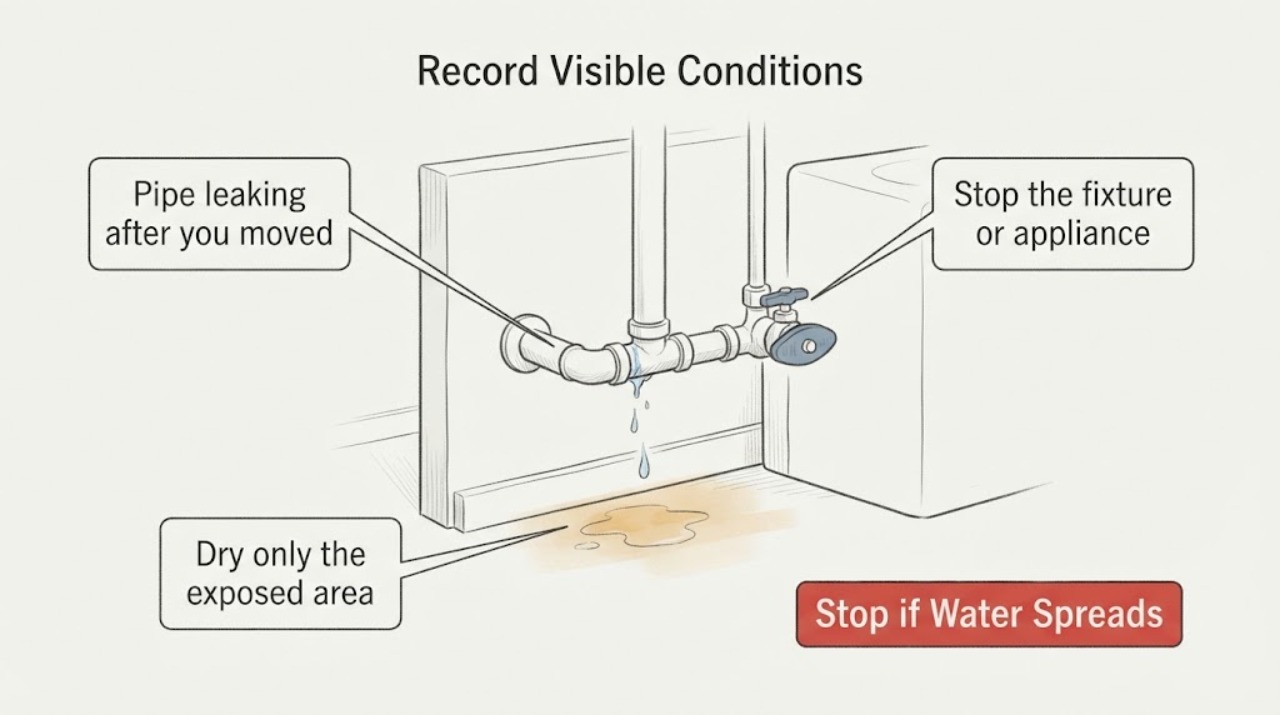
Stop using the affected pipe, close the nearest safe shutoff or the main water valve if needed, and keep the area away from wet electrics. Dry the accessible area and find the first wet point: a shifted coupling, stressed supply joint, drain connection that leaks only during use, or water emerging from a wall or floor. Do not tighten or rebuild a pressurized connection, open a wall to chase water, or keep testing the pipe. A major spray, hot-water leak, sewage, structural dampness, or water near electrical equipment needs urgent plumbing help.
Work through in order
Diagnostic checks
Use only checks that match the exact appliance or system and its official guide.
-
Check 1
Stop the fixture or appliance using the moved pipe, close the nearest clearly identified shutoff from a dry safe position, and close the main water valve if the local valve does not stop the leak; keep away from wet electrical equipment.
Expected result: A leak that stops after the local valve closes is likely on that isolated branch. A leak that continues, sprays, or cannot be isolated means the section remains pressurized or the shutoff is not controlling the source.
Next step: Leave the water isolated for a continuing leak, damaged valve, unsafe floor, hot-water line, sewage, or water near electrics, and call a plumber. Do not reopen the line to keep testing.
Why this matters
Why: Isolation limits water damage and separates an active supply leak from a drain leak that appears only when water is discharged.
-
Check 2
Dry only the exposed area and watch from a safe position for the first returning wet point at the moved pipe, coupling, valve, fitting, wall penetration, floor, or ceiling; do not remove insulation or cut a surface.
Expected result: Moisture at a moved joint supports an alignment, seal, or fitting branch. Water appearing above, inside a wall, or below the visible section means the visible pipe may only be carrying water from a concealed leak.
Next step: Photograph the location and keep the line isolated. Request a plumber for any joint leak, and add qualified water-damage or structural help when moisture has entered a wall, floor, ceiling, or insulation.
Why this matters
Why: The first wet point distinguishes an accessible connection repair from a hidden leak or building-moisture assessment.
-
Check 3
Without touching the connection, note whether the leak is constant, begins only when a faucet or appliance uses water, or appears only when a drain discharges; record whether the water is hot, clear, cloudy, or has a sewage odor.
Expected result: A constant drip or spray from a supply pipe points to a pressurized connection. A leak only during use points toward a drain or waste connection. Hot water, cloudy water, or sewage odor increases the burn, contamination, and damage risk.
Next step: Keep hot or contaminated lines out of service and request plumbing help. Do not handle sewage, test unknown water with bare hands, or keep operating the fixture to reproduce the leak.
Why this matters
Why: Flow timing and water character separate supply, drain, and contaminated-water branches without requiring a pressure test or pipe opening.
-
Check 4
Inspect the moved pipe only from the outside for a bent section, visible gap, cracked fitting, pulled support, corrosion, staining, or a pipe that is bearing against a wall or electrical equipment; do not force it back into position.
Expected result: A visible displacement or unsupported span can explain why the leak began after movement. A pipe that crosses or bears on electrical equipment, or a fitting that shifts under normal use, needs professional correction.
Next step: Leave the pipe untouched and provide the observations to a plumber. Do not apply sealant over an active joint or use a clamp as a permanent repair without a qualified assessment.
Why this matters
Why: Plumbing routing must preserve access and avoid loading electrical equipment; restoring alignment may require cutting, support, or code-compliant reconnection.
-
Check 5
Check the area around the moved line for persistent dampness, staining, softened material, mold odor, a rising water-meter reading when all fixtures are off, or a leak-detection alert; do not enter a flooded or unsafe space.
Expected result: Persistent moisture or flow with all fixtures off supports an ongoing concealed or supply leak. Damp building cavities can lead to rot and structural damage even when the exposed joint looks dry.
Next step: Keep water isolated and arrange a plumber plus qualified water-damage assessment when hidden moisture is suspected. Do not open walls or ceilings as a DIY leak search.
Why this matters
Why: A repair option must include both the plumbing source and any building material that has remained wet; drying the visible puddle alone is not a repair.
-
Check 6
Prepare the repair handoff with the pipe location and material if known, what was moved and why, the first wet point, shutoff result, flow timing, water character, photos, and any electrical or structural impact; leave the line isolated until assessed.
Expected result: A clear accessible joint may need resealing or replacement. A misaligned or unsupported run may need a plumber to reroute or support it. A hidden or recurring leak may need tracing and building drying before the pipe is restored.
Next step: Call a plumber for repair or rerouting, and request urgent help for a major leak, sewage, hot water, structural damage, or water contacting electrical equipment. Do not re-pressurize the moved line for a final test yourself.
Why this matters
Why: These are different repair options with different access and safety requirements; the movement history is important evidence for finding stress or installation error.
Use your observations
Decision map
Find the observation that best matches what you see, then follow the next safe action.
-
PATH 01Next step
What you see
The leak is constant and starts at an accessible moved supply joint or fitting.
Do this next
Arrange qualified service and follow the exact model guidance.
Why this path and its safety boundary
Why it matters: Keep the branch or main water isolated and have a plumber repair the alignment, seal, fitting, or support; do not tighten or rebuild it under pressure.
-
PATH 02Next step
What you see
The leak appears only when a fixture or appliance discharges water.
Do this next
Arrange qualified service and follow the exact model guidance.
Why this path and its safety boundary
Why it matters: Treat it as a drain or waste connection branch, stop using that fixture, and call a plumber for the moved connection and any backup.
-
PATH 03Next step
What you see
The visible pipe is dry but water appears in a wall, floor, ceiling, or insulation, or the meter indicates flow with fixtures off.
Do this next
Arrange qualified service and follow the exact model guidance.
Why this path and its safety boundary
Why it matters: Keep water isolated and obtain leak tracing, plumbing repair, and qualified water-damage assessment; do not open the building surface yourself.
-
PATH 04Next step
What you see
The pipe is bent, unsupported, rubbing on structure, or routed across electrical equipment after it was moved.
Do this next
Arrange qualified service and follow the exact model guidance.
Why this path and its safety boundary
Why it matters: Do not force it back or add an improvised permanent clamp. Request a plumber to restore routing, support, access, and code-compliant connections.
-
PATH 05Next step
What you see
A major spray, hot water, sewage, flooding, structural damage, smoke, electrical odor, sparking, or water near electrical equipment is present.
Do this next
Arrange qualified service and follow the exact model guidance.
Why this path and its safety boundary
Why it matters: Stop immediately, keep people away, isolate utilities only if safe, and obtain urgent plumbing, electrical, water-damage, or emergency help as appropriate.
Helpful context
Understand the symptom
Moving a pipe can load a joint, pull a washer or seal out of alignment, crack a fitting, or disturb a concealed connection. It can also make an existing leak visible. The practical options are to isolate and repair an accessible connection, have a plumber restore support and alignment, or obtain a concealed-leak and building-damage assessment. The right option depends on the first wet point, not on the size of the puddle.
Supply piping remains pressurized even when a nearby faucet is closed. Drain piping can release contaminated water when a fixture is used. Do not open a wall, pull a pipe farther, loosen a union, or use a wet area for electrical work while trying to identify the cause.
Safety boundary
Stop conditions
- Stop immediately for a major or uncontrolled leak, hot water, sewage, a flooded area, damp walls or ceilings, structural damage, water near electrical equipment, a hot or damaged electrical panel, smoke, electrical odor, or sparking.
- Do not re-pressurize a moved leaking line, loosen a pressurized fitting, force a pipe into alignment, open a wall, use a wet area for electrical work, or cover an active joint with sealant as a permanent repair.
Only after diagnosis
Potential parts
- pipe coupling, gasket, or seal
Consider only after a plumber confirms that the moved joint is the leak boundary and identifies the connection design.
Confirm pipe material, joint type, dimensions, pressure use, and local requirements; do not select a seal from the leak symptom alone. - pipe support or approved rerouting hardware
Consider only when a plumber confirms that movement or stress on the pipe run caused the leak and a support or reroute is appropriate.
Support, access, clearances, and connection methods must match the existing system and local code; improvised clamps are not a complete repair.
Common questions
FAQ
Why did a pipe start leaking after I moved it?
Movement can pull a joint out of alignment, stress a seal or fitting, damage a pipe, or disturb a concealed connection. It can also reveal an older weakness. Isolate water and find the first wet point before choosing repair or rerouting.
Can I tighten the leaking connection after moving the pipe?
Do not tighten or rebuild a pressurized connection as a guess. Close the nearest safe shutoff, keep the area dry, and have a plumber assess the joint, seal, material, support, and alignment.
What if the pipe leak is inside a wall or floor?
Keep water isolated and arrange plumbing leak tracing and qualified water-damage assessment. Hidden moisture can damage building materials; opening the wall yourself may increase the hazard and repair scope.
Read the exact guide
Official sources
- NIST Reference Building Plumbing Models Plumbing DrawingsNational Institute of Standards and Technology · Plumbing routing, existing-system verification, access, and code-compliant installation guidance
- Leak Detection and Flow Monitoring DevicesU.S. Environmental Protection Agency · Household leak causes, moisture detection, and damage reduction
- Water Shut OffNew York City Department of Environmental Protection · Main water shutoff guidance
- Home MaintenanceU.S. Environmental Protection Agency · Household leak detection and plumber escalation guidance
- Addressing Indoor Environmental Concerns During RemodelingU.S. Environmental Protection Agency · Plumbing leak, moisture, structural damage, and combustion-safety boundaries during remodeling
Community feedback
Share a repair observation
Share a plain-text repair observation. Accepted observations are published automatically; this page may take a moment to update.