
On this page
Start here
Quick answer
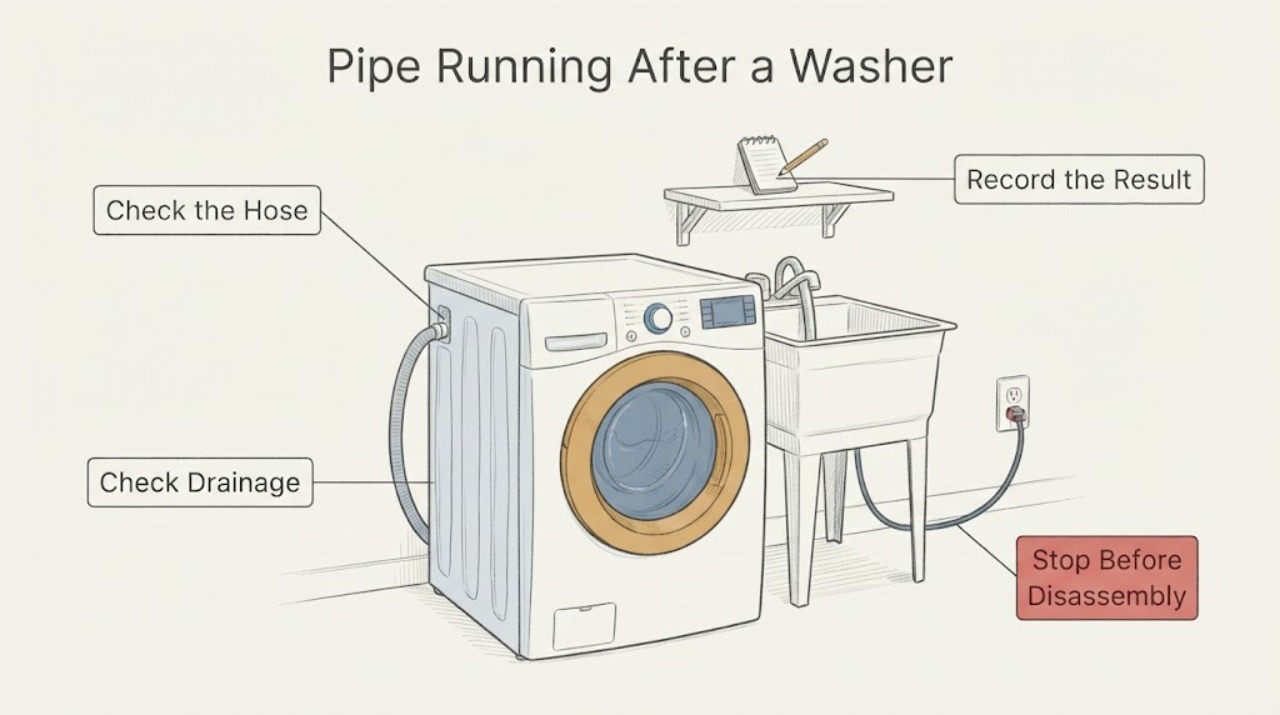
If a pipe sounds as though it is still running after the washer drains, first establish whether the sound is the washer pump finishing a routine, water being pulled through the washer hose, or a drain that is slow, backing up, or continuing to flow. Watch the standpipe or laundry tub without opening the plumbing, note whether the washer pump has stopped, and inspect the visible hose routing only after the area is dry. A hose that is too deep, too low, kinked, or sealed to the standpipe can create siphoning, while rising water, gurgling at several fixtures, sewage, or an overflow points to a plumbing blockage. Stop the washer and call a plumber when water is escaping, the condition persists after the external checks, or electrical and wastewater hazards are present.
Work through in order
Diagnostic checks
Use only checks that match the exact appliance or system and its official guide.
-
Check 1
During the next safe observation, stand clear of the washer and mark when the drain cycle ends. Listen at the washer, the drain hose, the wall standpipe or laundry tub, and nearby fixtures without touching the pipe or opening a connection.
Expected result: The washer pump may run for a limited routine and then stop, while a pipe sound can continue after the pump stops. A gurgle, rushing sound, rising water, or silence at the washer but flow in the pipe are distinct patterns.
Next step: Use Action 2 to watch the receiving drain and compare nearby fixtures. Stop the washer immediately if water rises, spills, smells like sewage, or reaches electrical equipment.
Why this matters
Why: If the pump and water stop together, the sound may be routine. If water or sound continues after the pump stops, suspect siphoning, a restricted drain, or flow from another fixture rather than assuming the washer motor is still running.
-
Check 2
Watch the standpipe or laundry tub during and just after drainage from a dry, stable position. Note whether the water level rises, drains slowly, returns toward the hose, splashes out, or remains normal; then check whether a sink, toilet, or floor drain gurgles at the same time.
Expected result: A normal receiving drain stays below its rim. Rising or returning water, a spill, slow drawdown, or several fixtures reacting together supports a partial branch or main-line restriction; a normal drain with a continuing washer sound points back to hose routing or the washer pump routine.
Next step: If any receiving fixture backs up or several fixtures react, stop washer use and arrange plumbing service. If the receiving drain remains clear, continue to the external hose check.
Why this matters
Why: A high-volume washer discharge can expose a drain that handles small flows but cannot carry the washer's discharge. Multiple fixtures or a lower drain reacting together are plumbing evidence, not proof of a washer part failure.
-
Check 3
With the washer stopped and the floor dry, inspect only the visible drain hose route. Confirm it is supported by the supplied guide or an equivalent arrangement, is not kinked or crushed, and enters the standpipe or tub loosely rather than being taped or sealed airtight. Do not pull the washer out alone or disconnect a hose containing water.
Expected result: A hose that is too deep, too low, kinked, unsupported, or sealed to the standpipe can cause siphoning or poor drainage. A correctly routed visible hose does not rule out a blocked pipe or an internal pump issue.
Next step: If a simple external routing correction is clearly allowed by the washer manual, make that correction without sealing the opening and observe one safe drain. If the sound or flow remains, stop and call a plumber or appliance technician rather than dismantling the connection.
Why this matters
Why: Whirlpool's opened guidance links continuous draining and water returning to hose insertion, missing air gap, low or excessive standpipe placement, kinks, and blockages. Exact height and insertion limits vary by model, so a manual is required for any measurement.
-
Check 4
Read the washer display and note whether it says drain, fill, pause, or an error, then compare that state with the exact owner guide. Do not repeatedly start cycles to reproduce the sound, and do not access a pump filter or internal hose unless the exact manual gives a safe, water-controlled procedure.
Expected result: A washer that fills and drains continuously, reports a drain issue, or keeps its pump running differs from a washer that finishes while the building pipe continues to gurgle. A normal completion with a clear receiving drain makes an appliance control issue less likely.
Next step: If the washer remains in a drain routine beyond the guide's stated behavior, shows an error, or cannot finish with a clear drain, stop using it and request appliance service. If the washer finishes but the pipe continues running, use the plumbing branch.
Why this matters
Why: Whirlpool documents a drain routine in which the pump can run continuously for a period and controls may not accept input. The washer's display and cycle state help separate that behavior from siphoning or building-drain flow.
-
Check 5
After one observation, check the area for a first wet point, wastewater residue, chemical odor, or water near the washer plug and nearby electrical equipment. Keep the washer off and do not open a drain connection if a chemical cleaner was used or the line may be pressurized by a backup.
Expected result: A dry floor and clear drain support a routing or normal-cycle investigation. Water, sewage, chemical residue, a swollen wall or ceiling, or electrical contact changes the problem to an immediate safety and service call.
Next step: Stop washer use. If it is safe to do so without standing in water, close the washer supply valves and isolate power from a dry position; arrange a plumber for wastewater or drain flow and qualified electrical help for damaged power equipment.
Why this matters
Why: A pipe that runs after a washer discharge can move contaminated water or expose electrical hazards. The absence of a visible spill does not make a slow backup safe to dismantle.
Use your observations
Decision map
Find the observation that best matches what you see, then follow the next safe action.
-
PATH 01Next step
What you see
The washer pump runs briefly as part of a documented drain routine, then the sound and water stop with no rise or overflow.
Do this next
Treat this as a possible normal cycle behavior, but confirm it against the exact washer guide. If the run-on grows longer, repeats outside a drain cycle, or the washer cannot finish, request appliance service.
-
PATH 02Next step
What you see
The washer finishes, but water or a rushing sound continues through the standpipe or hose and the receiving drain stays clear.
Do this next
Inspect visible hose routing for a kink, excessive insertion, low placement, missing air gap, or airtight seal using the exact washer manual. Correct only an obvious external issue; persistent siphoning needs plumbing or appliance service.
-
PATH 03Next step
What you see
The standpipe or laundry tub rises, drains slowly, spills, or sends water back toward the washer.
Do this next
Stop using the washer and keep people away from wastewater. Do not pour mixed chemicals into the line or disconnect a water-filled connection; call a plumber for the branch drain or standpipe.
-
PATH 04Next step
What you see
Several fixtures gurgle, a lower drain reacts, or wastewater backs up when the washer discharges.
Do this next
Treat this as a wider building-drain or main-line warning. Stop using water-producing fixtures and arrange prompt plumbing service; use emergency service if sewage is spreading or the building is at risk of damage.
-
PATH 05Next step
What you see
The washer display remains in a drain state, reports a drain error, or the pump never finishes while the building drain itself remains clear.
Do this next
Stop repeated cycle tests and arrange appliance service. Provide the cycle stage, display state, pump timing, hose routing, and whether the receiving drain stayed clear.
-
PATH 06Next step
What you see
There is overflow, sewage, chemical residue, water near electrical equipment, a damaged cord or receptacle, a swollen wall or ceiling, or a wet area that cannot be isolated safely.
Do this next
Stop the washer immediately and keep clear. Do not stand in water to unplug it or open the drain; isolate water or power only from a dry safe position, then use qualified plumbing or electrical service and emergency help when conditions are urgent.
Helpful context
Understand the symptom
Define what is still running
The sound may come from the washer pump, the drain hose, the wall standpipe, a laundry tub, or a nearby branch drain. A short pump run-on can be part of a washer routine, while a water level that moves back toward the washer or a pipe that gurgles after the pump stops indicates a different path. Record the exact location and whether water is actually moving before changing anything.
Why hose routing matters
Whirlpool's opened installation guidance says siphoning can occur when a drain hose is inserted too far, installed too low, lacks an air gap, or is sealed to the standpipe. Those requirements vary by washer and installation method, so use the exact machine manual for dimensions. The safe homeowner check is external: the hose should be supported, free of kinks, and not airtight at the standpipe.
When the pipe itself is the problem
If the standpipe rises, spills, gurgles at other fixtures, or backs up after a high-volume washer discharge, the issue may be in the branch or main drain rather than the washer hose. Do not pour mixed chemical cleaners into a backed-up line or open a connection that may contain wastewater. Stop using the washer and arrange plumbing service if the flow cannot be contained safely.
Safety boundary
Stop conditions
- Stop the washer for rising or spilling water, sewage, wastewater odor, a backup at more than one fixture, or flow that cannot be contained.
- Stop for water near a plug, outlet, extension lead, or other electrical equipment. Do not stand in water to unplug the washer or reset power.
- Do not mix drain chemicals, open a connection after chemicals were used, force a blocked hose, or disconnect a water-filled line without a safe water-control plan.
- Do not keep restarting the washer to reproduce continuous flow, and do not open the washer cabinet, pump, or wall plumbing as a homeowner test.
Only after diagnosis
Potential parts
- washer drain hose guide or air-break component
Consider this category only if the exact installation instructions call for a missing or damaged routing component and the diagnosis supports siphoning rather than a blocked building drain.
Hose guides, air-break arrangements, and dimensions vary by washer and drain method. Confirm the exact model instructions before selecting anything. - standpipe or branch drain service component
Consider this category only after a plumber identifies a damaged or incorrectly configured receptor, trap, vent, or branch connection.
Drain components must follow local plumbing requirements and the existing system layout; do not infer a replacement from the running sound alone.
When checks do not resolve it
Need a professional?
Request plumbing diagnosis for persistent pipe flow after washer drainage, siphoning that returns after hose routing is corrected, a slow or overflowing standpipe, or any multi-fixture backup.
Common questions
FAQ
Why does my drain pipe sound like it is running after the washer stops?
The sound may be a washer pump routine, siphoning through a hose that is too low or too deep, or a restricted drain. Watch the receiving drain and note whether water continues after the pump stops. Rising water, multiple gurgling fixtures, or an overflow means stop using the washer and call a plumber.
Can a washer drain hose cause continuous water flow?
Yes. Whirlpool identifies excessive insertion, low placement, a missing air gap, an airtight seal, kinks, and blockages as possible contributors to siphoning or continuous draining. Check only the visible routing and use the exact washer manual for dimensions.
Should I run another washer cycle to test the pipe?
Do not keep repeating cycles when water rises, the pipe backs up, the pump never finishes, sewage is present, or water is near electrical equipment. If the receiving drain stays clear, make one safe observation and then call plumbing or appliance service if the flow persists.
Read the exact guide
Official sources
- How to Install a Washing MachineWhirlpool · Whirlpool washing machine drain hose routing, visible hose condition, water connections, and installation safety
- Service Pointer - W10611623 - Drain Hose InstallationWhirlpool · Whirlpool, Maytag, Amana, Admiral, Inglis, Crosley, and Roper washer drain hose installation and siphoning prevention
- Washer Keeps Draining - Commerical Grade Washer - Product HelpWhirlpool · Whirlpool washer drain routine, continuous drain behavior, hose installation, and service escalation
- Continuously Fills / Fills and Drains - Washer - Product HelpWhirlpool · Whirlpool washer continuous draining, siphoning, drain hose air gap, and standpipe placement
Community feedback
Share a repair observation
Share a plain-text repair observation. Accepted observations are published automatically; this page may take a moment to update.