
On this page
Start here
Quick answer
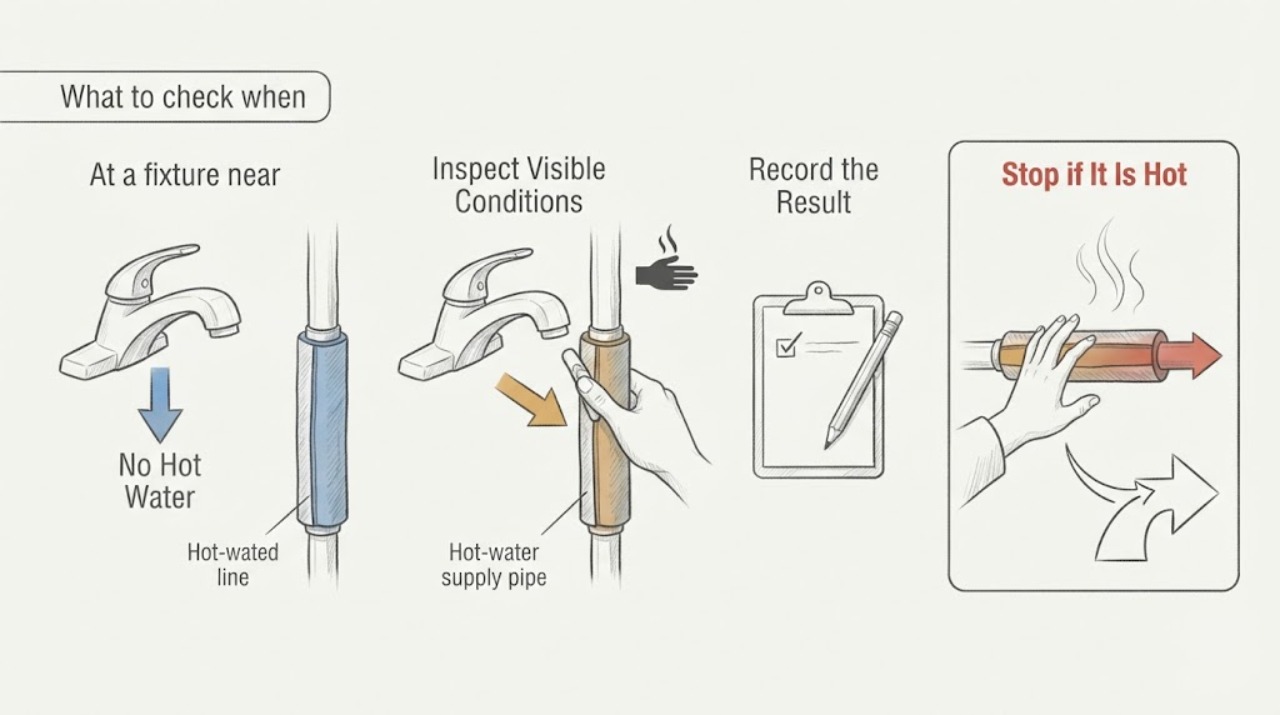
Start by comparing hot-water flow and temperature at more than one fixture. If cold water flows normally but every hot tap is cold, the problem is more likely at the water heater, its heat source, a control, or a mixing arrangement than in one pipe. If only one branch is affected, look for an obvious closed valve, a blocked outlet, a frozen or damaged exposed pipe, or a local mixing fixture while staying outside the cabinet and avoiding scalding surfaces. Visually check the water heater and accessible pipes for leaks, corrosion, frost, or unusual discharge, but do not remove covers, adjust electrical or gas controls, or apply direct heat to a pipe. Stop use and call a qualified plumber or other appropriate professional for a leak, frozen or damaged pipe, unsafe water-heater condition, gas odor, repeated electrical trip, or hot water that does not return after safe external checks.
Work through in order
Diagnostic checks
Use only checks that match the exact appliance or system and its official guide.
-
Check 1
At a fixture near the water heater and at one farther away, open the hot tap briefly and compare the flow with the cold tap. Stop if the water is unexpectedly scalding, discolored, or leaking, and do not use hot tap water for drinking or cooking.
Expected result: If every hot tap has normal flow but stays cold, a shared water-heater or mixing condition is more likely. If cold flow is normal but hot flow is weak or absent at only one fixture, the fault is more likely local to that outlet or branch.
Next step: Record which fixtures were tested and whether the hot flow was absent, weak, or normal. Use the whole-system branch or local-branch checks rather than opening a wall or pipe connection.
Why this matters
Why: The distribution pattern is the quickest way to separate a whole-system heating problem from a single pipe or fixture problem.
-
Check 2
Inspect the water heater from the outside only. Look for water at the tank base or pipe connections, rust-colored or unusual water, corrosion, a visible status indication, or an obvious leak. Do not remove panels, touch wiring, alter a gas control, or change the temperature setting as a test.
Expected result: A leak, corrosion, or abnormal discharge makes this more than a cold-pipe nuisance. If the heater appears intact but all hot fixtures remain cold, the heating element, heat source, control, or a shared mixing device still needs diagnosis.
Next step: Stop using the heater and call a plumber or qualified service professional for any leak, corrosion with moisture, or abnormal discharge. Otherwise continue only with accessible pipe and outlet observations.
Why this matters
Why: Visible water-heater evidence can establish urgency, but the heating components are not identifiable or safe to test from outside.
-
Check 3
For a single affected fixture, inspect the accessible hot-water shutoff and nearby pipe without forcing the handle or loosening a connection. Look for a valve that is clearly closed, a visible kink or crush point, mineral or corrosion buildup, or moisture under the sink or beside the fixture.
Expected result: A clearly closed valve, damaged pipe, or local leak can interrupt hot water to one outlet while other hot fixtures work. No visible issue does not rule out a concealed obstruction, mixing-valve fault, or corroded pipe.
Next step: If a valve position is unclear, stuck, or accompanied by a leak, leave it alone and call a plumber. Do not remove the faucet, aerator, mixing cartridge, or wall covering as part of this check.
Why this matters
Why: The branch can fail independently of the water heater, especially when cold water remains available at that fixture.
-
Check 4
From a safe distance, inspect exposed hot-water piping in an unheated basement, crawlspace, garage, exterior-wall chase, or other accessible area. Look for frost, a split or bulging section, dripping, wet insulation, or a pipe routed where it is exposed to freezing conditions. Do not apply a torch, heating cable, hair dryer, or other direct heat to the pipe.
Expected result: Frost or visible damage can indicate a frozen or burst section and requires a stop response. Dry, intact exposed pipe may still lose heat, but it does not explain a complete whole-home loss without another fault.
Next step: If freezing or damage is suspected, close the water supply or the water-heater inlet only if the valve is clearly accessible and safe, then contact a qualified plumber. Do not force a valve or enter a hazardous crawlspace.
Why this matters
Why: A pipe can lose service because it is frozen or damaged, and thawing or repair can release pressurized water; the condition is not a routine temperature adjustment.
-
Check 5
If all hot fixtures are cold but cold-water flow is normal, note whether the water heater has power or fuel service indicated externally and whether a breaker is tripped. Do not reset a breaker repeatedly, open a service panel, relight a fuel appliance, or test electrical terminals.
Expected result: A missing external power or fuel indication can explain a whole-system loss, but a tripped breaker may signal an equipment fault. Normal external indications do not prove that the heating element, burner, sensor, or control is working.
Next step: Leave a tripped breaker off and arrange appropriate plumbing or electrical service. If there is a fuel odor, smoke, or an unsafe appliance condition, leave the area and seek emergency help; do not continue testing.
Why this matters
Why: The whole-system pattern points to the water-heating system, but safe homeowner observation cannot identify or repair its internal heat source.
-
Check 6
Record the affected fixtures, hot and cold flow comparison, approximate onset, weather or freezing exposure, water color or odor, heater type and visible status, leaks, and any recent plumbing or water-heater work. Keep the water-heater manual and identification information available.
Expected result: A whole-home symptom with no leak supports a shared heater or control investigation; a single-branch symptom or recent pipe work points the professional toward that section; discoloration, corrosion, or a leak raises urgency.
Next step: Give the record to a qualified plumber or water-heater professional. Do not flush, drain, or open the heater unless the manufacturer’s instructions and your skill level make that maintenance appropriate; otherwise leave it to service.
Why this matters
Why: A complete pattern is more useful than a guessed replacement part and helps separate heating, distribution, and safety conditions.
Use your observations
Decision map
Find the observation that best matches what you see, then follow the next safe action.
-
PATH 01Next step
What you see
Cold water flows normally, hot water has normal flow but is cold at every fixture.
Do this next
Keep the heater cabinet closed and arrange a plumber or qualified water-heater professional to diagnose the heat source and controls. Do not raise the setting or reset a tripped protection device as a repeated experiment.
Why this path and its safety boundary
Why it matters: The shared water-heating system, heat source, control, or mixing arrangement is more likely than one isolated pipe.
-
PATH 02Next step
What you see
Hot water works at other fixtures but is weak or absent at one outlet.
Do this next
Inspect only the accessible valve and pipe for an obvious position, kink, leak, or buildup. If nothing is clear, have a plumber diagnose the local branch without opening walls or removing the fixture.
Why this path and its safety boundary
Why it matters: A local shutoff, mixing fixture, aerator or outlet restriction, corrosion, or branch-pipe problem is more likely.
-
PATH 03Next step
What you see
An exposed hot-water pipe is frosted, split, bulging, or leaking.
Do this next
Do not apply direct heat. If safely accessible, close the water supply or water-heater inlet without force and contact a qualified plumber; otherwise leave the area alone and seek service.
Why this path and its safety boundary
Why it matters: The pipe may be frozen or damaged, and thawing can release water through a hidden break.
-
PATH 04Next step
What you see
Hot-water flow is reduced at several outlets, with corrosion, sediment, or an unusual water color.
Do this next
Stop treating this as a temperature-setting problem and arrange plumbing or water-heater service. Do not drain the heater or remove fittings without the model instructions and appropriate skill.
Why this path and its safety boundary
Why it matters: Corrosion or sediment in the tank, water heater, or hot-water piping may be restricting flow or affecting water quality.
-
PATH 05Next step
What you see
There is a tank or pipe leak, abnormal relief-valve discharge, gas odor, smoke, repeated electrical trip, or uncertainty about safe isolation.
Do this next
Stop using the water-heating system. If the water shutoff or power isolation is clearly reachable without wet or hazardous contact, close it or disconnect it; otherwise keep clear, leave the area for a gas or smoke hazard, and contact the appropriate emergency or qualified service professional.
Why this path and its safety boundary
Why it matters: This is an immediate professional or emergency safety boundary.
Helpful context
Understand the symptom
Use flow and location to narrow the fault
A pipe itself does not create hot water; it carries water heated elsewhere. Compare a fixture near the water heater with one farther away, and compare hot flow with cold flow at each. Hot water missing everywhere points toward the water-heating system or a shared control, while normal hot water at some fixtures points toward a local valve, mixing fixture, obstruction, or damaged section of pipe. Long or poorly insulated runs can also lose heat before the water reaches an outlet.
Keep the check visual and avoid scalding hazards
Look for leaks, corrosion, frost, or a water-heater condition that is visibly abnormal. Do not touch an uninsulated hot pipe, remove a water-heater access cover, adjust an electrical or gas control, operate a pressure-relief valve as a troubleshooting shortcut, or thaw a suspected frozen pipe with a flame or other direct heat. Hot-water systems can contain stored heat and pressure; unclear or unsafe conditions belong with a plumber or qualified service professional.
Do not choose a part from a cold tap alone
A heating element, mixing valve, pipe section, insulation, or other component may be relevant only after the affected section and water-heater condition are established. A part that fits one system may be wrong for another, and raising the water-heater setting can create a scalding hazard. A professional can diagnose the source and select a compatible repair while accounting for local requirements and the system design.
Only after diagnosis
Potential parts
- water-heater heating element or heat-source component
Consider this only after a professional confirms that hot water is absent throughout the system and the heater’s heat source has failed; a local cold branch, mixing issue, or pipe restriction does not identify this part.
Confirm the heater type, model, electrical or fuel configuration, and manufacturer fit information before selecting an internal component. - thermostatic mixing valve
Consider this only when a professional confirms that the heater produces hot water but a shared mixing valve is reducing outlet temperature or flow.
Mixing-valve selection and anti-scald settings depend on the plumbing layout and local requirements; have a qualified professional confirm the installation and adjustment. - hot-water pipe insulation
Consider this only for an intact, accessible pipe that loses heat in an unheated area after the active no-hot-water fault is resolved; insulation will not repair a frozen, leaking, or blocked pipe.
Confirm the pipe material, location, heat exposure, and safe insulation method before fitting material around the pipe.
When checks do not resolve it
Need a professional?
Arrange service when hot water is absent throughout the home, one branch remains cold after safe visual checks, a pipe is frozen or leaking, or any heater safety symptom appears.
Common questions
FAQ
Why is there no hot water in one pipe but other taps are hot?
That pattern points more toward a local shutoff, mixing fixture, obstruction, corrosion, or branch-pipe issue than a whole-home heater failure. Inspect only the accessible valve and pipe for an obvious problem, then call a plumber if the cause is not clear.
What if every hot tap is cold but cold water works?
A shared water-heater heat source, control, or mixing arrangement is more likely. Check the heater only from outside for leaks or abnormal conditions and arrange qualified service rather than opening panels or adjusting controls.
Can a frozen hot-water pipe cause no hot water?
Yes. Frost, a split, bulging, or leaking exposed pipe is a stop condition. Do not apply direct heat; close a clearly accessible water shutoff without force if safe and contact a qualified plumber.
Should I turn up the water-heater temperature to restore hot water?
No. A higher setting can create a scalding hazard and does not diagnose a failed heater, mixing valve, or blocked pipe. Have the system diagnosed and adjusted according to the equipment instructions and local requirements.
Read the exact guide
Official sources
- Home MaintenanceU.S. Environmental Protection Agency · Used for visual leak checks, hot-water-system maintenance, pipe insulation as heat-loss control, pressure context, and professional service boundaries.
- Maintaining your water heaterCity of Portland, Oregon · Used for distinguishing water-heater heating problems from pipe or flow symptoms, visual leak and corrosion checks, and the boundary around heating-element and maintenance work.
- Cold Weather SolutionsPhiladelphia Water Department · Used for identifying frozen or damaged hot-water pipes, avoiding direct heat, safe shutoff guidance when a pipe breaks, and professional repair.
Community feedback
Share a repair observation
Share a plain-text repair observation. Accepted observations are published automatically; this page may take a moment to update.