
On this page
Start here
Quick answer
When shower temperature changes as a toilet, sink, dishwasher, or washer runs, the immediate trigger is usually a change in hot or cold water flow or pressure on the shared plumbing system. Pressure-balancing and thermostatic shower valves are designed to compensate, but a valve, cartridge, supply imbalance, restricted showerhead, hot-water capacity, or plumbing layout can still cause a noticeable change. Stop the shower and test the water with your hand before re-entering; a sudden hot surge or cold drop is a scald or slip risk. Without opening the wall, note which fixture caused the change, whether the shower flow also drops, whether the issue affects every shower use, and the shower valve model. Do not adjust a hidden valve, remove a cartridge, change water-heater or gas settings, or repeatedly provoke a temperature swing. Arrange plumbing service when the change is large, persistent, occurs without another fixture, or the valve cannot maintain safe temperature.
Before you begin
Safety first
- The plumber should determine whether the cause is shared pressure, a pressure-balance cartridge or thermostatic valve, showerhead restriction, hot-water source, local supply, pipe sizing, or broader plumbing branch before selecting parts.
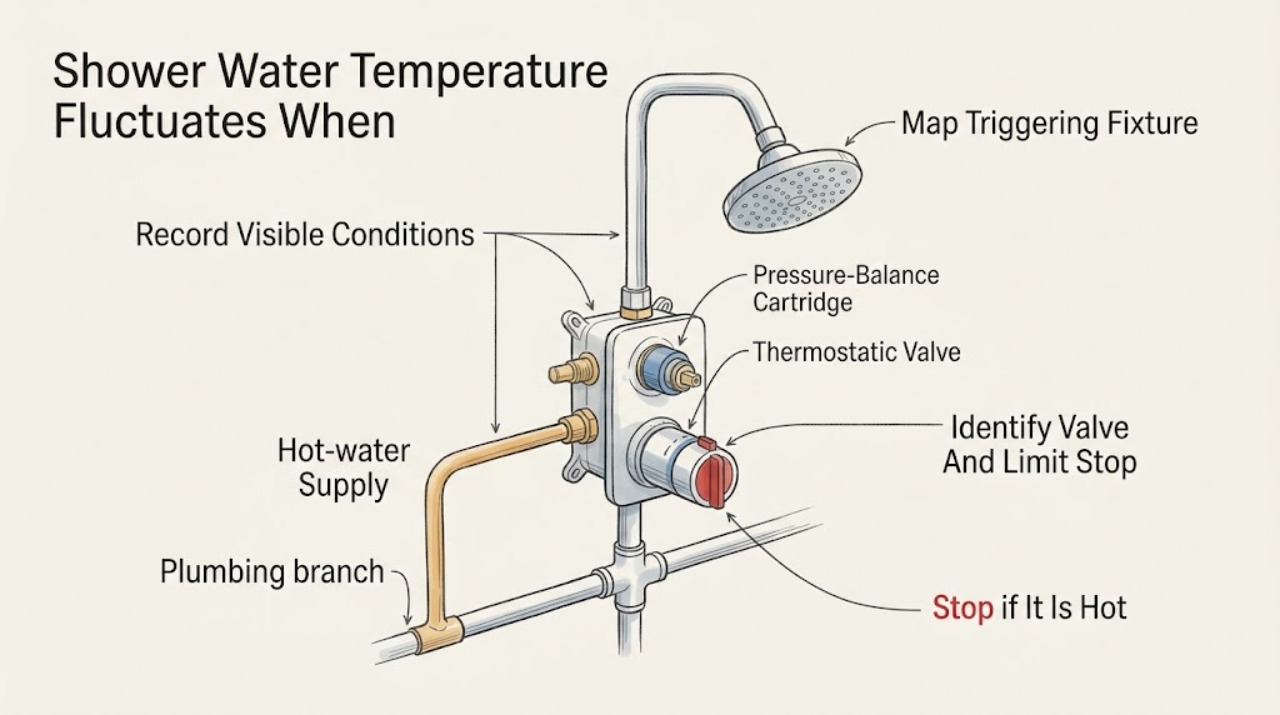
Work through in order
Diagnostic checks
Use only checks that match the exact appliance or system and its official guide.
-
Check 1
Stop bathing when the temperature changes, check the water with your hand from a safe position, and record whether it became hotter, colder, weaker, or stronger when the other fixture ran; do not deliberately create the event while someone is under the spray.
Expected result: The water becomes suddenly hot, suddenly cold, loses flow, gains flow, or the direction and trigger are unclear.
Next step: Keep the shower out of use until the pattern is understood. Record the other fixture and timing from outside the shower and arrange service for a severe, recurring, or unsafe swing.
Stop if: Do not remain under a changing spray, ask another person to operate fixtures for a live test, or continue if the bather could be scalded or lose balance.
Why this matters
Why: A hot surge is a scald risk; a cold drop or flow loss points to a pressure or supply change; a change in both temperature and flow keeps the mixing valve, showerhead, and shared branch in focus. An unclear event needs documentation rather than repeated exposure.
-
Check 2
From outside the shower, list which fixture caused the change—such as a toilet, sink, washer, or dishwasher—and whether it draws hot water, cold water, or discharges water; do not operate fixtures with a person bathing.
Expected result: Only one nearby fixture triggers the change, several fixtures trigger it, the event follows hot-water use, or it occurs even when no other fixture runs.
Next step: Keep a short event log and give it to a plumber. Do not repeatedly operate fixtures to reproduce a potentially unsafe temperature change.
Stop if: Do not test by flushing or opening fixtures while bathing, and do not alter the main supply, pressure regulator, or water-heater controls.
Why this matters
Why: One trigger keeps a local branch, supply, or valve response in focus; several triggers make a shared pressure-balance or hot-water capacity issue more likely. A fluctuation with no other draw points away from the stated trigger and toward the shower valve, showerhead, heater, or plumbing system.
-
Check 3
Photograph the shower handle and trim, note any visible pressure-balance or thermostatic marking, and locate the model information without removing the trim or opening the wall; do not adjust a temperature limit stop unless the exact manual directs a safe user adjustment.
Expected result: The valve model and type are known, the trim has a temperature limit feature, only the brand is known, or the valve cannot be identified.
Next step: Use the model manual or provide the photos to a plumber. Have a professional evaluate the cartridge, balancing spool, limit stop, and supply pressure when identification is uncertain.
Stop if: Do not remove the handle, trim, cartridge, balancing spool, or wall cover, and do not force a seized temperature control.
Why this matters
Why: The valve type determines whether pressure or outlet-temperature compensation is expected and which cartridge or service procedure applies. Handle appearance alone cannot establish the internal valve or a compatible repair.
-
Check 4
With the shower off and cool, inspect the visible showerhead face and hose for scale, blockage, kink, or damage; clean only an accessible showerhead according to its manual and do not remove flow-control parts as a temperature test.
Expected result: The showerhead is visibly restricted, flow is weak even without another fixture, flow is normal until another fixture runs, or the head cannot be serviced safely.
Next step: Restore only a clean, correctly assembled accessible head. If the temperature still changes, the valve, supply, heater, or pipework requires plumbing diagnosis.
Stop if: Do not use tools on a seized head, remove internal screens without instructions, or continue using a shower that delivers unsafe temperature.
Why this matters
Why: A restricted head can reduce or destabilize shower flow and change how a mixing valve responds, while normal flow until another fixture runs keeps the shared pressure or valve response in focus. A concealed or damaged head needs service rather than force.
-
Check 5
When no one is bathing and the area is safe, note whether the shower starts at a stable temperature, whether the change occurs only after hot-water use elsewhere, and whether other faucets also show pressure or temperature changes; do not change water-heater or gas settings.
Expected result: The shower changes only during simultaneous hot-water use, changes when any fixture runs, other fixtures are also affected, or only the shower is affected.
Next step: Document the pattern and arrange a plumber to assess the hot-water source, pressure balance, valve, and pipework. Do not attempt to raise heater settings or open a valve body.
Stop if: Do not adjust gas, electric, or water-heater controls, test hidden pressures, or keep using the shower while temperature control is unreliable.
Why this matters
Why: Hot-water-only changes can keep water-heater capacity or hot supply in focus; changes with any fixture keep shared pressure, mixing-valve compensation, or plumbing branch in focus. A shower-only issue makes its valve, cartridge, head, or local supply more likely.
-
Check 6
Prepare a service record with valve and showerhead photos, the triggering fixture, hot or cold direction of the change, flow change, timing, water-heater type, model information, and any history of cartridge or plumbing work.
Expected result: The event is repeatable, the valve is unknown or old, the showerhead is restricted, multiple fixtures are affected, or the water remains unsafe to control.
Next step: Keep the shower out of service and arrange qualified plumbing service; provide the complete event log instead of ordering a generic cartridge or valve.
Stop if: Do not dismantle the valve, remove wall trim, adjust the water heater, or keep testing a scalding or unstable shower.
Why this matters
Why: The record helps a plumber distinguish shared-pressure demand from a valve, cartridge, showerhead, hot-water, or pipework issue. An unsafe or persistent temperature swing needs correction before normal bathing.
Use your observations
Decision map
Find the observation that best matches what you see, then follow the next safe action.
-
PATH 01Next step
What you see
A toilet, sink, washer, dishwasher, or other fixture runs and the shower flow and temperature change together.
Do this next
Avoid simultaneous use while bathing until a plumber assesses the pressure-balance or thermostatic valve, supply, and pipework; do not create another live temperature test.
Why this path and its safety boundary
Why it matters: A shared pressure change, insufficient plumbing capacity, or mixing-valve compensation issue is more likely than a temperature-control setting alone.
-
PATH 02Next step
What you see
Another fixture runs and the shower becomes suddenly hotter, or the bather cannot hold a safe temperature with the handle.
Do this next
Stop bathing and keep the shower out of use. Arrange prompt plumbing service to inspect the valve and limit setting; seek urgent help for a burn or uncontrolled hot water.
Why this path and its safety boundary
Why it matters: The compensation or temperature-limiting function may not be controlling a pressure change adequately, creating a scald risk.
-
PATH 03Next step
What you see
Only the shower changes while other fixtures remain stable, or the change persists when no other fixture runs.
Do this next
Perform only a cold visual showerhead check and record the valve model; arrange a plumber for persistent fluctuation or any internal valve diagnosis.
Why this path and its safety boundary
Why it matters: A showerhead restriction, local valve cartridge or spool, trim limit, local supply, or shower-specific plumbing issue is more likely than a whole-house demand event.
-
PATH 04Next step
What you see
The shower changes during simultaneous hot-water use and other hot fixtures also lose temperature or pressure.
Do this next
Schedule plumbing service to assess the hot-water source, demand, pressure, and distribution; do not adjust heater or gas settings as a guess.
Why this path and its safety boundary
Why it matters: Hot-water source capacity, shared supply pressure, pipe sizing, or a broader plumbing branch becomes more likely than a showerhead-only fault.
-
PATH 05Next step
What you see
The fluctuation is severe, the valve cannot maintain a safe temperature, the model is unknown, or the event cannot be checked without opening the wall or valve.
Do this next
Keep the shower out of service and arrange qualified plumbing diagnosis before normal use; seek urgent care for a burn or an uncontrolled hot-water event.
Why this path and its safety boundary
Why it matters: The cause and scald risk remain unresolved; a generic cartridge, limit adjustment, or pressure change is not a safe fix.
Helpful context
Understand the symptom
Treat the temperature swing as a safety issue first
A sudden hot or cold change can startle a bather and create a scald or slip risk. Stop the shower, check the water with your hand, and do not ask someone to flush or run another fixture while a person is bathing. Keep the shower unused if the handle cannot control a safe temperature or the fluctuation is severe.
Other fixture demand points to the mixing and supply system
A shared line can experience a pressure change when another fixture draws or discharges water. A pressure-balancing valve responds by changing the hot and cold mix; a thermostatic valve responds to outlet temperature. The design, valve condition, hot-water source, pipe sizing, and shower flow path determine how well that compensation works.
Identify the valve before considering a repair
The trim and handle do not reliably identify the valve internals. Photograph the shower trim, handle, showerhead, and accessible plumbing records, and use the manufacturer manual before selecting a cartridge or valve. Internal spool, cartridge, pressure, temperature, and pipework work should be left to a qualified plumber.
Safety boundary
Stop conditions
- Stop bathing for a sudden hot surge, unsafe temperature, loss of balance, severe flow change, or a shower that cannot be controlled safely.
- Do not remove the trim, cartridge, balancing spool, valve cover, or wall materials, and do not adjust hidden pressure or temperature components as a guess.
- Do not change water-heater, gas, or electric settings, alter the main supply or regulator, or repeatedly operate other fixtures to provoke a temperature swing.
- Do not order a generic shower cartridge, mixing valve, showerhead flow device, or pressure part without the valve model, plumbing design, and professional diagnosis.
- Arrange qualified plumbing service for persistent or severe fluctuation, a shower-only problem with no trigger, multiple-fixture effects, unknown valve, or any condition that cannot be checked safely.
Only after diagnosis
Potential parts
- model-specific shower mixing-valve cartridge or pressure-balance component
Consider this category only after a qualified plumber identifies the installed valve and confirms that its cartridge, balancing spool, or thermostatic component is causing the cross-fixture temperature change.
Confirm the exact valve model, trim, hot and cold orientation, plumbing design, and manufacturer fit information; mixing components are not universal.
When checks do not resolve it
Need a professional?
Use prompt plumbing service for a persistent or repeatable fluctuation, a suspected pressure-balance or thermostatic valve problem, restricted shower flow, multiple-fixture hot-water effects, or an unknown valve. Treat a sudden hot surge, uncontrolled temperature, or burn as urgent.
Safety scope: The plumber should determine whether the cause is shared pressure, a pressure-balance cartridge or thermostatic valve, showerhead restriction, hot-water source, local supply, pipe sizing, or broader plumbing branch before selecting parts.
Have this ready
- Photos of the shower trim, handle, showerhead, visible model information, and accessible water-heater identification
- Which other fixture was used, whether it draws hot or cold water, and whether the shower became hotter, colder, weaker, or stronger
- Whether the fluctuation occurs with no other fixture running and whether other fixtures show similar pressure or temperature changes
- The showerhead and hose condition, any safe cleaning performed, and whether flow changes with the temperature change
- Any previous cartridge, valve, water-heater, pressure, or plumbing work and whether the temperature posed a scald or burn risk
Common questions
FAQ
Why does my shower get hot or cold when another fixture runs?
The other fixture changes hot or cold flow and pressure on shared plumbing. A pressure-balancing or thermostatic valve is designed to compensate, but valve condition, supply imbalance, showerhead restriction, hot-water capacity, or pipework can still cause a noticeable swing.
Is a sudden hot shower temperature change dangerous?
It can create a scald or slip risk. Stop bathing, check the water with your hand, avoid deliberately repeating the event, and keep the shower out of use until a plumber corrects an unsafe or recurring fluctuation.
Can a pressure-balance valve stop all temperature changes?
It is designed to reduce changes caused by hot or cold pressure shifts, but performance depends on the valve, supplies, plumbing design, and shower flow path. A large or persistent change still needs model-specific plumbing diagnosis.
Should I replace the shower cartridge?
Only after the exact valve model and a plumber's diagnosis point to the cartridge or balancing component. Do not select a generic cartridge by handle appearance, because shower valve internals and hot-cold arrangements vary.
Could the showerhead cause temperature fluctuation?
A restricted showerhead can reduce or destabilize flow and affect how the mixing system responds. Inspect and clean only an accessible head according to its manual; if the swing continues, the valve, supply, hot-water source, or pipework needs service.
When should I call a plumber for shower temperature changes?
Call for severe or repeatable changes, a shower that fluctuates without another fixture, multiple fixtures losing hot water or pressure, an unknown valve, or any temperature that cannot be controlled safely. Seek urgent care for a burn or uncontrolled hot-water event.
Read the exact guide
Official sources
- Temperature Balancing Shower with TempAssure® and Monitor® Valve TechnologyDelta Faucet Company · The opened Delta manufacturer page explains that its TempAssure and Monitor technologies address temperature changes caused by water use elsewhere and include an adjustable handle limit stop.
- If I have large differences between hot and cold pressure in my house, what effect does that have on operating pressure of a Monitor valve?Delta Faucet Company · The opened Delta support page explains how its pressure-balancing spool responds when hot and cold supply pressure changes or differs.
- Best Management Practice #7: Faucets and ShowerheadsU.S. Department of Energy · The opened Department of Energy guidance recommends an auto-compensating mixing valve designed for the showerhead flow rate to reduce significant pressure and temperature fluctuations.
- What is meant by "pressure-balancing" tub and shower faucet?Moen Incorporated · The opened Moen support article describes balancing incoming hot and cold pressure and names toilet flushing and dishwasher use as demand events.
Community feedback
Share a repair observation
Share a plain-text repair observation. Accepted observations are published automatically; this page may take a moment to update.