
On this page
Start here
Quick answer
A shower can keep a normal-looking flow while its temperature swings because the hot and cold supply pressures or temperatures are changing, the pressure-balancing or thermostatic valve is sticking, the temperature limit is misadjusted, or the valve and showerhead are not compatible. First observe whether the change happens when another fixture runs, whether nearby hot water changes too, and whether the shower uses a pressure-balancing or thermostatic control. Keep the handle steady and avoid testing with very hot settings. Do not remove the cartridge, adjust a hidden stop, change the water heater, or bypass a temperature-limiting device as a guess; a sudden hot change is a scald risk and needs qualified plumbing service.
Before you begin
Safety first
- This article covers safe observation, comparisons, model identification, and external inspection only. Do not open the wall or valve, remove internal cartridges, adjust temperature limits or supply pressure, alter piping, or change water-heater controls as a guess.
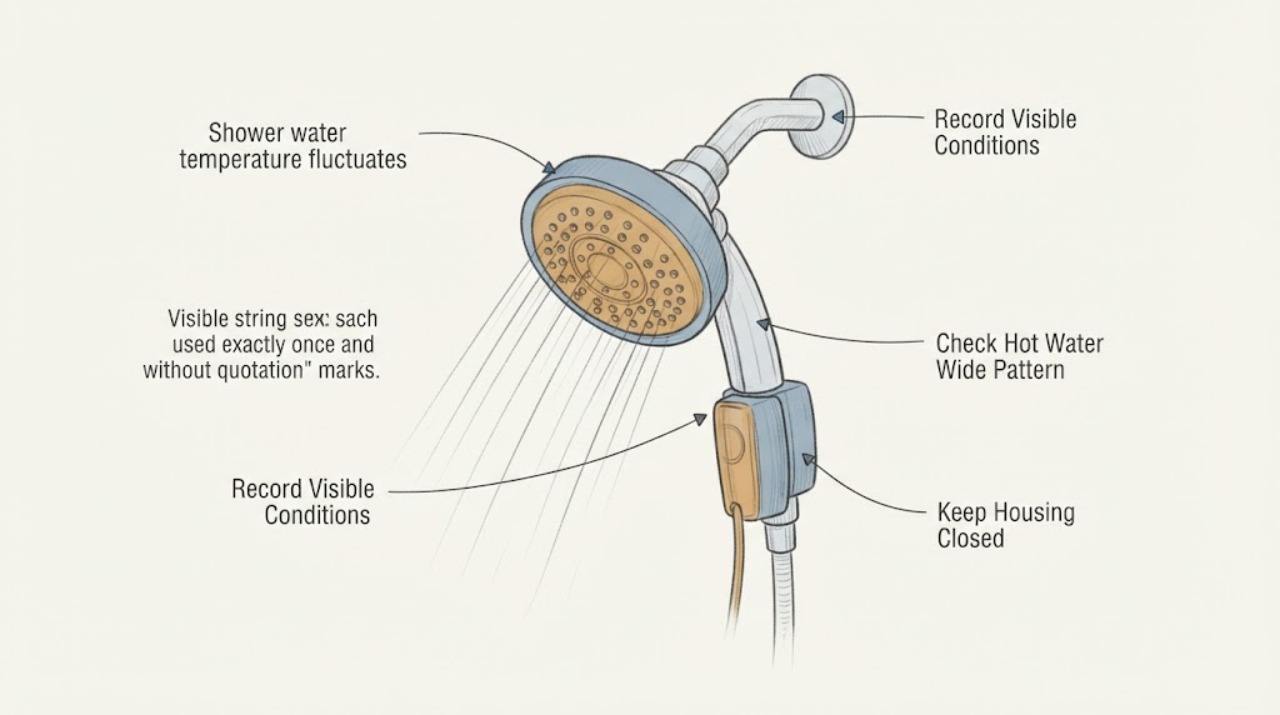
Work through in order
Diagnostic checks
Use only checks that match the exact appliance or system and its official guide.
-
Check 1
With the handle held at one safe setting, observe several showers and record whether the water becomes hotter, colder, or alternates, how quickly it changes, whether the stream remains steady, and whether the change starts after another fixture is used.
Expected result: Temperature is stable, changes gradually with household use, swings suddenly while flow stays steady, or becomes unsafe to touch.
Next step: Keep the record and use a lower, stable setting while observing only if the temperature remains safe; stop using the shower and arrange prompt plumbing service for sudden or unsafe swings.
Stop if: Stop immediately for a scalding surge, inability to maintain a safe temperature, burns, or a control that becomes stuck.
Why this matters
Why: A stable stream with a repeatable response to another fixture supports a supply-pressure or hot-water interaction. A shower-only swing with normal flow points more toward the mixing valve, cartridge, temperature control, or component compatibility; an unsafe surge is a scald hazard.
-
Check 2
At a safe distance from the shower spray, have another person briefly operate a nearby sink or flush a toilet while you keep the shower control unchanged; do not turn the shower hotter to compensate for a cold interval.
Expected result: The shower temperature changes when another fixture draws water, the nearby fixture also has a hot-water change, or the shower is unaffected while only its temperature fluctuates.
Next step: Document which fixture caused the change and ask a plumber to evaluate the hot and cold supplies, valve, and system arrangement; do not alter supply stops or piping as a test.
Stop if: Stop the comparison if the water becomes suddenly hot or cold, the control response is delayed, or anyone is at risk of a burn.
Why this matters
Why: A synchronized change supports a supply-pressure or water-delivery interaction that a pressure-balancing valve may not fully correct. A shower-only change makes the shower valve, cartridge, temperature-limiting setting, or showerhead and valve compatibility more likely.
-
Check 3
Without changing water-heater settings or opening any equipment, compare a nearby hot-water outlet at a safe temperature before and after the shower fluctuation and note whether other hot-water uses are consistently hotter, cooler, or stable.
Expected result: Only the shower temperature varies, all hot-water outlets vary, hot water is slow or insufficient throughout the home, or the comparison cannot be made safely.
Next step: Record the outlet comparison and request plumbing or water-heater assessment when more than one outlet changes or hot water is unreliable; do not adjust the heater to compensate for a shower valve fault.
Stop if: Do not inspect burners, electrical elements, relief devices, or water-heater controls, and stop if the water is too hot to handle safely.
Why this matters
Why: A whole-home pattern shifts concern toward the water heater, hot-water delivery, supply, or building plumbing. A shower-only pattern keeps the valve, cartridge, limit, and mixing arrangement as the focused path; normal flow does not exclude those causes.
-
Check 4
From ordinary external access, record the shower control brand and model markings if visible, number of handles, whether volume and temperature are separate, whether a tub spout or diverter is present, and the showerhead model or flow marking if available.
Expected result: The control is identified as pressure-balancing, thermostatic, an unknown single-handle design, or a multi-outlet arrangement; the showerhead was recently changed or its compatibility is unknown.
Next step: Photograph the markings and provide them to the manufacturer or plumber; do not remove the trim or change the head or limiter solely to test temperature stability.
Stop if: Stop if identifying the model would require removing trim, opening the wall, or disturbing a seal or water connection.
Why this matters
Why: The valve type determines how it should respond to pressure and temperature changes. A recently changed or unmatched showerhead can interact with a mixing valve, while an unknown or multi-outlet arrangement needs model-specific assessment rather than generic cartridge advice.
-
Check 5
With the water off, inspect only the visible handle, escutcheon, showerhead, and tub-spout or diverter area for looseness, leaks, mineral damage, or a control that binds; follow the installed manufacturer's care instructions for any external cleaning.
Expected result: The control moves normally with no visible leak, the handle is loose or stiff, the trim or connection leaks, the showerhead or diverter was recently serviced, or mineral buildup is visible.
Next step: Leave the control and water connections intact, document the condition, and request model-specific service for any leak, binding, recent-repair change, or persistent fluctuation.
Stop if: Do not remove the handle or cartridge, adjust a temperature stop, force a stiff control, or apply lubricant or cleaner not approved for the fixture.
Why this matters
Why: A loose or damaged external control can affect the selected setting, but visible condition cannot confirm an internal cartridge or pressure-balancing fault. A recent service or mineral buildup makes incorrect assembly or a sticking internal part more plausible.
-
Check 6
Gather the temperature pattern, fixture and valve identity, other-fixture comparison, hot-water comparison, showerhead change history, visible condition, and any recent plumbing or water-heater work before requesting service.
Expected result: The issue began after a valve or showerhead change, occurs with household demand, affects the whole home, remains shower-only, or has become more severe or unsafe.
Next step: Ask a qualified plumber to measure or assess hot and cold supply behavior, identify the valve type, inspect the pressure-balancing or thermostatic assembly, verify temperature limits, and check component compatibility.
Stop if: Do not approve a cartridge, pressure regulator, water-heater adjustment, or valve replacement based only on the symptom; request a measured cause and compatible repair plan.
Why this matters
Why: A post-change pattern focuses on installation, compatibility, cartridge, or temperature-limit setup; a demand-linked pattern focuses on pressure and hot-water delivery; a shower-only pattern focuses on the valve or head. Severity determines how quickly service is needed.
Use your observations
Decision map
Find the observation that best matches what you see, then follow the next safe action.
-
PATH 01Next step
What you see
The shower temperature changes when a toilet, sink, dishwasher, or another hot-water fixture runs, while the flow appears otherwise normal.
Do this next
Have a plumber assess hot and cold supply pressure, valve performance, and the home's plumbing arrangement; do not change the temperature stop or supply piping yourself.
Why this path and its safety boundary
Why it matters: A hot or cold supply-pressure interaction is more likely than a showerhead clog. A pressure-balancing valve is intended to compensate for some pressure changes, but the plumbing system may still be outside its effective conditions.
-
PATH 02Next step
What you see
Nearby hot-water outlets stay stable, flow stays normal, and only this shower changes temperature without another fixture drawing water.
Do this next
Provide the valve and showerhead identity to the manufacturer or plumber and request model-specific diagnosis; do not remove the cartridge or adjust a hidden stop as a trial.
Why this path and its safety boundary
Why it matters: The shower valve's pressure-balancing or thermostatic cartridge, temperature-limit setting, inlet condition, or head-and-valve relationship is more likely.
-
PATH 03Next step
What you see
A nearby hot-water outlet also varies, hot water is unreliable throughout the home, or the temperature change follows water-heater use or recent water-heater work.
Do this next
Arrange qualified plumbing or water-heater evaluation and keep shower use at a safe temperature until the cause is known; do not increase heater settings to compensate.
Why this path and its safety boundary
Why it matters: The hot-water source, delivery system, supply pressure, or building plumbing is more likely than a shower-only cartridge issue.
-
PATH 04Next step
What you see
The fluctuation began after a showerhead, trim, cartridge, or plumbing change, or the control is stiff and mineral buildup is visible.
Do this next
Document the changed parts and fixture model and request manufacturer-specific or qualified service; do not disassemble or soak an internal part without the exact procedure.
Why this path and its safety boundary
Why it matters: Incorrect assembly, component compatibility, a sticking spool or cartridge, or a disturbed temperature limit is more plausible than a normal pressure response.
-
PATH 05Safety boundary
What you see
The water suddenly becomes scalding or dangerously cold, the control cannot hold a safe setting, or the fluctuation can injure a user.
Do this next
Stop using the shower and arrange prompt qualified plumbing service. Keep children and vulnerable users away until a safe temperature can be maintained.
Why this path and its safety boundary
Why it matters: This is a safety problem, not a routine comfort adjustment; a failed or misconfigured temperature-control system is possible.
Safety stop: Do not keep testing, bypass the temperature limit, or compensate by moving the handle rapidly between hot and cold.
-
PATH 06Next step
What you see
The temperature remains stable with the handle fixed, no other fixture affects it, and the issue cannot be reproduced after one safe observation.
Do this next
Monitor without changing settings, record any repeat pattern, and arrange service if it returns, becomes demand-linked, or changes into a sudden hot or cold surge.
Why this path and its safety boundary
Why it matters: The event may have been a transient supply or user-control interaction, but a recurring fluctuation still warrants a record and follow-up rather than assuming the valve is sound.
Helpful context
Understand the symptom
Normal flow does not rule out a mixing problem
When the stream stays steady but the water alternates between hot and cold, the restriction is less likely to be the showerhead alone. A pressure-balancing valve responds to changes in hot or cold pressure, while a thermostatic valve measures temperature and adjusts the mix differently. Moen and Delta describe these functions, and EPA notes that temperature fluctuation can involve the plumbing layout, mixing valve, hot-water delivery system, and compatibility of the showerhead and valve.
Use a fixture comparison to separate supply changes from the shower valve
Hold the shower control steady and note whether the temperature changes when a toilet is flushed, a sink or dishwasher runs, or another person uses hot water. If nearby fixtures also change, the hot-water source, supply pressure, or building plumbing deserves attention. If only the shower changes while flow remains normal, the cartridge, pressure-balancing spool, thermostatic element, temperature limit, or showerhead/valve relationship is more relevant. Never deliberately create a scalding test.
Temperature safety takes priority over a DIY valve repair
A sudden hot surge can burn someone even when the flow feels normal. Keep the control at a safe, stable setting and stop using the shower if the temperature becomes unpredictable, especially for children or anyone who cannot react quickly. Cartridge, pressure-balancing, thermostatic, stop, and temperature-limit adjustments are model-specific and may require water isolation and correct commissioning; a plumber should identify the valve and verify the repair.
Safety boundary
Stop conditions
- Stop using the shower for sudden scalding or freezing changes, a control that cannot hold a safe temperature, or any user burn risk.
- Do not remove the cartridge, pressure-balancing spool, thermostatic element, or temperature-limit stop as a first-line check.
- Do not change water-heater settings, supply stops, pressure regulators, piping, or showerhead flow-control parts to compensate for an undiagnosed fluctuation.
- Do not force a stiff handle, open the wall, disturb valve seals, or use unapproved cleaners or lubricants.
- Arrange qualified plumbing service for recurring shower-only fluctuation, whole-home hot-water changes, demand-linked changes that persist, visible leaks, or behavior after recent plumbing work.
Only after diagnosis
Potential parts
- pressure-balancing valve cartridge or spool
Consider this category only when the valve model and professional diagnosis show that a pressure-balancing cartridge or spool is sticking, worn, or damaged after supply conditions are assessed.
Confirm exact valve model, cartridge design, seals, and manufacturer procedure; do not select a cartridge by handle appearance or bypass the temperature limit. - thermostatic shower cartridge
Consider this category only when an identified thermostatic valve has a tested cartridge or temperature-sensing fault and supply conditions are not the primary cause.
Confirm exact valve model, temperature range, connections, and commissioning requirements with the manufacturer or plumber before ordering. - shower temperature-limit or seal component
Consider this category only when model-specific inspection finds a damaged seal or incorrectly set limit component; normal temperature fluctuation does not justify changing the limit.
Confirm the exact valve, safe temperature requirements, and manufacturer adjustment procedure; installation and safety verification may require qualified service. - compatible showerhead and mixing-valve assembly
Consider replacement only when the existing head or valve is damaged or incompatible and a qualified assessment identifies a compatible assembly as the remedy.
Confirm flow marking, pressure conditions, valve type, temperature safety, connections, and local requirements with the manufacturer or plumber before ordering.
When checks do not resolve it
Need a professional?
Arrange qualified plumbing service when the shower temperature repeatedly fluctuates despite normal flow, when nearby fixtures are stable but this shower is not, when temperature changes with household water use, when hot water varies throughout the home, when the issue began after valve or showerhead work, or when the handle, trim, or connection leaks or binds. Stop using the shower for sudden scalding or freezing changes and obtain prompt help for any burn risk.
Safety scope: This article covers safe observation, comparisons, model identification, and external inspection only. Do not open the wall or valve, remove internal cartridges, adjust temperature limits or supply pressure, alter piping, or change water-heater controls as a guess.
Common questions
FAQ
Why does my shower temperature fluctuate when the water flow stays normal?
The hot and cold mix can change even when the stream looks steady. Possible causes include another fixture changing supply pressure, whole-home hot-water variation, a pressure-balancing or thermostatic valve issue, a temperature-limit setting, or head-and-valve compatibility. Compare demand patterns and identify the valve before changing anything.
Can flushing a toilet make the shower turn cold or hot?
It can change hot or cold supply pressure. Pressure-balancing valves are designed to compensate for some flow changes, but the valve and plumbing system still have operating limits. If the change is repeatable, have a plumber assess both supplies and the valve rather than adjusting the handle to a hotter setting.
Is a pressure-balancing valve the same as a thermostatic shower valve?
No. A pressure-balancing valve responds primarily to changes in hot and cold pressure, while a thermostatic valve measures temperature and adjusts the mix differently. The installed valve type determines the correct diagnosis and repair path, so record the model or ask a plumber to identify it.
Could my water heater cause shower temperature fluctuations?
If nearby hot-water outlets also change or the whole home has unreliable hot water, the water heater, hot-water delivery, supply, or building plumbing becomes more likely. If only the shower changes with normal flow, the shower valve and its temperature-control components deserve focused diagnosis.
Should I replace the shower cartridge when the temperature fluctuates?
Not from the symptom alone. A cartridge or pressure-balancing component may be involved, but supply pressure, water temperature, valve type, temperature limit, and component compatibility can produce the same complaint. Identify the exact valve and request model-specific diagnosis before ordering a part.
When should I stop using a shower with changing temperature?
Stop for a sudden scalding or freezing surge, a control that cannot hold a safe setting, a burn risk, or visible leaks or water damage. Do not bypass the temperature limit or continue testing; arrange qualified plumbing service and keep vulnerable users away until the temperature is safe.
Read the exact guide
Official sources
- Frequently Asked Questions: WaterSense Labeled ShowerheadsU.S. Environmental Protection Agency, WaterSense · EPA WaterSense showerhead and plumbing-system guidance; it does not replace the installed manufacturer's instructions or local plumbing requirements.
- Temperature Balancing Shower with TempAssure® and Monitor® Valve TechnologyDelta Faucet · Delta Monitor and TempAssure tub and shower valve information; performance depends on correct inlet conditions and model setup.
- If I have large differences between hot and cold pressure in my house, what effect does that have on operating pressure of a Monitor valve?Delta Faucet · Delta Monitor pressure-balance valve explanation; it does not diagnose another manufacturer's valve or a particular plumbing system.
- Rite-Temp Valve Dripping from Showerhead or SpoutKohler Assist · Kohler Rite-Temp single-control valve guidance; pressure and component requirements are model-specific.
- What is meant by "pressure-balancing" tub and shower faucet?Moen Solutions · Moen Posi-Temp and Moentrol tub and shower faucet guidance; other valve designs and system conditions may differ.
Community feedback
Share a repair observation
Share a plain-text repair observation. Accepted observations are published automatically; this page may take a moment to update.