
On this page
Start here
Quick answer
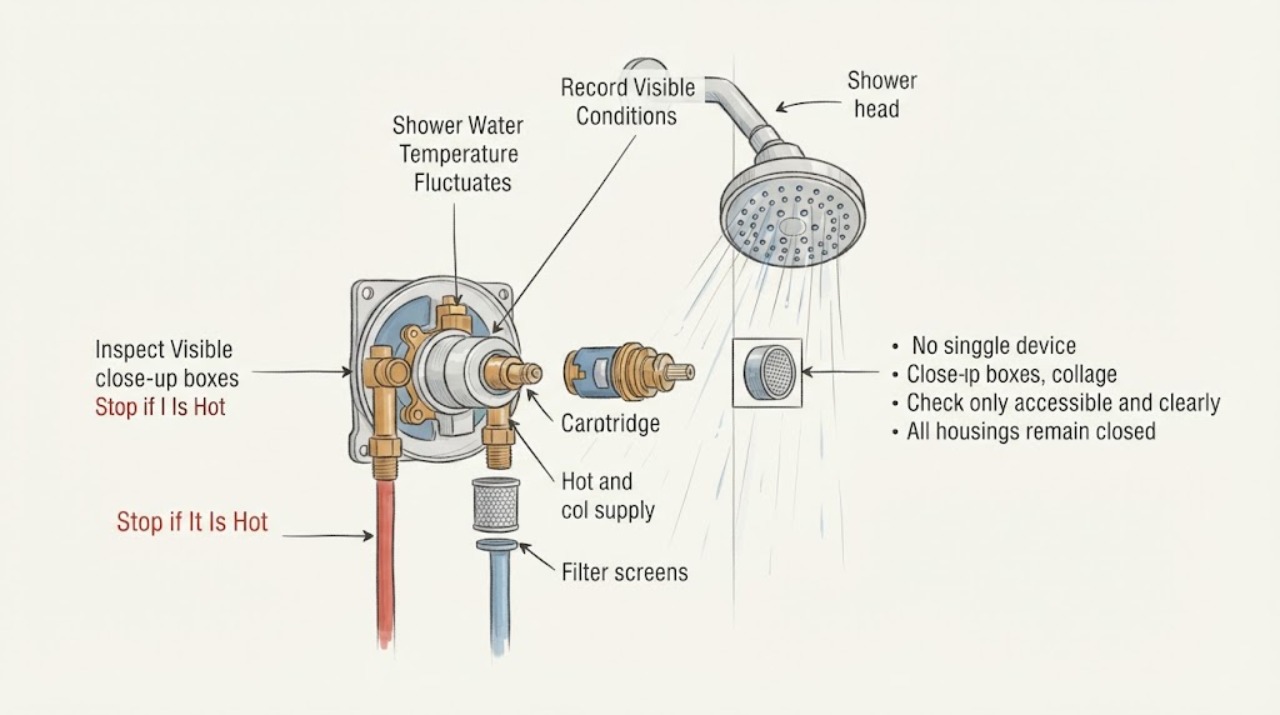
A shower that swings hot and cold can be reacting to changing hot or cold supply pressure, a partially closed stop, blocked filter or valve passage, a miscalibrated or worn cartridge, or a plumbing/installation condition. First note whether the temperature changes when another fixture runs, whether only hot or cold is affected, and whether flow changes at the same time. Pressure-balancing valves are designed to compensate for supply-pressure changes, but the exact valve and cartridge determine the repair. Check only clearly identified accessible stops and the shower device; do not alter a hot-limit stop, pressure regulator, or concealed cartridge by guesswork. If the water becomes scalding, the valve is unknown, the supply cannot be isolated safely, or the fluctuation persists after safe external checks, stop using the shower and arrange a licensed plumber.
Work through in order
Diagnostic checks
Use only checks that match the exact appliance or system and its official guide.
-
Check 1
Run the shower at a moderate, steady setting from a safe position and note whether the temperature swings hot-to-cold, cold-to-hot, or both. Observe whether the flow strength changes at the same moment; do not stand under an unexpectedly hot stream.
Expected result: Temperature changes with flow, temperature changes while flow stays steady, or the shower becomes dangerously hot or cold.
Next step: Stop using the shower for an uncontrolled or scalding swing. For a stable but inconsistent mix, continue by checking whether another fixture triggers the change and identify the valve before any repair.
Stop if: Stop immediately for scalding temperature, sudden loss of cold, unstable controls, water leaking at the valve, or any need to touch a hot-limit or pressure control while the cause is unknown.
Why this matters
Why: A simultaneous flow and temperature change makes supply pressure or a pressure-balancing path more likely. A temperature-only change keeps the balancing unit, filter, cartridge, calibration, or hot/cold mix in view. A scalding swing is a safety fault, not a comfort adjustment.
-
Check 2
Without changing the shower control, have another person operate one nearby cold-water and one hot-water fixture briefly, one at a time, and record whether the shower changes. Avoid deliberately creating a large demand while anyone is under the shower.
Expected result: A fixture demand triggers the swing, the shower fluctuates even when other fixtures are idle, or only one temperature side responds abnormally.
Next step: Limit simultaneous water use while arranging diagnosis. If the symptom occurs independently of other use or affects one side, identify the valve and use only its exact troubleshooting instructions; do not adjust household pressure by guesswork.
Stop if: Stop if the test produces a scalding change, banging or uncontrolled flow, a leak, or any condition that cannot be safely observed from outside the spray path.
Why this matters
Why: A repeatable response to another fixture suggests changing hot/cold supply pressure and a pressure-balancing or supply-path issue. A fluctuation with no other demand makes a valve, cartridge, screen, or local plumbing fault more likely; a one-sided response narrows the affected supply side.
-
Check 3
Check only accessible and clearly labeled shower supply stops, if present, for an obviously incomplete open position; review whether the symptom began after installation or service. Do not turn an unidentified stop or remove trim to reach one.
Expected result: A known local stop is partly closed, the shower was recently installed or serviced, no stop is accessible, or the fluctuation remains after a known stop is fully open.
Next step: If the exact instructions support it, restore a clearly identified stop to its normal open position and retest cautiously. Otherwise document the valve and recent work and arrange a licensed plumber.
Stop if: Stop for a stiff or leaking stop, a moving valve body, an unidentified control, hot water at the trim, or any need to remove a cartridge or wall covering.
Why this matters
Why: A restricted hot or cold inlet can disturb the intended mix, and a post-service symptom raises the possibility of a filter, balancing component, or valve assembly issue. An unknown or concealed stop cannot be safely diagnosed by appearance.
-
Check 4
Identify the valve and shower configuration from safe visible information: brand/model marking, one or multiple handles, separate temperature and volume controls, shower-only or tub-and-shower layout, and any visible filter-screen access described by the manual.
Expected result: The exact valve is known, the system matches a model-specific temperature guide, or the valve family and service parts are unknown.
Next step: Follow only the exact model instructions for an external check or filter-screen service. If the model is unknown or access requires trim removal, keep the shower off when not supervised and arrange plumbing service.
Stop if: Stop if identification requires opening the wall, removing a concealed cartridge, disturbing a hot-limit stop, or working without a confirmed safe shutoff.
Why this matters
Why: Pressure-balancing and thermostatic systems can use different cartridges, screens, balancing units, and calibration procedures. A generic cartridge or adjustment can create unsafe temperature behavior or fail to correct the issue.
-
Check 5
If the exact manual permits a safe filter-screen or valve-cleaning check, isolate the water, relieve pressure as instructed, protect the drain, and inspect only the named accessible screen or passage. Reassemble every seal exactly as directed before restoring water and testing temperature from a safe position.
Expected result: The manual identifies debris or a filter issue, cleaning improves the mix, the fluctuation is unchanged, or the valve leaks after reassembly.
Next step: If the symptom persists or a leak appears, stop disassembly and arrange a licensed plumber to check pressure, cartridge/balancing components, and the concealed supply path. Do not substitute a part or alter a pressure setting.
Stop if: Stop for a damaged seal, unexpected hot water, failed shutoff, moving valve body, water inside the wall, or any need to improvise cleaner, lubricant, part, or adjustment.
Why this matters
Why: Debris can restrict one side or interfere with a valve's balancing response, but unchanged fluctuation makes incoming pressure, cartridge wear, installation, or concealed plumbing more likely. A post-service leak indicates a sealing or assembly problem.
Use your observations
Decision map
Find the observation that best matches what you see, then follow the next safe action.
-
PATH 01Safety boundary
What you see
Does the shower temperature change when another fixture uses hot or cold water, especially when the flow changes too?
Do this next
Treat changing supply pressure and the shower's pressure-balancing response as more likely. Limit simultaneous demand and arrange valve or supply diagnosis if the swing is severe or persists.
Why this path and its safety boundary
Why it matters: A repeatable interaction with another fixture is a useful pressure-related clue, but it does not identify a failed cartridge by itself.
Safety stop: If the shower fluctuates with other fixtures idle, focus on the local valve, cartridge, screens, calibration, or shower piping rather than assuming a whole-house event.
-
PATH 02Next step
What you see
Does the temperature vary while the shower flow remains nearly steady, or does only hot or only cold become unreliable?
Do this next
Identify the valve and follow the exact model guide; do not adjust the hot-limit stop or replace a cartridge by visual similarity. Arrange service if the valve is unknown or the fault continues.
Why this path and its safety boundary
Why it matters: A steady-flow, one-sided, or unexplained temperature change makes a filter screen, balancing component, thermostatic cartridge, calibration, or one supply side more likely than normal demand alone.
-
PATH 03Next step
What you see
Did the fluctuation begin after installation or service, or is a known local stop partly closed?
Do this next
Check only the clearly identified stop or model-approved screen. If the valve or piping is concealed, isolate if safe and arrange a licensed plumber rather than reopening the work by guesswork.
Why this path and its safety boundary
Why it matters: A post-service or restricted-inlet pattern makes a stop, filter, balancing component, reversed connection, or installation-related valve issue more likely; the correct fix depends on the valve model.
-
PATH 04Next step
What you see
Is the temperature swing scalding, the valve unknown, the water supply impossible to isolate, or the symptom still present after the exact external check?
Do this next
Stop using the shower, isolate the supply if safe, document the valve and symptom, and arrange a licensed plumber. Do not keep adjusting the temperature stop or pressure controls.
Why this path and its safety boundary
Why it matters: The condition has crossed the safe DIY boundary or requires model-specific valve and pressure diagnosis; continued testing can expose the user to thermal shock or worsen a hidden fault.
Helpful context
Understand the symptom
First identify what changes with the temperature
When the mix swings hot and cold, observe both temperature and flow. A temperature change that coincides with a toilet flush, faucet, washer, or another demand suggests changing supply pressure; a temperature change with steady flow can point more toward a balancing unit, cartridge, filter, or control calibration. American Standard explains that pressure-balanced valves are intended to compensate for changes in hot and cold supply pressure, but that protection does not identify a failed or obstructed valve.
Do not treat every shower valve as the same
A single-control pressure-balancing valve, a thermostatic valve, and a multi-handle arrangement use different components and adjustment steps. Moen's temperature troubleshooting page is specific to its 1/2-inch Exact Temp valve and names filter screens, recalibration, and a thermostatic cartridge for defined symptoms. Kohler's guidance is specific to Rite-Temp valves and calls for incoming-pressure inspection when temperature fluctuates. Use those patterns as diagnostic clues, not as a universal parts list.
Hot-limit adjustments are not a cure for an unstable mix
A hot-limit stop can restrict maximum temperature, but moving it will not prove that the hot and cold supplies are balanced or that a cartridge is healthy. Because an incorrect adjustment can increase scald risk, leave the stop and pressure controls alone unless the exact valve manual supports the work and the result can be checked safely. A plumber can measure incoming pressure and inspect a concealed or model-specific valve path.
Safety boundary
Stop conditions
- Stop using the shower and isolate the water supply if safe for scalding or freezing swings, sudden loss of control, a leak, water entering the wall, or any condition that could injure someone; use local emergency guidance for immediate hazards.
- Do not adjust a hot-limit stop, pressure regulator, balancing unit, or unidentified supply stop to chase a temperature fluctuation.
- Do not remove a concealed cartridge or valve, reverse hot/cold connections, or open the wall without the exact model instructions and a confirmed safe shutoff.
- Stop testing after the first clear unsafe swing, after a model-approved screen check fails to help, or whenever a seal, shutoff, or valve body behaves unexpectedly.
Common questions
FAQ
Why does my shower go hot and cold while other faucets work normally?
The shower has its own mixing path, so a pressure-balancing unit, cartridge, filter screen, local stop, or shower-side supply can be at fault even when sinks work normally. Note whether another fixture triggers the change and whether the shower flow changes too, then identify the valve before selecting a repair.
Can flushing a toilet make shower temperature fluctuate?
It can change supply pressure, which a pressure-balanced valve is designed to compensate for. A repeatable swing during another fixture's use is a pressure-related clue, but a severe or persistent fluctuation still needs valve and supply diagnosis. Do not deliberately create a large demand while someone is showering.
Why does the shower temperature change without moving the handle?
For some model-specific valves, manufacturer guidance associates temperature and flow changes without knob movement with filter screens or a thermostatic cartridge. That does not identify the part for another valve. Use the exact model instructions or arrange service rather than installing a generic cartridge.
Should I adjust the shower hot-limit stop to stop temperature swings?
Not as a first diagnostic step. A hot-limit stop limits maximum temperature but does not prove that the hot and cold supplies or balancing components are working. An incorrect adjustment can increase scald risk, so leave it alone unless the exact valve instructions support the work and the result can be checked safely.
When should I call a plumber for fluctuating shower temperature?
Call for a scalding or uncontrolled swing, a leak, an unknown or concealed valve, failed supply isolation, one-sided hot/cold loss, a symptom that began after service, or fluctuation that remains after an exact model-approved screen check. Keep the shower off if the temperature cannot be controlled safely.
Read the exact guide
Official sources
- K-304 Rite-Temp® Valve - CleaningKohler Assist · Kohler model-specific valve cleaning and reassembly guidance, including supply isolation, pressure relief, mineral cleaning, O-ring placement, and leak testing
- Shower Faucet: Water Temperature Issues- 1/2" Exact Temp ValveMoen Solutions · Moen troubleshooting for a specific Exact Temp valve when temperature changes without knob movement, including filter-screen cleaning and thermostatic-cartridge service
- What Does Pressure Balance Mean?American Standard · American Standard explanation of pressure-balanced shower valves compensating for hot/cold supply-pressure changes and helping reduce drastic temperature changes
- Rite-Temp Valve Dripping from Showerhead or SpoutKohler Assist · Kohler Rite-Temp guidance on hot/cold pressure differences causing temperature fluctuations, supply stops, installation conditions, and pressure measurement
Community feedback
Share a repair observation
Share a plain-text repair observation. Accepted observations are published automatically; this page may take a moment to update.