
On this page
Start here
Quick answer
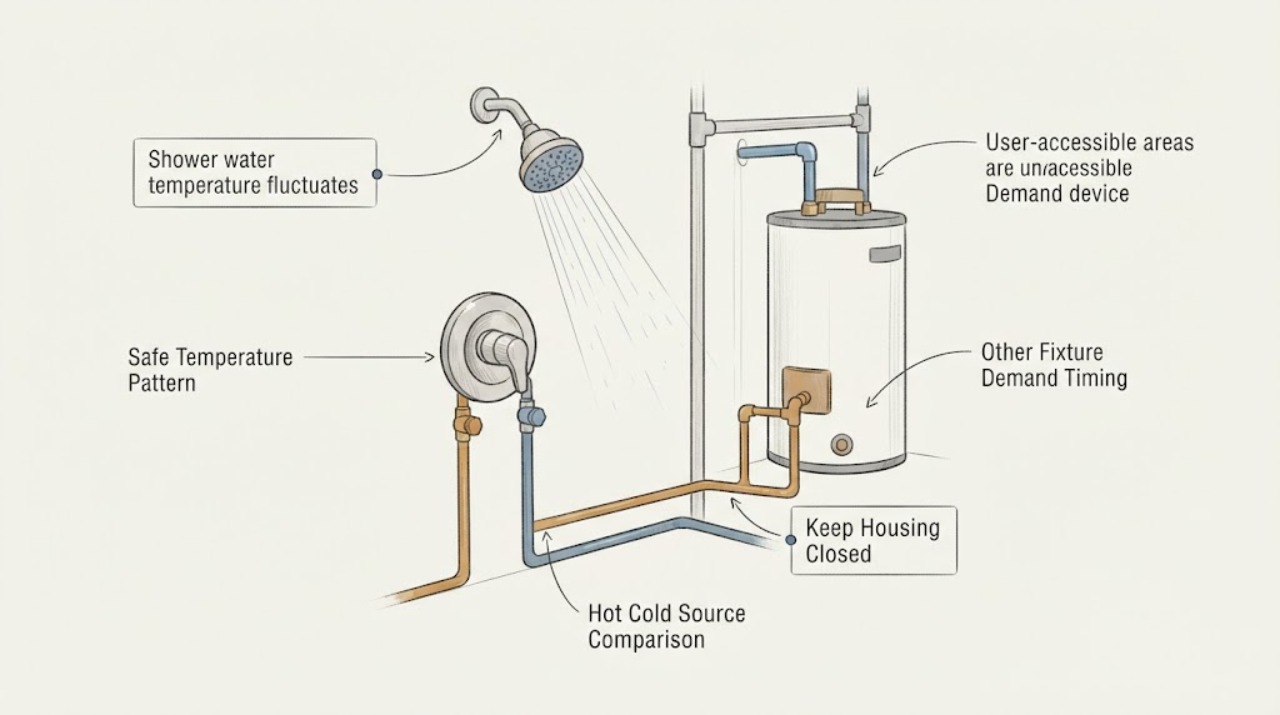
Treat a sudden hot-to-cold or cold-to-hot change as a burn-safety problem first. Stop using the shower if the temperature is unsafe or cannot be controlled. When it is safe, record whether the change occurs when a toilet, faucet, or appliance uses water, whether only hot or cold supply is affected, whether another hot tap behaves the same way, and whether the pattern is tied to time or recent plumbing or water-heater work. Do not deliberately run scalding tests, adjust a temperature limit, open a valve or heater, or perform gas, electrical, or plumbing work. A plumber can determine whether the shower's pressure-balancing or thermostatic cartridge, the supply, or the water-heating system needs service.
Work through in order
Diagnostic checks
Use only checks that match the exact appliance or system and its official guide.
-
Check 1
During one normal shower use, keep the control at a comfortable setting and observe whether the water stays stable, becomes warmer, becomes cooler, or changes repeatedly; do not deliberately move through extreme temperatures.
Expected result: Record the direction, speed, and repeatability of the change, along with any simultaneous change in flow or unusual sound.
Next step: Stop using the shower if the change is unsafe, preserve the description, and request plumbing service rather than trying to adjust the valve or heater.
Stop if: Stop immediately for scalding, unexpectedly cold water, loss of control, steam or burn injury, leaking trim, gas odor, smoke, or electrical hazard; leave the area and seek appropriate emergency or professional help.
Why this matters
Why: A sudden or repeated change can expose a supply, mixing, pressure-balancing, thermostatic, or water-heating problem, but the pattern alone cannot identify the concealed part.
-
Check 2
Without creating a deliberate stress test, note whether the shower changes when a toilet is flushed, a faucet is used, or a household appliance is already drawing water during ordinary activity.
Expected result: Record which other fixture was active, whether the shower became warmer or cooler, whether flow changed with temperature, and whether the shower recovered when that activity ended.
Next step: Give the timing and fixture details to a plumber; do not close or adjust concealed stops, change the water-heater setting, or keep repeating the condition.
Stop if: Stop the observation if the water becomes unsafe, the shower cannot maintain a comfortable setting, or a leak or abnormal sound appears.
Why this matters
Why: A repeatable demand-linked pattern makes supply pressure or pressure-balancing behavior worth investigating. A shower-only pattern keeps the local valve or control path in consideration.
-
Check 3
At a nearby sink or other normal hot-water fixture, observe one ordinary use at a comfortable setting and compare its behavior with the shower; do not open or touch the water heater or plumbing connections.
Expected result: Record whether the other fixture is stable, fluctuates in the same direction, or has a different hot-versus-cold symptom.
Next step: Provide the comparison to a plumber and include the water-heater type or service history only if it is already known from safe household records.
Stop if: Stop if any fixture produces scalding water, no hot water, a gas odor, smoke, an active leak, or an electrical warning; do not approach the heater.
Why this matters
Why: If multiple hot-water fixtures fluctuate, the water-heating or household supply path becomes more likely. If only the shower changes, its mixing or pressure-balancing path remains a stronger branch.
-
Check 4
During a normal comfortable use, observe whether the temperature change is accompanied by weaker or stronger flow, and whether a tub spout or handheld outlet behaves differently if the installation has one; do not force a selector or disassemble a device.
Expected result: Record stable flow with changing temperature, changing flow with temperature, one outlet changing while another is stable, or water emerging from an unintended outlet.
Next step: Return the selector to its normal position and tell the plumber exactly which outlet and flow pattern occurred; do not remove a cartridge, trim, or hose.
Stop if: Stop for a stuck control, leak behind trim, water in a wall or ceiling, or an unsafe temperature change, and arrange plumbing service.
Why this matters
Why: Temperature change with flow change can support a pressure or valve path investigation. One-device or unintended-outlet symptoms may involve a diverter or local control, while a shared pattern may involve supply.
-
Check 5
Write down when the fluctuation began and whether it follows a recent fixture installation, plumbing visit, water-heater service, seasonal change, or a particular time of day; use existing records rather than opening equipment.
Expected result: Record whether the symptom is new or gradual, occurs on the first use or after other hot-water use, and disappears or persists without further control changes.
Next step: Send the timeline and all safe observations to a plumber and ask for a diagnosis that covers both the shower valve and the hot-water source when the pattern is shared.
Stop if: Stop using the shower and request prompt service if fluctuations persist, worsen, or create any burn, leak, gas, smoke, or electrical risk.
Why this matters
Why: A post-service or gradual pattern helps the professional review the correct installation and equipment history. A time-linked pattern can indicate demand or hot-water recovery rather than a showerhead problem.
Use your observations
Decision map
Find the observation that best matches what you see, then follow the next safe action.
-
PATH 01Next step
What you see
The temperature becomes scalding, unexpectedly cold, or impossible to control.
Do this next
Stop using the shower and arrange prompt plumbing service; seek medical or emergency help for a burn, gas odor, smoke, or electrical hazard. Do not adjust the temperature limit or open the valve.
-
PATH 02Next step
What you see
The shower changes when another fixture uses water, and flow changes with the temperature.
Do this next
Request a plumber to assess household supply and the shower's pressure-balancing path. Do not create more demand tests or adjust concealed stops.
-
PATH 03Next step
What you see
Only the shower fluctuates while another hot-water fixture remains stable.
Do this next
Have a plumber assess the shower's mixing, pressure-balancing, thermostatic, or diverter path. Do not remove the cartridge or trim.
-
PATH 04Next step
What you see
Several hot-water fixtures fluctuate or become unstable after hot-water use.
Do this next
Request a plumber to evaluate the water-heating and supply system. Do not open the heater, change its setting, or perform gas or electrical work.
-
PATH 05Next step
What you see
There is a leak, water behind trim, gas odor, smoke, electrical warning, or abnormal heater sound.
Do this next
Leave the hazard area, avoid the equipment, and contact the appropriate emergency or licensed professional service.
Helpful context
Understand the symptom
Why the timing is useful
Pressure-balancing and thermostatic shower systems are designed to reduce temperature changes when demand elsewhere changes, but the exact behavior depends on the installed valve and the home's supplies. A temperature shift linked to another fixture points to a different diagnostic path from a shift that occurs only at this shower or across every hot-water fixture.
Keep the check comfortable
Do not chase the hottest or coldest point to reproduce a fluctuation. Use only normal, comfortable control positions and stop as soon as the water becomes unsafe. The shower trim, concealed valve, water heater, gas connections, electrical parts, and temperature-limit setting are not user-level inspection points here.
What to tell a plumber
Provide the shower and other-fixture pattern, the direction of the temperature change, the timing, any pressure change, the water-heater type if known from ordinary records, and any recent work. A concise timeline is more useful than repeated exposure to unsafe water.
Only after diagnosis
Potential parts
- shower cartridge
Consider this only after a plumber confirms that a local shower-valve fault, rather than supply or heater behavior, causes the fluctuation.
Identify the exact valve and model before ordering; cartridge removal and replacement are professional work for this topic. - thermostatic shower cartridge
Consider this only when the installed system is identified as thermostatic and a qualified diagnosis confirms its temperature-control path is faulty.
Confirm the complete valve model and manufacturer fit information; do not infer compatibility from the trim appearance. - pressure-balancing spool
Consider this only after a plumber links the fluctuation to the pressure-balancing mechanism and rules out demand, supply, and water-heater causes.
Match the exact valve family and approved component information; do not open or adjust a concealed pressure-balancing assembly yourself.
When checks do not resolve it
Need a professional?
Have this ready
- Provide the direction and timing of the change, hot-versus-cold and flow pattern, other-fixture comparison, outlet behavior, recent service history, water-heater type if safely known, and any hazard observed.
Common questions
FAQ
Why does the shower turn cold when a toilet is flushed?
The timing can indicate a supply-pressure change that the shower's balancing system is not compensating for, but it does not identify the failed part. Record the pattern and ask a plumber to assess the supply and valve.
Why does the shower alternate between hot and cold while other taps are stable?
A shower-only pattern keeps its mixing, pressure-balancing, thermostatic, or diverter path in consideration. Stop if the temperature is unsafe and do not remove the cartridge or trim.
Should I adjust the water-heater temperature to stop fluctuations?
No. Temperature-limit and heater adjustments can create a scald or equipment hazard and are outside this user-level check. Have a plumber diagnose the pattern first.
How can I test the fluctuation safely?
Do not deliberately reproduce an unsafe change. Use one normal, comfortable observation and record the timing, direction, flow behavior, and other-fixture context for a plumber.
Read the exact guide
Official sources
- Temperature Balancing Shower with TempAssure and Monitor Valve TechnologyDelta Faucet · Delta explains that pressure-balance and thermostatic shower valves are designed to reduce temperature changes caused by other water use, while noting that inlet conditions matter.
- Consumer Water HeatersU.S. Department of Energy · DOE identifies storage, instantaneous, and heat-pump water heaters as distinct equipment categories, supporting the need to identify the installed source before a professional diagnosis.
- How can I make sure my shower is safe?Delta Faucet · Delta emphasizes avoiding dangerously hot water, pressure-balance protection, and checking the water before bathing; this article uses that safety posture without prescribing temperature adjustment.
- What is meant by pressure-balancing tub and shower faucet?Moen Solutions · Moen describes balancing incoming hot and cold pressure to compensate for flow fluctuations from other household demands and notes that both hot and cold pressure are required.
Community feedback
Share a repair observation
Share a plain-text repair observation. Accepted observations are published automatically; this page may take a moment to update.