
On this page
Start here
Quick answer
A bang or thump when the shower valve closes is usually a pressure shock from a sudden change in water flow, but the safe fix depends on where and when it occurs. Close the shower valve normally and note whether the sound is at the shower, in the wall, or elsewhere, whether it happens on hot, cold, or both supplies, and whether pipes move, leak, or vibrate. If the noise is brief and isolated, a plumber may check the shower valve, pipe support, pressure, and a correctly sized water-hammer arrestor installed near the shock source. Stop and call a plumber promptly for leaking joints, repeated severe impacts, visible pipe movement, unstable pressure, or a valve that sticks; do not open the wall or install a pressurized device from a generic size guess.
Work through in order
Diagnostic checks
Use only checks that match the exact appliance or system and its official guide.
-
Check 1
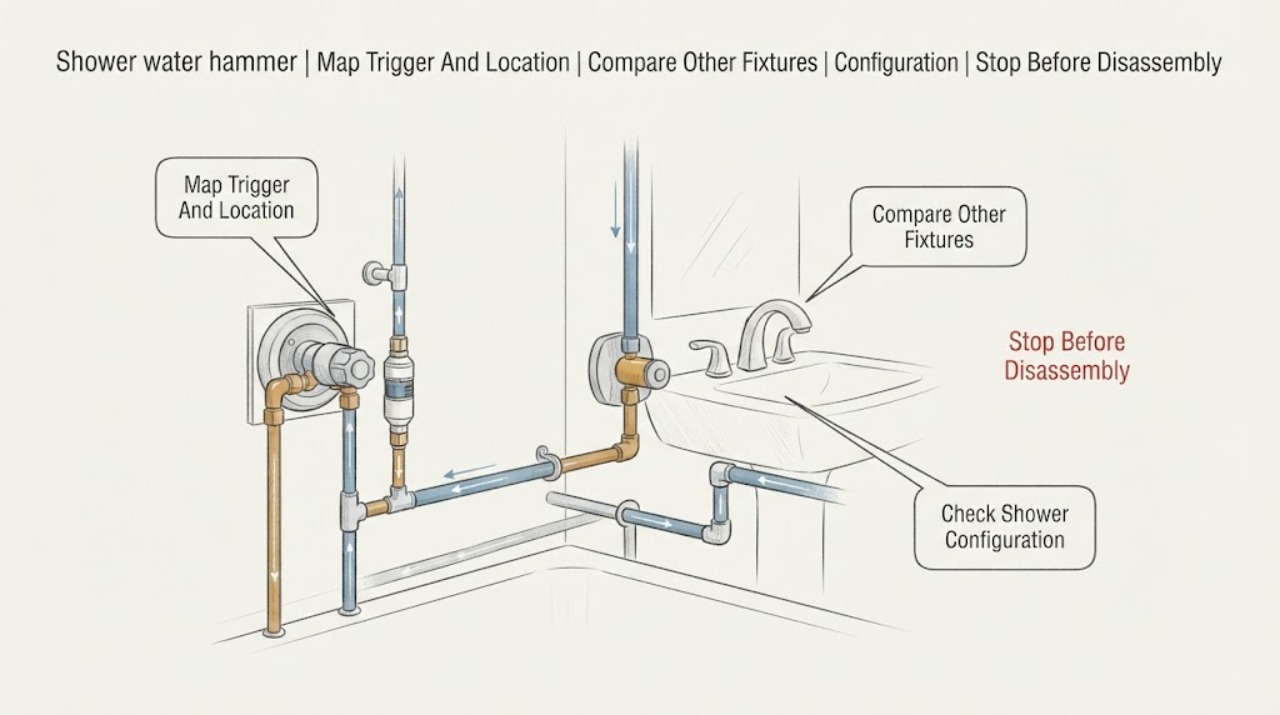
From a safe position, close the shower valve once at the normal rate and note the exact trigger and location: immediately when flow stops, when switching a diverter, when a handheld or body spray is selected, during flow, or after another fixture closes.
Expected result: A single bang at rapid valve closure supports a flow-shock path; a bang while running, at a diverter transition, or from a different fixture points toward another valve, pipe support, branch, or pressure issue.
Next step: Repeat no more than once for a clear observation, then use the matching branch. Record whether hot, cold, or both supplies trigger the noise.
Stop if: Do not repeatedly snap the valve closed, operate a sticking handle by force, or continue if the bang is severe, the wall moves, or a leak appears.
Why this matters
Why: Water hammer is associated with sudden changes in flow velocity, but sound alone cannot distinguish a pressure wave from loose piping or a defective shower valve.
-
Check 2
Use other nearby fixtures normally and note whether a toilet, faucet, dishwasher, or washing machine creates the same bang or vibration. Do not create rapid valve closures just to reproduce it.
Expected result: A hammer isolated to the shower points toward the shower valve, branch piping, or shower configuration; similar impacts from multiple fixtures suggest a shared pressure, support, or supply-piping condition.
Next step: Tell the plumber which fixtures reproduce the noise and whether it travels through the wall. Keep the affected fixture use gentle until the cause is assessed if impacts are repeated.
Stop if: Stop if any fixture causes a leak, pipe movement, loss of water, or a rapidly worsening impact.
Why this matters
Why: The source of the shock may be a quick-closing valve elsewhere even when the sound is heard near the shower, so fixture isolation changes the plumber's inspection path.
-
Check 3
Identify whether the shower uses one head, a handheld, a diverter, body sprays, or multiple heads, and note whether the bang occurs only when changing functions or only when all flow stops.
Expected result: A function-specific bang suggests the diverter or that branch; a bang only with a high-flow or multi-head arrangement may indicate flow, cavitation, or piping behavior rather than a single loose trim piece.
Next step: Record the active shower function and have a plumber evaluate the valve, branch piping, flow demand, and any arrestor application together.
Stop if: Do not remove the shower valve trim, cap a spray outlet, or permanently restrict flow as a noise experiment.
Why this matters
Why: Shower configuration changes the flow path and shock source. Sioux Chief specifically identifies high-flow fixtures such as multi-head showers as an application where cavitation and water-hammer shocks may occur.
-
Check 4
With water off, inspect only exposed, accessible piping and the area around the shower and nearby fixtures for drips, dampness, staining, loose-looking supports, or movement during one normal use. Do not open a wall or ceiling.
Expected result: A leak, movement, or new vibration means the impact may already be stressing a joint or unsupported line; no visible issue does not rule out concealed movement or damage.
Next step: If any leak or movement is present, stop using the affected shower and arrange plumbing service. Photograph safe-to-view evidence and note when it occurs.
Stop if: Do not tighten concealed fittings, cut drywall, touch wet electrical equipment, or continue testing a leaking line.
Why this matters
Why: Water hammer can create noise and potential damage, while a loose pipe can also make a hammer-like bang. The repair must address the actual source rather than masking the sound.
-
Check 5
Note whether the hammer began after a plumbing alteration, pressure-regulator change, fixture replacement, or installation of a multi-head shower. Observe any unusual pressure swings at the shower without adjusting a regulator or valve.
Expected result: A new symptom after a plumbing change or pressure change makes installation, sizing, support, or pressure-control review more relevant; stable pressure with a shower-only bang keeps the valve/branch path prominent.
Next step: Provide the timing, recent work, fixture configuration, and any pressure observations to a qualified plumber for measurement and code-compliant design.
Stop if: Do not adjust the pressure-reducing valve, vent or recharge a concealed chamber, or add an arrestor without confirming the application and isolation method.
Why this matters
Why: Watts' guidance ties arrestor selection and placement to line conditions, flow, and fixture units, and requires local plumbing-code review. A generic pressure adjustment or arrestor size is not justified by sound alone.
-
Check 6
Prepare a service record with the shower valve and fixture type, hot/cold or both trigger, exact timing, sound location, other fixtures affected, visible leaks or movement, recent plumbing work, and any accessible pressure-control information.
Expected result: A complete sequence helps distinguish a local shower valve or diverter issue from a shared supply/pressure condition and lets the plumber assess whether an arrestor, support, valve repair, or pressure work is appropriate.
Next step: Give the record and safe photos to a qualified plumber and keep use gentle or stopped if impacts are severe, recurrent, or accompanied by leaks.
Stop if: Do not order a hammer arrestor, pressure regulator, valve cartridge, or pipe support from a generic shower symptom without model, line, and application review.
Why this matters
Why: Water hammer is a system interaction, so a guessed replacement valve or arrestor may fail if the actual shock source is elsewhere.
Use your observations
Decision map
Find the observation that best matches what you see, then follow the next safe action.
-
PATH 01Safety boundary
What you see
One brief bang occurs exactly when the shower valve closes, with no leak, pipe movement, or other warning.
Do this next
Use the fixture configuration and history to have a plumber inspect the shower valve, branch piping, supports, and application for a correctly placed arrestor if needed.
Why this path and its safety boundary
Why it matters: A local flow-shock or valve/branch vibration is plausible, but the observation does not prove an arrestor is required.
Safety stop: Do not repeatedly slam the valve or install a generic inline device as a trial.
-
PATH 02Safety boundary
What you see
Several fixtures produce banging or vibration, or the shower appears to transmit a shock caused elsewhere.
Do this next
Arrange a plumbing inspection of system pressure, supports, valves, and hot/cold line layout.
Why this path and its safety boundary
Why it matters: A shared supply, pressure, pipe-support, or quick-closing-valve condition may be involved rather than a shower-only part.
Safety stop: Do not change the whole-home regulator or add multiple arrestors without system assessment and code review.
-
PATH 03Safety boundary
What you see
The noise occurs only when switching a diverter, handheld, body spray, or multi-head shower function.
Do this next
Have a plumber assess the valve, branch flow, supports, and arrestor application as a matched system.
Why this path and its safety boundary
Why it matters: The diverter or high-flow branch may be creating a rapid flow change or cavitation-related shock.
Safety stop: Do not cap outlets, force the diverter, or permanently restrict a shower function to hide the noise.
-
PATH 04Safety boundary
What you see
The impact is accompanied by dripping, dampness, staining, visible pipe movement, or a worsening vibration.
Do this next
Stop using the affected fixture, isolate water only if clearly safe, and arrange prompt plumbing service.
Why this path and its safety boundary
Why it matters: The piping or connection may be under damaging stress, or an unsupported line may be amplifying the shock.
Safety stop: No wall opening, concealed fitting tightening, or continued use to reproduce the impact.
-
PATH 05Safety boundary
What you see
The hammer started after a shower replacement, renovation, regulator change, or other plumbing work.
Do this next
Contact the installer or a qualified plumber with the before/after history and ask for a code-compliant system review.
Why this path and its safety boundary
Why it matters: An installation configuration, support, pressure, flow, or valve-closure change may be responsible.
Safety stop: Do not reopen the work, adjust pressure, or add an arrestor before confirming the piping and application.
-
PATH 06Safety boundary
What you see
The sound is not tied to valve closure, occurs while water runs, or cannot be located confidently.
Do this next
Avoid repeated testing, document the sequence, and have a plumber locate the source before selecting a part.
Why this path and its safety boundary
Why it matters: It may be a loose pipe, pressure fluctuation, valve vibration, water heater or appliance event, or a different plumbing noise rather than classic shower water hammer.
Safety stop: Escalate immediately for leaks, loss of water, severe impact, or signs of structural or electrical damage.
Helpful context
Understand the symptom
What makes a shower bang a water-hammer clue
Water hammer is a pressure wave created when moving water changes speed quickly, often when a valve closes. A sound exactly at shower shutoff is more suggestive than a general hum or a bang that occurs while the shower is already running. The same noise can also come from a loose pipe, a vibrating valve, excessive pressure, or a fixture component, so timing and location matter before choosing a repair.
A shower's configuration changes the diagnosis
A single showerhead, handheld, diverter, body sprays, and multi-head systems do not place the same flow demand or valve arrangement on the piping. If the bang happens only when switching between shower functions, the diverter or branch piping deserves attention. If other fixtures cause the same impact, the cause may be upstream in the supply, pressure, or building piping.
Keep arrestor and pressure work professional
An arrestor must be selected for the system and placed near the shock source; Watts' installation guidance also calls for local plumbing-code review and separate consideration of hot and cold lines. A concealed shower connection or pressure device is not a safe trial-and-error project. Persistent hammer, leaks, or movement should be evaluated by a qualified plumber before the wall is opened or a component is added.
Safety boundary
Stop conditions
- Stop using the shower for visible leaks, pipe movement, severe or repeated impacts, loss of water, or dampness that may be entering a wall or ceiling.
- Do not open walls, remove concealed shower-valve parts, tighten hidden fittings, or alter pressure controls as a first-line water-hammer test.
- Do not install, recharge, relocate, or size a water-hammer arrestor from a generic shower description; application, hot/cold lines, placement, and local plumbing codes must be reviewed.
- Do not cap outlets, force a diverter, or restrict flow to mask hammer in a multi-head or body-spray system.
- Do not assume that a quiet pipe means the underlying pressure or support problem is resolved; persistent or worsening hammer needs qualified plumbing inspection.
Only after diagnosis
Potential parts
- water-hammer arrestor
Only relevant when a plumber confirms that sudden flow change at the shower is the shock source and that an arrestor is suitable, correctly sized, and placeable near that source.
Confirm hot/cold line application, connection, pressure, placement, manufacturer instructions, and local-code requirements before installation; a generic size is not sufficient. - pressure-reducing or pressure-control component
Only relevant when measured system pressure or pressure fluctuation is shown to contribute to the hammer and a qualified plumber selects the appropriate control.
Pressure-control selection depends on the whole plumbing system and local requirements; do not adjust or replace a regulator from sound alone. - shower mixing or diverter valve cartridge
Only relevant when the impact is isolated to a sticking, rapidly closing, or damaged shower valve/diverter and a model-specific diagnosis confirms the cartridge or valve path.
Confirm the valve brand, series, and model before ordering; a similar-looking cartridge may not fit or correct a system pressure problem. - pipe support or vibration-control component
Only relevant when inspection finds an accessible or concealed line that moves or resonates and the plumber determines that support or vibration control is the correct remedy.
Support method depends on pipe material, routing, access, and code; concealed work should be planned and performed professionally.
When checks do not resolve it
Need a professional?
Arrange qualified plumbing service for recurrent shower hammer, a bang that travels through walls, hammer after plumbing work, or a symptom involving several fixtures., Call promptly for visible leaks, pipe movement, dampness, severe impacts, unstable pressure, or a sticking or damaged shower valve., Ask the plumber to evaluate valve operation, line supports, pressure, flow configuration, and any arrestor or pressure-control application together rather than replacing one guessed part.
Have this ready
- Shower valve, diverter, head, handheld, and body-spray configuration
- Exact trigger, sound location, and whether hot, cold, or both lines are involved
- Other fixtures that reproduce or trigger the impact
- Visible leaks, pipe movement, dampness, or pressure changes
- Recent installation, renovation, valve, regulator, or flow changes
Common questions
FAQ
Why does my shower bang when I turn it off?
A sudden change in water flow can create a pressure shock called water hammer, but a loose pipe or vibrating valve can sound similar. Record whether it happens exactly at shutoff, where it is heard, and whether other fixtures trigger it before choosing a repair.
Is a shower water-hammer arrestor always the fix?
No. An arrestor may be appropriate when the shower valve is confirmed as the shock source, but sizing, placement, hot/cold lines, pressure, fixture configuration, and local plumbing requirements matter. A plumber should confirm the application rather than installing a generic device.
Can a multi-head shower cause water hammer?
A high-flow or multi-head arrangement can create a distinct flow and cavitation path, especially when switching functions. Have the diverter, flow configuration, supports, pressure, and any arrestor application assessed together; do not cap outlets or restrict flow as a trial.
Should I open the wall to stop shower water hammer?
No. First document the trigger and inspect only safe, exposed evidence. Opening a wall or tightening concealed fittings can create a leak or damage the valve; persistent hammer or visible movement needs a qualified plumber.
When is shower water hammer urgent?
Arrange prompt service for leaks, dampness, visible pipe movement, severe or repeated impacts, unstable pressure, or hammer that began after plumbing work. Stop using the affected fixture if continued flow may worsen the damage.
Read the exact guide
Official sources
- 652-ADSioux Chief Manufacturing Company · Sioux Chief VacuRester product page; used only to identify a shower-configuration branch, not to claim product fit.
- Installation Guidelines Series 05 and LF05 Water Hammer ArrestorsWatts · Watts Series 05/LF05 installation guidance; not a DIY instruction for a concealed shower retrofit.
- LF150A Lead Free Water Hammer ArrestorsWatts · Watts LF150A product family; not a universal fitment or sizing claim for an unspecified shower system.
- Shock/Hammer ArrestorsWatts · General domestic and commercial piping concept; product selection remains application-specific.
Community feedback
Share a repair observation
Share a plain-text repair observation. Accepted observations are published automatically; this page may take a moment to update.