
On this page
Start here
Quick answer
A bang or knock in your shower area only after the unit above finishes a shower or bathroom faucet use is often a pressure wave from a quick-closing valve, but the sound may also be pipe movement where a shared riser passes through the building. First confirm the exact timing, location, and whether your own water use can reproduce it. Look only at accessible fixtures, ceilings, walls, and shutoff areas; do not enter the other unit, open a wall, adjust a building valve, or work on a pressurized connection. If the sound is accompanied by a leak, damp ceiling, changing water temperature, severe vibration, or a pressure problem in several fixtures, stop using the affected fixture and have a licensed plumber or building manager inspect the shared system. A plumber may need to assess pipe supports, valve closure, pressure control, and a correctly sized water-hammer arrestor.
Before you begin
Safety first
- Keep away from wet or unstable ceilings and do not enter another unit, open concealed plumbing, alter shared valves or pressure controls, or loosen a pressurized connection.
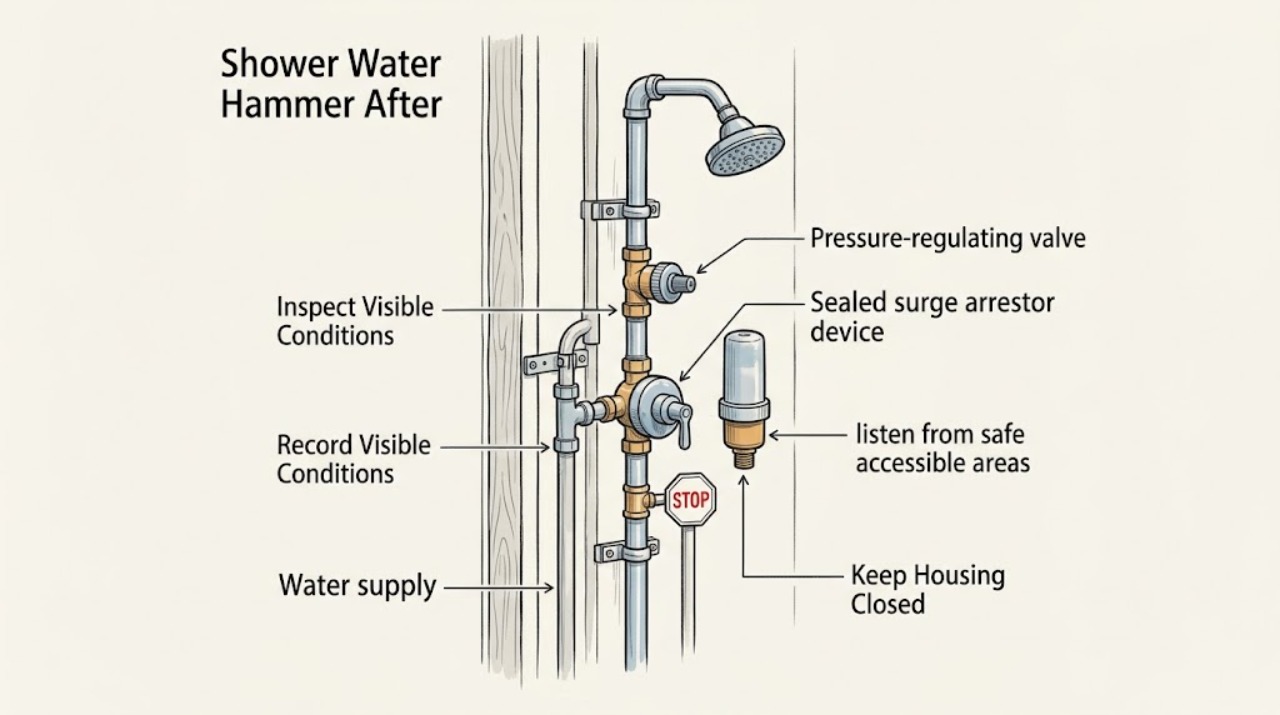
Work through in order
Diagnostic checks
Use only checks that match the exact appliance or system and its official guide.
-
Check 1
From your own unit and without opening a wall or ceiling, look for a damp patch, active drip, bulging paint, staining, mold-like growth, a wet floor, or a sudden change in shower temperature or flow; keep clear of any ceiling material that appears unstable.
Expected result: Water damage, an active leak, a ceiling that is sagging or cracking, scalding temperature change, loss of pressure, or no visible damage is present.
Next step: For active water or an unstable ceiling, stop using the affected fixture, keep people clear, and notify the building manager or plumber immediately. If safe and accessible, close only your own fixture shutoff; do not operate a shared valve or enter the unit above.
Stop if: Stop immediately for an active leak near electrical equipment, a wet or unstable ceiling, rapidly worsening damage, or a scalding temperature change.
Why this matters
Why: A sound with water or structural evidence may involve a failed connection, pressure event, or concealed building plumbing and is not only a nuisance noise.
-
Check 2
Ask the occupant or building manager to note when the upstairs shower or bathroom faucet starts and stops, while you record the sound from your own unit with the fixture unused; write down whether the knock occurs at opening, during flow, or immediately after closure.
Expected result: The knock follows the upstairs fixture closing, occurs during steady flow, occurs only when your own shower runs, or cannot be correlated with water use above.
Next step: Give the timing log to the building manager and plumber. Do not repeat a coordinated test if it produces a leak, severe movement, or a dangerous temperature change.
Stop if: Stop the coordinated observation for a leak, violent pipe movement, pressure loss, temperature surge, or a request to access or alter another unit's plumbing.
Why this matters
Why: A close timing link to upstairs closure supports a shared pressure or valve event; noise during flow or without a flow event may instead involve pipe support, contact, a local valve, drainage, or another source.
-
Check 3
With water use stopped, listen from safe accessible areas such as your shower wall, ceiling, service cupboard, and nearby bathroom fixtures; compare whether the sound is a sharp single impact, repeated rattle, humming, hiss, gurgle, or vibration transmitted through the structure.
Expected result: The sound is strongest at a shared wall or ceiling, at your shower valve, at an exposed pipe or access panel, or only through the building structure; its character is sharp, repetitive, or flowing-water-like.
Next step: Photograph only visible access points and give the location, sound type, and timing to a plumber. Do not remove trim, drill, cut, or press on walls, ceilings, or pipes to improve the observation.
Stop if: Stop for a crack, bulge, active drip, exposed wet pipe, hot surface, strong vibration, or any need to enter a restricted service space.
Why this matters
Why: A shared wall or ceiling location supports a common riser or pipe-support path, while a local valve or fixture location leaves a local cause possible. A gurgle or flowing sound is not proof of water hammer.
-
Check 4
When your own fixture is safe and there is no leak, briefly compare the sound with your shower or bathroom faucet opening and closing normally, without slamming the handle; note whether a slow, gentle closure changes the impact.
Expected result: The sound occurs only with your own fixture, occurs with both your fixture and upstairs use, changes when the handle closes more slowly, or occurs only with the upstairs fixture.
Next step: Use the result only to prioritize the service call. Ask the plumber to assess valve closure, pipe movement, pressure regulation, and arrestor placement; do not adjust a pressure control or replace a valve based on this comparison.
Stop if: Stop if the fixture becomes hard to control, the water temperature changes sharply, the pipe shakes forcefully, or the sound is followed by a leak.
Why this matters
Why: A local response can involve your valve or nearby pipe support, while a response only to upstairs use points toward the shared branch, riser, or upstairs valve. A change with closure speed is consistent with a flow-transient mechanism but does not identify the repair.
-
Check 5
Ask the building manager or plumber whether other units or fixtures report the same bang, pressure fluctuation, or temperature change, and record whether the issue began after a plumbing renovation, valve replacement, fixture change, or water-service interruption; do not change a regulator or building shutoff.
Expected result: Several units report the noise, only your unit reports it, the issue followed plumbing work, or there is no known change.
Next step: Route a multi-unit symptom to the building manager and a licensed plumber. For a symptom limited to your unit, request an inspection of your fixture and nearby accessible branch while preserving the upstairs timing evidence.
Stop if: Stop any user check that would require adjusting a pressure regulator, closing a shared valve, entering another unit, or loosening a pressurized connection.
Why this matters
Why: Multiple units or a recent shared-system change makes a building branch, riser, valve, support, or pressure-control issue more likely than a shower-only defect.
-
Check 6
Prepare a service note with the exact condition, sound recording if safe, location, timing after the upstairs shower or faucet stops, fixture type, whether your own fixture reproduces it, visible damage, affected units, and recent plumbing changes; leave concealed pipe, valve, support, pressure, and arrestor work to a licensed plumber.
Expected result: The event is repeatable, affects more than one unit, persists after the upstairs fixture closes, or has any leak, pressure, temperature, or structural symptom.
Next step: Request plumbing service through the building manager or landlord when shared piping is involved. Ask the plumber to trace the event, inspect accessible supports and valve behavior, assess pressure control, and determine whether a correctly selected arrestor or repair is appropriate.
Stop if: Stop all troubleshooting when diagnosis would require opening a wall, entering another unit, changing a building valve, or working on pressurized plumbing.
Why this matters
Why: The issue may be in shared or concealed plumbing and cannot be assigned to a shower cartridge, pipe support, or arrestor from sound alone.
Use your observations
Decision map
Find the observation that best matches what you see, then follow the next safe action.
-
PATH 01Next step
What you see
The knock is accompanied by a drip, wet ceiling, staining, bulging finish, loss of pressure, or a sudden temperature change.
Do this next
Stop using the affected fixture, keep clear of unsafe ceiling material, notify the building manager, and arrange urgent plumbing service. Close only a clearly accessible local shutoff if it is dry and safe; do not operate a shared valve.
Why this path and its safety boundary
Why it matters: A pressure event or plumbing failure may be causing water or structural damage.
-
PATH 02Next step
What you see
A single sharp impact consistently follows the upstairs shower or bathroom faucet stopping while your own fixture is unused.
Do this next
Give the timing record to the building manager and licensed plumber and request a shared-system inspection. Do not enter the upstairs unit or alter its valve.
Why this path and its safety boundary
Why it matters: A shared supply branch, riser, quick-closing valve, pipe support, or pressure event is more likely than a shower-head problem in your unit.
-
PATH 03Next step
What you see
The sound occurs with your own shower or faucet and is strongest at your accessible fixture or nearby local piping.
Do this next
Arrange a plumber inspection of the local fixture and accessible piping. Avoid slamming the handle and do not remove trim or loosen a connection yourself.
Why this path and its safety boundary
Why it matters: Your shower valve, local pipe support, pressure behavior, or fixture connection may be involved, but the sound does not identify a replaceable part.
-
PATH 04Next step
What you see
Other units hear the same event, or the issue began after shared plumbing work or a building water interruption.
Do this next
Route the report through the building manager or landlord and ask for a building-level plumbing assessment. Do not approve a repair that changes a shared system without the responsible party.
Why this path and its safety boundary
Why it matters: The fault may be in common piping, a riser, a building valve, pressure control, or supports serving more than one home.
-
PATH 05Next step
What you see
The sound is a hiss, gurgle, sustained vibration, or noise during flow rather than a short impact after closure.
Do this next
Record the sound and flow stage and have a plumber identify the source. Do not pour chemicals into a drain or open concealed plumbing to chase the noise.
Why this path and its safety boundary
Why it matters: Drainage, venting, turbulence, a moving pipe, a valve restriction, or structural sound transmission may be involved instead of classic water hammer.
-
PATH 06Next step
What you see
The sound is brief, repeatable after upstairs fixture closure, and there is no visible leak or pressure change.
Do this next
Keep a timing log and request a non-destructive plumbing inspection. A professional can consider closure behavior, support contact, pressure control, and an appropriately selected arrestor without the resident opening the wall.
Why this path and its safety boundary
Why it matters: A non-emergency flow transient or pipe-support vibration may still need correction because repeated pressure shocks can stress fittings and supports.
Helpful context
Understand the symptom
Why the upstairs timing matters
The condition is specific: the noise follows water use in the unit above, not necessarily the moment your shower valve closes. Water moving through a shared riser or branch can create a pressure wave when an upstairs shower or bathroom faucet closes. A pipe that is loose at a support or contacting framing can turn that short event into a loud knock in your ceiling or wall. The sound path does not prove that the fault is inside your unit.
Do not test by entering the other unit
Coordinate any observation with the occupant, landlord, strata, or building manager. You need a time correlation, not access to another person's valves or ceiling. Do not turn a shared shutoff, remove a shower trim plate, open a wall, or loosen a fitting to chase the sound. A shared pipe, pressure regulator, valve, or support may serve several homes and must be assessed by the responsible plumber.
Water hammer versus a drainage or structural sound
A single sharp knock immediately after flow stops is more consistent with a pressure event than with a slow drain. A gurgle, hiss, repeated vibration while water is flowing, or a knock that continues after use may point to venting, a moving pipe, a valve, or another building condition. The useful diagnosis is the relationship between flow, shutoff timing, sound location, and any visible water damage; do not assign a failed part from the sound alone.
Safety boundary
Stop conditions
- Stop and seek urgent plumbing or building help for an active leak, wet or sagging ceiling, rapidly worsening stain, loss of pressure, or a sudden scalding temperature change.
- Do not enter the unit above, open a wall or ceiling, remove shower trim, adjust a shared shutoff or pressure regulator, loosen a pressurized connection, or install a device based on sound alone.
- Stop any coordinated observation for forceful pipe movement, severe vibration, a crack or bulge, electrical equipment near water, or an unsafe service space.
- Keep the affected fixture out of use when the noise is followed by damage or cannot be separated from a pressure, temperature, or leak event.
Only after diagnosis
Potential parts
- water-hammer arrestor
Consider an arrestor only after a plumber confirms that the event is a pressure transient and selects the location, type, sizing, and access method for the shared or local branch.
Arrestor placement and selection depend on the piping layout, fixture branch, pressure, code, and access. Do not install one in a wall or shared system without professional approval. - shower or faucet valve assembly
Consider a valve repair or replacement only when a plumber identifies the local valve as the source and confirms that the upstairs timing is not caused by shared piping.
Valve parts vary by model, trim, connection, and building installation. The noise alone does not establish fit or justify a replacement. - pipe support or isolation hardware
Consider support or isolation work only after inspection locates pipe movement or contact with framing and establishes safe access.
Support spacing, attachment, movement allowance, and fire or acoustic requirements are installation-specific and should be handled by a qualified plumber or building contractor.
When checks do not resolve it
Need a professional?
The bang consistently follows water use stopping in the unit above or affects more than one unit., The sound is accompanied by a leak, wet ceiling, staining, pressure fluctuation, temperature surge, or visible pipe movement., The cause is not visible from your own unit or would require access to shared or concealed plumbing., The event began after a plumbing renovation, valve replacement, fixture change, or water-service interruption., The noise persists after the upstairs fixture stops, is severe, or suggests a moving pipe, valve restriction, support problem, or drainage issue., A professional needs to assess pressure control, a shared valve, pipe supports, or a water-hammer arrestor.
Safety scope: Keep away from wet or unstable ceilings and do not enter another unit, open concealed plumbing, alter shared valves or pressure controls, or loosen a pressurized connection.
Common questions
FAQ
Why does my shower bang after the unit above finishes using water?
A quick-closing upstairs shower or faucet valve can create a pressure wave in shared piping. A loose support or pipe contacting the building can make that event louder in your ceiling or wall. Timing alone cannot identify the failed part, so record it and route a persistent or damaging symptom to the building manager and a plumber.
Should I adjust my shower valve to stop water hammer from the unit above?
Do not adjust or replace the valve based only on the sound. Compare the event with your own fixture from a safe position, then have a plumber determine whether the source is your local valve, a shared branch, a pipe support, pressure control, or an arrestor requirement.
Can I install a water-hammer arrestor myself?
Not when the suspected pipe is concealed or shared with another unit. Arrestor location, sizing, access, and compatibility depend on the actual plumbing layout and should be selected by a qualified plumber after confirming a pressure-transient cause.
Is a bang always water hammer?
No. A sustained hiss, gurgle, vibration during flow, or sound that continues after closure can involve drainage, venting, a moving pipe, a restricted valve, or structural sound transmission. Record the sound stage and location instead of assuming a water-hammer repair.
Read the exact guide
Official sources
- Review of standards and other information on thermoplastic piping in residential plumbingU.S. Government Publishing Office · Technical residential-plumbing review; it is not a site-specific diagnosis and does not authorize a resident to alter concealed or shared plumbing.
- PLUMBING DETAILSNational Institute of Standards and Technology · A reference building design drawing, not a diagnosis for this building; it supports the need for layout-specific professional inspection and accessible service provisions.
- CIR828/AE066: Water Hammer In Irrigation SystemsUniversity of Florida IFAS Extension · Extension guidance is written for pressurized irrigation systems; the flow-transient mechanism and mitigation concepts are used here cautiously for residential plumbing, while sizing and installation remain professional and model-specific.
Community feedback
Share a repair observation
Share a plain-text repair observation. Accepted observations are published automatically; this page may take a moment to update.