
On this page
Start here
Quick answer
A bang, knock, or vibration in your ceiling or walls when an upstairs neighbor uses a shower is often a water-flow or pipe-support noise rather than an immediate emergency. Water hammer occurs when moving water changes speed abruptly, commonly as a quick-closing valve stops flow; a shared riser can transmit that pressure wave and vibration between units. Concern is higher if the sound is getting louder, repeats with every valve movement, is followed by a leak, damp ceiling, staining, loss of water pressure, or visible pipe movement, or occurs with a pressure problem. From your own unit, record when the sound occurs and look for safe, accessible signs of moisture or damage. Do not enter the neighbor's unit, alter a shared riser, adjust a building pressure regulator, or install an arrestor without identifying the source and obtaining owner or building approval. A licensed plumber or building manager can inspect the common piping, supports, valves, pressure, and any correctly located water-hammer arrestor. Active leaks, ceiling bulging, rapidly spreading water, contaminated water, or electrical equipment near water require immediate isolation and urgent help.
Work through in order
Diagnostic checks
Use only checks that match the exact appliance or system and its official guide.
-
Check 1
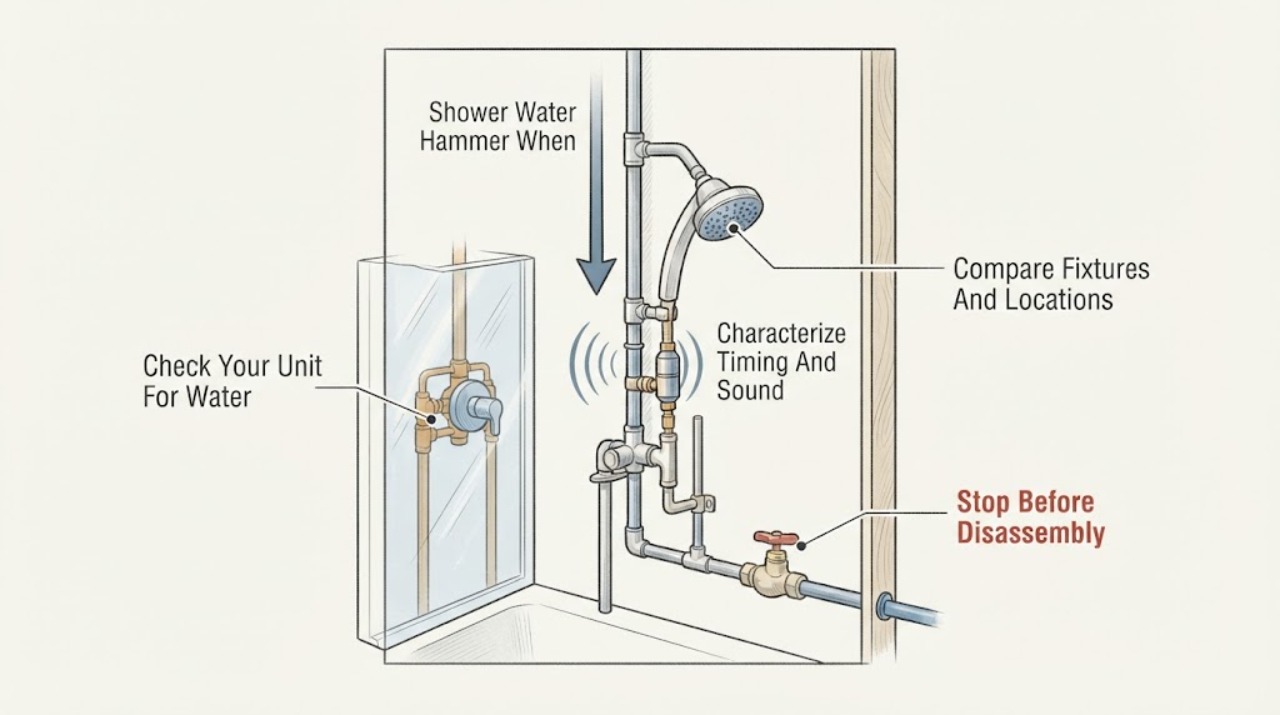
From your own unit, record whether the sound is a single bang, a series of knocks, a vibration, a hiss, or a gurgle, and whether it starts when the upstairs shower opens, changes temperature, changes flow, or stops; do not ask anyone to repeat the event for testing.
Expected result: A sharp knock immediately after flow stops is consistent with water hammer; a continuous hiss, gurgle, or vibration that continues after the shower is off suggests a valve, leak, pressure, drain, or support issue that needs a broader check.
Next step: Keep the observation log and continue only with safe, visible checks. If the sound is accompanied by water, ceiling movement, or a new loss of service, use the urgent branch.
Why this matters
Why: The timing separates a flow-change noise from a continuously active plumbing fault and gives a plumber a safer starting point.
-
Check 2
Inspect only accessible surfaces in your unit below and around the shared wall or ceiling for fresh dampness, staining, bubbling paint, a musty odor, dripping, or a change in your own shower pressure; do not open the ceiling or wall.
Expected result: No moisture or service change with an occasional brief knock is less urgent; active moisture, a growing stain, a bulging ceiling, dripping, or pressure loss changes it to a leak or building-piping response.
Next step: Stop using the affected area if water is active, protect people from the area, and notify the building manager or plumber immediately. Keep electrical equipment away from water and isolate power only from a safe, dry location.
Why this matters
Why: Water damage or a service change can indicate a failed connection, valve, or pipe rather than harmless transmitted noise.
-
Check 3
Without accessing the neighbor's unit, note whether your own faucets, toilet fill, washing machine, or shower create similar sounds and whether the vibration is strongest at one accessible wall, ceiling, valve, or pipe location.
Expected result: A sound only during the upstairs shower points toward the shared shower supply or riser; similar sounds from several fixtures point toward a building pressure, support, or common-piping issue; a local sound at your own valve points toward your fixture.
Next step: Do not remove trim, adjust concealed valves, or modify the common piping. Give the pattern to building maintenance or a licensed plumber for coordinated access.
Why this matters
Why: The fixture and location pattern helps separate a neighbor-triggered shared-line problem from a defect in your own unit.
-
Check 4
Review only existing building or unit maintenance information for a pressure regulator, recent plumbing work, a prior hammer complaint, or a known shared riser; do not change a regulator setting or add a gauge to a common line.
Expected result: A recent valve replacement, pressure complaint, renovation, or building-wide pattern raises the likelihood of a common-system cause; no history does not rule out a loose support or concealed valve problem.
Next step: Ask the building manager or owner to coordinate a plumber inspection of the common riser, pressure control, supports, and source fixture; do not enter another unit or service a shared component yourself.
Why this matters
Why: Pressure and recent work can change the force or timing of a flow stop, but the actual pressure and common piping need professional assessment.
-
Check 5
Provide the manager or plumber with the time, sound type, duration, location, affected fixtures, water or pressure signs, and whether the event follows opening or stopping the upstairs shower; request consent-based coordination rather than independent access.
Expected result: A repeatable relation to a quick valve movement supports water-hammer investigation; a random or continuous noise with leaks or pressure changes supports inspection for a valve, support, pipe, or water-service fault.
Next step: Keep your unit's accessible area dry and monitored while awaiting service. Escalate immediately if the sound becomes forceful, water appears, or the ceiling or wall changes.
Why this matters
Why: A shared-piping issue may require access to the source unit and common areas, so the building's authorized professional must control the inspection and repair.
Use your observations
Decision map
Find the observation that best matches what you see, then follow the next safe action.
-
PATH 01Next step
What you see
There is active water, a rapidly spreading stain, a bulging ceiling, dripping from a fixture or wall, loss of water service, or water near electrical equipment.
Do this next
Treat it as an urgent leak, not just a noise complaint. Keep people away, notify building management or emergency plumbing service, and isolate water or electricity only from a safe, dry, authorized location. Do not open the ceiling or enter the neighbor's unit.
-
PATH 02Next step
What you see
The sound is a brief occasional knock tied to a shower valve movement and there is no moisture, damage, or change in service.
Do this next
It is usually a maintenance concern rather than an immediate emergency. Keep a short log and ask the owner or building manager to have a plumber identify the source before installing or changing any arrestor or valve.
-
PATH 03Next step
What you see
The banging is loud, repeated, increasing, or accompanied by visible pipe vibration, pressure fluctuation, or other fixture noise.
Do this next
Request a prompt shared-piping inspection for supports, valves, pressure, and the common riser. Do not alter a pressure regulator, enter the source unit, or attach equipment to a shared pipe without authorization and professional sizing.
-
PATH 04Next step
What you see
The noise continues after the upstairs shower stops, or sounds like hissing, running water, or a pump rather than a brief knock.
Do this next
Arrange prompt plumbing and building-management assessment for a running valve, hidden leak, drain or supply issue, or pipe support. Monitor your ceiling and wall for moisture and stop using a fixture if it causes water damage.
-
PATH 05Next step
What you see
The sound is clearly strongest in the neighbor's bathroom or a concealed shared riser.
Do this next
Use the building manager, owner, or authorized plumber to coordinate access and repair. Do not enter the neighbor's unit, remove shared-area covers, or modify common plumbing yourself.
Helpful context
Understand the symptom
How concerned should you be?
An occasional short knock with no leak, movement, or change in water service is usually a maintenance concern rather than an emergency. Repeated or forceful banging can stress fittings and supports over time, especially in a shared riser or an older building. The sound alone cannot identify whether the source is a shower valve, a pressure condition, a loose support, a narrow fitting, or a different fixture that happens to run at the same time.
Neighbor timing is useful evidence
Water hammer is tied to flow changes, so note whether your sound starts when the upstairs shower is opened, when its control is moved, when water is stopped, or when another fixture drains. A vibration through a wall or ceiling may be traveling along common supply piping. Do not use this as a reason to enter another unit or ask the neighbor to repeat a potentially damaging event; a building manager or plumber can coordinate observation with consent.
Arrestors and pipe supports are not one-size-fits-all
Manufacturers describe water-hammer arrestors as shock-absorbing devices, and plumbing guidance places them near the quick-closing source with sizing and installation governed by the actual system and local requirements. An arrestor installed in your unit may not correct a shared riser problem, and an inaccessible or common pipe may belong to the building. Pressure regulation, valve repair, support isolation, or a correctly selected arrestor are plumber or building-maintenance decisions.
Safety boundary
Stop conditions
- Stop and seek urgent plumbing or building help for active water, rapidly spreading stains, a bulging ceiling, visible pipe movement, loss of water service, sewage or contaminated water, or water near electrical equipment.
- Do not enter the upstairs neighbor's unit, open a ceiling or wall, or alter a shared riser, pressure regulator, valve, or common-area pipe without authorization and a qualified plumber.
- Do not install a water-hammer arrestor based only on the noise; location, sizing, pressure, source valve, and local requirements must be assessed for the actual system.
- Do not keep using a fixture that causes a leak, severe vibration, or worsening structural or water damage while waiting for service.
Only after diagnosis
Potential parts
- water-hammer arrestor
Only consider an arrestor after a qualified plumber identifies the quick-closing source, confirms the shared or private piping arrangement, and selects a device and location suitable for the system and local requirements.
Confirm pipe type, connection, pressure, access, source location, and building approval with the plumber; this is not a universal homeowner replacement part.
When checks do not resolve it
Need a professional?
Notify the building manager or owner for any sound involving a shared riser, neighbor unit, or common area. Arrange a licensed plumber promptly for repeated or forceful hammer, pressure changes, continuous running or hissing, visible vibration, or any leak. Treat active water, ceiling movement, sewage, or electrical exposure as urgent and use emergency help when immediate danger exists.
Common questions
FAQ
Is a bang from an upstairs neighbor's shower dangerous?
A brief occasional knock without moisture or service changes is usually a maintenance concern, but repeated or forceful banging can indicate a valve, pressure, support, or shared-riser problem. Escalate quickly if water or structural changes appear.
Why can I hear the neighbor's shower in my ceiling?
A pressure wave or pipe vibration can travel through shared supply piping and building supports. The sound location does not prove that the faulty part is inside your unit.
Can I install a water-hammer arrestor in my apartment?
Do not choose or install one based only on the sound. A plumber must identify the quick-closing source, shared-pipe ownership, pressure, access, sizing, and local requirements first.
When should I call the building manager or a plumber?
Notify building management for any shared riser or neighbor-triggered noise. Request prompt plumbing assessment for repeated or forceful hammer, pressure changes, hissing, visible vibration, continuous running water, or any leak.
Read the exact guide
Official sources
- LF150AWatts · Watts residential water-hammer arrestor function, shock absorption, installation orientation, and pressure limits
- Quieting in the HomeU.S. Environmental Protection Agency · EPA technical guidance on plumbing noise, water hammer, sudden flow interruption, pipe supports, and shock-absorbing devices
- 2022 Plumbing Code Chapter 6: Water Supply and DistributionNew York City Department of Buildings · New York City plumbing-code provisions on water hammer and installation of water-hammer arrestors
- Installing a new waterlineKing County · King County plumbing guidance on water distribution, pipe support, shower installations, and water-hammer arrestors
Community feedback
Share a repair observation
Share a plain-text repair observation. Accepted observations are published automatically; this page may take a moment to update.