
On this page
Start here
Quick answer
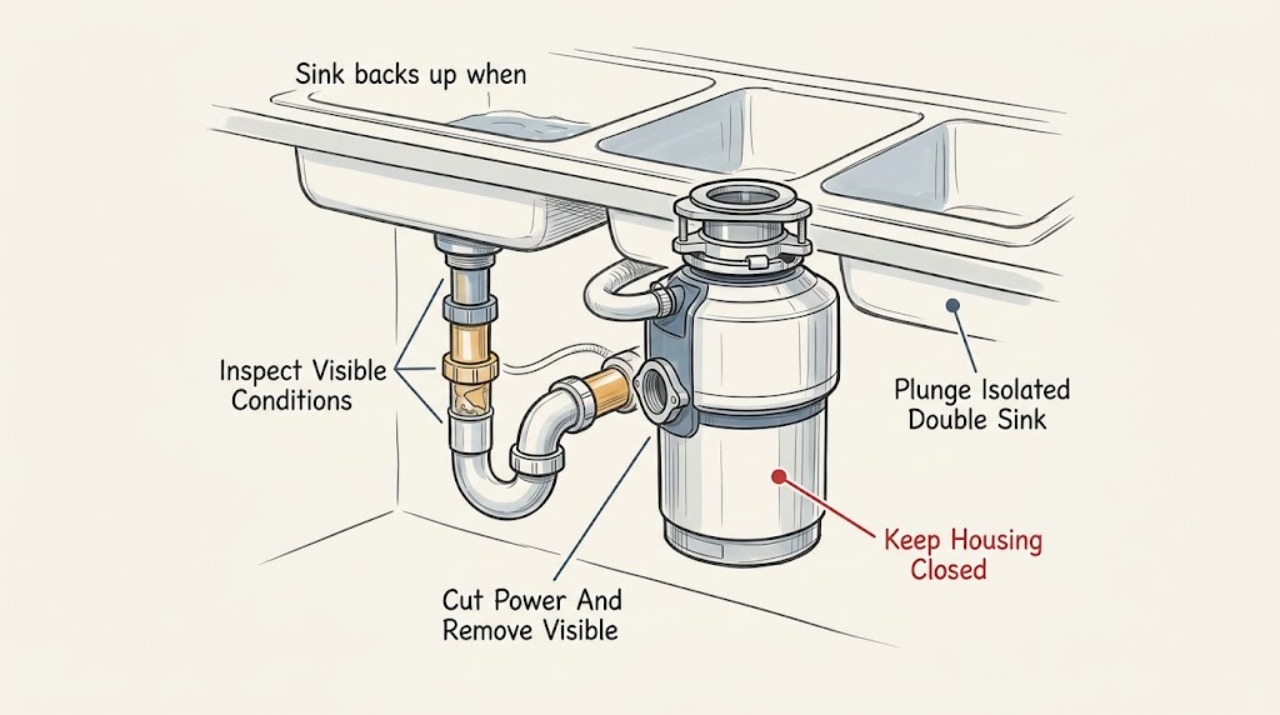
If water rises in the sink when the garbage disposal runs, the disposal motor may be working while the drain path is restricted. A clear second basin does not rule out a clog at the disposal outlet, the baffle or discharge connection, the trap, or the shared drain farther downstream. Stop running the disposal, keep hands out of the grinding chamber, and cut power before looking for visible debris. Remove standing water, seal the other basin in a double sink, and use a plunger gently as directed by the disposal manufacturer. If the disposal hums, stops, leaks, repeatedly trips its reset, or the sink still backs up after a safe plunge, stop and arrange qualified plumbing or appliance service. Do not use caustic drain cleaner, reach into the disposal, repeatedly reset it, or loosen under-sink connections while water is spilling.
Before you begin
Safety first
- This article supports stopping use, disconnecting disposal power, removing visible objects with tools, isolating a double sink, making one gentle manufacturer-directed plunger attempt, and observing visible fittings. It does not authorize reaching into the chamber, live electrical work, disposal removal, blind pipe disassembly, chemical drain treatment, or deep drain clearing.
Work through in order
Diagnostic checks
Use only checks that match the exact appliance or system and its official guide.
-
Check 1
Stop adding water and run the disposal only if there is no standing-water overflow, no leak, and no abnormal electrical or mechanical symptom. From a safe position, note whether the motor runs smoothly, whether water swirls or rises in the disposal basin, and whether the other basin drains normally when used without the disposal.
Expected result: Record a smooth motor with a whirlpool or rising water, a hum with no grinding, a silent motor, a repeated stop or reset, unusual noise, odor, or leakage. Note whether the other basin backs up at the same time or remains clear.
Next step: Use the drain-restriction branch for a running motor and rising water. Use the jam-or-power branch for humming, silence, repeated resets, or abnormal noise, and cut power before inspection.
Stop if: Do not keep running a disposal against standing water, reach into the opening, or test it if there is smoke, burning odor, a loose unit, or an active leak.
Why this matters
Why: A smooth motor with rising water makes a drain-line restriction more likely than a motor jam. A hum, silence, repeated reset, or unusual noise makes a jam or electrical/disposer fault more likely. If both basins rise, the restriction is more likely in the shared trap or downstream drain; if only the disposal basin rises, the local discharge branch remains suspect.
-
Check 2
Turn off the wall switch and disconnect power at the plug or dedicated breaker before inspecting the disposal. Remove standing water from the sink, then use a flashlight and long-handled tongs or pliers to remove only visible objects at the opening; keep hands and face out of the chamber.
Expected result: Note food, glass, metal, or other foreign material at the opening; a splash baffle that is displaced; a disposal that is loose; or water, corrosion, or a leak at the discharge connection. Do not force anything deeper into the unit.
Next step: Leave power off and continue to the correctly isolated plunger check only if there is no leak or damage. If the unit is jammed, the object cannot be removed safely, or the disposal is loose, arrange service.
Stop if: Do not put fingers into the disposal, operate it while a tool is inside, remove the unit, or reconnect power when water is near electrical parts.
Why this matters
Why: A visible object can explain a jam or poor grinding, but it does not prove that the sink drain is open. A loose or leaking discharge connection points to a plumbing or mounting problem. No visible object with a running motor and backup keeps a downstream clog more likely.
-
Check 3
If the sink is a safe double-basin setup with no active leak, seal the other drain opening with a stopper or drain cover. Remove enough standing water to work safely, add only a shallow amount if needed for a plunger seal, place the plunger over the disposal opening, and press and pull gently as the disposal manufacturer's clog guidance directs.
Expected result: Watch for the water level to drop, movement in the other basin, a gurgle followed by drainage, or no change. Stop if water sprays, the stopper lifts, the disposal shifts, or the water rises toward an overflow.
Next step: If drainage returns, run cold water and the disposal only according to its instructions and watch for a repeat backup. If it does not, leave the disposal off and arrange plumbing service rather than adding chemicals or escalating force.
Stop if: Do not plunge against an active leak, use excessive force, plunge with the disposal powered, or use chemical drain cleaner before or after plunging.
Why this matters
Why: A sudden drop and free drainage support a local, loosened restriction. No change after an isolated gentle attempt makes a deeper trap or branch clog, a blocked discharge connection, or a non-drain problem more likely. Movement in the other basin can show that pressure is reaching the shared plumbing rather than proving it is clear.
-
Check 4
With power still off, inspect the visible disposal discharge elbow, sink tailpiece, trap, and nearby drain tubing for kinks, sagging, food residue, or a connection that is visibly leaking. Do not loosen a fitting if the cabinet is flooded or you cannot contain the water; if the disposal or drain was recently installed, have the installation instructions checked for a missing knockout plug or incorrect routing.
Expected result: Record whether the restriction appears immediately below the disposal, at the trap, farther downstream, or cannot be seen. Note a recent disposal installation, a pipe connection that is loose, or water that backs up from the shared drain when either basin is used.
Next step: Do not disassemble a wet or uncertain connection. Photograph the visible routing and arrange a plumber for a trap or downstream-line clearing, installation correction, or leak repair.
Stop if: Do not remove the disposal, cut tubing, open a wall, run a snake through an unknown connection, or work under a unit that is loose or unsupported.
Why this matters
Why: A local restriction or installation obstruction can affect the disposal basin first while the other basin still drains. A backup from both basins or beyond the visible trap points farther downstream and is not a disposal cleaning task. A leak at a fitting needs correction before normal use.
-
Check 5
Arrange qualified plumbing or appliance service when the sink backs up again after a safe plunge, the disposal hums or stops, its reset trips repeatedly, water leaks, both basins back up, or a clog appears farther down the plumbing. Provide the technician the sound, basin comparison, power and visible-debris observations, and what happened during plunging.
Expected result: Report whether the motor turns, whether water swirls or rises, whether the other drain remains clear, whether the unit resets, where any leak appears, and whether a recent installation or drain change preceded the problem.
Next step: Keep the disposal off and avoid using the affected sink until the restriction or leak is diagnosed. Have the professional verify drainage, safe electrical isolation, mounting, and leak-free operation after service.
Stop if: Do not repeatedly reset, operate against a backup, pour caustic cleaner into the line, or continue if wastewater is overflowing or a fitting is separating.
Why this matters
Why: The fault may be a disposal jam or motor/control issue, a discharge connection, trap, shared drain, or an installation obstruction. The symptom does not identify a replacement disposal, motor, gasket, or drain component by itself.
Use your observations
Decision map
Find the observation that best matches what you see, then follow the next safe action.
-
PATH 01Safety boundary
What you see
The disposal runs smoothly, water swirls or rises in its basin, the other basin may still drain, and there is no visible jam or active leak.
Do this next
Cut power, remove only visible debris with tools, isolate the other basin, and make one gentle manufacturer-directed plunger attempt. Arrange service if drainage does not stay clear.
Why this path and its safety boundary
Why it matters: A restriction in the disposal outlet, discharge connection, trap, or a downstream branch is more likely than a failed motor. A clear other basin does not exclude a partial or branch-specific clog.
Safety stop: Do not run the disposal repeatedly to force the clog through or use chemical drain cleaner.
-
PATH 02Safety boundary
What you see
Both basins rise when either drain is used, water backs up from the shared trap or farther downstream, or isolated plunging produces no meaningful drainage.
Do this next
Stop using both basins and arrange qualified plumbing service to clear and inspect the shared drain. Keep standing wastewater contained.
Why this path and its safety boundary
Why it matters: A shared trap or downstream household drain restriction is more likely than a disposal-only blockage.
Safety stop: Do not remove a flooded trap, push a snake through an unknown line, or pour chemicals into standing wastewater.
-
PATH 03Safety boundary
What you see
The disposal hums without turning, stays silent, stops during use, makes abnormal noise, or repeatedly trips its reset while the sink may or may not back up.
Do this next
Cut power completely, keep hands out, and use only the model-specific jam or reset procedure if you are confident and the manufacturer's instructions allow it. Arrange service when the fault persists or the sink also backs up.
Why this path and its safety boundary
Why it matters: A jam, overload, electrical, motor, or control problem is more likely than a simple drain clog; operating it against water can worsen the condition.
Safety stop: Do not reach inside, probe with a tool while powered, repeatedly reset, or work on wiring or the motor under the sink.
-
PATH 04Safety boundary
What you see
Water leaks at the disposal, discharge elbow, trap, or sink flange, or the backup began after a disposal or drain installation or modification.
Do this next
Turn off the disposal and contain the water. Have a plumber inspect the visible connections and installation before normal operation.
Why this path and its safety boundary
Why it matters: A loose seal, damaged connection, incorrect routing, or an installation obstruction may be contributing; plunging alone will not correct a leaking or misconfigured connection.
Safety stop: Do not tighten blindly against a cracked fitting, operate a loose disposal, or restore power where water can reach the receptacle or wiring.
Helpful context
Understand the symptom
A running disposal can still have a blocked drain
The motor only tells you that the grinding assembly is turning; it does not prove that water and ground waste can leave the disposal. When the disposal side rises as it runs, water is often meeting a restriction at the discharge path, trap, or downstream shared drain. The other basin may remain clear because it has a different branch or because the restriction is partial and flow-dependent.
Separate a drain restriction from a disposal jam
A whirlpool or rising water while the disposal motor runs points toward a drain-line restriction. A hum without grinding, a stopped motor, or a reset that trips points toward a jam or electrical overload instead. Cut power before any inspection, use tools rather than hands for visible objects, and do not treat a reset as a way to clear a sink clog.
Plunge only when the setup is safe and the blockage is local
A double sink must be sealed at the other opening so plunging pressure is directed through the restricted branch. If gentle plunging does not restore drainage, if water leaks at a fitting, or if the restriction is farther in the plumbing, repeated attempts can spread contaminated water or damage connections. At that point a plumber can isolate the disposal discharge, trap, and shared drain safely.
Safety boundary
Stop conditions
- Cut power before looking for objects or a jam; never put hands into the disposal and never operate it with tools inside.
- Do not run the disposal repeatedly against a backed-up sink, repeatedly press its reset, or use caustic chemical drain cleaner.
- Do not plunge against an active leak, overflowing wastewater, a loose disposal, or an electrical area exposed to water.
- Do not remove or cut under-sink plumbing, open a wall, or clear a deep shared drain without the appropriate plumbing experience and equipment.
- Arrange qualified service when a safe isolated plunge fails, both basins back up, the motor hums or trips, a leak persists, or the restriction is farther down the plumbing.
Only after diagnosis
Potential parts
- garbage disposal splash baffle or stopper
Consider this category only when the baffle or stopper is confirmed torn, displaced, or unable to seal and the disposal model identifies it as replaceable.
Match the exact disposal model and installation instructions; a baffle replacement will not clear a trap or downstream drain restriction. - garbage disposal discharge gasket or elbow seal
Consider this only when a qualified inspection confirms a damaged or failed discharge seal is the source of a visible leak.
Confirm the disposal model, discharge configuration, and approved gasket procedure before ordering or installing. - garbage disposal
Consider replacement only after qualified diagnosis confirms an internal motor, control, or housing failure and rules out a drain restriction, jam, installation issue, or repairable seal.
Confirm sink mount, feed type, electrical arrangement, discharge orientation, and local installation requirements; do not infer compatibility from appearance.
When checks do not resolve it
Need a professional?
Arrange qualified plumbing or appliance service when the sink backs up again after one safe, manufacturer-directed plunge, when both basins or a downstream drain back up, when the disposal hums, stops, repeatedly trips its reset, or when any discharge, trap, sink-flange, or electrical-area leak is present. Stop immediately for overflowing wastewater, smoke, burning odor, a loose unit, or water near electrical connections.
Safety scope: This article supports stopping use, disconnecting disposal power, removing visible objects with tools, isolating a double sink, making one gentle manufacturer-directed plunger attempt, and observing visible fittings. It does not authorize reaching into the chamber, live electrical work, disposal removal, blind pipe disassembly, chemical drain treatment, or deep drain clearing.
Common questions
FAQ
Why does the sink back up when the disposal runs if the other basin drains?
The disposal can run while water is restricted at its outlet, discharge connection, trap, or a partial downstream branch. The other basin may have a separate branch or enough remaining capacity to appear clear. Stop the disposal, isolate the other opening in a double sink, and make only one gentle manufacturer-directed plunger attempt before arranging service if drainage does not return.
Is a running garbage disposal proof that it is not clogged?
No. The motor can run while the drain line is clogged. InSinkErator specifically uses a whirlpool or rising water with a running disposer as a clue for a drain-line clog. A smooth motor does not prove that the outlet, trap, or shared drain is clear.
How do I plunge a double sink when the disposal side backs up?
Cut disposal power, remove enough standing water to work safely, seal the other drain opening, and use a plunger gently over the disposal opening. Stop if water sprays, a fitting leaks, the disposal shifts, or the level rises toward overflow. If one safe attempt does not restore drainage, call a plumber rather than adding force or chemicals.
Should I press the reset button when the sink backs up?
Only a disposal that has stopped, jammed, or tripped protection may need a model-specific reset, and power must be isolated before inspection. A reset does not clear a drain restriction. If the motor hums, repeatedly trips, or the sink continues to back up, leave it off and arrange service.
Can I pour drain cleaner into a backed-up garbage disposal?
Do not pour caustic drain cleaner into a disposal or standing sink water. It can create a chemical hazard for anyone who later opens the line and may damage the disposal or plumbing. Use power isolation and a gentle manufacturer-approved plunge, or have a plumber clear a deeper restriction.
Read the exact guide
Official sources
- InSinkErator In-Home Full Service Limited Warranty and Installation, Care and Use ManualInSinkErator · InSinkErator manual guidance; model-specific instructions and hardware may differ.
- Fixing a Clogged Garbage DisposalInSinkErator · InSinkErator consumer guidance; exact disposer construction and safe procedures vary by model.
- Operating a Batch-Feed Waste DisposerWhirlpool Product Help · Whirlpool batch-feed disposer guidance; continuous-feed units and local installations may differ.
- How to Reset a Garbage DisposalWhirlpool Product Help · Whirlpool disposer guidance; button locations and jam procedures vary by model.
Community feedback
Share a repair observation
Share a plain-text repair observation. Accepted observations are published automatically; this page may take a moment to update.