
On this page
Start here
Quick answer
When water rises in the sink as the garbage disposal runs, the disposal is probably moving water into a restricted path rather than clearing it. The restriction may be at the disposal outlet, sink tailpiece, trap, shared drain, or farther downstream; a jammed or weak disposal can also leave debris in the discharge path. Turn the disposal off, keep hands and tools out of the grinding chamber, and remove standing water safely. With power disconnected, inspect the sink opening for visible objects using tongs or pliers only, and check for a kinked or leaking drain connection from outside the piping. Do not use chemical drain cleaner, reach into the disposal, repeatedly run a humming unit, or loosen plumbing full of standing water unless you are prepared to contain it. Call a plumber for a persistent backup, a blockage beyond the accessible trap, a leak, sewage-like water, a disposal that hums or trips, or any uncertainty about safe power isolation.
Before you begin
Safety first
- Owner checks are limited to ordinary switching, safe water containment, power-off visual inspection, visible-object removal with tongs, and external connection observation. A qualified plumber or electrician must handle chamber access, disposal removal, drain clearing, trap disassembly, wiring, and electrical testing.
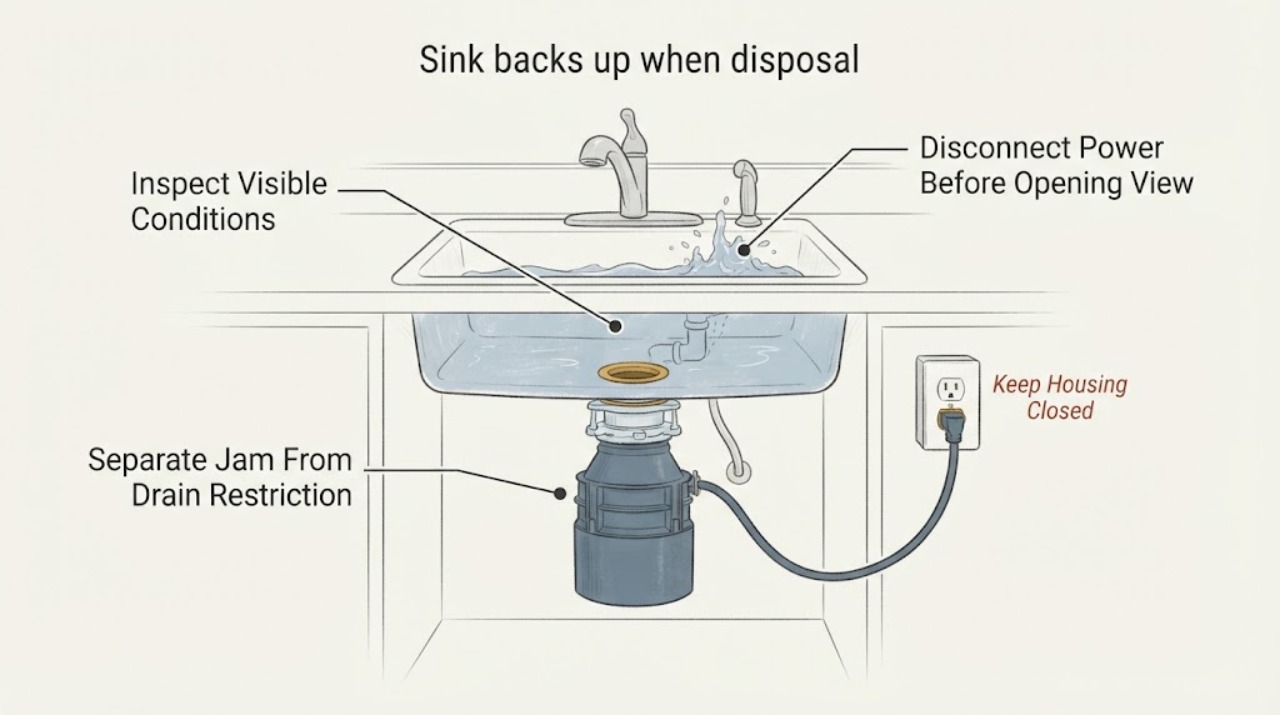
Work through in order
Diagnostic checks
Use only checks that match the exact appliance or system and its official guide.
-
Check 1
Turn the disposal off and observe the sink level, the other sink bowl if present, and whether the water drains at all without running the disposal. Do not restart it while the sink is full or the motor is humming.
Expected result: Record a sink that drains slowly after stopping, remains full, backs up into the other bowl, contains food debris, or shows sewage-like water or an odor.
Next step: Leave the disposal off and limit water use at the affected sink. Request plumbing service for a persistent, shared, widespread, foul, or non-draining backup.
Stop if: Stop immediately for sewage-like water, an overflowing sink, an electrical outlet or cord getting wet, a leak at the disposal, or any uncertainty about safe power isolation.
Why this matters
Why: A slow or shared-bowl backup points toward a restriction in the disposal outlet, trap, shared branch, or downstream drain. A disposal-specific rise with no other drain symptom can keep a local outlet or jam in consideration. Sewage-like water or a widespread backup suggests a household drain problem beyond the appliance.
-
Check 2
Disconnect power to the disposal using the model's safe method, then use a flashlight to view the sink opening without putting a hand into the chamber. Remove only a clearly visible object with long tongs or pliers while keeping face and hands away from the opening.
Expected result: Record no visible object, a removable foreign object, compacted food debris, a splash baffle that blocks the view, or power that cannot be confidently disconnected.
Next step: Leave the disposal without power and request qualified service if the obstruction is not clearly removable, the unit is jammed, or power isolation is uncertain. Never reach into the chamber.
Stop if: Do not use bare hands, insert a tool to pry or probe, turn the disposal on during inspection, or continue if water can reach the electrical connection.
Why this matters
Why: A visible object or debris can explain a jam or restricted discharge, but no object does not rule out an internal jam or downstream plumbing restriction. A blocked view or uncertain power state is a stop condition, not permission to probe farther.
-
Check 3
From outside the unit, note whether the disposal motor is silent, hums without normal grinding, trips its protection, or runs with a normal sound while the sink rises. Do not use a hand, broom handle, or tool to turn the grinding parts.
Expected result: Record a normal-sounding motor with rising water, a hum with no rotation, no sound, repeated reset or breaker behavior, burning odor, or an unusual grinding sound.
Next step: Keep power off and arrange disposal or plumbing service for a hum, trip, odor, abnormal grinding, or no improvement after visible debris is safely removed. Do not keep resetting or cycling the unit.
Stop if: Stop for smoke, burning odor, sparking, a hot unit, repeated trips, a leak onto electrical parts, or a motor that only hums.
Why this matters
Why: A normal-sounding motor with rising water makes an outlet, trap, shared drain, or downstream restriction more likely. A hum, repeated trip, burning odor, or abnormal grinding makes a jam or electrical or motor fault more likely and should not be run against the backup.
-
Check 4
Place a towel or shallow pan under the sink and inspect the outside of the disposal discharge connection, trap, and nearby drain pipe for drips, a kink, sag, separation, or a recently changed connection. Do not loosen a trap or fitting containing standing water unless a qualified person directs the work.
Expected result: Record dry and intact connections, water leaking at the disposal or trap, a separated or misaligned pipe, a kinked hose, or a blockage that appears farther down the drain.
Next step: Keep the disposal off, contain any water, and call a plumber for a leak, separated fitting, inaccessible blockage, or backup that returns after visible checks.
Stop if: Do not disassemble a full trap, use chemical drain cleaner, force a fitting, or work near a wet electrical connection.
Why this matters
Why: A leak or misaligned connection can accompany a failed installation or restriction, while a dry connection with an unchanged backup shifts attention to the internal or downstream drain. A blockage beyond the accessible trap is a plumbing task, not a disposal reset.
-
Check 5
After flow has been restored by a safe, model-approved procedure or professional service, record whether the backup followed grease, oil, fibrous scraps, starchy scraps, large amounts of food, or too little running water. Do not test by adding more waste to a slow drain.
Expected result: Record normal cold-water use with a clear drain, a recurrence after certain waste, a backup when water runs without food, or a slow drain that recurs immediately.
Next step: Use cold water before, during, and briefly after small feedings only when the drain is clear. Arrange plumbing service if the sink rises with plain water or the restriction returns.
Stop if: Do not continue testing a rising sink, pour grease or chemical cleaner into the drain, or run the disposal against a standing backup.
Why this matters
Why: Waste type and insufficient flushing can contribute to residue and restrictions. A recurrence with plain water or no waste makes a plumbing restriction, disposal discharge issue, or installation problem more likely than food choice alone.
-
Check 6
Prepare the service request with disposal brand and model if safely visible, continuous or batch feed type, whether the light or motor works, sink level and other-bowl behavior, motor sound, visible debris, connection leaks, recent installation or drain work, and what was put down the disposal.
Expected result: Confirm that the record contains external observations only and that no hand, tool, chemical, wiring, trap, disposal mount, or motor component was disturbed unsafely.
Next step: Request qualified plumbing or disposal service and provide the backup timeline. Let the professional isolate power, clear or inspect the drain, and verify the disposal and connections with model-appropriate procedures.
Stop if: Stop all user troubleshooting when the next step requires chamber access, electrical testing, disposal removal, trap disassembly with standing water, drain augering, or work near wet wiring.
Why this matters
Why: This record helps a plumber or appliance technician separate a disposal jam or motor fault from a local outlet, trap, shared branch, or downstream drain restriction and identify a recent installation issue.
Use your observations
Decision map
Find the observation that best matches what you see, then follow the next safe action.
-
PATH 01Next step
What you see
The motor sounds normal, the sink rises only when the disposal runs, there is no leak or electrical warning, and the other bowl or nearby drains remain normal.
Do this next
Keep the disposal off, perform only the power-off visible-opening check, and request plumbing or disposal service if the backup remains. Do not assume the motor needs replacement.
-
PATH 02Next step
What you see
Both sink bowls back up, the sink remains full after the disposal stops, plain faucet water also drains slowly, or another nearby fixture is affected.
Do this next
Stop using the affected sink and call a plumber for a shared branch or downstream drain restriction. Do not keep running the disposal or add chemical cleaner.
-
PATH 03Next step
What you see
The disposal hums, grinds abnormally, stays silent after a command, trips protection, smells hot, or does not rotate normally while the sink backs up.
Do this next
Leave power off and arrange qualified disposal or electrical service. Do not reach into the chamber, repeatedly reset, or use a tool to force the grinding parts.
-
PATH 04Next step
What you see
Water leaks at the disposal discharge, trap, or recently changed under-sink connection, or a pipe is separated, kinked, or misaligned.
Do this next
Keep the disposal off, contain the water, and call a plumber. Do not loosen a full trap or work near a wet electrical connection.
-
PATH 05Next step
What you see
There is sewage-like water, overflowing water, smoke, sparks, burning odor, a hot electrical connection, exposed wiring, or a repeated breaker trip.
Do this next
Stop using the sink and disposal, keep clear, and use appropriate plumbing, electrical, or emergency help from a safe location. Do not restore power to reproduce the issue.
Helpful context
Understand the symptom
The disposal may be pushing against a restriction
A disposal does not make a blocked sink drain faster. When the motor runs and water rises, the restriction may be inside the disposal outlet, the connected tailpiece or trap, the shared branch drain, or farther downstream. Food debris, grease, fibrous scraps, a foreign object, or a recent under-sink installation can all change flow. If the motor hums without normal rotation, the disposal may also be jammed; if it runs normally while both sink bowls back up, a shared plumbing restriction is more likely. These patterns are useful clues, not a safe reason to dismantle the disposal.
Protect hands and contain the standing water
Turn the disposal switch off and disconnect power using the model's safe method before inspecting the opening or any accessible obstruction. Remove standing water with a container or other safe means, keep hands out of the chamber, and use tongs or pliers only for a visible object at the opening. Do not run a humming or stalled unit against a full sink, and do not pour chemical drain cleaner into the disposal. If a connection leaks or the blockage is not accessible without loosening a trap, stop and call a plumber.
Normal operation helps prevent a repeat backup
After a professional or safe, model-approved clearing has restored flow, run cold water before and during disposal use, feed small amounts gradually, and let water continue briefly after grinding so particles can move through the drain. Avoid grease, oil, large amounts of starchy or fibrous scraps, and non-food objects. If water rises again even with normal cold-water use and a clear disposal, the plumbing restriction or installation needs service rather than more disposal cycles.
Safety boundary
Stop conditions
- Turn the disposal off and disconnect power before inspecting the opening; never put a hand into the grinding chamber or run a humming unit against standing water.
- Do not use chemical drain cleaner, probe or pry inside the disposal, repeatedly reset a tripping unit, loosen a full trap, or work near wet electrical connections.
- Stop using the sink and disposal for overflow, sewage-like water, leaks onto electrical parts, smoke, sparks, burning odor, a hot unit, exposed wiring, or an inaccessible blockage.
Only after diagnosis
Potential parts
- garbage disposal splash baffle or discharge connection
Consider this category only when service confirms a damaged baffle or restricted or leaking discharge connection; a rising sink can originate farther downstream.
Confirm disposal model, sink connection, discharge configuration, seals, and manufacturer-approved fit before sourcing or installing a part. - garbage disposal motor or internal grinding component
Consider an internal component only when testing confirms a jammed, stalled, or failed disposal after drain restrictions and safe visible obstructions are separated.
A qualified technician should identify the exact disposal model, motor design, electrical rating, mounting, and approved replacement path. - sink trap or downstream drain service component
Consider this category when both bowls, plain faucet water, or other fixtures back up, indicating a shared or downstream restriction rather than a disposal-only fault.
Have a plumber verify pipe size, configuration, local code requirements, and the exact failed connection or component before replacement.
When checks do not resolve it
Need a professional?
Call a plumber when water remains in the sink, both bowls or other fixtures back up, plain faucet water drains slowly, a connection leaks, or the backup returns after safe visible checks. Call qualified disposal or electrical service for a humming, silent, tripping, hot, sparking, or abnormally grinding unit. Stop immediately for sewage-like water, overflow, smoke, sparks, burning odor, exposed wiring, or water at electrical connections.
Safety scope: Owner checks are limited to ordinary switching, safe water containment, power-off visual inspection, visible-object removal with tongs, and external connection observation. A qualified plumber or electrician must handle chamber access, disposal removal, drain clearing, trap disassembly, wiring, and electrical testing.
Have this ready
- Give the professional the disposal brand and model if safely visible, feed type, motor and light response, sink and other-fixture behavior, motor sound, visible debris, connection leaks, recent installation or drain work, and waste or water-use history.
Common questions
FAQ
Why does water rise in the sink when the disposal runs?
The disposal may be moving water into a restricted outlet, trap, shared branch, or downstream drain. A jammed or weak disposal can also leave debris in the discharge path. Whether the other bowl backs up and whether plain faucet water drains slowly helps narrow the service path.
Can I run the disposal again to clear the backup?
Do not keep running it against standing water. Turn it off, disconnect power before inspecting, and call service if the water remains, the motor hums, or the backup returns.
Can I reach into the disposal to remove debris?
No. Never put a hand into the grinding chamber. With power disconnected, use a flashlight and long tongs only for an object clearly visible at the opening, and stop if it is not easily removable.
Should I pour chemical drain cleaner into the sink?
No. Chemical cleaner can create a hazard in a disposal and sink full of standing water and does not identify the restriction. Keep the disposal off and call a plumber for a persistent backup.
What if both sink bowls back up?
A shared branch or downstream drain restriction becomes more likely, especially if plain faucet water also drains slowly. Stop using the affected sink and call a plumber rather than repeatedly cycling the disposal.
How can I prevent another disposal backup?
When the drain is clear, run cold water before and during disposal use, feed small amounts gradually, and let water continue briefly after grinding. Avoid grease, oil, large starchy or fibrous loads, and non-food objects.
When is this an urgent safety issue?
Stop immediately for overflow, sewage-like water, smoke, sparks, burning odor, exposed wiring, water at an electrical connection, a hot disposal or outlet, or a repeated breaker trip. Keep clear and use appropriate plumbing, electrical, or emergency help.
Read the exact guide
Official sources
- Clearing a Jammed DisposerWhirlpool · Whirlpool product-help guidance used for general disposer safety and jam symptom separation; exact disposer instructions govern.
- Garbage Disposal (2026) | InSinkErator USInSinkErator · InSinkErator manufacturer guidance used for general disposal operation and prevention; the user's model instructions govern.
- How to Reset a Garbage DisposalWhirlpool · Whirlpool disposer support guidance used for general safety and operation context, not a diagnosis or universal reset procedure.
Community feedback
Share a repair observation
Share a plain-text repair observation. Accepted observations are published automatically; this page may take a moment to update.