
On this page
Start here
Quick answer
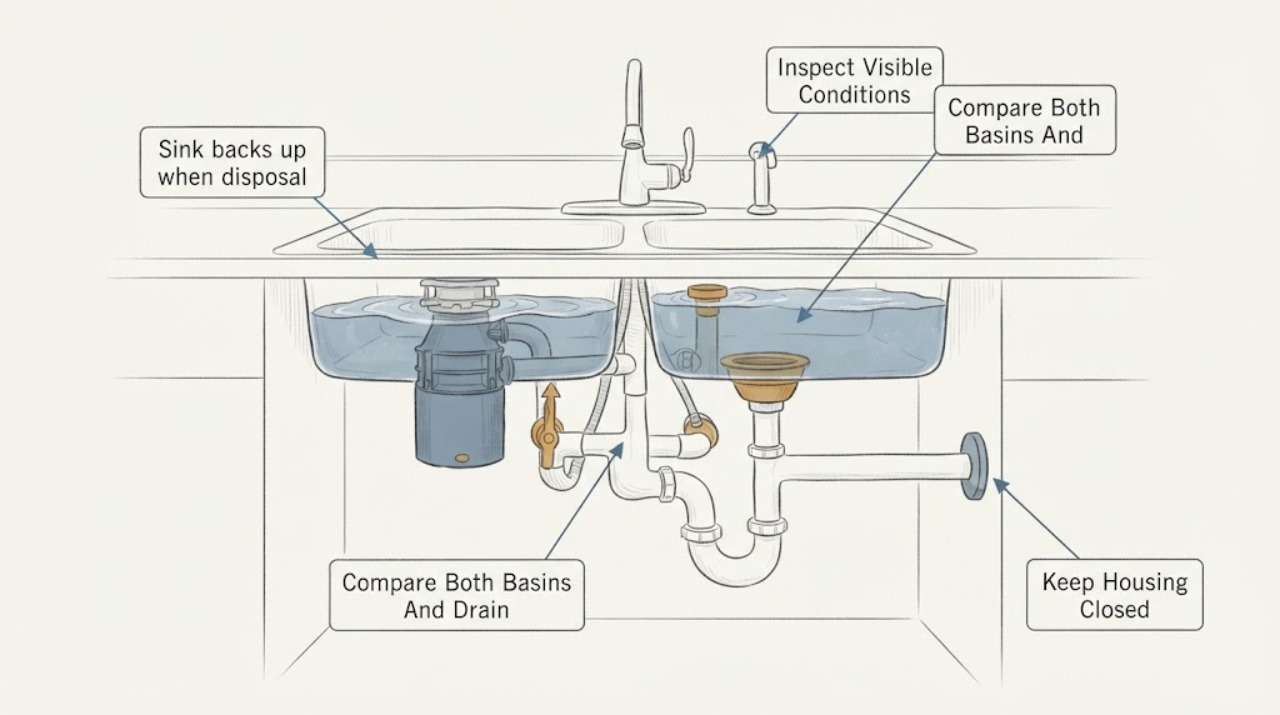
Stop treating the symptom as a disposal-only problem. From a dry position, note whether the backup appears immediately when the disposal runs, whether the other basin rises, whether water drains normally with the disposal off, and whether you hear gurgling or see standing water. A disposal that sounds normal while water backs up often points to a shared drain or downstream restriction; a disposal that does not run is a separate appliance issue. Do not put a hand or tool into the disposal, touch wet electrical parts, mix chemicals, open the trap or disposal, or repeat tests after an overflow. Arrange plumbing service when the backup is persistent, reaches both basins, or involves sewage or a leak.
Work through in order
Diagnostic checks
Use only checks that match the exact appliance or system and its official guide.
-
Check 1
Only if both basins are empty and the area is dry, observe one brief normal disposal run with normal water flow, then switch it off as soon as the first backup or unusual behavior appears. Do not repeat the cycle, reach into the opening, or continue if water is already standing.
Expected result: Water rises immediately, rises after a short delay, does not rise, or the disposal does not run.
Next step: Record the timing, water level, sound, and whether the disposal ran, then stop using it and continue only with safe visual observations.
Stop if: Stop immediately at any backup, gurgle with rising water, leak, odor, sparking, or need to touch the disposal or wet electrical area.
Why this matters
Why: Immediate or delayed rise while the motor sounds normal keeps a shared drain or downstream restriction in focus. No rise makes the symptom intermittent rather than resolved; a disposal that does not run is a separate electrical or motor issue and should not be combined with a drain test.
-
Check 2
With the disposal off and no standing water, observe whether the other basin, the disposal basin, or both drain slowly during ordinary use. Do not fill either basin to provoke a backup and do not remove a stopper or open a drain connection.
Expected result: Only the disposal basin backs up, both basins rise or drain slowly, the other basin remains normal, or the drain behavior cannot be checked safely.
Next step: Tell the plumber which basin changes, whether slow drainage exists with the disposal off, and whether the symptom is repeatable without creating an overflow.
Stop if: Stop if either basin contains standing water, the cabinet or floor is wet, the drain leaks, or checking the other basin would require repeated filling.
Why this matters
Why: Both basins or a slow drain with the disposal off makes a shared or downstream restriction more likely. A disposal-side-only symptom keeps the disposal outlet or immediate branch connection in consideration, but location alone does not establish the repair.
-
Check 3
From above the sink and from a dry position, listen for gurgling and observe whether water swirls, pauses, rises, or crosses the divider between basins when the symptom occurs. Do not place a hand, utensil, plunger, or tool into the disposal opening and do not look under a wet cabinet by touch.
Expected result: There is a clear whirlpool with no backup, gurgling with a rising level, cross-basin movement, a slow silent rise, or no safe observation.
Next step: Stop the disposal, keep the sink unused, and provide the sound and movement pattern to a plumber rather than trying to push the blockage farther downstream.
Stop if: Stop if water rises, spills, smells like sewage, reaches electrical equipment, or any inspection would involve contact with the disposal or wet cabinet.
Why this matters
Why: Gurgling, cross-basin movement, or a slow rise supports a shared drain-path or air movement concern. A whirlpool without backup does not rule out a partial restriction, while no safe observation leaves the cause unknown.
-
Check 4
From above the counter or another dry, hands-off position, note visible context such as a dishwasher air-gap cap overflowing, water at the sink rim, a recent disposal or drain change, a visible leak under the cabinet, or a recently changed drain connection. Do not remove the cap, loosen a clamp, open the trap, or disassemble the disposal.
Expected result: No recent change or visible leak is present, an air-gap or rim overflow is visible, a connection appears wet, or recent work preceded the backup.
Next step: Photograph the visible condition without touching it and tell the plumber what changed, where water appeared, and whether the backup preceded or followed any appliance work.
Stop if: Stop if water is near an outlet or cord, a connection is actively leaking, the cabinet floor is wet, or inspection would require disassembly.
Why this matters
Why: Recent work or a visible connection leak changes the service request toward installation and connection verification. An air-gap or rim overflow can show that the drain path is being overwhelmed, but it does not identify a safe clearing method.
-
Check 5
Confirm that the disposal timing, both-basin behavior, gurgle and flow pattern, visible connection context, and recent-work history are documented without hand or tool contact, chemical mixing, wet electrical contact, trap or disposal disassembly, or repeated overflow testing.
Expected result: The symptoms are documented safely, or the sink is wet, the cause is uncertain, or a boundary would be crossed to learn more.
Next step: Request plumbing service and provide the timing, basin, sound, visible-water, recent-work, and safety observations; leave the disposal and sink unused until advised.
Stop if: Stop and seek professional help for persistent backup, both basins affected, sewage odor, active leaks, standing water, or any electrical or access concern.
Why this matters
Why: A clear record helps a plumber distinguish disposal-side, shared-drain, connection, and downstream restrictions. An unsafe or incomplete record means the next step is service, not a more aggressive test.
Use your observations
Decision map
Find the observation that best matches what you see, then follow the next safe action.
-
PATH 01Next step
What you see
Both basins rise or drain slowly even when the disposal is off.
Do this next
Treat the issue as a shared or downstream drain restriction and request plumbing service. Do not keep running the disposal or force repeated sink tests.
-
PATH 02Next step
What you see
Only the disposal basin backs up and the other basin remains normal when the disposal is off.
Do this next
Tell the plumber the symptom is disposal-side and provide the run timing, sound, and recent-work history. Do not place a hand or tool inside the disposal or disassemble its outlet.
-
PATH 03Next step
What you see
A visible air-gap, rim, cabinet connection, or recent installation is associated with water or the backup.
Do this next
Request connection and drain-path inspection and provide photos. Do not remove the cap, loosen clamps, open the trap, or continue operating the disposal.
-
PATH 04Next step
What you see
The disposal does not run during the brief observation.
Do this next
Treat the motor or power symptom separately and request appliance or electrical service as appropriate. Do not touch wet cords, receptacles, or internal components.
-
PATH 05Next step
What you see
Water is already standing, spilling, leaking into the cabinet, or has a sewage odor.
Do this next
Stop use, keep away from wet electrical areas, and request prompt plumbing or water service. Do not repeat the test, mix chemicals, or enter the wet cabinet.
Helpful context
Understand the symptom
Why the disposal can trigger a sink backup
A disposal sends water and ground food waste into the sink drain. If the branch connection, shared drain, trap, or downstream line cannot accept that flow, the water can rise in the disposal basin or cross into the other basin. The disposal motor may still sound normal, so the timing and location of the backup are more useful than the sound alone.
Observe once, then stop
Use only a brief, ordinary-use observation when both basins are empty and no water is already standing. Do not fill the sink or repeat a cycle to force an overflow. If water is present, stop the disposal and keep hands, tools, and electrical contact away from the wet area.
The other basin is a key clue
A backup that crosses into the second basin points attention toward the shared drain path, while water isolated at the disposal opening may involve the disposal outlet or its immediate connection. Neither pattern identifies a safe DIY repair; a plumber can inspect the complete path without turning a blockage into a leak or electrical hazard.
Only after diagnosis
Potential parts
- garbage disposal splash guard
Consider this category only if a professional confirms that the splash guard is damaged and the observed symptom is at the disposal opening rather than a shared drain restriction.
Confirm the disposal model and splash-guard fit before ordering; this part will not correct a blocked shared drain or downstream line. - sink air gap
Consider this category only if the installation includes an air gap and a professional confirms that its body or connections are damaged or unsuitable.
Confirm the hose routing, sink configuration, and connection fit before ordering; do not treat an air-gap replacement as proof of a disposal clog. - drain auger
Consider this category only as a professional drain-service category after the symptom pattern indicates a shared or downstream restriction.
Confirm the drain layout and safe access with the plumber; do not insert an auger through the disposal or trap as a homeowner test.
When checks do not resolve it
Need a professional?
Call a plumber for a persistent backup, both basins affected, slow drainage with the disposal off, gurgling and rising water, an air-gap or connection overflow, sewage odor, an active leak, or a symptom that returns after a brief safe observation. Add qualified electrical or appliance service when the disposal will not run or wet electrical equipment is involved.
Have this ready
- Provide the disposal on/off timing, affected basin, drain behavior with the disposal off, gurgling or cross-basin movement, visible air-gap or leak context, recent disposal or drain work, photos from a dry position, and whether standing water or sewage odor is present.
Common questions
FAQ
Why does the sink back up only when the disposal runs?
The disposal may be sending flow into a restricted shared branch or downstream drain. Record whether the other basin rises and whether the sink drains normally with the disposal off, then request plumbing service if the pattern persists.
Can I reach into the disposal to clear the backup?
No. Do not put a hand or tool into the disposal. Keep power and wet areas separate, stop operation, and have a qualified professional inspect the disposal and drain path.
What does gurgling in the other basin mean?
Gurgling with cross-basin movement or rising water keeps a shared drain, air movement, or downstream restriction in focus. Do not keep running the disposal to test it; provide the sound and basin pattern to a plumber.
Should I use a chemical drain cleaner?
Do not mix or pour chemicals while the cause is unknown. Chemicals can create exposure and complicate later service; stop using the sink and request a plumber for a persistent or standing-water backup.
Read the exact guide
Official sources
- Fixing a Clogged Garbage DisposalInSinkErator · Supports distinguishing a disposal clog symptom from a deeper drain-line problem; this article intentionally omits the source's hands-on clearing procedure.
- InSinkErator SupportInSinkErator · Supports the use of manufacturer-specific troubleshooting and service escalation for disposals; it does not establish the reader's model or a repair outcome.
Community feedback
Share a repair observation
Share a plain-text repair observation. Accepted observations are published automatically; this page may take a moment to update.