
On this page
Start here
Quick answer
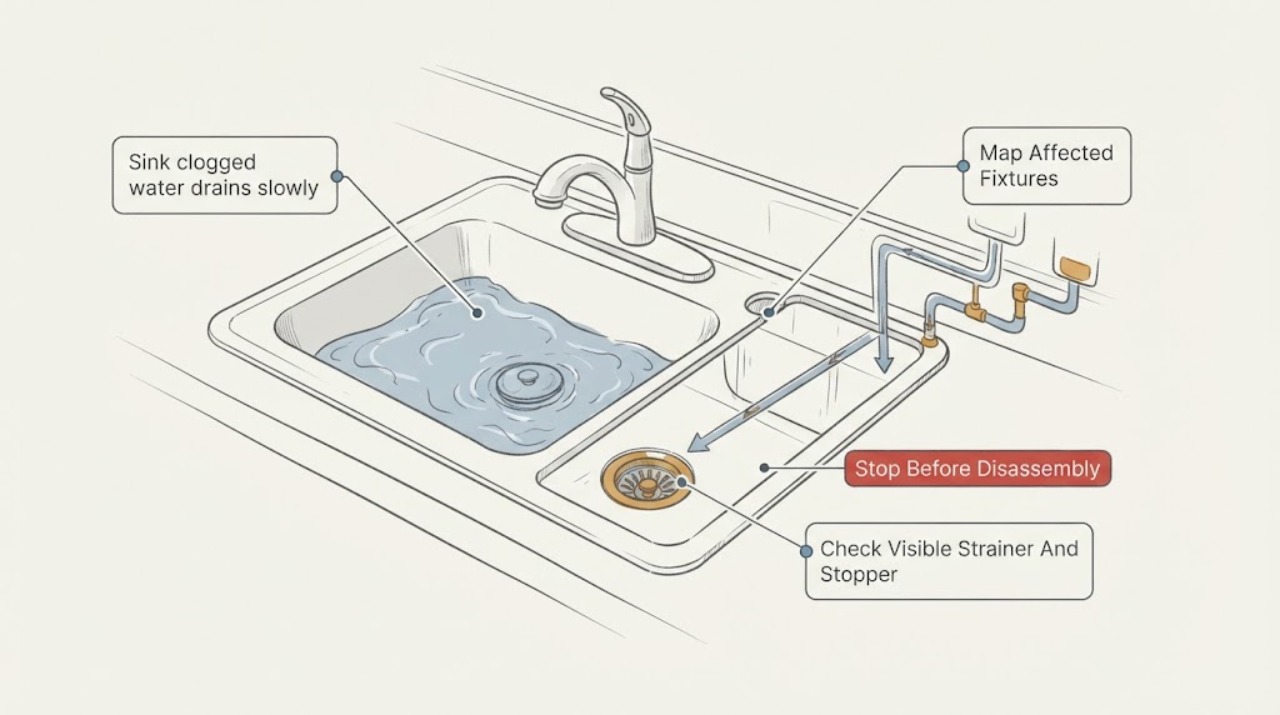
If a sink drains slowly or not at all, first determine whether the blockage is limited to the sink or whether other fixtures are backing up. Remove only visible debris at the strainer or stopper, then use a correctly sized sink plunger with enough water to seal the drain if no chemical cleaner has been used. A clog in the P-trap, branch line, or main drain, a garbage-disposal restriction, or a drain that is leaking under the sink needs a different response. Do not mix drain chemicals, plunge after pouring chemical opener into standing water, force a stuck fitting, or open the P-trap without preparing for contaminated water and a safe reassembly. Stop using the sink and call a plumber for sewage backup, multiple affected fixtures, an inaccessible or leaking trap, a recurring clog, or chemical exposure.
Work through in order
Diagnostic checks
Use only checks that match the exact appliance or system and its official guide.
-
Check 1
Stop adding water and observe the sink and nearby fixtures. Note whether one basin, both basins, the disposal, a nearby tub or toilet, or several fixtures are slow or backing up.
Expected result: Record one sink only; both bowls; water rising in another fixture; gurgling or sewer odor; wastewater backing up; or water already pooling under the cabinet.
Next step: Avoid using affected fixtures and arrange a plumber for multiple-fixture backup, sewage, recurring gurgling, or water damage. If only one sink is affected and no chemical has been used, continue with the visible debris and plunger checks.
Stop if: Stop immediately for sewage backup, flooding, a ceiling or wall leak, contaminated water, or water near electrical equipment or a disposal connection.
Why this matters
Why: A single sink points more toward a local strainer, stopper, trap, or branch obstruction. Multiple fixtures or wastewater backup makes a downstream or main-line restriction more likely. Water under the cabinet adds a leak or trap-joint concern and is not solved by repeated plunging.
-
Check 2
With standing water kept shallow and using gloves, inspect the visible strainer, stopper, and drain opening for hair, food, grease, or a small object. Remove only loose material that is plainly accessible; do not push it deeper or use a sharp tool.
Expected result: Record a visible obstruction that lifts out; a stopper or disposal baffle that is not seated; a clear opening with slow flow; or an object that is stuck below the opening.
Next step: Restore only the visible strainer or stopper position and add a small amount of water to observe flow. If the sink remains slow or blocked, use a plunger only when no chemical opener is present, or call a plumber.
Stop if: Do not reach into an energized disposal, run it to clear a blockage, probe the drain with a sharp object, or push debris farther into the pipe.
Why this matters
Why: Debris at the opening can cause a local slow drain and may be removed without opening the plumbing. A clear opening with no improvement means the restriction may be in the trap or branch line; a stuck object should not be forced downward.
-
Check 3
Only if no drain chemical has been used, place a sink plunger over the drain with enough water to cover the cup. Seal the overflow opening and, for a double sink, close the other drain; use controlled strokes without splashing.
Expected result: Record that water begins draining; the level moves but returns; no movement occurs; the other basin rises; or dirty water or chemical odor splashes back.
Next step: If flow improves, flush cautiously with ordinary water and monitor for recurrence. If it does not, stop and arrange plumbing service rather than increasing force, adding chemicals, or opening the trap without a safe plan.
Stop if: Do not plunge after chemical opener was used, over a disposal that is energized, against a cracked fixture, or when sewage or chemical liquid can splash into eyes or skin.
Why this matters
Why: Improvement suggests a local, movable obstruction. Little or no movement, water transferring to another basin, or backup elsewhere makes a trap, branch, vent, or downstream restriction more likely. Splashback or chemical odor makes continued plunging unsafe.
-
Check 4
From outside the cabinet, use a flashlight to observe the P-trap and drain connections for standing water, bulging, corrosion, dripping, a loose joint, or a visibly kinked or collapsed section. Do not loosen the trap or supply lines.
Expected result: Record a dry, intact trap; water leaking at a joint; a damaged or corroded trap; a trap packed with visible residue; or no safe access under the sink.
Next step: Place a container under a minor drip only if it can be done without touching contaminated liquid, stop using the sink, and arrange service for any leak, corrosion, standing water, or inaccessible trap. Do not rely on tightening a joint as a clog repair.
Stop if: Do not unscrew a trap, cut piping, force slip nuts, or work beneath a sink where chemical opener, sewage, or electrical equipment is present.
Why this matters
Why: The P-trap is a common local clog location, but a leak or damaged fitting changes the job from simple flow clearing to containment and repair. Inaccessible, corroded, or chemical-contaminated piping should be opened by a plumber.
-
Check 5
Ask whether any drain opener, bleach, acid, lye, baking-soda mixture, or other cleaner was poured into the sink, and check the label or container without handling spilled liquid. Note any fumes, heat, splashing, skin or eye contact, or breathing symptoms.
Expected result: Record no chemical use; a chemical used recently; an unknown product in standing water; fumes or heat; or a person with eye, skin, throat, breathing, or swallowing symptoms.
Next step: Do not add another product or plunge. Keep people away, ventilate only without spreading fumes, tell the plumber the product and time, and obtain immediate medical or poison-control help for exposure symptoms.
Stop if: Stop and leave the area for strong fumes, eye or skin burns, breathing difficulty, collapse, or an unknown chemical spill; do not touch or neutralize the product yourself.
Why this matters
Why: No chemical history permits a mechanical plunger decision. A chemical in a blocked drain can remain concentrated and make plunging, trap opening, or mixing products hazardous. Exposure symptoms require poison-control or emergency guidance, not drain troubleshooting.
-
Check 6
Prepare the plumbing service request with sink type, single or double basin, disposal presence, affected fixtures, onset, standing-water level, visible debris, plunger result, P-trap condition, leak or backup location, chemical history, and any water damage.
Expected result: Confirm that the record contains observations only and that no trap, branch pipe, disposal, supply line, or chemical residue was disturbed or mixed.
Next step: Arrange plumbing service when the drain remains slow or blocked after a safe visible check and plunger attempt, when multiple fixtures are affected, or when the trap is leaking, inaccessible, corroded, or chemically contaminated.
Stop if: Stop homeowner troubleshooting when the next step requires trap or branch disassembly, a powered auger, disposal removal, chemical handling, or work near electrical equipment.
Why this matters
Why: The pattern helps a plumber distinguish an opening or local trap clog from a downstream or main-line restriction, a disposal or trap leak, a damaged fitting, or a chemical-contaminated drain.
Use your observations
Decision map
Find the observation that best matches what you see, then follow the next safe action.
-
PATH 01Next step
What you see
Only one sink is affected, the drain opening has visible removable debris, and there is no leak, chemical history, or contaminated backup.
Do this next
Remove only loose visible debris, restore the stopper or baffle, and test with a small amount of water. Call a plumber if flow remains slow or the obstruction is below the opening.
Why this path and its safety boundary
Why it matters: A local strainer, stopper, or opening obstruction is more likely than a main-line problem.
-
PATH 02Next step
What you see
One sink is affected, no chemical has been used, and controlled plunging makes the water drain normally or substantially faster.
Do this next
Flush cautiously with ordinary water and monitor. Arrange service for recurrence, gurgling, odor, or any backup in another fixture rather than escalating force or chemicals.
Why this path and its safety boundary
Why it matters: A movable local clog is more likely, but a partial obstruction may remain and can recur.
-
PATH 03Next step
What you see
The opening is clear and plunging does not restore flow, or water moves between double basins or backs up elsewhere.
Do this next
Stop using the affected fixtures and call a plumber. Do not force the trap, run a disposal against standing water, or open piping without a safe containment and reassembly plan.
Why this path and its safety boundary
Why it matters: A P-trap, branch, vent, disposal, or downstream restriction is more likely than debris at the strainer.
-
PATH 04Next step
What you see
Water is visible under the sink, the P-trap or joint is corroded or cracked, the drain connection drips, or the cabinet or wall is wet.
Do this next
Stop using the sink, contain only a safe minor drip without touching contaminated liquid, and obtain plumbing service. Escalate promptly for spreading water or water near electrical equipment.
Why this path and its safety boundary
Why it matters: A leak or damaged fitting is present in addition to or instead of a clog; repeated drainage tests can increase water damage.
-
PATH 05Next step
What you see
A drain chemical was used, fumes or splashback are present, a person has exposure symptoms, or several fixtures are backing up with wastewater.
Do this next
Do not mix, plunge, or open the piping. Keep people away, use poison-control or emergency help for exposure, and tell a plumber what entered the drain before service.
Why this path and its safety boundary
Why it matters: The situation is a chemical or sanitary hazard or a broader drain-system restriction, not a routine plunger job.
Helpful context
Understand the symptom
First decide whether the sink or the drain system is blocked
A single slow sink with no other symptoms often has a local obstruction at the strainer, stopper, trap, or nearby branch. If both bowls back up, a nearby fixture also drains slowly, or wastewater rises in another fixture, the restriction may be farther downstream. A sink that drains slowly but leaves water under the cabinet has both a flow problem and a possible leak; do not keep adding water until the source is known.
Use mechanical checks only when no hazardous chemical is present
Visible debris can sometimes be removed from a strainer or stopper, and a sink plunger can act on a local clog when the drain is free of chemical opener. On a double sink, the other opening must be sealed for pressure to work. If a plunger does not restore flow, a snake or trap inspection may be the next mechanical step, but opening a trap releases dirty water and is not a good guess when the piping is stuck, corroded, or inaccessible.
Chemical drain opener changes the safety decision
Drain-opening products can contain caustic or acidic ingredients that burn skin, eyes, and airways. Do not mix products or use a plunger after chemical opener has been poured into a blocked sink, because splashback can expose you and the person who later opens the piping. Tell the plumber exactly what product was used and when; if a person was exposed, follow poison-control or emergency guidance rather than trying another drain treatment.
Safety boundary
Stop conditions
- Do not mix drain chemicals, use a plunger after chemical opener was poured, or open a trap containing unknown or caustic liquid.
- Do not force a stuck P-trap or fitting, cut piping, run an energized disposal against a blockage, or use sharp objects to push debris deeper.
- Stop for sewage backup, flooding, spreading cabinet or wall damage, water near electrical equipment, strong fumes, or eye, skin, throat, breathing, or swallowing symptoms after chemical exposure.
Only after diagnosis
Potential parts
- sink plunger
Consider this only for a single, non-chemical sink clog where the drain opening can be sealed safely; it is not appropriate for chemical-contaminated standing water or sewage backup.
Use a sink-style cup that seals the basin drain; double sinks and overflow openings require a model-appropriate seal. - p-trap kit
Consider this only when a plumber confirms that the trap is cracked, corroded, incorrectly sized, or the source of the obstruction or leak after water is safely contained.
Confirm drain size, material, tailpiece arrangement, slip-joint or solvent-weld configuration, and local code; do not open a trap with chemical residue. - drain snake
Consider this only for a confirmed mechanical obstruction beyond the opening when no chemical cleaner is present and the tool and access are appropriate; a recurring or multi-fixture clog may be farther downstream.
Match the tool to the drain and use a plumber when piping is fragile, inaccessible, contaminated, or connected to a disposal or shared branch.
When checks do not resolve it
Need a professional?
Call a plumber when the sink remains slow or blocked after a safe visible check and plunger attempt, when the P-trap or drain joint leaks or is corroded, when multiple fixtures back up, when the clog recurs, or when a snake, trap opening, disposal work, or chemical-contaminated pipe would be required. Use urgent help for sewage flooding, spreading water damage, water near electrical equipment, strong fumes, or a drain-opener exposure.
Have this ready
- Provide sink type, basin and disposal arrangement, affected fixtures, onset, standing water, visible debris, plunger result, under-sink leak or trap condition, chemical product and timing if any, and water-damage or exposure symptoms. State whether the drain was left unused and whether any fitting was opened.
Common questions
FAQ
What should I try first when a sink drains slowly?
Check whether other fixtures are affected, remove only visible debris at the strainer or stopper, and use a sink plunger if no chemical cleaner has been used. Stop and call a plumber for multiple-fixture backup, leaks, or a recurring clog.
Why is my sink completely blocked but the other drains work?
A local obstruction at the opening, stopper, P-trap, or nearby branch is more likely. A controlled plunger attempt may help when the drain is free of chemicals; if it fails, the trap or branch needs safe mechanical diagnosis.
Can I use drain cleaner and then plunge the sink?
No. Chemical opener can remain in standing water and splash back during plunging or trap work. Do not mix products or add another treatment; tell a plumber what was used and seek poison-control or emergency help for exposure symptoms.
When should I suspect the P-trap?
A single sink with a clear opening but no flow improvement can have a trap obstruction, especially when water is stagnant under the cabinet. Do not loosen a trap that is corroded, inaccessible, contaminated, or leaking; have a plumber open or replace it safely.
What does it mean if several fixtures back up together?
A shared branch, vent, or main drain restriction is more likely than a sink-only clog. Stop using the affected fixtures and arrange plumbing service, especially if wastewater rises or flooding is possible.
Read the exact guide
Official sources
- Maintenance bookletCity of Apache Junction, Arizona · Municipal home-maintenance guidance used for general drain-clearing and chemical-safety boundaries; fixture and pipe construction vary.
- A Few Good RecipesU.S. Environmental Protection Agency · EPA household-chemical guidance used only for caution against mixing drain products and unsafe improvised treatments; no chemical recipe is recommended here.
- Drain opener poisoningMedlinePlus, U.S. National Library of Medicine · MedlinePlus medical safety guidance used to establish a no-mixing/no-splashback boundary; it is not a drain-clearing procedure.
- THIS WAY TO A BETTER HOMEU.S. Department of Housing and Urban Development · HUD homeowner-maintenance guidance used for general sink-drain diagnostic order; local plumbing conditions and safe access govern.
- Homeowner Technical Training CourseHenrico County, Virginia · County homeowner-training material used for explaining P-trap location and the need to shut off water before supply-line work; it is not a universal repair procedure.
- Disinfecting and Flushing Your PipesCity of Oklahoma City · Municipal plumbing guidance used for general P-trap and deeper-line escalation; it does not replace a licensed plumber's diagnosis.
Community feedback
Share a repair observation
Share a plain-text repair observation. Accepted observations are published automatically; this page may take a moment to update.