
On this page
Start here
Quick answer
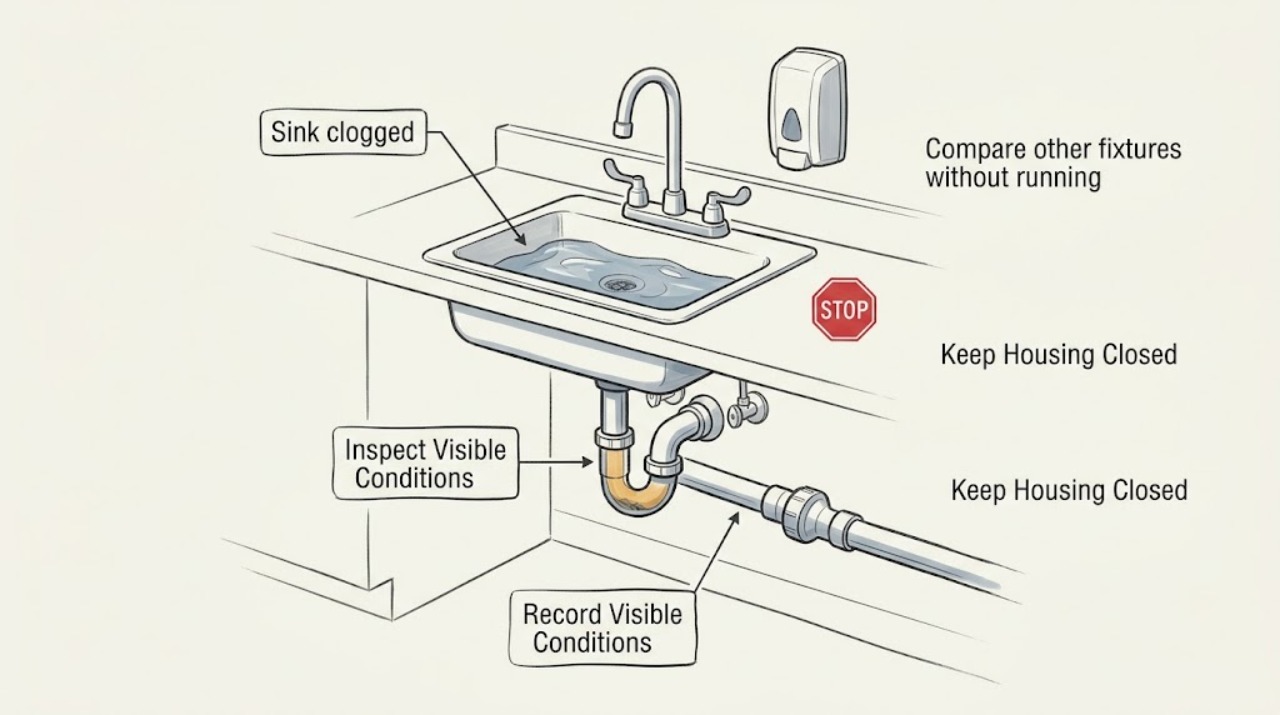
First determine whether the blockage is limited to one sink or affects multiple fixtures, then note the water level, timing, gurgling, disposal context, and anything visible at the strainer. Stop adding water if the basin is filling, keep a garbage disposal switched off, and do not mix or add drain chemicals, use pressure tools, open the trap, reach into a disposal, or contact sewage. One slow sink with a visible strainer obstruction can be described to a plumber; multiple affected fixtures, backflow, repeated overflow, chemical exposure, or a leak under the cabinet needs prompt professional service.
Before you begin
Safety first
- Do not mix or add drain chemicals, use pressure tools, repeatedly flush or fill the basin, open the trap, disassemble the disposal, reach into it, contact sewage, or work near water and electricity.
Work through in order
Diagnostic checks
Use only checks that match the exact appliance or system and its official guide.
-
Observe the standing-water level and timing
Stop using the sink and note whether the basin is empty, slowly draining, or holding water, and whether the change began suddenly during one use or gradually over several uses; do not add more water to repeat the test.
Expected result: The water level falls slowly, stays unchanged, rises after another fixture runs, or the basin is already close to overflowing.
Next step: Record the level and timing for the plumber, keep the basin unused, and protect the cabinet or floor from any spill without reaching into the drain.
Stop if: Stop all testing immediately if water is near the rim, spills onto the floor, or contains sewage-like material.
Why this matters
Why: A single slow fall is consistent with a local or branch restriction, while a level that rises or does not fall increases the need to stop using the fixture. Water rising after another fixture runs can indicate a shared drain problem rather than a sink-only obstruction.
-
Compare other fixtures without running them repeatedly
Ask whether another nearby sink, tub, shower, toilet, or floor drain is also slow, gurgling, backing up, or showing a higher water level; use existing observations and do not deliberately send more water through the system.
Expected result: Only this sink is affected, or two or more fixtures show the same drainage change.
Next step: Stop using the affected fixtures and tell the plumber exactly which fixtures changed and in what order.
Stop if: Stop if another fixture backs up with dirty water, a toilet level changes unexpectedly, or any drain threatens to overflow.
Why this matters
Why: A one-fixture pattern makes a local sink or branch restriction more plausible. Multiple affected fixtures raise concern for a shared branch or building drain and should not be treated as a simple strainer clog.
-
Record gurgling, air, and recurrence
From beside the sink, note any gurgling, bubbling, odor, or air movement that occurred during normal recent use, and record whether the sound happens at startup, near the end of draining, or when another fixture is used; do not place a hand or tool over the opening.
Expected result: There is no unusual sound, intermittent gurgling accompanies slow drainage, bubbling follows another fixture, or sewage-like odor or air movement is present.
Next step: Write down the sound and timing and give it to the plumber; keep the sink and nearby fixtures unused until the risk of overflow is clear.
Stop if: Stop the inspection and leave the area if fumes, strong sewage odor, dirty-water backflow, or chemical irritation is present.
Why this matters
Why: Intermittent gurgling can indicate air movement around a restriction or venting issue; bubbling linked to another fixture makes a shared path more important. Odor or air movement from a drain increases the need to avoid contact and obtain professional assessment.
-
Check disposal context without operating or opening it
If the sink has a garbage disposal, confirm the wall switch is off and note whether the clog began after food was processed, whether the disposal is silent or humming when it was last used normally, and whether a reset or cover is already visibly out of place; do not turn it on, reach into it, remove its cover, or remove plumbing.
Expected result: The disposal is not present, the sink issue started independently, the issue followed disposal use, or the disposal has a leak, unusual sound, odor, or visible damage.
Next step: Tell the plumber the disposal timing and condition, leave its switch off, and do not attempt a jam release, wiring check, disassembly, or repeated reset.
Stop if: Stop immediately for smoke, burning odor, exposed wiring, water near electrical parts, a jammed unit, or any urge to reach into the disposal.
Why this matters
Why: A timing link to disposal use makes the disposal, its outlet, or connected branch worth professional assessment, but silence or a hum does not identify a safe repair. Visible leakage or damage increases the urgency and the need to keep power off.
-
Inspect only visible strainer and cabinet conditions
From above the basin, note whether the strainer or stopper has visible hair, food, or a foreign object without removing it; from outside the cabinet, look for a fresh drip, damp floor, swollen material, or a water mark without opening the trap or touching drain contents.
Expected result: The visible opening is clear, an object is visibly present, the cabinet is dry, or moisture or a leak is visible below.
Next step: Photograph the condition from a safe position and request plumbing service; keep the cabinet clear of stored items so a professional can inspect it without forcing or dismantling anything.
Stop if: Stop if the basin or cabinet contains dirty water, a chemical product has been used, the trap is leaking actively, or inspection would require disassembly.
Why this matters
Why: A visible obstruction is useful information but may not be the whole blockage. A dry cabinet does not clear the hidden drain, while moisture below the sink can indicate a connection or trap leak in addition to the clog.
Use your observations
Decision map
Find the observation that best matches what you see, then follow the next safe action.
-
PATH 01Safety boundary
What you see
Only one sink is slow, the basin is not near overflow, no chemicals were used, and no leak or disposal hazard is visible.
Do this next
Arrange plumbing service and provide the water-level, timing, sound, and visible strainer observations.
Why this path and its safety boundary
Safety stop: Stop if the basin begins rising, another fixture changes, or a leak appears.
-
PATH 02Safety boundary
What you see
Two or more fixtures are slow, bubbling, or backing up, or another fixture changes when this sink is used.
Do this next
Treat it as a shared drainage concern and request prompt plumbing assessment.
Why this path and its safety boundary
Safety stop: Do not use a chemical, pressure tool, trap opening, or repeated flushing to test the shared line.
-
PATH 03Safety boundary
What you see
The disposal is involved, has a leak, makes an unusual sound, or may contain a jam.
Do this next
Keep the disposal switched off and request a plumber or qualified appliance professional to assess it and the connected drain.
Why this path and its safety boundary
Safety stop: Stop for smoke, heat, exposed wiring, water near electrical parts, or any need to remove the disposal.
-
PATH 04Safety boundary
What you see
A chemical drain product was added, or the basin contains unknown or irritating liquid.
Do this next
Do not add another product, use pressure, open the trap, or handle the liquid; tell the plumber the product name if known and follow local poison or emergency guidance for exposure.
Why this path and its safety boundary
Safety stop: Leave the area and obtain urgent help for breathing difficulty, burns, eye exposure, strong fumes, or a spill.
-
PATH 05Safety boundary
What you see
Water is overflowing, dirty water is backing up, the cabinet is actively leaking, or the floor is becoming wet.
Do this next
Stop using the fixtures and request prompt plumbing service; protect the area without contacting drain contents.
Why this path and its safety boundary
Safety stop: Do not repeatedly test the drain, enter contaminated water, or work near electricity.
Helpful context
Understand the symptom
What a sink clog pattern tells you
A sink that drains slowly or holds water can have a local obstruction near the stopper or strainer, a branch-drain restriction, a disposal-related problem, or a larger building-drain issue. The most useful first distinction is one fixture versus several. Water level, timing, gurgling, and cabinet moisture help a plumber choose the safe inspection path, but they do not justify opening plumbing or diagnosing the hidden blockage from above.
Prevent a more dangerous test
Do not keep adding water to see whether the sink will clear, repeatedly run a disposal, combine cleaners, or use a pressure device. If any drain product has already been added, tell the plumber exactly what it was and when; do not open the trap or use a plunger or snake after chemical treatment unless a professional has confirmed a safe procedure. Keep children and pets away from standing water and clean up only ordinary water that can be handled without contact with drain contents.
Only after diagnosis
Potential parts
- sink plunger
Consider this category only if a plumber confirms that a safe, chemical-free pressure-cup method is suitable for this fixture and no shared-line, disposal, or leak hazard is present.
Match the tool to the sink opening and fixture configuration; do not use it after drain chemicals or against an overflowing or contaminated basin. - p-trap kit
Consider this category only if a plumber confirms that a leaking or damaged trap, rather than the clog alone, requires replacement.
Confirm pipe material, connection size, configuration, and local requirements; do not open the trap when chemicals or sewage may be present. - drain snake
Consider this category only after the plumber identifies a suitable mechanical-access point and confirms that the line is free of chemical residue and unsafe backflow.
Match the method to the pipe, stopper, trap, and blockage location; do not insert a tool blindly or use pressure equipment.
When checks do not resolve it
Need a professional?
Request plumbing service when the sink remains blocked, multiple fixtures are involved, water backs up, gurgling recurs, the disposal is affected, a leak appears, chemicals were used, or safe access does not permit a clear observation.
Safety scope: Do not mix or add drain chemicals, use pressure tools, repeatedly flush or fill the basin, open the trap, disassemble the disposal, reach into it, contact sewage, or work near water and electricity.
Have this ready
- Provide the fixture list, water level and timing, gurgling or odor pattern, disposal status, visible strainer and cabinet conditions, any chemical product and time used, and whether dirty water or overflow occurred.
Common questions
FAQ
How do I tell whether only the sink or the whole drain line is clogged?
Use existing observations to compare nearby fixtures without deliberately adding water. If several fixtures are slow, bubbling, or backing up, stop using them and request prompt plumbing assessment.
Should I keep running water to test a clogged sink?
No. Note whether the level falls or stays high, then stop using the sink. Repeated filling can turn a slow drain into an overflow and does not safely locate the blockage.
What if my sink has a garbage disposal?
Keep the disposal switched off and do not reach inside, remove its cover, repeatedly reset it, or disassemble it. Tell the plumber whether the problem began after disposal use and whether a leak or unusual sound was already visible or heard.
Can I use a drain chemical or pressure tool?
Do not mix or add chemicals, and do not use pressure tools in this observation workflow. If a product was already added, tell the plumber exactly what it was and do not open the trap.
When should a clogged sink be treated as urgent?
Request prompt help for dirty-water backflow, repeated overflow, an active cabinet leak, multiple affected fixtures, water near electricity, disposal damage, or any chemical exposure or irritating fumes.
Read the exact guide
Official sources
- Premise Plumbing Decontamination and Exposure Pathway AssessmentsU.S. Environmental Protection Agency · Supports treating sink, drain, pipe, and appliance contents as premise-plumbing material that may require informed professional handling after contamination.
- Drainpipe cleanersMedlinePlus, U.S. National Library of Medicine · Supports the stop condition for fumes, splashes, burns, breathing difficulty, or other suspected chemical exposure; it is not a clog-clearing procedure.
- How to Care for Your Septic SystemU.S. Environmental Protection Agency · The waste and chemical cautions are especially relevant to homes on septic systems; the no-chemical boundary remains prudent when the drain condition is unknown.
- Household Hazardous WasteU.S. Environmental Protection Agency · Supports stopping after an unknown or hazardous drain product has been used and preventing incompatible chemical mixing.
Community feedback
Share a repair observation
Share a plain-text repair observation. Accepted observations are published automatically; this page may take a moment to update.