
On this page
Start here
Quick answer
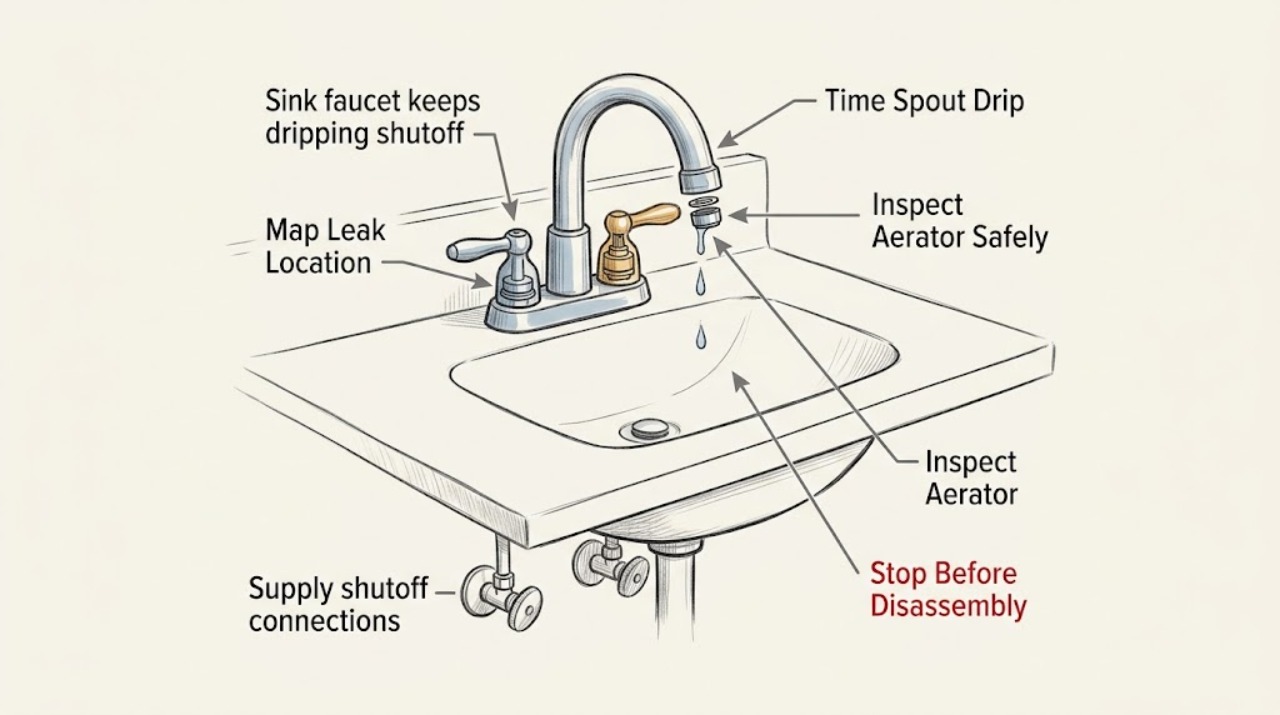
If the sink's hot and cold shutoff valves work but the faucet still drips with its handle off, the shutoffs are not the same as the faucet's internal flow-control valve. A brief drip from the spout may be residual water or aerator debris; a drip that continues steadily usually points to a worn cartridge, valve, washer, O-ring, or handle mechanism. First dry the faucet and identify whether water exits the spout, appears around the handle or base, or starts under the sink. Clean the aerator only as the faucet instructions allow, identify the model and one- or two-handle design, and use the working shutoffs to contain water before any authorized repair. Do not force a stop valve, open the faucet body while pressurized, guess at a cartridge, or keep cycling the handle. Arrange plumbing service for a continuous drip after simple checks, a corroded connection, a leak inside the cabinet, or any repair that requires cartridge or valve access.
Work through in order
Diagnostic checks
Use only checks that match the exact appliance or system and its official guide.
-
Check 1
Dry the spout, handle, faucet base, supply tubes, shutoff valves, and cabinet floor, then watch the first location that becomes wet while the handle stays off.
Expected result: The spout tip drips, the handle or base wets, a supply fitting or shutoff wets, or the dry area stays dry.
Next step: Follow the branch matching the highest wet point. Contain spreading water, and keep clear if water approaches electrical equipment.
Why this matters
Why: Spout moisture points toward the faucet valve, cartridge, washer, or aerator. Handle or base moisture suggests a body seal or handle mechanism; under-sink moisture indicates a connection or stop-valve leak despite a working shutoff.
-
Check 2
Close the faucet handle fully and observe the spout long enough to distinguish a short release of water from a drip that keeps returning; do not force the handle past its normal stop.
Expected result: The drip stops after a short interval, or it continues repeatedly for hours or all day.
Next step: For a brief drip, inspect the aerator. For continuous dripping, record the faucet model and handle style and plan a valve or cartridge diagnosis rather than repeatedly closing the handle.
Why this matters
Why: Kohler identifies a brief post-shutoff drip as consistent with aerator debris and a continuous all-day drip as characteristic of a worn valve or cartridge.
-
Check 3
Look at the removable spout screen for visible mineral or debris buildup and clean it only with the faucet manufacturer's procedure; do not force a seized aerator or damage its threads.
Expected result: The screen is dirty and the drip is brief, the screen is clear, or cleaning does not change a continuous drip.
Next step: Reinstall an intact aerator according to the model instructions. If the spout still drips all day, move to model-specific valve diagnosis or plumbing service.
Why this matters
Why: Aerator debris may extend a brief drip by retaining water, but cleaning will not normally correct a continuous leak caused by the internal valve or cartridge.
-
Check 4
Record whether the faucet has one handle or two and locate its model information from accessible paperwork or markings; do not remove the handle or cartridge just to identify the faucet.
Expected result: The faucet is single-handle, two-handle, or the model cannot be confirmed.
Next step: Use the model-specific parts diagram or give the recorded identity to a plumber. If the model remains unknown and the drip is continuous, arrange diagnosis instead of ordering by appearance.
Why this matters
Why: Single- and two-handle faucets can use different cartridges or valves, and manufacturers state that the correct replacement depends on the model. A working shutoff does not make cartridges interchangeable.
-
Check 5
If the drip is growing, place a towel or container below the faucet and gently close the relevant working hot or cold shutoff only if it turns freely; do not force, loosen, or disassemble the valve.
Expected result: The drip slows or stops when the supply is isolated, the stop valve will not turn, or water continues despite isolation.
Next step: Leave a seized or corroded stop alone and call a plumber. If isolation does not stop water, keep clear of the wet area and arrange urgent plumbing diagnosis rather than opening the faucet.
Why this matters
Why: A working stop can contain a faucet-side leak, while a seized stop or continued water points to a different supply, cross-connection, or valve problem that should not be forced.
-
Check 6
After the handle, aerator, and visible connection checks, observe whether the drip returns with the faucet off or whether water appears around the base, cabinet, wall, or nearby electrical equipment; do not open the faucet body while either supply is pressurized.
Expected result: The drip stops, the spout continues all day, a body or connection leak returns, or water is spreading beyond the sink fixture.
Next step: Use the working shutoff to contain water only if it remains safe to operate, keep the area dry, and arrange qualified plumbing service. Do not keep cycling the handle or force hardware.
Why this matters
Why: A persistent drip or body and connection leak needs a model-specific seal, cartridge, valve, or plumbing repair. Water spreading into a cabinet or electrical area adds a damage and safety risk.
Use your observations
Decision map
Find the observation that best matches what you see, then follow the next safe action.
-
PATH 01Next step
What you see
Do this next
Clean the aerator only as the model instructions allow and monitor. Reassess if the drip becomes continuous or appears at another location.
-
PATH 02Next step
What you see
Do this next
Identify the model and handle style and follow the exact service procedure or call a plumber. Do not remove the cartridge without isolating both supplies and following the model instructions.
-
PATH 03Next step
What you see
Do this next
Dry and observe the exact joint, then arrange model-specific repair. Do not assume replacing the spout cartridge will fix a leak outside the spout.
-
PATH 04Next step
What you see
Do this next
Gently close the working stop if needed to contain water and arrange a plumber for the fitting or valve. Do not force a corroded stop or disassemble pressurized plumbing.
-
PATH 05Next step
What you see
Do this next
Contain water with a normally operating shutoff if safe, keep clear of wet electrical areas, and arrange qualified plumbing service. Do not force valves or open the faucet body under pressure.
Helpful context
Understand the symptom
A working shutoff does not prove the faucet valve seals
The small hot and cold valves under the sink isolate the supply to the fixture. The cartridge, valve, or washers inside the faucet then stop flow at the handle. A shutoff that closes normally can therefore coexist with a faucet that drips from its spout.
Use location and timing together
A short drip from the spout can be leftover water or aerator debris. A continuous drip all day points more strongly to the faucet valve or cartridge. Water around the handle, base, or supply connection is a different leak path and should not be treated as proof that the cartridge is at fault.
The working shutoff is for containment, not diagnosis
If the leak grows, close the accessible stop valve gently only if it turns normally, place a container or towel below the plumbing, and keep the cabinet dry. Valve or cartridge access requires the exact model procedure and both supplies isolated; a seized stop or concealed leak is a plumber's job.
Only after diagnosis
Potential parts
- faucet valve or cartridge
Consider this only when a continuous spout drip remains after the aerator and external leak paths are cleared and the faucet model identifies the valve or cartridge.
Confirm the exact faucet model and handle arrangement; a working shutoff does not make replacement cartridges interchangeable. - faucet washer or O-ring set
Consider these seals only when model-specific information or a plumber identifies a worn seal as the source of the spout or handle leak.
Match the exact valve design and isolate both water supplies before any authorized disassembly. - faucet handle mechanism
Consider a handle mechanism only when water originates around the handle and diagnosis finds a broken or misinstalled component.
Handle parts are model-specific; use the manufacturer's parts information or qualified plumbing service. - faucet aerator
Consider an aerator only when a brief post-shutoff drip is linked to debris or a damaged screen at the spout end, not as the default fix for an all-day drip.
Confirm thread and model fit before ordering and follow the faucet instructions for cleaning or replacement.
When checks do not resolve it
Need a professional?
Arrange plumbing service for an all-day spout drip after safe aerator and external checks, a handle or base leak, a wet supply connection, a seized stop, an unknown model requiring cartridge access, or water spreading into cabinetry or walls. Keep wet areas away from electrical equipment and do not force valves or open a pressurized faucet body.
Common questions
FAQ
Why does my faucet drip when the shutoff valve works?
The under-sink shutoff isolates the supply, while the faucet's cartridge, valve, washer, or O-ring seals flow at the handle. A working shutoff can therefore coexist with a worn internal faucet seal.
Is a short drip after shutting off the faucet a failed cartridge?
Not necessarily. A brief spout drip can be residual water or aerator debris. A continuous drip that returns for hours or all day is more consistent with a worn valve or cartridge.
Should I replace the faucet cartridge because the shutoff works?
Only after locating the leak and confirming a continuous spout drip points to the internal valve. Identify the faucet model and handle style first; do not choose a cartridge by appearance or open the body under pressure.
What if the faucet leaks around the handle instead of the spout?
A handle mechanism, cartridge O-ring, body seal, or installation issue is more likely than aerator debris. Dry the area, watch the first wet joint, and use model-specific service or a plumber if it returns.
When should I stop and call a plumber?
Call for a continuous drip after simple checks, a wet supply fitting, a seized stop, concealed plumbing, spreading water, or any repair requiring valve or cartridge access. Keep wet plumbing away from electrical equipment and do not force hardware.
Read the exact guide
Official sources
- Fix a Leak WeekU.S. Environmental Protection Agency WaterSense · General household faucet-leak guidance; it does not replace the faucet manufacturer's model instructions.
- Fixture leaks from the end of the spoutMoen Solutions · Manufacturer guidance for Moen fixture families; exact model identification is required for a replacement part.
- Leaking from End of SpoutKohler Assist · Manufacturer guidance for Kohler bathroom faucet families; use the exact faucet model for parts and repair details.
Community feedback
Share a repair observation
Share a plain-text repair observation. Accepted observations are published automatically; this page may take a moment to update.