
On this page
Start here
Quick answer
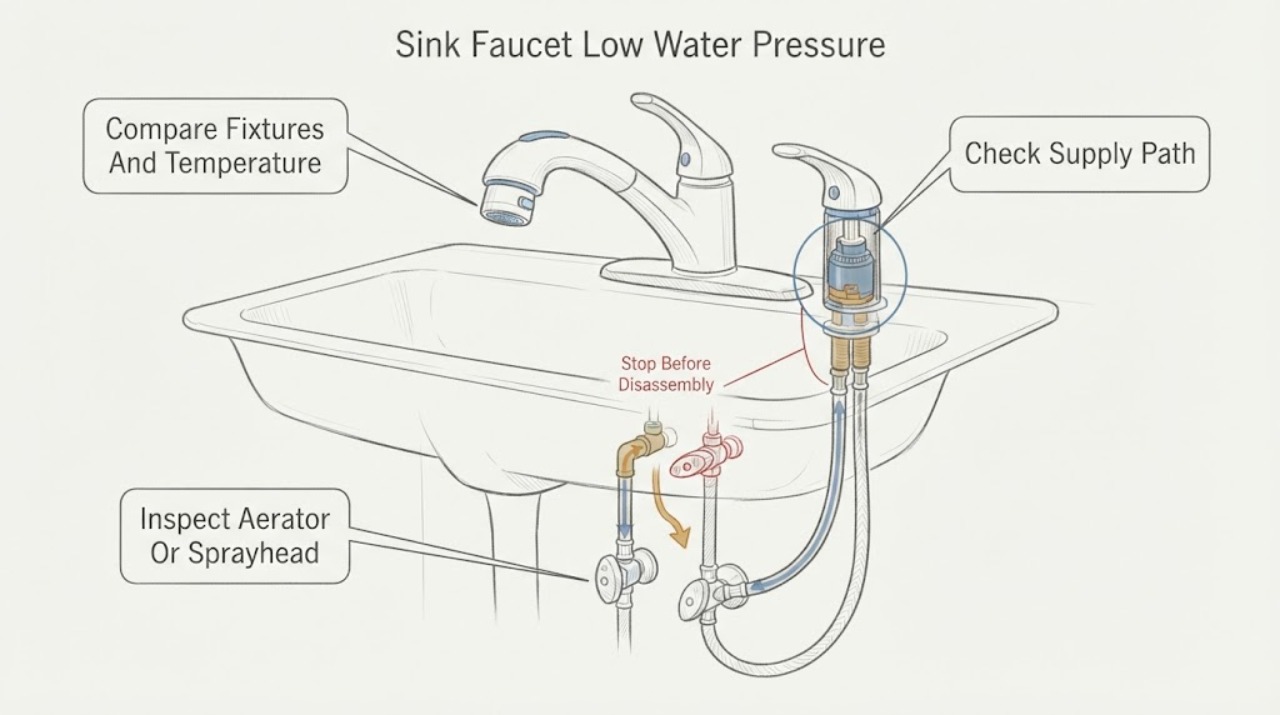
When only one sink faucet has low flow, a restriction at that fixture is more likely than a whole-house pressure problem. Start by comparing hot and cold flow and nearby faucets, then inspect or rinse the aerator or sprayhead, check that the under-sink shutoff valves are open and the supply hoses are not kinked, and identify whether a side spray or pull-out hose changes the symptom. If the aerator is clear and both hot and cold remain weak, debris in the cartridge or faucet body, a diverter, or a restricted supply line becomes more likely. Do not force a shutoff valve, probe a passage with a sharp object, disconnect a pressurized hose, or choose a cartridge by appearance. Arrange plumbing service for a seized or leaking valve, concealed restriction, persistent low flow after safe external checks, or any repair requiring the cartridge or valve body to be opened.
Work through in order
Diagnostic checks
Use only checks that match the exact appliance or system and its official guide.
-
Check 1
Run the affected faucet briefly and compare its hot and cold streams with another nearby faucet, then note whether one side or both sides are weak; do not remove parts while water is running.
Expected result: Only this faucet is weak, both hot and cold are weak, or one temperature side is substantially weaker.
Next step: Use the matching outlet or supply check below. If several fixtures are weak, stop treating this as a single-faucet fault and arrange broader plumbing assessment.
Why this matters
Why: One-faucet weakness points toward the fixture or its short supply path. Both weak sides make the aerator, sprayhead, cartridge, diverter, or body more likely; one weak side makes that supply hose, inlet, or stop more likely.
-
Check 2
Inspect the faucet aerator or sprayhead for visible sediment and rinse it only as the model instructions allow; do not force a stuck fitting or damage the screen.
Expected result: The outlet screen is obstructed, the screen is clear, or flow improves after the accessory is cleaned and reinstalled.
Next step: Use an intact, model-appropriate accessory and monitor. If both temperatures remain weak, continue to the supply-hose and shutoff check rather than replacing the cartridge immediately.
Why this matters
Why: An obstructed aerator or sprayhead can restrict the stream while the rest of the faucet remains healthy. Improved flow localizes the problem to that accessory; no improvement shifts attention upstream.
-
Check 3
Look beneath the sink for fully open hot and cold shutoff valves and for kinked, crushed, or visibly wet supply hoses; do not force a valve or loosen a hose connection.
Expected result: A valve is partly closed, a hose is kinked or wet, or the visible supply path looks open and dry.
Next step: If a normally operating valve is partly closed, open it gently and retest. Leave corroded, seized, or leaking valves alone and call a plumber; do not use force to correct low flow.
Why this matters
Why: A partly closed valve or kink can restrict one side of the faucet. A dry, open supply path makes an aerator, cartridge, diverter, or internal body restriction more likely.
-
Check 4
For a pull-out, pull-down, or side-spray faucet, compare the main stream with the spray mode while keeping the hose and connections intact; do not disconnect a hose under pressure.
Expected result: The spray mode has good flow while the main spout is weak, both modes are weak, or the faucet has no auxiliary spray.
Next step: Clean the accessible spray outlet if the model permits. If the symptom persists or a diverter or hose must be accessed, use model-specific service or a plumber rather than opening the valve body.
Why this matters
Why: Good auxiliary flow makes the spout, screen, or diverter more likely; weak flow in every mode keeps the supply hose, cartridge, or valve body in question. No auxiliary spray removes that comparison but does not change the outlet-first sequence.
-
Check 5
Record the faucet model and whether it is a one-handle or two-handle design before considering an internal part; do not order a cartridge or diverter from a visual resemblance.
Expected result: The model and handle design are confirmed, or the model cannot be confirmed.
Next step: Use the exact model parts diagram or provide the identity to a plumber. If the model is unknown and low flow persists, arrange diagnosis instead of disassembling the faucet to identify parts.
Why this matters
Why: Manufacturers state that cartridge, valve, hose, and diverter parts vary by model. An unknown model prevents a reliable fitment decision even when the symptom sounds familiar.
-
Check 6
After the outlet, temperature, and visible supply checks, observe whether flow remains low, a valve or hose leaks, or the restriction appears to be inside the faucet body; do not open a pressurized valve or use a sharp tool to clear it.
Expected result: Flow returns, remains weak on both temperatures, remains weak on one side, or water damage and corrosion are visible.
Next step: Contain any leak with a normally operating shutoff and arrange qualified plumbing service for persistent low flow, internal restrictions, corroded hardware, or concealed plumbing.
Why this matters
Why: Persistent both-side weakness can involve a cartridge, diverter, or valve body; one-side weakness can involve a supply inlet or hose. Corrosion or leakage adds a service and water-damage risk.
Use your observations
Decision map
Find the observation that best matches what you see, then follow the next safe action.
-
PATH 01Next step
What you see
Do this next
Keep the accessory clean and model-appropriate. If low flow returns quickly or the screen is damaged, replace it only after confirming the model and accessory fit.
-
PATH 02Next step
What you see
Do this next
Open a normally operating stop gently if needed and arrange a plumber for a kinked, wet, corroded, or seized supply path. Do not loosen connections under pressure.
-
PATH 03Next step
What you see
Do this next
Follow the exact model procedure for the spray component. If diverter or hose access is required, stop and use qualified service rather than disconnecting a pressurized line.
-
PATH 04Next step
What you see
Do this next
Use model-specific documentation and arrange plumbing diagnosis for cartridge, valve-body, or inlet service. Do not select a replacement part by appearance or open the faucet under pressure.
-
PATH 05Next step
What you see
Do this next
Keep wet areas dry, avoid force or disassembly, and arrange a qualified plumber to assess the fixture and wider supply path.
Helpful context
Understand the symptom
One affected faucet narrows the search
If showers, other sinks, or another nearby tap have normal flow, the restriction is probably at this faucet or its short supply path rather than the home's incoming supply. Compare hot and cold separately: one weak side points toward that supply or inlet, while both weak sides keep the aerator, sprayhead, cartridge, diverter, or faucet body in question.
The outlet is the easiest first check
An aerator or sprayhead can collect sediment and restrict the stream. Pull-out and pull-down faucets add a hose screen and diverter, so their symptom can change when the spray mode is used. A restriction farther upstream will remain weak even when the outlet accessory is removed according to the model instructions.
Keep internal plumbing work conditional
Supply hoses, shutoff valves, cartridges, and diverters are not interchangeable across faucet designs. Use only accessible visual checks and model documentation. Stop if a valve is corroded, a hose is leaking, or the next step requires opening a pressurized fitting; a plumber can isolate and diagnose the restriction safely.
Only after diagnosis
Potential parts
- faucet aerator or sprayhead
Consider this only when cleaning identifies a blocked or damaged outlet accessory and flow improves or the model documentation identifies it as the restriction.
Confirm the faucet model, outlet type, and thread or connection before ordering; do not force a stuck accessory. - faucet cartridge or valve
Consider this only when both temperatures remain weak after the outlet and visible supply path are cleared and model-specific diagnosis points to the internal valve or cartridge.
Match the exact model and handle design; isolate water supplies before any authorized disassembly. - faucet diverter
Consider a diverter only when an auxiliary spray has good flow but the main spout remains weak and the model design uses a diverter.
Confirm the exact faucet configuration and use model instructions or qualified plumbing service for access. - faucet supply hose or shutoff valve
Consider this category only when one temperature side is restricted and the hose or valve is confirmed kinked, damaged, corroded, or unable to pass flow.
Verify connection type and local installation requirements; do not force or disassemble a pressurized or corroded stop.
When checks do not resolve it
Need a professional?
Arrange plumbing service when one faucet remains weak after safe aerator, sprayhead, and visible supply checks, when a cartridge, diverter, or valve body needs access, when a supply hose or shutoff is corroded or leaking, or when several fixtures are affected. Do not force valves, disconnect pressurized hoses, or probe passages with sharp tools.
Common questions
FAQ
Why is only one sink faucet low pressure?
A restriction at that fixture is more likely than a whole-house issue. Common paths include a clogged aerator or sprayhead, kinked supply hose, partly closed shutoff, cartridge or valve-body debris, or a diverter in a pull-out or side-spray design.
What should I check first on a low-flow faucet?
Compare hot and cold flow and a nearby faucet, then inspect or rinse the aerator or sprayhead. Next look for partly closed shutoffs and kinked hoses under the sink without loosening connections.
What if the faucet spray setting has good flow but the spout is weak?
That pattern makes the main spout screen, hose end, or diverter more likely than the incoming supply. Clean only the accessible component allowed by the model instructions and use service for diverter or hose access.
Could the faucet cartridge cause low water flow?
Yes. Manufacturers identify debris in the cartridge or valve body as a possible cause after the aerator, sprayhead, and supply path are cleared. Confirm the model before considering a cartridge and do not choose one by appearance.
When should I call a plumber for low faucet pressure?
Call when the restriction persists after safe external checks, a valve or hose leaks or is seized, the faucet body or cartridge needs opening, or multiple fixtures are weak. Avoid force and pressurized disassembly.
Read the exact guide
Official sources
- Low water flow from spout- BOTH hot and cold water on sink faucetsMoen Solutions · Manufacturer guidance for Moen sink faucet families; model-specific instructions govern access and replacement.
- Bathroom FaucetsU.S. Environmental Protection Agency WaterSense · General EPA guidance for bathroom sink faucets and aerators; it does not diagnose a particular faucet or supply restriction.
- Low Flow from Hot and Cold WaterKohler Assist · Manufacturer guidance for Kohler kitchen faucet families; use the exact faucet model for procedures and parts.
Community feedback
Share a repair observation
Share a plain-text repair observation. Accepted observations are published automatically; this page may take a moment to update.