
On this page
Start here
Quick answer
When other fixtures have normal flow, low flow at one sink faucet usually points to a local restriction rather than a whole-house pressure problem. Compare hot and cold flow, then cover the drain and remove the faucet aerator or screen if it is accessible. Rinse sediment and scale from the aerator, preserve the order of its small parts, and briefly test the faucet with the aerator removed. If flow returns without the aerator, clean or conditionally replace that screen; if flow stays low, check that both under-sink shutoff valves are open and that visible supply hoses are not kinked. Do not force a corroded valve, open a pressurized connection, or assume a new cartridge will fit. Persistent low flow with the aerator removed needs a plumber to test the faucet inlet, cartridge or valve, supply hose, and the short branch serving that sink.
Before you begin
Safety first
- A qualified plumber should handle seized shutoffs, pressurized connections, faucet-body or cartridge work, hidden inlet screens, corroded or concealed piping, pressure regulators, and any leak that cannot be isolated safely.
Work through in order
Diagnostic checks
Use only checks that match the exact appliance or system and its official guide.
-
Check 1
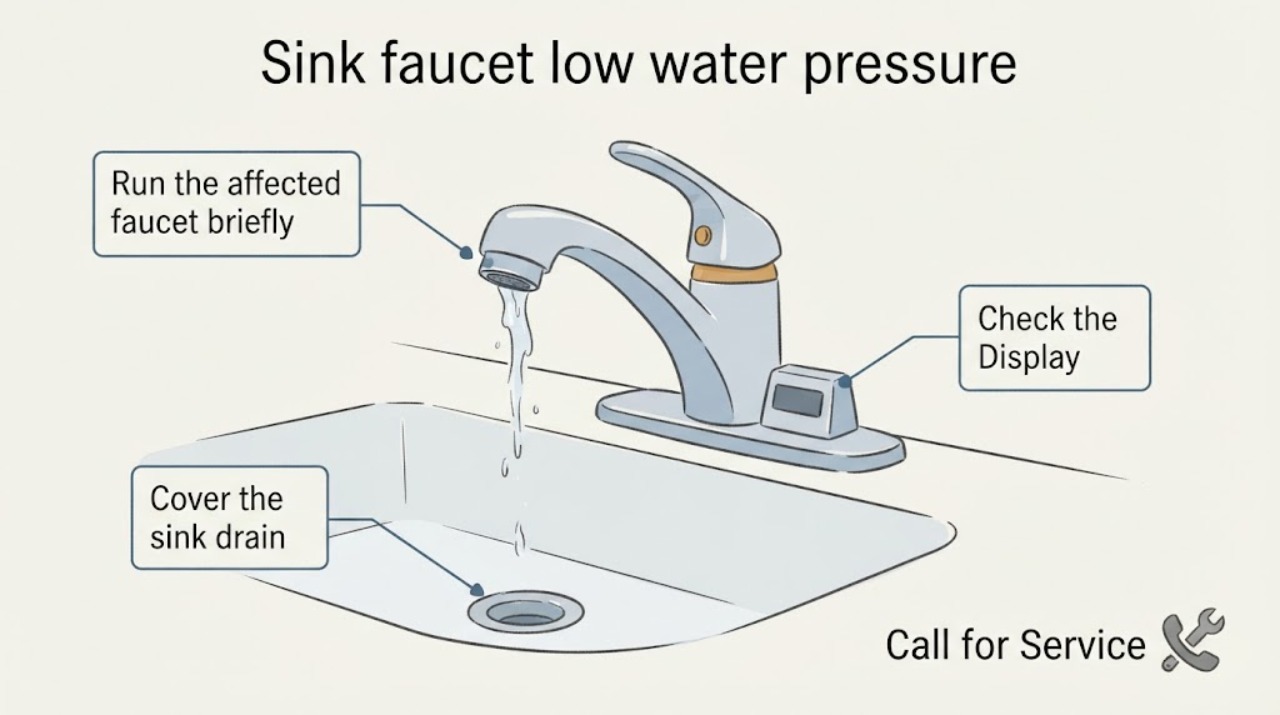
Run the affected faucet briefly and compare cold and hot flow with another nearby faucet, noting whether the reduction is sudden or gradual and whether the stream is weak, uneven, or spraying.
Expected result: Other fixtures remain normal and both temperatures are weak; only hot or only cold is weak; or the flow changes at different times of day.
Next step: Continue with the aerator and local-valve checks for an isolated problem. If all fixtures or the whole building are affected, stop treating this as a sink-only fault and check for a broader water-service issue or notify the property manager.
Why this matters
Why: Normal fixtures support a local faucet, valve, hose, or branch restriction. A temperature-specific reduction narrows attention to that side of the faucet or its hot-water path. Time-dependent changes can reflect demand or an intermittent obstruction but do not identify a part.
-
Check 2
Cover the sink drain with a towel or plug, then remove the faucet aerator or screen by hand or with the correct tool; if it is recessed, use the faucet's intended key and avoid forcing a stuck fitting.
Expected result: The screen contains sediment or scale, the faucet has an insert or washer that falls out, the aerator is damaged, or the aerator cannot be removed without force.
Next step: Photograph and preserve the order of the parts, then rinse or clean them according to the faucet instructions. If removal is difficult or the finish, threads, or faucet body begin to move, stop and arrange plumbing service.
Why this matters
Why: Debris or a damaged screen can restrict flow at this one faucet. A loose insert may change the outlet pattern, while a seized aerator can be damaged by improvised tools and may require professional removal.
-
Check 3
With the aerator off, briefly direct a small stream into the basin and compare the faucet's flow to the same faucet's prior flow; keep the test controlled to avoid splashing and do not leave the opening unattended.
Expected result: Flow is strong without the aerator, flow remains weak, or the stream is intermittent or contains fresh particles.
Next step: Clean and correctly reassemble the aerator if the removed-aerator flow is normal. If flow remains low or particles recur, reinstall only what can be safely fitted by hand and have a plumber test the local supply and faucet internals.
Why this matters
Why: Strong flow without the screen isolates the restriction to the aerator or its inserts. Continued low or intermittent flow points upstream to the faucet inlet, cartridge or valve, local supply hose, shutoff, or branch piping. New particles can signal upstream corrosion or recent plumbing work.
-
Check 4
Look under the sink at both shutoff valves and the visible hot and cold supply hoses; confirm the valves appear fully open and the hoses are not sharply kinked, crushed, swollen, or wet, without forcing a handle or loosening a connection.
Expected result: A valve is partly closed, a hose is kinked or damaged, a connection is wet, or the valves and hoses look open and sound.
Next step: If a valve is clearly in the closed direction and moves normally, adjust it only as the fixture instructions allow and watch for leaks. Do not force or replace a valve or hose under pressure; arrange a plumber for damage, wetness, corrosion, or unchanged low flow.
Why this matters
Why: A partly closed valve or kink can reduce flow to one faucet. Wetness or swelling indicates a leak risk, and normal visible hoses shift suspicion to the faucet inlet, cartridge, or branch pipe. A valve that will not move safely is not a DIY adjustment.
-
Check 5
After cleaning or reinstalling the aerator, run cold and hot water separately while watching the aerator, faucet base, shutoff valves, hose ends, and cabinet for leaks or a change in flow.
Expected result: Flow is restored and all joints stay dry; the stream remains weak; flow is low only on one temperature; or water appears around the faucet or supply connection.
Next step: Use the faucet normally only when flow and connections remain stable. If the faucet leaks, remains restricted, or the aerator cannot be reassembled correctly, stop use as needed and arrange plumbing service with the removed parts available.
Why this matters
Why: Restored flow with dry joints supports an aerator restriction. Persistent one-temperature or both-temperature weakness points to different local components. New water at a joint is a plumbing leak that should not be concealed by repeated tightening.
-
Check 6
If the faucet is still weak with a clean aerator and open visible valves, document the faucet type, whether the problem is hot, cold, or both, recent water work, recurring particles, and any meter or leak signs without opening the faucet body.
Expected result: The restriction began after plumbing work, occurs only at this faucet despite normal hoses, or has progressed gradually in an older plumbing system.
Next step: Give the plumber the timing, hot/cold comparison, aerator condition, and photos. Request testing of the faucet inlet and internal valve, supply hose, shutoff, and local branch before selecting a replacement part.
Why this matters
Why: Recent work can leave sediment at the faucet inlet. A persistent one-faucet problem with normal visible supply points to an inlet screen, cartridge or internal valve, flexible hose, or local pipe restriction. Gradual loss in older galvanized piping can reflect internal corrosion rather than a serviceable aerator.
Use your observations
Decision map
Find the observation that best matches what you see, then follow the next safe action.
-
PATH 01Next step
What you see
Other fixtures flow normally, both temperatures at this faucet are weak, and the aerator contains scale or particles; flow becomes normal with the aerator removed.
Do this next
Clean and reassemble the screen in its original order, or conditionally replace it after confirming the faucet's design. Retest for normal flow and leaks; do not force a corroded aerator.
Why this path and its safety boundary
Why it matters: A blocked or damaged aerator is more likely than a whole-house pressure fault or faucet cartridge failure.
-
PATH 02Next step
What you see
Flow remains weak with the aerator removed, while the visible under-sink valves are open and the hoses are not kinked or leaking.
Do this next
Do not open a pressurized faucet body or force a shutoff. Arrange a plumber to isolate the local supply and test internal components before ordering a part.
Why this path and its safety boundary
Why it matters: A restriction inside the faucet inlet, cartridge or valve, supply hose, shutoff, or local branch is more likely than an outlet-screen problem.
-
PATH 03Next step
What you see
Only hot flow is weak while cold flow at this faucet and other fixtures is normal, or only cold flow is weak while hot is normal.
Do this next
Check only visible local components and stop if there is a leak or corrosion. Have a plumber diagnose the affected side and any water-heater or building-level issue rather than replacing the cartridge by guesswork.
Why this path and its safety boundary
Why it matters: The affected temperature side's shutoff, hose, faucet inlet or internal valve is more likely; if every hot fixture is weak, the hot-water system needs separate evaluation.
-
PATH 04Next step
What you see
An aerator or valve is seized, a supply connection leaks, particles keep returning, the faucet body moves, or low flow persists after cleaning.
Do this next
Stop forcing the fixture, contain any safe drip, and arrange qualified plumbing service. Provide the aerator pieces, photos, hot/cold comparison, and recent plumbing history.
Why this path and its safety boundary
Why it matters: Force can damage the finish, threads, shutoff, or pipe and turn a flow restriction into an uncontrolled leak. Recurring sediment or gradual loss can indicate upstream corrosion or a local pipe problem.
Helpful context
Understand the symptom
Why normal flow elsewhere matters
A faucet's apparent pressure is often a flow restriction at the fixture. If showers, toilets, outside spigots, and another sink are normal, the main supply and whole-house regulator are less likely to be the immediate cause. The faucet aerator, an under-sink valve, a kinked hose, sediment at an inlet, or the faucet's internal cartridge can still limit this one outlet. Compare both temperatures and record whether the change was sudden or gradual before taking anything apart.
Start with the aerator
The small screen at the end of many faucets can trap sediment, scale, or particles while the rest of the plumbing flows normally. Cover the drain before removing it, take a photo of the assembled pieces, and rinse or soak the parts according to the faucet and material instructions. A recessed aerator may require the correct key. If it is stuck, corroded, or the faucet finish could be damaged, stop rather than applying increasing force.
Use the removed-aerator test carefully
A short, controlled flow test with the aerator removed separates an outlet-screen restriction from a problem inside the faucet or supply path. Keep the stream aimed into the basin, avoid splashing, and reinstall the aerator promptly after the observation. Strong flow without the screen points to the screen or its inserts; unchanged low flow means the restriction is upstream of the outlet and needs a different check.
Hot-only and cold-only clues change the path
If cold flow is normal but hot flow is weak, the hot-side valve, hose, faucet inlet, or hot-water plumbing deserves attention. If both temperatures are weak only at this faucet, the aerator, both local valves or hoses, the faucet cartridge, or the local branch are more likely. A whole-house hot-water problem is a different diagnosis from a single faucet restriction.
Do not turn a small flow problem into a leak
Shutoff valves and old supply connections can be brittle. Check their visible position and hoses without loosening a pressurized fitting or forcing a seized handle. A professional should handle a valve that will not move, a hose that swells or leaks, particles that return after cleaning, or low flow that persists with the aerator removed.
Safety boundary
Stop conditions
- Do not force a stuck or corroded aerator, shutoff valve, hose, or faucet connection; stop if the faucet body or pipe begins to twist, move, or leak.
- Do not open a pressurized faucet body, alter a pressure regulator, or replace a cartridge, valve, or hose based only on low flow. Confirm the faucet design and have a plumber test the local restriction.
- If water appears at a supply connection, the cabinet is wet, particles keep returning, or flow drops at other fixtures too, stop using or disassembling the faucet as needed and arrange plumbing or property-management help.
- Use a plumber when the aerator is clean or removed but flow remains low, the problem is persistent or temperature-specific, or older piping may be corroded.
Only after diagnosis
Potential parts
- faucet aerator or screen
Consider this only when the removed screen is damaged, missing parts, or remains restricted after cleaning and the faucet's design is confirmed; low flow with the screen removed points elsewhere.
Match the faucet's thread style, size, flow-control inserts, and manufacturer instructions before ordering. - faucet cartridge or internal valve
Consider this only after testing shows flow remains low with a clean or removed aerator and the faucet inlet or internal valve is identified as the restriction.
Confirm the faucet brand, model, handle configuration, cartridge type, and hot/cold orientation; do not infer fit from appearance alone. - faucet supply hose or shutoff valve
Consider this only when the visible local supply component is kinked, damaged, leaking, or confirmed restricted by a plumber; a dry intact hose does not justify replacement.
Match connection type, length, material, valve configuration, and local code requirements, and have a professional handle pressurized or corroded connections.
When checks do not resolve it
Need a professional?
Safety scope: A qualified plumber should handle seized shutoffs, pressurized connections, faucet-body or cartridge work, hidden inlet screens, corroded or concealed piping, pressure regulators, and any leak that cannot be isolated safely.
Common questions
FAQ
Why is one sink faucet weak when other fixtures are normal?
That pattern usually points to a fixture-level restriction such as a clogged aerator, partly closed under-sink valve, kinked hose, faucet inlet or cartridge restriction, or a short local pipe blockage. Compare hot and cold flow and test the aerator before assuming the main water pressure is low.
How can I tell whether the aerator is causing the low flow?
Cover the drain, remove and clean the aerator, then briefly test the faucet with it removed. If flow is normal without the screen, the aerator or its inserts are restricting the outlet. If flow remains weak, check only visible local valves and hoses and arrange service for upstream faucet or pipe testing.
Should I soak a faucet aerator in vinegar?
For mineral buildup, a short soak may be appropriate when the faucet and aerator materials allow it. Preserve the order of small parts, rinse them thoroughly, and stop if the aerator is stuck or the finish could be damaged. Follow the faucet manufacturer's instructions when they differ.
What if only hot water has low flow at the sink?
A hot-side shutoff, hose, faucet inlet or internal valve may be restricted. If hot flow is weak at every fixture, the water-heater or broader hot-water plumbing becomes more relevant. Do not open a pressurized connection; have a plumber diagnose a persistent temperature-specific problem.
When should a plumber handle low faucet flow?
Arrange service when an aerator is seized, a valve or hose leaks or is corroded, flow remains low with the aerator removed, particles return after cleaning, the faucet body moves, or the problem may involve a cartridge or concealed pipe. These conditions can turn a small restriction into a leak if forced.
Read the exact guide
Official sources
- Troubleshooting water pressure and flowCity of Portland, Oregon · Residential water-pressure and flow troubleshooting; local service conditions and fixtures vary
- Advice to Chicago Residents About Lead in Drinking WaterU.S. Environmental Protection Agency · Residential drinking-water faucet aerator maintenance; follow the faucet manufacturer's design instructions
- FaucetAerator_09.23.25New Jersey Department of Health · Residential faucet-aerator cleaning; exact removal tool and design vary by faucet
- Water Pressure HelpEast Valley Water District, California · Residential customer water-pressure guidance; private plumbing configurations vary
Community feedback
Share a repair observation
Share a plain-text repair observation. Accepted observations are published automatically; this page may take a moment to update.