
On this page
Start here
Quick answer
Low flow at one sink faucet is often caused by mineral scale or debris in the aerator or outlet screen, a partly closed stop valve, a kinked supply line, or a faucet-specific filter. First compare that faucet with another fixture and compare hot with cold. If only this faucet is weak, cover the drain, remove only an accessible aerator or screen using the faucet's instructions, rinse or gently clean it, and reinstall its gasket. If both hot and cold remain weak, the screen is clean, the faucet uses a concealed filter, the stop or hose is corroded or leaking, or several fixtures are weak, stop forcing parts and arrange qualified plumbing service. Do not use sharp tools in the outlet, overtighten a seized aerator, open a pressurized connection without shutting off water, or assume a clean screen proves the faucet valve or household supply is healthy.
Before you begin
Safety first
- This article supports symptom comparison, ordinary-access aerator cleaning with the drain protected, visual checks of accessible stops and hoses, and an optional safe household pressure observation. A qualified plumber should handle concealed filters, cartridges, corroded or leaking shutoffs, pressurized connections, pressure-regulating equipment, and water-damage conditions.
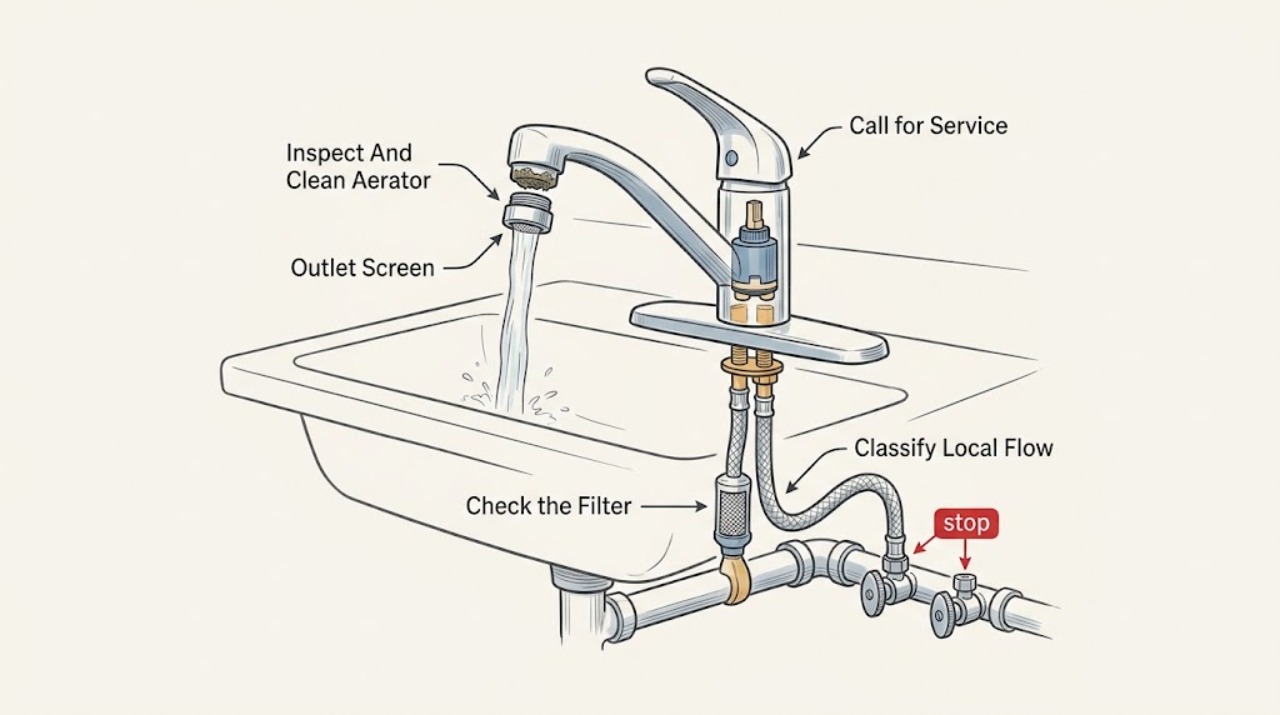
Work through in order
Diagnostic checks
Use only checks that match the exact appliance or system and its official guide.
-
Check 1
Run the sink faucet briefly, then compare its hot and cold streams and one other nearby faucet without removing any part; note whether the stream is weak, uneven, angled, or pulsing.
Expected result: Only this faucet may be weak, only hot or cold may be weak, or several fixtures may have low flow; the affected stream may also contain visible grit or spray sideways.
Next step: Proceed to the accessible faucet-end screen check only when the problem is local and there is no leak; for whole-home or multi-fixture low flow, investigate service pressure and arrange plumbing diagnosis.
Stop if: Stop for an active leak, discolored or contaminated water, a hot connection, water near electrical equipment, or a fixture that cannot be controlled by its stop valve.
Why this matters
Why: A one-faucet or one-temperature problem makes a local aerator, screen, supply stop, hose, or faucet valve issue more likely. Several weak fixtures make household supply pressure, a leak, or a shared restriction more likely than one clogged screen.
-
Check 2
Cover the sink drain, identify the faucet-end aerator or screen, and remove it only by the faucet manual's method; protect the finish with a cloth and use gentle hand force or the specified removal tool.
Expected result: The screen may contain grit, white scale, rust-colored particles, or no visible debris; the gasket may be intact, stuck to the spout, missing, or damaged, and the aerator may be seized or concealed.
Next step: Rinse the screen and clean deposits gently, preserve the gasket and part order, then reinstall without overtightening and retest; if removal is uncertain or the part is damaged, stop and obtain model-specific service or a confirmed part.
Stop if: Do not use a sharp object to enlarge openings, clamp the faucet body, distort the screen housing, or continue if the aerator or spout begins to crack or leak.
Why this matters
Why: Debris or scale at the outlet supports a local restriction. A clean outlet shifts attention toward the stop, supply line, cartridge, in-line filter, or household pressure. A concealed or seized aerator is not a reason to use excessive force.
-
Check 3
If the faucet has no visible aerator or the manual identifies an in-line filter or screen under the sink, close the appropriate stop valves and follow only that manual's filter-removal procedure; do not disconnect a supply line while water remains pressurized.
Expected result: The faucet may have a removable filter with debris, a concealed outlet screen requiring a supplied tool, no user-serviceable screen, or a stop valve that will not fully close or begins leaking.
Next step: Rinse only a filter the exact manual identifies as serviceable, reinstall its seals correctly, and retest; arrange qualified plumbing service for a leaking stop, corroded line, seized filter, or inaccessible assembly.
Stop if: Do not remove supply lines, cartridge parts, or a concealed screen if the stop valve will not shut off, the connection is corroded, or water cannot be contained safely.
Why this matters
Why: A blocked accessible filter can explain a local low-flow symptom. A failed stop valve, corroded connection, concealed design, or uncertainty about the filter assembly makes a small-screen cleaning attempt a leak or flood risk.
-
Check 4
With the faucet off, visually check that the hot and cold stop valves are open and that each flexible supply line is not kinked, crushed, leaking, or sharply bent; do not force a stiff valve.
Expected result: One stop may be partly closed, a hose may be kinked, both lines may look normal, or a connection may drip, corrode, or remain wet after the faucet is used.
Next step: If a normal, accessible stop turns freely, open it gradually and retest; otherwise leave it in place, contain any drip, and arrange qualified plumbing service for valve, hose, or connection work.
Stop if: Do not force or disassemble a stop valve, bend a braided hose into a new shape, or continue if water reaches cabinetry, flooring, or electrical equipment.
Why this matters
Why: A partly closed stop or kinked line can restrict one temperature or the whole faucet without a clogged screen. Normal-looking lines shift attention toward the cartridge or upstream pressure; a leak or corroded valve adds a water-damage boundary.
-
Check 5
After one careful screen or aerator cleaning and one controlled retest, record whether flow is restored, improved only on one temperature, still weak at this sink, or weak at multiple fixtures; do not keep scraping the screen or add unverified parts.
Expected result: Flow may return normally, improve partially, remain low despite a clean screen, or reveal weak pressure elsewhere in the home; leakage may appear at the spout or under the sink.
Next step: For optional pressure screening, follow EPA's method with all fixtures off and a gauge at a hose bib; arrange qualified plumbing service for persistent local flow loss, unusual household pressure, leaks, or any need to service a cartridge, PRV, or concealed piping.
Stop if: Stop for a leak, pressure that is unexpectedly high or low, water damage, contaminated water, or any need to alter a pressure-regulating device or open pressurized piping.
Why this matters
Why: A lasting local improvement supports a clogged aerator or screen. Persistent local low flow makes the cartridge, stop, hose, or concealed filter more likely. Multi-fixture low flow points toward the home supply, leak, or pressure-regulating system.
Use your observations
Decision map
Find the observation that best matches what you see, then follow the next safe action.
-
PATH 01Safety boundary
What you see
Only this sink faucet was weak, the removable aerator or screen contained scale or debris, and normal flow returns after gentle cleaning and correct reassembly.
Do this next
Monitor the stream for recurrence and keep the gasket and screen seated; use the faucet manual if cleaning is needed again.
Why this path and its safety boundary
Why it matters: A local faucet-end restriction is more likely than a household supply problem.
Safety stop: Arrange service if the aerator leaks, the screen distorts, or low flow returns quickly despite a clean outlet.
-
PATH 02Safety boundary
What you see
The sink faucet has normal cold flow but weak hot flow, or normal hot flow but weak cold flow, while another fixture is normal.
Do this next
Compare the affected stop and line visually without forcing them, then arrange plumbing service if the restriction is not an obvious free-moving stop position.
Why this path and its safety boundary
Why it matters: A single supply stop, flexible line, in-line filter, or faucet-side valve path is more likely than a shared clogged aerator.
Safety stop: Do not disconnect a pressurized line or force a corroded valve; stop for any drip or wet connection.
-
PATH 03Safety boundary
What you see
The aerator or screen is clean and correctly reinstalled, but flow at this sink remains low with normal-looking supply lines.
Do this next
Stop adding force or parts and arrange model-specific plumbing service; provide the faucet identity and whether both temperatures are affected.
Why this path and its safety boundary
Why it matters: A concealed filter, cartridge, internal faucet restriction, or stop-valve issue is more likely than the visible screen.
Safety stop: Do not disassemble the cartridge or faucet body unless the exact manual and safe shutoff procedure support it.
-
PATH 04Safety boundary
What you see
The faucet uses a concealed or in-line filter, or the stop valve will not close fully, leaks, or shows corrosion while the filter is being considered.
Do this next
Leave the connection undisturbed, contain any accessible water, and arrange qualified plumbing service for shutoff, filter, hose, or faucet work.
Why this path and its safety boundary
Why it matters: The issue has moved beyond a simple outlet-screen cleaning and carries a leak or flooding risk.
Safety stop: Do not remove supply lines or force a seized stop; stop if water cannot be isolated or reaches the cabinet, floor, or electrical equipment.
-
PATH 05Safety boundary
What you see
Several faucets or fixtures have weak flow, or the affected sink and another fixture change when other water is used.
Do this next
Stop replacing faucet screens as a guess; use EPA's optional hose-bib pressure check if a suitable gauge and safe access are available, then arrange plumbing diagnosis.
Why this path and its safety boundary
Why it matters: A household supply, leak, pressure-regulating, building, or shared-piping issue is more likely than one clogged sink screen.
Safety stop: Stop for a major leak, flooding, contaminated water, or unusually high pressure and seek prompt professional help.
-
PATH 06Safety boundary
What you see
The faucet outlet, gasket, supply connection, or under-sink fitting leaks after the screen is disturbed, or the screen housing is cracked or distorted.
Do this next
Stop using the faucet if necessary, close a working local stop if it can be operated without force, contain the water, and arrange qualified plumbing service.
Why this path and its safety boundary
Why it matters: A sealing or component-damage problem now accompanies the low-flow symptom; further cleaning can worsen water damage.
Safety stop: Do not overtighten the housing, force a stop valve, or continue if water contacts electrical equipment or spreads into cabinetry and flooring.
Helpful context
Understand the symptom
Confirm that the restriction is at this sink
Run the affected faucet briefly and compare another nearby faucet or fixture. Then compare hot and cold at the sink. A weak stream on only one side or only one faucet makes a local screen, aerator, cartridge, stop valve, or hose issue more likely. Weak flow throughout the home points toward the supply, a pressure-regulating device, a leak, or a building-side issue instead of one clogged screen.
An aerator may be visible, concealed, or absent
Delta describes the faucet aerator as a likely place for debris when flow drops or the stream becomes uneven. Moen's manufacturer guide notes that aerators vary by attachment and that some faucets hide the aerator or use an in-line filter instead. Do not assume every sink faucet unscrews the same way; identify the faucet and use its instructions before applying a tool.
Clean gently and preserve the sealing parts
Cover or plug the sink drain before removing a small screen or gasket so parts cannot disappear down the drain. Rinse debris and scale, and keep track of the order of the screen, insert, and gasket. A damaged mesh, missing gasket, or distorted housing can cause leaks or poor flow after reassembly and may require a model-confirmed replacement rather than more cleaning.
When a screen is not the answer
A clean screen does not clear a kinked hose, partly closed stop, failed cartridge, blocked in-line filter, or low incoming pressure. EPA WaterSense guidance recommends checking home service pressure at a hose bib with all water-using fixtures off and notes that unusually low or high pressure may need leak investigation or professional pressure-regulator work.
Safety boundary
Stop conditions
- Do not force a seized aerator, stop valve, supply fitting, concealed screen, or cartridge; stop for corrosion, cracking, a drip, or water that cannot be isolated.
- Cover or plug the sink drain before removing a screen or gasket, and do not use sharp objects to enlarge or scrape delicate outlet openings.
- Do not disconnect a supply line, open pressurized piping, or alter a pressure-regulating device without a safe shutoff and appropriate plumbing experience.
- Stop using the faucet for an active leak, contaminated or discolored water, water reaching electrical equipment, cabinet or floor damage, or a connection that becomes hot or unsafe to touch.
- Arrange qualified plumbing service when the clean screen does not restore flow, a concealed filter or cartridge is involved, multiple fixtures are weak, pressure is abnormal, or the problem recurs quickly.
Only after diagnosis
Potential parts
- exact faucet aerator or outlet screen
Consider this only when the existing screen is damaged, missing, permanently scaled, or confirmed to be the restriction after inspection.
Match the faucet model, thread or concealed fit, gasket, flow specification, and stream pattern; do not select by diameter or appearance alone. - exact faucet in-line filter or filter screen
Consider this only when the exact faucet instructions identify a serviceable filter and a diagnosis confirms that it is blocked or damaged.
Match the filter housing, seals, flow path, and faucet model; confirm that the stop valve and supply connection can be isolated safely. - faucet cartridge or supply hose
Consider this only after a qualified diagnosis identifies a cartridge, hose, or internal valve restriction rather than an outlet screen blockage.
Match the exact faucet model, connection type, dimensions, seals, and hot/cold orientation; do not replace an internal part by visual similarity.
When checks do not resolve it
Need a professional?
Arrange qualified plumbing service when cleaning the accessible aerator or screen does not restore flow, the faucet uses a concealed filter or cartridge, a supply stop or hose is corroded or leaking, several fixtures have low flow, household pressure is unusually low or high, or the restriction returns quickly. Stop using the faucet for an active leak, contaminated water, water damage, or any connection that cannot be safely isolated.
Safety scope: This article supports symptom comparison, ordinary-access aerator cleaning with the drain protected, visual checks of accessible stops and hoses, and an optional safe household pressure observation. A qualified plumber should handle concealed filters, cartridges, corroded or leaking shutoffs, pressurized connections, pressure-regulating equipment, and water-damage conditions.
Common questions
FAQ
Can a clogged faucet screen cause low water pressure at one sink?
Yes. Scale or debris in an aerator or outlet screen can restrict a single faucet and may also distort the stream. Compare hot and cold and another fixture first, then clean only an accessible screen using the faucet's instructions.
How do I clean a sink faucet aerator safely?
Cover the drain, remove the aerator gently, preserve the gasket and part order, rinse debris, clean scale without sharp tools, and reinstall without overtightening. Stop if it is concealed, seized, cracked, or starts leaking.
What if my sink faucet has no visible screen?
It may have a concealed aerator or an in-line filter. Use the exact model instructions; close the local stops before any filter or supply-line work. If the stop will not close or the assembly is corroded, arrange qualified plumbing service.
Why is only the hot or cold side of my faucet low?
A temperature-specific restriction makes one stop valve, supply hose, in-line filter, or faucet valve path more likely than a shared outlet screen. Check only for an obvious accessible stop position or kink, and do not force a corroded valve.
When should I call a plumber for low faucet flow?
Call when cleaning the screen does not restore flow, several fixtures are weak, pressure is unusually low or high, a concealed filter or cartridge is involved, a stop or hose leaks or is corroded, or the problem returns quickly. Stop for water damage or an unsafe connection.
Read the exact guide
Official sources
- Nettoyage de l'aérateur de robinetMoen Solutions · Moen manufacturer guide used for general faucet-design distinctions; a particular sink faucet's model instructions control tools and access.
- Home MaintenanceU.S. Environmental Protection Agency · EPA WaterSense household guidance; local plumbing requirements and the installed faucet control a particular repair.
- INS10163C Installation InstructionsMoen · Moen installation sheet for a specific commercial faucet family; it supports the general safety boundary that low-flow filter work requires closing stops, while the exact faucet manual controls the particular assembly.
- How to Fix Your FlowDelta Faucet · Delta manufacturer guidance for faucet aerator maintenance; the exact sink faucet design and manual control the removal method and replacement decision.
Community feedback
Share a repair observation
Share a plain-text repair observation. Accepted observations are published automatically; this page may take a moment to update.