
On this page
Start here
Quick answer
The timing after tub trouble or after something was put in the tub does not prove that the tub caused the sink leak. Find the first wet point while no water is running: sink faucet or supply connection, drain or trap, cabinet wall and floor, or a nearby tub, wall, or ceiling. Close the sink's accessible shutoff valves if the leak is on a supply side and safe to do so; stop using the sink and tub if water is migrating or the source is unclear. Do not mix or test drain chemicals, open a trap after an unknown substance was used, open walls, or work near wet electrical equipment. Call a plumber for a hidden, shared, uncontrolled, sewage, or recurring leak.
Work through in order
Diagnostic checks
Use only checks that match the exact appliance or system and its official guide.
-
Check 1
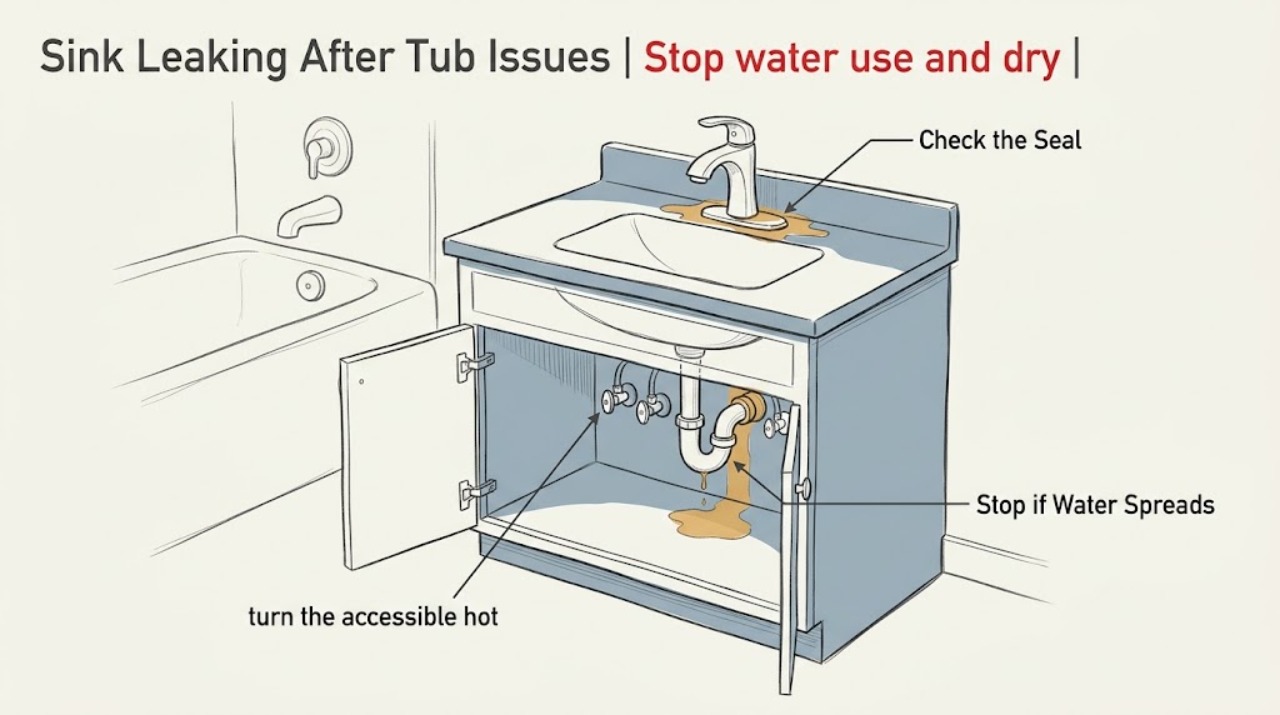
Stop water use and dry the visible sink cabinet, floor, wall edge, and nearby tub area with separate clean towels. Place a dry paper towel under the faucet base, each visible supply connection, the drain opening, and the waste pipe or trap without loosening anything. Note the first place that becomes wet and whether the sink or tub area is wet while all fixtures are idle.
Expected result: The first wet point is at the faucet or supply, at the sink drain or trap, on the cabinet wall or floor, or near the tub rather than at the sink hardware.
Next step: Keep the water off and record the location, odor, color, and whether the wetness returns without use. Continue only with the matching external check; do not open a wall, trap, or fitting to confirm the source.
Why this matters
Why: A faucet or supply wet point is a local pressurized-water leak. A drain or trap wet point is a waste-side leak that may appear only during discharge. A wall, floor, or tub wet point can indicate migration or a concealed source, so the visible sink may not be the origin.
-
Check 2
If the wet point is at a sink supply connection or faucet and the area is dry enough to work safely, turn the accessible hot and cold sink shutoff valves clockwise only until they stop normally. Do not force a seized valve, use a tool on a leaking fitting, or turn a valve that is damaged or spraying.
Expected result: The drip stops after the sink valves are closed; the drip continues; or the valve cannot be operated safely.
Next step: Leave the sink valves closed and arrange plumbing service if the leak returns, the valve will not close, or a connection is wet behind the cabinet. If flow continues, use the house shutoff only when it is accessible and safe, or call an emergency plumber.
Why this matters
Why: Stopping the drip at the sink valves supports a local supply or faucet-side source. Continued flow suggests a drain, upstream connection, valve failure, tub or wall source, or a leak that cannot be controlled at the fixture.
-
Check 3
If the wet point is at the drain opening, tailpiece, waste pipe, or trap, keep the sink and tub unused and inspect only from outside for a cracked pipe, displaced joint, standing wastewater, or water that is not contained by the sink bowl. Do not loosen the trap, plunge against a suspected chemical product, or pour another cleaner into the drain.
Expected result: Water appears only after sink drainage; water rises or backs up; wastewater is present; or the pipe leaks while no fixture is being used.
Next step: Stop all connected fixture use and call a plumber, especially if a chemical product was used or wastewater is present. Do not disassemble the drain path until the plumber knows what was put in the tub.
Why this matters
Why: A drain or trap leak can be local, while backup or a shared drain problem can connect the sink and tub symptoms. Wastewater or a leak while idle needs prompt plumbing diagnosis. An unknown substance in the tub changes the handling risk even if the sink is the visible outlet.
-
Check 4
Compare the timing without deliberately provoking a leak: record whether moisture appears when the sink is filled or drained, when the tub is filled or drained, or with no water use at all. If the leak is active, do not run either fixture to reproduce it. Note whether the sink cabinet, tub surround, adjacent wall, ceiling below, or floor is the first visible wet area.
Expected result: The sink alone triggers wetness; the tub alone triggers wetness near the sink; both fixtures affect it; or water appears during idle periods.
Next step: Keep the fixtures unused when the source is not clear and give the timing map to a plumber. Do not infer that the item placed in the tub caused the leak, and do not open the wall to trace it.
Why this matters
Why: Sink-only timing supports local sink supply or drain hardware. Tub-only timing supports migration from the tub, a shared branch, or a concealed wall or floor path. Both fixtures can implicate a shared drain or supply route. Idle wetness suggests a pressurized or concealed leak rather than normal discharge.
-
Check 5
Look from a dry, stable position at the tub edge, caulk line, overflow area, visible supply trim, nearby wall, ceiling below, cabinet base, and flooring. Note gaps, movement, staining, soft material, mold-like growth, or water tracking away from the tub. Do not climb, remove trim, drill, cut, or stand on a softened floor or ceiling.
Expected result: The tub area shows a separate active leak or damage; the wall or ceiling is soft or stained; or all visible surfaces are dry while the sink cabinet gets wet.
Next step: Stop using the affected fixtures and arrange a plumber for concealed or shared plumbing. Arrange qualified building or restoration help for structural damage, mold-like growth, or a soft ceiling or floor.
Why this matters
Why: A tub or structural wet point can be the source even when water emerges by the sink. A dry tub exterior does not exclude a concealed supply or drain leak. A sink-only wet cabinet makes local sink hardware more likely but still does not justify opening it without locating the first wet point.
-
Check 6
Stop immediately if water is uncontrolled, sewage-colored or foul-smelling, hot enough to burn, near an outlet or appliance, entering a wall or ceiling, accompanied by structural movement, or associated with a chemical product, smoke, or an electrical fault. Keep people and pets away and do not use the affected fixtures.
Expected result: The leak is small and contained with no hazard, or one of the water, chemical, structural, or electrical warning signs appears.
Next step: Close the nearest safe water shutoff or the main shutoff if it can be reached without entering water. Call an emergency plumber; use qualified electrical or emergency services when electrical danger, fire, collapse, or exposure is present.
Why this matters
Why: A contained drip can wait for prompt scheduled plumbing service after the local shutoff is closed. Uncontrolled, contaminated, hot, chemically exposed, structural, or electrically adjacent water can cause injury or property damage and needs urgent help.
Use your observations
Decision map
Find the observation that best matches what you see, then follow the next safe action.
-
PATH 01Next step
What you see
The first wet point is at the sink faucet, supply line, or shutoff valve, and closing the sink valves stops it.
Do this next
Leave the valves closed and call a plumber if the faucet, valve, or connection needs repair. The tub timing may be coincidental unless separate evidence links the sources.
Why this path and its safety boundary
Why it matters: A local pressurized sink-side leak is more likely than a tub-caused leak.
-
PATH 02Next step
What you see
The first wet point is the sink drain, waste pipe, or trap and the leak appears during sink discharge.
Do this next
Keep the sink and connected fixtures unused and arrange plumbing service. Do not loosen the trap or add drain chemicals.
Why this path and its safety boundary
Why it matters: A local waste-side connection or trap leak is possible.
-
PATH 03Next step
What you see
The sink remains dry until the tub is used or drained, then water appears at the wall, cabinet, floor, or ceiling.
Do this next
Stop using both fixtures and arrange a plumber to trace the shared supply or drain path. Do not open walls or assign cause from timing alone.
Why this path and its safety boundary
Why it matters: Water may be migrating from the tub or a shared concealed branch; the sink may only be the visible exit point.
-
PATH 04Next step
What you see
Water appears while no fixture is in use, or closing the sink valves does not stop the flow.
Do this next
Use the main water shutoff only from a dry, safe position and call a plumber. Do not leave the leak under pressure for repeated testing.
Why this path and its safety boundary
Why it matters: An upstream pressurized leak, concealed pipe, failed shutoff, or another fixture may be involved.
-
PATH 05Next step
What you see
An unknown substance was put in the tub, or a drain product may be present and the sink or tub is blocked or leaking.
Do this next
Stop using both fixtures, do not mix products or plunge aggressively, tell the plumber exactly what was used if known, and follow the product safety instructions for exposure.
Why this path and its safety boundary
Why it matters: Chemical exposure and splash risk make trap or drain disassembly unsafe for an unqualified person.
-
PATH 06Next step
What you see
The leak is uncontrolled, contaminated, hot, near electrical equipment, or causing soft ceiling, floor, wall, or visible structural damage.
Do this next
Keep clear, shut off water only if safely accessible without entering water, and obtain emergency plumbing, electrical, building, or emergency help as appropriate.
Why this path and its safety boundary
Why it matters: This exceeds a routine sink check and can threaten people or property.
Helpful context
Understand the symptom
Treat the tub timing as a clue, not a diagnosis
The condition says the sink began leaking after issues with the tub and after something was put in it, but the object and the plumbing relationship are not specified. A sink can leak locally while a tub leak travels through a wall, floor, cabinet, or shared drain route and appears somewhere else. First locate the earliest wet surface and record whether the leak is present with all water use stopped, only when the sink runs, only when the tub runs, or after water drains. Do not assign responsibility or causation from sequence alone.
Safety boundary
Do not use or mix chemical drain products, open a trap after an unknown substance was put into the tub, cut a wall or ceiling, loosen pressurized supply fittings, or reach through water toward an outlet or appliance. Stop for uncontrolled flow, sewage, hot water, a soft or bulging ceiling, structural movement, mold or contaminated water, or water near electrical equipment.
Safety boundary
Stop conditions
- Do not mix or test drain chemicals, open a trap after an unknown substance was used, cut walls or ceilings, loosen pressurized fittings, or use tools on a seized shutoff valve.
- Stop for uncontrolled flow, sewage or foul odor, hot water, a soft or bulging ceiling, structural movement, mold-like growth, or water near an outlet, appliance, or other electrical equipment.
- Do not run the sink or tub repeatedly to reproduce a leak, and do not assume that the tub timing proves causation or installation responsibility.
- Do not enter standing water or reach through wet areas toward electrical controls.
When checks do not resolve it
Need a professional?
Call a plumber when the first wet point is hidden, the sink or tub share a drain or supply path, the leak continues with fixtures idle, the sink shutoffs do not stop it, wastewater or an unknown chemical is involved, or the leak returns after a temporary stop. Use urgent building, electrical, or emergency help for structural damage, uncontrolled flow, hot or contaminated water, or water near electrical equipment.
Common questions
FAQ
Can a tub leak make the sink appear to leak?
Yes, water can travel through a concealed wall, floor, cabinet, or shared drain path, but timing alone does not prove that relationship. Find the first wet point and note which fixture use changes the moisture.
What should I check first under a leaking sink?
Dry the area and identify whether the first wet point is the faucet, supply connection, shutoff valve, drain, waste pipe, trap, cabinet wall, or floor. Close the local shutoffs if the leak is on the supply side and they operate safely.
What if something was put in the tub before the sink started leaking?
Do not assume it caused the leak and do not mix products or open the trap. Stop using the sink and tub, tell the plumber what was used if known, and treat an unknown drain substance as a handling hazard.
Read the exact guide
Official sources
- UPCS-V Protocol V1U.S. Department of Housing and Urban Development · Residential visual inspection criteria; not a substitute for model-specific or site-specific plumbing service.
- Checking for LeaksPhiladelphia Water Department · General household water-leak checks; local shutoff layout and plumbing responsibility vary.
- Home MaintenanceU.S. Environmental Protection Agency WaterSense · General residential plumbing maintenance and leak awareness.
Community feedback
Share a repair observation
Share a plain-text repair observation. Accepted observations are published automatically; this page may take a moment to update.