
On this page
Start here
Quick answer
A sink that is leaking only a trickle still needs its source identified, because a slow faucet drip, a leak under the sink, a drain-joint seep, and a supply connection leak have different repairs. Empty the cabinet, keep electrical items and stored goods dry, and use a dry cloth or tissue to find the first wet point without loosening anything. Note whether the trickle occurs with the faucet off, only while water runs, or after the sink bowl drains; note whether it is hot or cold. If an accessible shutoff closes normally, isolate that side. If it will not close, or water is reaching the cabinet, wall, floor, or electrical equipment, use the home's main shutoff only from a safe dry position and call a plumber. Do not force valves, remove the faucet, open a pressurized connection, or keep testing a leak that is growing.
Before you begin
Safety first
- Keep the sink isolated for an uncontrolled or concealed leak, water near electrical equipment, hot water, an ineffective shutoff, or a slippery or damaged floor. Do not force valves, loosen pressurized connections, open walls, or operate wet electrical controls.
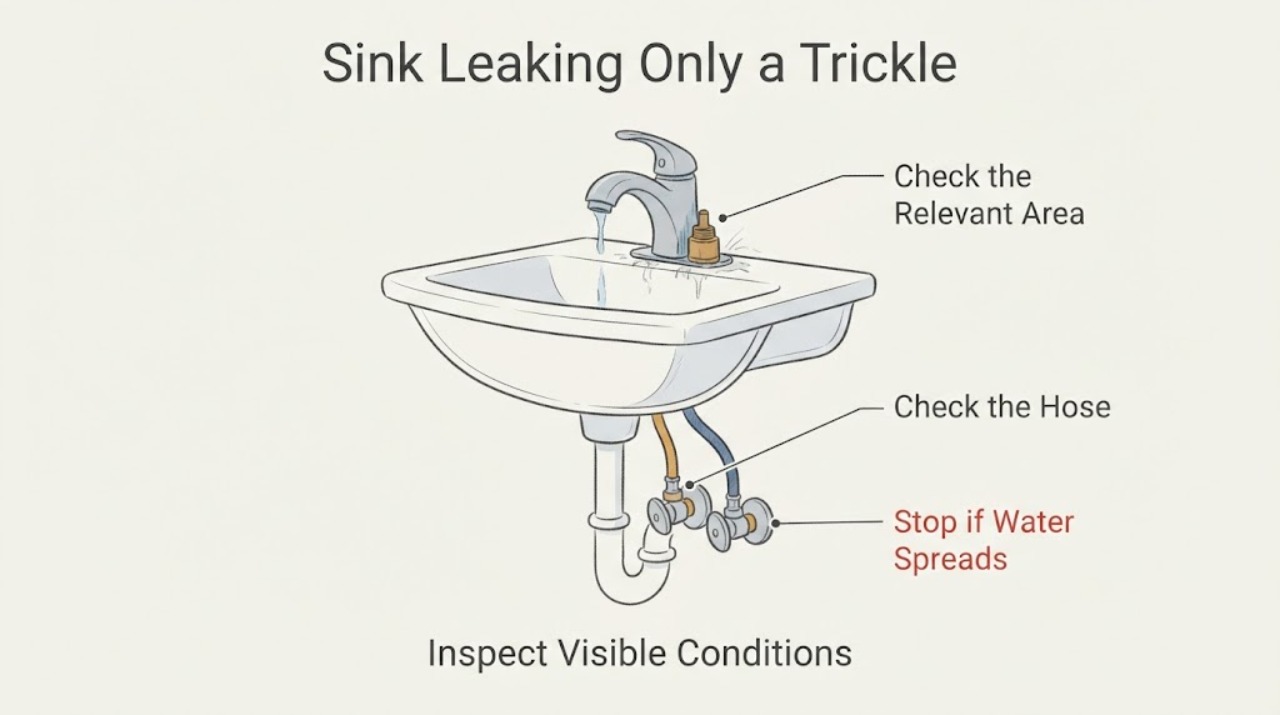
Work through in order
Diagnostic checks
Use only checks that match the exact appliance or system and its official guide.
-
Check 1
Remove items from beneath the sink and dry the cabinet floor and visible pipes without loosening a fitting. Look at the spout, handle, faucet base, supply connections, drain joints, cabinet sides, wall, and floor; use a dry tissue on an exposed surface to identify the first place that becomes wet.
Expected result: The first wet point is the spout, handle or base, a supply connection, a drain joint, the wall or floor, or it cannot be seen.
Next step: Photograph the first wet point and keep the cabinet clear. Isolate the local supply if safe; call a plumber for a wall, floor, concealed, or unidentifiable source.
Why this matters
Why: The location separates a faucet-control path from a pressurized supply path, drain path, or concealed leak. A hidden first point is more concerning than a visible isolated drip.
-
Check 2
Observe the sink with both faucet handles or the single control fully off, then note whether the trickle continues. If the leak is controlled and the area is dry, observe whether it appears only while water runs; do not keep opening the tap if the flow is getting stronger.
Expected result: The spout drips while off, the handle or base wets only while on, the under-sink area wets only while on, or the leak appears after the sink bowl drains.
Next step: Keep the control off and isolate the local supply when appropriate. Arrange plumber service for a persistent off-state drip, a supply leak, or any drain-joint leak that returns after use.
Why this matters
Why: Off-state spout dripping suggests an internal faucet shutoff issue; an on-state base or supply leak suggests pressurized connections; a post-drain leak suggests the drain assembly or waste connection.
-
Check 3
Note whether the trickle is warm, cold, or not identifiable, and whether one handle or both sides produce it. Keep hands away from a hot stream and do not remove a supply hose or faucet part to compare temperatures.
Expected result: Only the hot side, only the cold side, both sides, or neither side can be associated with the trickle.
Next step: Record the temperature pattern for the plumber and isolate the affected side only if its shutoff operates normally. Stop for scalding water, a spray, or a rapidly growing leak.
Why this matters
Why: A one-side pattern can narrow the supply or faucet-control path; both sides can point to the faucet body, shared drain, or an observation that is not temperature-specific.
-
Check 4
Check the accessible shutoff valves under the sink from a dry position. Close the affected valve gently only if it is clearly labeled, dry, and moves normally; then observe whether the spout or visible leak stops. Do not force a corroded valve or loosen a connection.
Expected result: The local valve stops the trickle, reduces it, does nothing, or is missing, stuck, wet, or damaged.
Next step: Leave a failed or stuck valve alone. If water continues, close the home's main valve slowly only from a safe dry position and verify flow has stopped; call a plumber for the valve or supply.
Why this matters
Why: A working local valve isolates the fixture. A valve that does not change flow leaves the line pressurized, while a partial reduction may indicate another supply or concealed path.
-
Check 5
Check the wider scope without creating another leak: note whether other faucets work normally, whether the water meter or leak indicator moves when all fixtures are off, and whether there is moisture or mold on a nearby wall, ceiling, or floor. Keep the meter box and wet areas safe to access.
Expected result: Only the sink leaks, several fixtures show a pressure or supply change, the meter indicates flow with fixtures off, or moisture appears beyond the cabinet.
Next step: Keep the sink isolated if possible and arrange plumbing service for unexplained flow, hidden moisture, or a wider supply issue. Do not open walls or floors to follow the pipe.
Why this matters
Why: An isolated sink symptom favors the fixture or its branch; unexplained meter flow or moisture beyond the cabinet can indicate a hidden supply leak that needs prompt attention.
-
Check 6
Prepare a plumber handoff with the first wet point, off-state or on-state timing, temperature, affected handle, local shutoff result, other-fixture status, meter observation, photos, and any recent faucet, drain, or cabinet work. Keep all enclosures and connections intact.
Expected result: The trickle is a controlled faucet drip, a supply or drain leak, an unexplained hidden leak, or a leak that cannot be isolated.
Next step: Request plumber service and ask for a leak-source diagnosis before selecting a cartridge, washer, hose, valve, or drain part. Keep the local or main supply isolated when needed.
Why this matters
Why: The evidence can distinguish a faucet cartridge or seal path from a supply, drain, or concealed-pipe service path without trial replacement.
Use your observations
Decision map
Find the observation that best matches what you see, then follow the next safe action.
-
PATH 01Next step
What you see
The trickle is from the spout while the faucet control is fully off.
Do this next
Observe whether it persists beyond residual drainage, isolate the local supply if safe, and arrange service for a persistent drip. Do not choose a cartridge without the faucet model.
Why this path and its safety boundary
Why it matters: The faucet's internal shutoff parts may not be sealing, although residual water can also drip briefly after use.
-
PATH 02Next step
What you see
The handle, faucet base, or a supply connection wets only while the sink is running.
Do this next
Keep the cabinet dry and isolate the affected local valve if it operates normally. Call a plumber for a returning connection leak or any valve that will not close.
Why this path and its safety boundary
Why it matters: Pressurized water may be escaping from the faucet body or supply path rather than the drain.
-
PATH 03Next step
What you see
Water appears beneath the drain or trap only after the sink bowl empties.
Do this next
Stop using the sink, dry the cabinet, and call a plumber if the joint continues to wet. Do not loosen a drain connection over stored items or electrical equipment.
Why this path and its safety boundary
Why it matters: The waste connection, drain seal, or trap path may be leaking under discharge rather than the faucet supply.
-
PATH 04Next step
What you see
The local shutoff stops the trickle and other fixtures work normally.
Do this next
Leave the valve closed and arrange plumber service for the faucet, supply, drain, or shutoff diagnosis. Do not reopen it repeatedly to test a slow leak.
Why this path and its safety boundary
Why it matters: The sink fixture or its local supply is isolated from the rest of the home's water system.
-
PATH 05Next step
What you see
The local shutoff is missing, stuck, ineffective, or the trickle continues into the wall, cabinet, floor, or ceiling.
Do this next
Use the home's main shutoff only from a safe dry position if it moves normally, verify the flow stops, and call a plumber. Do not force a valve or open a wall.
Why this path and its safety boundary
Why it matters: The line may remain pressurized and the leak may be concealed or beyond a fixture-only repair.
-
PATH 06Next step
What you see
The water meter or leak indicator moves with every fixture off, or moisture or mold appears outside the cabinet.
Do this next
Isolate the home's water if safe and arrange prompt plumber or leak-detection service. Do not open the wall, floor, or meter equipment to follow the leak.
Why this path and its safety boundary
Why it matters: An unobserved supply or concealed-pipe leak may be wasting water or damaging the structure even though the sink symptom is only a trickle.
-
PATH 07Next step
What you see
Water reaches an electrical outlet, appliance, power lead, or other electrical equipment, or the leak becomes a stream, spray, or flood.
Do this next
Keep clear of wet electrical areas, do not operate a wet switch, isolate water only from a safe dry position, and obtain qualified plumbing and electrical or emergency help.
Why this path and its safety boundary
Why it matters: The situation is a water-damage and possible electrical hazard, not a low-flow faucet repair.
Helpful context
Understand the symptom
Keep “only trickling” as a meaningful condition
A trickle describes volume, not location or timing. It may come from the spout while the handle is off, from the handle or faucet base while the tap is on, from a supply connection in the cabinet, or from the drain after the sink is emptied. It may also be residual water on the faucet that has not yet stopped. Record the exact outlet, when it appears, water temperature, and whether the cabinet or floor is wet before choosing a part.
Find the first wet point, not the largest puddle
Dry the visible surfaces, place a clean cloth or tissue under exposed joints, and watch from a safe position while the faucet is off and then during normal use only if the leak is controlled. Check the spout, handle, base, supply connections, drain tailpiece, trap area, cabinet sides, and wall or floor. EPA lists pooling under sink pipes and moisture or mold on walls, ceilings, or floors as clues that a hidden pipe problem may need professional attention.
A faucet leak and a drain leak behave differently
A spout drip with the handles off often follows the faucet's internal shutoff parts, while a leak at a connection or under the sink may appear only when water is flowing or the sink bowl is draining. Portland's faucet guide separates handle, stem, and faucet leak locations and recommends turning off the local supply before repair. Do not copy a repair sequence when the faucet model or first wet point is unknown.
Control the water before the trickle becomes damage
Use the shutoff under the sink only if it is accessible, clearly intended for that fixture, dry, and turns normally. If it cannot be located or does not stop the trickle, the home main valve may be needed. Portland and water-district guidance both describe local or master shutoff paths, but a corroded or stuck valve should not be forced. A plumber can isolate a failed valve and check the hidden pipe or wall path.
Safety boundary
Stop conditions
- Stop immediately for a stream, spray, rapidly growing leak, water entering a wall or floor, moisture or mold beyond the cabinet, or an unidentified source. Isolate water from a safe dry position and call a plumber.
- Stop for hot water that may scald, water near an outlet, appliance, power lead, or other electrical equipment, or a wet floor that is unsafe to cross. Keep clear and obtain qualified plumbing and electrical help.
- Do not force a shutoff, loosen a supply or drain connection, remove the faucet, open a wall or floor, reach into a wet electrical area, or keep reopening the tap to reproduce a trickle.
- Stop troubleshooting when a local valve will not close, the meter shows unexplained flow, the first wet point cannot be found, or the leak returns after isolation. Leave the water controlled and arrange plumber service.
Only after diagnosis
Potential parts
- faucet cartridge, stem, or seal
Consider this only when a plumber or exact manufacturer guidance confirms that the persistent trickle is from the faucet outlet or control with the water off.
Internal parts vary by faucet design and model. Confirm the exact model and first wet point before selection. - sink supply hose or shutoff valve
Consider this only after diagnosis identifies a supply connection or local isolation valve as the first wet point or failed isolation device.
Connection size, material, valve type, and access vary. Do not loosen or replace a pressurized connection as a test. - drain seal, tailpiece, or trap component
Consider this only when water is confirmed below the sink after discharge and a plumber identifies the drain or trap path as the source.
Drain layouts and seals differ by sink and installation. Confirm the exact configuration before selection.
When checks do not resolve it
Need a professional?
Request plumbing service for a persistent off-state faucet drip, handle or base leak, supply connection leak, drain seep, stuck or ineffective shutoff, unexplained meter flow, concealed moisture, or any sink leak that cannot be safely isolated. Escalate immediately for flooding, hot water, structural moisture, or water near electrical equipment.
Safety scope: Keep the sink isolated for an uncontrolled or concealed leak, water near electrical equipment, hot water, an ineffective shutoff, or a slippery or damaged floor. Do not force valves, loosen pressurized connections, open walls, or operate wet electrical controls.
Common questions
FAQ
Why is my sink leaking only a trickle?
The leak may be a persistent spout drip, a handle or faucet-base seep, a supply connection leak, or a drain-joint leak that appears after the sink bowl empties. Find the first wet point and note whether it occurs with the faucet off or on before choosing a repair.
How do I find a slow leak under the sink?
Clear the cabinet, dry visible surfaces, and use a dry cloth or tissue on exposed joints while observing from a safe position. Check supply connections, drain joints, cabinet sides, wall, and floor. Do not loosen a fitting to make the leak appear.
Should I shut off the water for a small sink trickle?
If an accessible under-sink valve is dry and turns normally, isolate the affected side. If it is stuck, missing, or ineffective, use the home's main shutoff only from a safe dry position and call a plumber. A small leak can still cause hidden damage.
Does a faucet drip mean I need a new cartridge?
Not necessarily. A drip can involve the faucet's internal shutoff, a connection, a drain path, or residual water. Confirm the first wet point and exact faucet model; have a plumber identify the part before selection.
When is a trickling sink leak urgent?
Escalate for a growing stream or spray, a stuck or ineffective shutoff, wall or floor moisture, mold, water near electrical equipment, hot water, or an unidentified source. Keep clear, control water from a safe dry position, and call qualified plumbing or emergency help.
Read the exact guide
Official sources
- Leak Detection and Flow Monitoring DevicesUS EPA WaterSense · US EPA homeowner guidance; it does not replace local plumbing diagnosis or code requirements.
- Detect and Chase Down Leaks ChecklistUS EPA WaterSense · US EPA household leak checklist; it provides general clues rather than a fixture-specific repair procedure.
- How to fix a faucet leakCity of Portland Water Bureau · Municipal faucet guide; sink designs, valves, and local plumbing rules vary.
- How to check for leaksCity of Portland Water Bureau · Municipal guidance for typical residential systems; meter and valve locations vary.
Community feedback
Share a repair observation
Share a plain-text repair observation. Accepted observations are published automatically; this page may take a moment to update.