
On this page
Start here
Quick answer
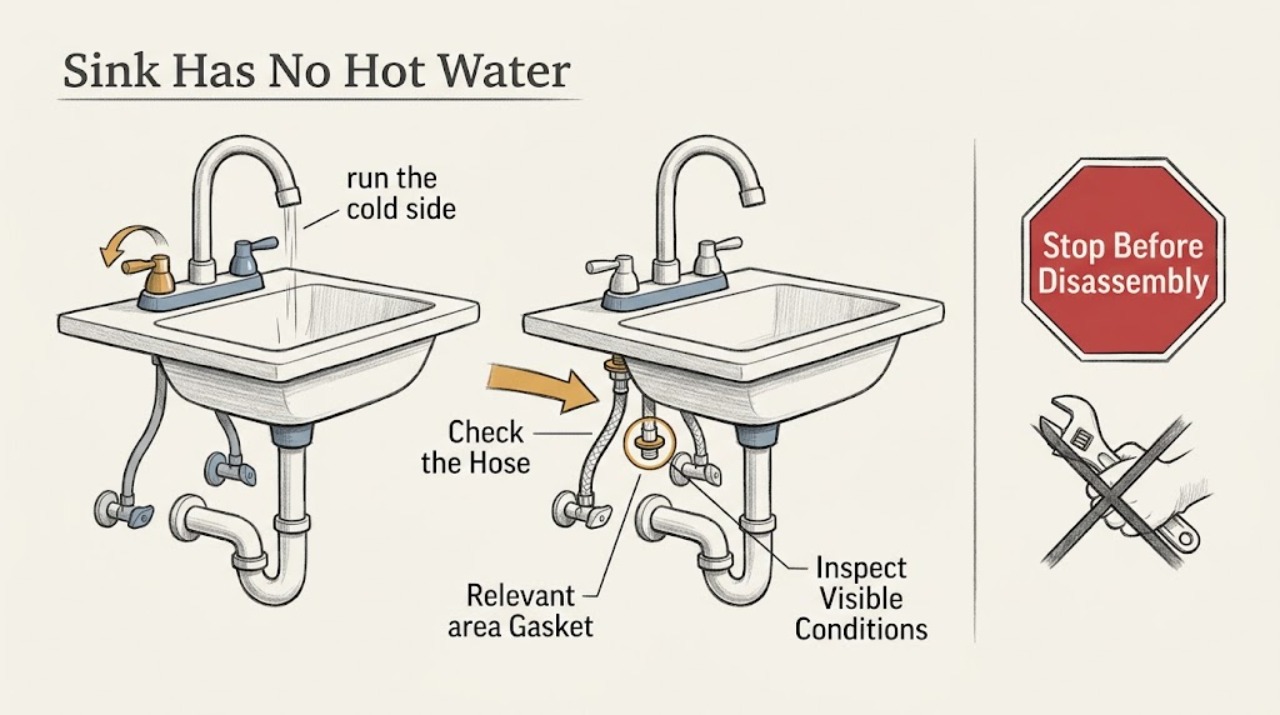
A sink gasket is a seal, not a heating element. If cold water works but this sink has no hot water, compare the hot side at another fixture, then check the sink's accessible hot shutoff, supply hose, faucet outlet, cartridge path, and visible leaks. A worn gasket may explain dripping at the faucet base, handle, or connection, but it does not by itself explain a cold-only stream; look for a hot-water supply or faucet-path restriction instead. Stop for a leak, scalding water, water near electrical equipment, a seized valve, or suspected gas or water-heater trouble, and call a plumber when the local checks do not restore hot water.
Work through in order
Diagnostic checks
Use only checks that match the exact appliance or system and its official guide.
-
Check 1
With the sink area dry, run the cold side and then the hot side briefly. Compare both flow and temperature at another nearby faucet, and note whether the sink's hot side is cold, only a trickle, or has no flow at all.
Expected result: Normal hot water elsewhere with a cold-only sink points to the sink's hot shutoff, hose, faucet path, cartridge, or screen. Hot water missing at several fixtures points toward the water-heater supply, a house valve, leak, or utility condition. A hot-side trickle is a flow restriction clue, not proof that the water heater cannot heat.
Next step: Follow the local branch when another fixture has hot water. Follow the whole-home branch when several fixtures are affected or no hot-water outlet has a normal supply.
Why this matters
Why: The comparison separates a local faucet problem from a whole-home hot-water problem before parts are disturbed.
-
Check 2
Look under the sink at the hot-side shutoff, supply hose, and their connections. Check whether the valve is obviously partly closed, the hose is sharply kinked, the connection is damp, or water is tracking along the cabinet; operate a sound valve only gently if it is clearly intended for user operation.
Expected result: A partly closed valve or kink can limit hot water to this sink. A drip, spray, wet cabinet, or valve that leaks when touched indicates a plumbing leak or failing shutoff, not a gasket that should be tightened by force. A dry, open visible path moves suspicion toward the faucet body or cartridge.
Next step: If a sound valve was clearly left partly closed, return it gently to its normal position and retest once. Leave a damaged, corroded, stiff, or leaking valve alone and call a plumber.
Why this matters
Why: A gasket or washer at a connection can seal water, but it cannot make cold supply water hot; a leak and a temperature fault may coexist but require separate decisions.
-
Check 3
Inspect the faucet base, handle area, spout outlet, and visible supply connection while the hot side is opened briefly. Look for a drip that starts when the handle moves, a leak at the base, or water escaping around a joint; do not remove the handle or cartridge just to inspect a gasket.
Expected result: A leak at the base, handle, or joint makes a gasket, O-ring, washer, cartridge seal, or connection a conditional service clue. No leak but no hot flow makes a gasket less likely as the primary cause and keeps the hot-side valve, hose, screen, cartridge, or upstream supply in scope.
Next step: If the leak is active, close the safe local shutoff and arrange plumbing service. If the faucet remains dry, continue only with external flow comparisons and model-specific service guidance.
Why this matters
Why: The gasket identity is preserved without mislabeling a seal as the source of heat; sealing and hot-water delivery are different paths.
-
Check 4
If the faucet has a removable outlet screen or aerator, and the manufacturer's instructions permit routine removal, inspect it for sediment after isolating the water safely. Keep the screen and gasket together, do not force a seized fitting, and compare the hot-side flow only after reassembly or a brief controlled check.
Expected result: Sediment or a blocked screen can reduce hot-side flow, especially after plumbing work or a pressure disturbance; it cannot make a normal hot supply cold. No change after a clean, correctly seated screen points toward the valve, hose, cartridge, or upstream hot-water path.
Next step: Rinse or replace only the model-matched screen or gasket allowed by the instructions, then check for leaks. If the screen is tamper-resistant, damaged, or repeatedly clogs, stop and call a plumber.
Why this matters
Why: A screen or outlet gasket may affect delivery or sealing, but the result must be interpreted as a flow finding rather than evidence of a failed heater.
-
Check 5
When hot water is absent at several fixtures, check only safe external clues: whether cold water is normal, whether there was recent plumbing work or a shutoff, whether a water-heater area shows a visible leak, and whether other household outlets have the same temperature problem. Do not open the heater, adjust gas controls, or handle hot pipes.
Expected result: Hot water absent throughout the home points away from the sink gasket and toward the water-heater supply, house plumbing, a leak, or an equipment fault. A visible leak or strong gas smell changes this to an immediate stop and professional or emergency safety path.
Next step: Stop using the affected hot-water path and call a plumber or qualified water-heater service. For a gas odor, leave the area and seek help from a safe location without operating switches or flame sources.
Why this matters
Why: A sink faucet cannot restore a whole-home hot-water supply; the faucet component boundary has been reached.
-
Check 6
After one permitted low-risk check, run the sink briefly and inspect the faucet outlet, base, hot shutoff, hose, and cabinet for new moisture. Observe whether hot water arrives normally and whether the water is clear and free of unusual particles or odor.
Expected result: Restored temperature with a dry cabinet supports a local delivery restriction that was corrected. A drip, recurring loss of hot water, cloudy or discolored water, particles, unusual odor, or water near an outlet means the problem is not safely resolved.
Next step: Close a safe local shutoff for an active leak, pause drinking-water use for abnormal water, and arrange plumbing or water-quality guidance. Do not repeatedly cycle a leaking or overheating system.
Why this matters
Why: A temperature improvement is successful only when the seal and surrounding cabinet remain dry and the water is suitable for its intended use.
Use your observations
Decision map
Find the observation that best matches what you see, then follow the next safe action.
-
PATH 01Safety boundary
What you see
Another fixture has hot water, but this sink has cold or no hot flow.
Do this next
Inspect the visible hot-side path and outlet using the low-risk checks above. Arrange plumbing service if the path is dry and open but hot water does not return.
Why this path and its safety boundary
Why it matters: The fault is more likely local to the sink's hot shutoff, hose, faucet screen, cartridge path, or branch connection than to the water heater.
Safety stop: Do not force the hot valve or disassemble the faucet to reach a gasket.
-
PATH 02Safety boundary
What you see
The hot side produces only a trickle while cold flow is normal.
Do this next
Check only the accessible, dry outlet and supply path. If cleaning does not restore flow, call a plumber for model-specific faucet diagnosis.
Why this path and its safety boundary
Why it matters: A hot-side screen, shutoff, hose, cartridge passage, or local blockage may be restricting flow; the water heater may still be producing hot water.
Safety stop: Do not use a gasket replacement as a substitute for diagnosing a restricted hot-water passage.
-
PATH 03Safety boundary
What you see
Water leaks from the faucet base, handle area, outlet joint, or a visible supply connection when the faucet is used.
Do this next
Close the safe local shutoff and call a plumber. Provide the leak location and whether hot water is also absent at other fixtures.
Why this path and its safety boundary
Why it matters: A gasket, washer, O-ring, cartridge seal, or connection may be failing, but the leak does not prove it is the reason for the missing hot water.
Safety stop: Do not tighten a wet or damaged fitting by force, leave the cabinet unattended, or continue flow tests over electrical equipment.
-
PATH 04Safety boundary
What you see
Hot water is absent or cold at several fixtures, while cold water remains available.
Do this next
Use only safe external observations and arrange qualified plumbing or water-heater service. Keep away from hot pipes, gas controls, and internal equipment.
Why this path and its safety boundary
Why it matters: The sink gasket is not a whole-home heating component; the water-heater supply, house valve, leak, or water-heater equipment is in scope.
Safety stop: Do not open the water heater, adjust gas controls, or perform live or hot-water equipment checks.
-
PATH 05Safety boundary
What you see
Hot water returns after a pressure or plumbing disturbance but remains discolored, contains particles, or has an unusual odor.
Do this next
Follow the utility or manufacturer flushing guidance and pause drinking-water use until the water runs clear and the source is understood.
Why this path and its safety boundary
Why it matters: The temperature symptom may be improved, but the drinking-water path still needs flushing or water-quality guidance.
Safety stop: Do not use uncertain or visibly contaminated water for drinking or food preparation.
-
PATH 06Safety boundary
What you see
There is an uncontrolled leak, water near electrical equipment, scalding water, a burst line, smoke, or a strong gas odor.
Do this next
Leave the hazard area as needed, close water only from a dry and clearly accessible shutoff, and seek qualified or emergency help from a safe location.
Why this path and its safety boundary
Why it matters: The immediate risk is water damage, burn, electrical shock, fire, or gas exposure, not routine sink troubleshooting.
Safety stop: Do not operate electrical switches near water, ignite a flame, adjust gas controls, touch hot damaged parts, or keep testing the faucet.
Helpful context
Understand the symptom
Start by defining no hot water. If cold water has a normal stream but the hot side is dry or cold, the key split is local versus whole-home: one sink suggests its hot shutoff, hose, faucet cartridge, or internal screen; several fixtures suggest the water-heater supply, a house valve, a leak, or a utility condition. A gasket belongs to the sealing path, so use it as a leak clue rather than assuming it creates heat.
Keep the inspection external and gentle. Do not remove a faucet cartridge, open a water heater, force a shutoff, or work on a wet cabinet. If hot water is present but unexpectedly scalding, stop using it and get plumbing or water-heater help rather than changing internal controls without the model instructions.
If plumbing work or a pressure interruption recently occurred, sediment can reach faucet screens or filters. Flush and maintain those parts only as the faucet or filter instructions allow, and stop drinking the water if it remains discolored, contains particles, or passes through a damaged seal.
Safety boundary
Stop conditions
- Stop for an active or uncontrolled leak, water pooling in the cabinet, water near an outlet or appliance, a burst hose, scalding water, smoke, or a strong gas odor.
- Do not force a shutoff, remove a seized aerator, dismantle a faucet cartridge, open a water heater, adjust gas controls, or treat a gasket replacement as a heating repair.
- Pause drinking-water use for persistent discoloration, particles, unusual odor or taste, or an uncertain or damaged filter or faucet seal; seek plumbing or water-quality guidance.
Only after diagnosis
Potential parts
- faucet gasket or washer
Consider this only when the leak location and the faucet instructions identify a failed seal at the base, handle, outlet, or connection; a gasket does not heat water.
Confirm the faucet model, seal location, material, and installation instructions before selecting a replacement. - faucet cartridge
Consider this only when hot water is available elsewhere, the local supply path is open and dry, and the faucet's model-specific diagnosis points to an internal cartridge restriction or seal.
Match the exact faucet model and leave cartridge work to a qualified person when the instructions require water isolation or internal disassembly.
Common questions
FAQ
Can a sink gasket cause no hot water?
A gasket seals a joint; it is not a heater. A worn gasket can explain a drip or leak, while no hot water usually requires checking the hot-side shutoff, hose, faucet path, cartridge, or the water-heater supply.
What does it mean if only this sink has no hot water?
If another fixture has hot water, the restriction is more likely local to this sink's hot valve, hose, outlet screen, cartridge path, or branch connection than to the water heater.
What if hot water is missing everywhere?
That points away from the sink gasket and toward the water-heater supply, a house valve, a leak, or water-heater equipment. Use only safe external observations and arrange qualified service.
When should I stop using the sink?
Stop for an active leak, water near electrical equipment, scalding water, smoke, a strong gas odor, or persistently discolored or particle-filled water. Keep away from the hazard and seek appropriate professional or emergency help.
Read the exact guide
Official sources
- Preventing Waterborne Germs at HomeCenters for Disease Control and Prevention · Flushing faucets after pressure drops and maintaining faucet aerators and water filters
- 109774 Two Handle Pull-Down Kitchen FaucetDelta Faucet · Manufacturer faucet installation, gasket placement, connection leak checks, cartridge and flow-restrictor service boundaries
- Troubleshooting water pressure and flowCity of Portland · Hot versus cold flow comparisons, local versus whole-home water problems, leaks, and plumbing escalation
- Saving water in your homeCity of Portland · Faucet flow effects, hot-water wait behavior, and faucet leak repair including worn washers or gaskets
- Water Pressure HelpEast Valley Water District · Local faucet restrictions, under-sink valves, main valves, pressure equipment, and visible leak clues
Community feedback
Share a repair observation
Share a plain-text repair observation. Accepted observations are published automatically; this page may take a moment to update.