
On this page
Start here
Quick answer
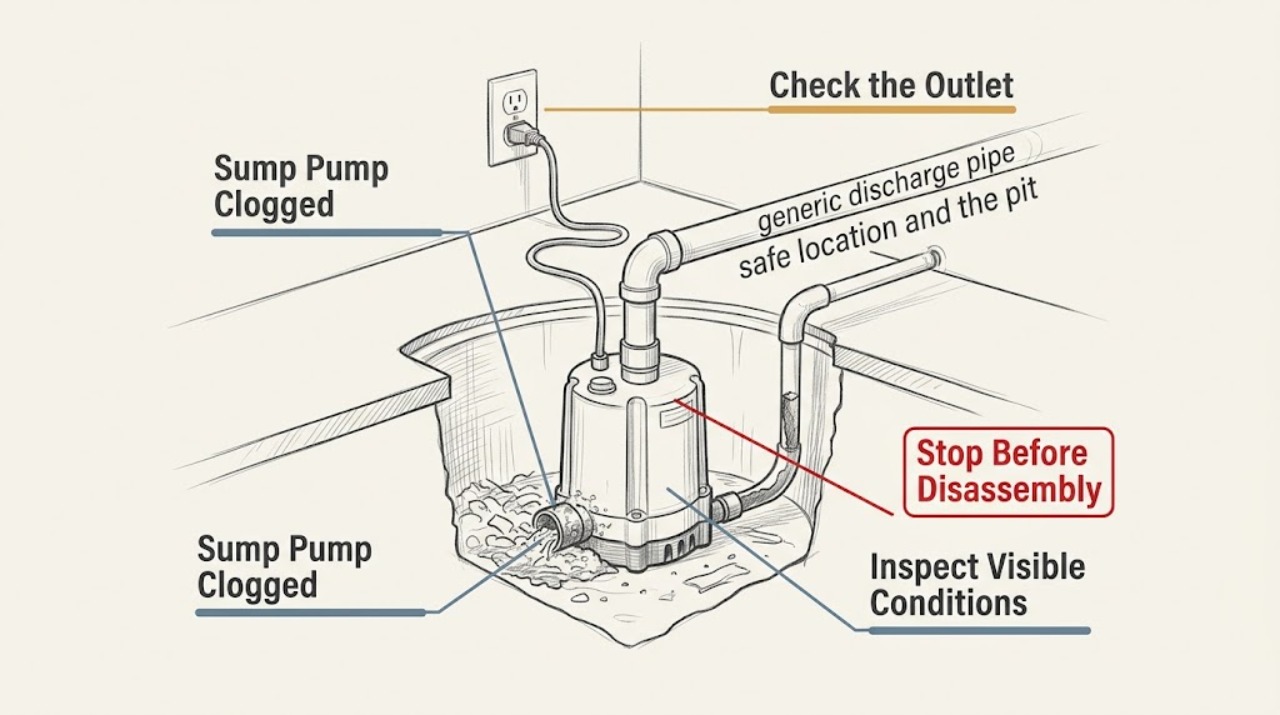
A sump pump that runs but does not move water may have a blocked, frozen, kinked, or poorly draining discharge line, but a stuck float, failed pump, closed check or gate condition, or loss of power can look similar. Start with safety: do not step into standing water or reach into the pit, and do not touch the pump or cord until power is isolated from a dry, safe location. From outside the pit, look for water at the discharge outlet, an obvious obstruction, ice, a bend, or water returning toward the foundation. Clear only loose snow or ice at an accessible outlet when no electrical or flood hazard is present; do not dismantle the line or pump. Persistent rising water, sewage-like water, a blocked buried line, repeat breaker trips, or any wet electrical equipment needs prompt plumber, pump, or electrician service.
Work through in order
Diagnostic checks
Use only checks that match the exact appliance or system and its official guide.
-
Check 1
From a dry, stable position, assess the basement or sump area without stepping into water. Note the water level, whether the pump is silent or running, whether the water looks clear or sewage-like, and whether the plug, cord, outlet, or nearby equipment is wet, hot, damaged, or repeatedly tripping protection.
Expected result: Rising water, sewage-like water, wet electrical equipment, smoke, a burning odor, or an unsafe floor is an immediate stop condition. A pump that runs without lowering the level keeps the discharge path, pump, float, or check condition in scope; a silent pump also keeps power and controls in scope.
Next step: Leave the area and request emergency or professional help for unsafe water or electrical conditions. If the area is dry and safe, continue with outside-only observations.
Why this matters
Why: Safety and pump behavior must be established before looking for a drain-line obstruction.
-
Check 2
From outside the pit, follow the visible discharge pipe to its outlet. Look for water arriving at the outlet, a closed or damaged visible section, a sharp kink, crushed flexible hose, ice, snow, leaves, mud, or an outlet buried against the foundation; do not disconnect or open the pipe.
Expected result: No discharge while the pump runs, or water backing up at a visible obstruction, supports a discharge-line restriction. Ice, a kink, or a buried outlet can prevent flow. Water that exits freely but the pit still rises points toward pump capacity, float, check condition, or a downstream buried restriction rather than the visible outlet alone.
Next step: Only clear loose snow or ice at an accessible outlet when the area is dry and safe and the pipe is not under pressure from a running pump. Leave a frozen, buried, damaged, or blocked line for a plumber or pump technician.
Why this matters
Why: The outlet pattern separates a visible drain-line problem from a pump or hidden-line problem without touching the equipment.
-
Check 3
If and only if power has been isolated from a dry, safe location and the pit opening is already accessible without removing a cover or reaching into water, look from above for obvious floating debris, a visibly trapped float, or a pipe entrance blocked by a loose object. Keep hands, tools, and clothing out of the pit.
Expected result: A visible loose obstruction or float that cannot move freely can explain a no-start or intermittent cycle, but debris below the waterline, a jammed impeller, or a pump that requires removal is not a user-level drain-line clearing task. No visible obstruction keeps the discharge line, pump, or controls in scope.
Next step: Do not reach into the water or remove the pump. Keep power isolated and call a plumber or pump technician for any obstruction that is not loose, visible, and safely accessible.
Why this matters
Why: A safe visual check can identify an obvious external clue without turning a flooded pit into a hands-on repair.
-
Check 4
Check the discharge route's visible slope and termination from a safe distance. Look for a low dip that could hold ice, a flexible hose exposed to freezing, water pooling beside the foundation, or an outlet connected to a drain whose permitted use is uncertain; do not reroute, cut, or reconnect piping.
Expected result: A low spot, frozen flexible hose, or pool returning toward the house can create a recurring discharge restriction. A line that ends in an uncertain or prohibited drain is a code and backup concern, not a clog to solve by making a new connection.
Next step: Photograph the route from a dry position and give it to a plumber or property manager. Do not alter buried or connected piping during an active flooding event.
Why this matters
Why: Drain-line geometry and discharge location affect whether water can leave the pit and whether it returns to the building.
-
Check 5
After a professional or safe external correction, observe one normal pump cycle without adding water or repeatedly resetting power. Note whether the pump starts at the normal level, the discharge remains steady, the pit level falls, and water stays away from the foundation.
Expected result: A falling pit level and steady discharge support a cleared or corrected route. Continued running, rising water, weak discharge, abnormal noise, repeat trips, or water returning to the pit indicates an unresolved pump, float, check, or drain-line issue.
Next step: Stop the test and call a plumber or pump technician for any unresolved symptom. Keep the system and area protected from further flooding while service is arranged.
Why this matters
Why: The outcome is verified by controlled drainage, not by repeatedly forcing a pump to run against a suspected blockage.
-
Check 6
Prepare a service note from a dry location: record the pit level, pump sound, whether the outlet discharged, the visible line condition, temperature or freezing conditions, any water near electrical equipment, breaker or GFCI behavior, and whether the water was clear or contaminated-looking.
Expected result: A pump-running/no-discharge pattern supports discharge-line or pump diagnosis; a silent pump with no power points to electrical or control diagnosis; contamination, flooding, or repeat protection trips increases urgency.
Next step: Give the note and safe-distance photos to a plumber, pump technician, or electrician as appropriate. Do not open the pump, pit wiring, check valve, or panel.
Why this matters
Why: The timing and visible symptoms help the professional choose between drain-line, pump, electrical, or cleanup response without unsafe user testing.
Use your observations
Decision map
Find the observation that best matches what you see, then follow the next safe action.
-
PATH 01Safety boundary
What you see
Water is rising, the pit or floor is flooded, electrical equipment is wet, a breaker or GFCI trips again, or smoke, heat, odor, or arcing is present.
Do this next
Leave the area, keep people away, and seek emergency or qualified plumbing/electrical help from a dry, safe location. Isolate power only if the disconnect is safely reachable without entering water.
Why this path and its safety boundary
Why it matters: The immediate risk is flooding, contamination, shock, or fire—not a routine clog check.
Safety stop: Do not touch the pump, cord, outlet, panel, or standing water; do not reset protection repeatedly or use water near an electrical fault.
-
PATH 02Safety boundary
What you see
The pump audibly runs but the pit level does not fall and little or no water appears at the visible discharge outlet.
Do this next
Inspect only the visible outlet and line from a safe dry position. Call a plumber or pump technician for any hidden, frozen, disconnected, or pressurized section.
Why this path and its safety boundary
Why it matters: A blocked, frozen, kinked, buried, or poorly draining discharge line is possible, as are pump, check, or float issues.
Safety stop: Do not loosen couplings, disconnect the discharge pipe, or run the pump repeatedly against the suspected restriction.
-
PATH 03Safety boundary
What you see
A visible outlet is blocked by loose snow, ice, leaves, mud, or another accessible obstruction and there is no flooding or electrical hazard.
Do this next
Clear only loose material from the accessible outlet without disconnecting or entering the pit, then have a professional verify the route if flow does not normalize.
Why this path and its safety boundary
Why it matters: The obstruction may be restricting discharge, but clearing the outlet does not prove the entire line or pump is sound.
Safety stop: Do not chip forcefully at a pressurized or damaged pipe, use heat or flame, or alter a buried line.
-
PATH 04Safety boundary
What you see
The discharge route has a frozen flexible section, a low dip holding water, or an outlet that drains back toward the foundation.
Do this next
Keep the pump off if safe and call a plumber or pump professional to correct the route; do not cut, heat, or reroute it during an active event.
Why this path and its safety boundary
Why it matters: Drain geometry or freezing can create a recurring blockage and may return water to the building.
Safety stop: Do not use an open flame, improvised heat, or a temporary connection into an unapproved drain.
-
PATH 05Safety boundary
What you see
The pit is wet but the pump is silent, with no clearly safe visible power or control explanation.
Do this next
From a dry location, note the visible control state and call a plumber, pump technician, or electrician. Keep hands and tools out of the pit.
Why this path and its safety boundary
Why it matters: Power, outlet, breaker/GFCI, float, control, or pump failure may be involved; a clogged drain line is not established.
Safety stop: Do not reach for the float, touch the cord or outlet in a wet area, or open the panel or pump housing.
-
PATH 06Safety boundary
What you see
The pump lowers the pit and water exits steadily, but the symptom returns or the route remains visibly damaged.
Do this next
Document the recurrence and arrange professional inspection rather than repeatedly cycling the pump or making an unapproved discharge change.
Why this path and its safety boundary
Why it matters: An intermittent obstruction, check or float issue, freezing risk, or drainage problem remains possible.
Safety stop: Stop any further test if the pit rises, the pump runs continuously, protection trips, or water approaches the foundation or electrical equipment.
Helpful context
Understand the symptom
A clogged drain line is only one branch of a sump-pump failure. If water is high in the pit, first ask whether the pump is silent, humming, running continuously, or discharging weakly. Then inspect the discharge route from the outside. A line that is frozen, kinked, obstructed, or draining back toward the foundation can leave the pump running without lowering the pit.
Treat a flooded basement or wet pump area as an electrical hazard. Stay out of standing water, keep hands away from the pit, plug, outlet, controls, and cord, and isolate power only from a dry location if the disconnect is safely reachable. Do not repeatedly reset a breaker or test a pump that has been submerged or is surrounded by unsafe water.
Sump discharge is normally clear foundation water routed away from the building. Local rules may restrict where it may discharge, and winter conditions can freeze flexible hoses or low spots. Do not redirect a line into a sanitary drain or make a buried connection change while troubleshooting a blockage.
Safety boundary
Stop conditions
- Stop immediately for standing or rising water, sewage-like water, water near electrical equipment, a wet cord or outlet, repeat breaker/GFCI trips, smoke, heat, burning odor, or visible arcing.
- Do not enter the pit or standing water, reach into the sump, touch wet electrical equipment, open the pump or panel, disconnect a pressurized line, or run the pump repeatedly against a suspected blockage.
- Do not chip, burn, or force a frozen pipe; do not reroute the discharge into an uncertain drain or make a buried connection during an active flooding event.
Only after diagnosis
Potential parts
- sump pump discharge pipe or hose
Consider this only after a plumber confirms that a frozen, damaged, kinked, or repeatedly blocked discharge section is the cause.
Confirm pump outlet, pipe material, local discharge rules, slope, freeze protection, and routing with the professional; do not infer a safe fit from appearance. - sump pump check valve
Consider this only when professional diagnosis shows that the valve is preventing discharge or allowing water to return and is compatible with the pump system.
A qualified person should verify direction, pipe size, head, access, and system design before replacement.
Common questions
FAQ
How can I tell if a sump pump discharge line is clogged?
If the pump runs but the pit does not fall and little or no water reaches the visible outlet, a blocked, frozen, kinked, or buried line is possible. Inspect only from a safe dry position and call a professional for hidden or pressurized sections.
Can I reach into the sump pit to clear debris?
No. Do not reach into a pit or standing water. If power and water safety cannot be established from a dry location, leave the area and arrange plumbing or electrical help.
Why does the sump pump run continuously?
A discharge restriction, frozen or poorly routed line, float issue, check condition, pump limitation, or continuing water inflow may be involved. Continuous running with no falling water or repeat trips needs professional diagnosis.
Is sump-pump water sewage?
A typical foundation sump handles clear groundwater, but older or unusual plumbing arrangements can differ. Treat unknown, foul-smelling, or visibly contaminated water as unsafe and avoid contact until a professional assesses it.
Read the exact guide
Official sources
- Sump PumpsCity of Plymouth, Minnesota · Sump discharge routing, winter freezing, outlet obstructions, slope, air gaps, and drainage away from the building
- Sewer Smarts and Plumbing BasicsCity of Superior, Wisconsin · Sump-pit purpose, clear-water discharge, discharge-pipe routing, freezing, and visible pump/float observations
Community feedback
Share a repair observation
Share a plain-text repair observation. Accepted observations are published automatically; this page may take a moment to update.