
On this page
Start here
Quick answer
A sump pump bang that occurs just after the motor stops is commonly the discharge check valve closing as water reverses, or the water column and pipe striking a nearby wall or joist. First listen for when the noise occurs and watch the exposed discharge pipe without putting hands near the pump. If the pipe moves, add suitable isolation or support; if the check valve slams, have the accessible valve and its flow direction checked and consider a model-approved quiet or slow-closing valve. Pentair also notes that an over-sized pump can move water too fast and that a flexible rubber section can isolate noise. Do not bypass the check valve, cut into a pressurized or frozen line, reach into an energized pit, or keep testing if a pipe is leaking, a fitting is separating, the pump repeatedly trips protection, or the basement is taking on water.
Before you begin
Safety first
- Do not enter a sump pit, reach into standing water, handle wet electrical connections, bypass a check valve, cut or unclamp a pressurized line, drill the discharge pipe, or open pump covers. Stop immediately for flooding, leaks, pipe separation, smoke, burning odour, damaged wiring or repeated protection trips.
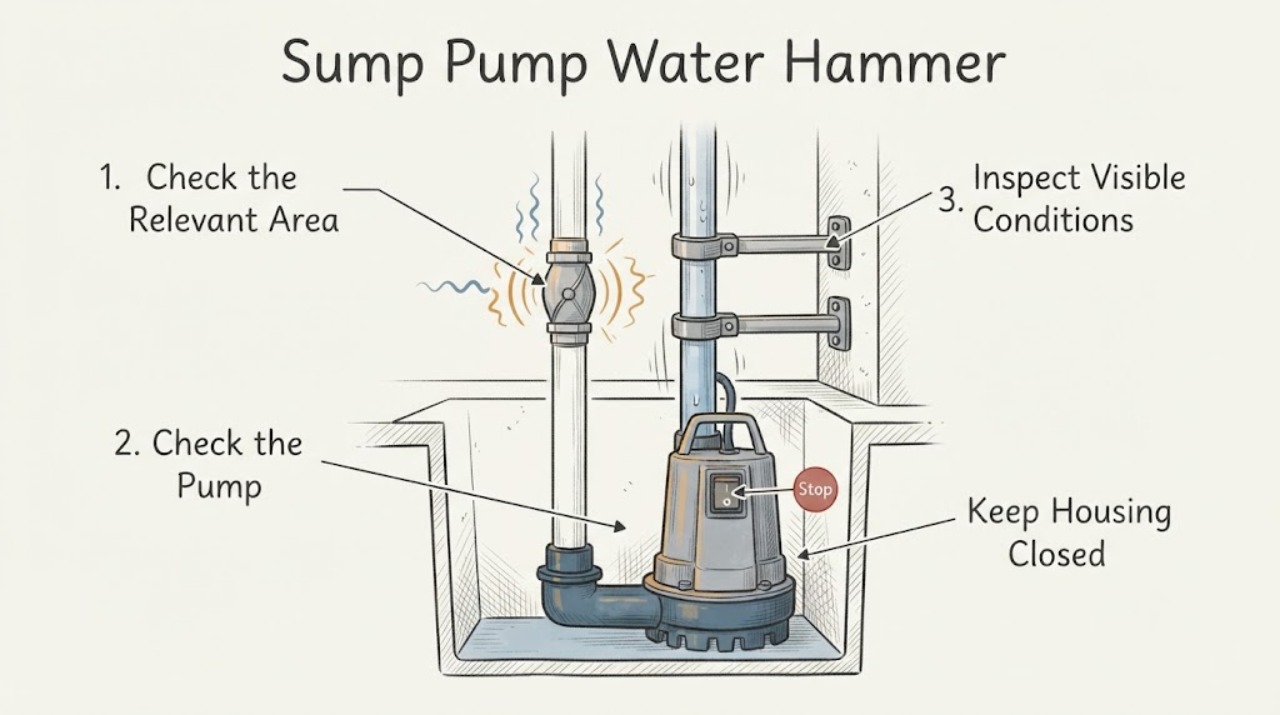
Work through in order
Diagnostic checks
Use only checks that match the exact appliance or system and its official guide.
-
Check 1
With the area dry and clear, observe one normal cycle from a safe position. Note whether the sound happens while the pump is running, exactly at shutoff, or a few seconds after shutoff; also note whether the exposed pipe visibly jumps.
Expected result: There is one sharp bang at shutoff, a rattle during operation, repeated banging as the pump cycles, or no sound but water is returning to the pit.
Next step: Follow the matching check-valve, pipe-isolation, or discharge-performance branch; do not disassemble anything during this observation.
Stop if: Stop if the pump, cord, outlet or water is wet in a way that could create an electrical hazard, if the pipe is leaking or separating, or if the water level is rising toward an overflow.
Why this matters
Why: A sharp post-shutdown bang makes check-valve closure or reverse-flow shock the leading branch. A running rattle makes pipe contact or vibration more likely. Repeated cycling or visible return flow suggests a discharge/check-valve or inflow problem rather than a sound-only nuisance.
-
Check 2
Inspect only the visible discharge pipe, unions, clamps and supports with the pump idle. Look for a pipe touching a wall or joist, a loose hanger, a strained fitting, a cracked section, or a check-valve arrow that appears to point away from the discharge direction.
Expected result: The pipe is contacting framing or moving, a support is loose, a joint shows water, or the valve orientation is unclear or appears reversed.
Next step: For a sound-only contact issue, have the accessible pipe isolated and supported without forcing the pipe. For a leak, damaged fitting or uncertain valve installation, leave the pump off when safe and call a qualified plumber or pump technician.
Stop if: Do not tighten, cut, unclamp or pull on a wet or pressurized line, and do not reach into the pit or handle wiring. Stop for any crack, active leak, pipe displacement or electrical smell.
Why this matters
Why: Contact and loose supports can transmit pump vibration as a rattle or bang. A leaking or strained joint needs repair before more cycling. A check valve installed in the wrong direction may restrict discharge or fail to prevent return flow; confirm against the pump and valve instructions rather than guessing.
-
Check 3
If the bang is only at shutdown and the exposed pipe is secure, identify the check valve's accessible body and listen from a dry, safe location for the click or slam at the moment the pump stops. Do not hold the valve or put a hand near the pump while it cycles.
Expected result: The valve produces the sharp closure noise, the noise is reduced when the pipe is gently isolated by an already-installed flexible section, or the noise source cannot be localized.
Next step: Ask a qualified installer to verify the valve type, condition, accessibility and flow direction, and to determine whether a compatible quiet or slow-closing valve or isolation section is appropriate for the pump system.
Stop if: Do not bypass or remove the check valve, add an improvised restriction, or open a union while water is standing in or around electrical equipment.
Why this matters
Why: A closure bang supports a valve/reverse-flow branch. A flexible section can provide vibration and noise isolation, but it is not a substitute for a functioning check valve. If the source cannot be localized, avoid repeated tests and have the discharge assembly assessed.
-
Check 4
Check the system's discharge performance during a safe supervised cycle: confirm that water exits at the intended outlet away from the foundation, the pump stops normally, and the level does not immediately refill from the discharge line.
Expected result: Water discharges away from the building and the pit level falls, or water drains back, the pit refills rapidly, the pump short-cycles, or the outlet is blocked or frozen.
Next step: For a clear discharge with no leak, continue only with the model-specific valve/support assessment. For return flow, blockage, freezing, rapid refill or short cycling, stop and arrange prompt professional service; protect the basement with an approved backup plan if available.
Stop if: Stop before testing if the pit is near overflow, the discharge terminates against the foundation, the line is frozen or visibly damaged, or the electrical supply is wet or repeatedly trips.
Why this matters
Why: A successful discharge makes a noise-isolation or valve-closure issue more likely. Return flow can mean a check valve is stuck, leaking or incorrectly installed. A blocked or frozen outlet, or inflow greater than pump capacity, is a water-management emergency, not merely water hammer.
-
Check 5
Review the pump model manual or installation record for the discharge size, approved valve arrangement and pump duty. Compare the noise onset with any recent pump, valve, pipe-routing or support change; do not infer that a larger-horsepower pump is wrong from noise alone.
Expected result: The noise began after a valve or pipe change, the pump appears oversized for the installation, the valve is a standard slamming style, or the installation and pump sizing cannot be verified.
Next step: Provide the technician with the pump model, pipe size, valve markings, discharge route, timing of the bang and any leak or cycling symptoms. Have them select compatible parts and confirm the discharge still prevents backflow and sends water away from the building.
Stop if: Do not replace the pump, alter the discharge diameter, drill the pipe, or modify a check valve based on sound alone; stop immediately for flooding, electrical fault, pipe failure or unsafe access.
Why this matters
Why: A changed discharge arrangement can alter reverse-flow timing and pipe movement. Pentair notes that an unnecessarily high-horsepower pump can move water too quickly and make the water column slam down after shutdown, but sizing requires the actual head and flow requirements. A missing manual or unknown installation is a reason to verify, not to substitute a guessed part.
Use your observations
Decision map
Find the observation that best matches what you see, then follow the next safe action.
-
PATH 01Next step
What you see
The bang is a single sharp sound immediately after the pump stops and the pipe is otherwise secure.
Do this next
Treat check-valve closure or reverse-flow shock as the leading hypothesis. Have the valve checked for correct direction, condition and suitability; ask about a compatible quiet or slow-closing valve or compliant flexible isolation section.
-
PATH 02Next step
What you see
The pipe rattles or bangs against a wall, floor joist or support while the pump runs.
Do this next
Keep the pump arrangement unchanged and have the accessible discharge pipe isolated and supported so it cannot transmit vibration. A support or fitting that is strained, cracked or leaking requires professional repair.
-
PATH 03Next step
What you see
Water returns to the pit after shutdown, the pump short-cycles, or the valve appears reversed, stuck or leaking.
Do this next
Stop treating this as a noise-only issue. Leave the pump off when safe and have the check valve and discharge path serviced; the valve must prevent backflow without blocking the pump's intended flow.
-
PATH 04Next step
What you see
The outlet is blocked or frozen, the pit is refilling faster than it drains, or the water level is rising.
Do this next
Prioritize flood prevention and qualified help. Do not heat a frozen plastic discharge with an open flame or repeatedly cycle a pump against a blocked line; use only an approved backup or emergency water-management method.
-
PATH 05Next step
What you see
There is a leak, separated fitting, damaged cord, repeated breaker or GFCI trip, burning smell, smoke, or water around electrical equipment.
Do this next
Stop immediately, keep people away from the hazard, and call qualified plumbing and/or electrical help. Do not enter standing water to unplug or retrieve the pump; power isolation must be handled only when it can be done safely.
Helpful context
Understand the symptom
The timing of the bang is the useful clue
A single bang immediately after the sump pump stops points toward the check valve and the moving water column. A rattle that continues while the pump runs points more toward pipe contact, vibration or a loose support. The sound alone does not prove that the pump is the wrong size: compare it with the actual shutdown moment and inspect the accessible discharge path before choosing a part.
A check valve protects against backflow, but it can also transmit a shock
The valve is there to keep the water column from draining back into the sump when the pump is off. If its flap closes abruptly, the resulting shock can be heard through the pipe. A quiet or differently seated valve may reduce that noise, but it must preserve the one-way function and fit the actual discharge arrangement. Do not remove the valve simply to make the sound disappear.
Keep the pit and discharge route safe while testing
PNNL's Building America guidance calls for the discharge to carry water away from the building, for the float to remain unobstructed, and for the system to be tested for proper discharge. Keep the sump cover and electrical connections dry. If the noise comes with a leak, a damaged fitting, electrical trouble or rising water, stop troubleshooting and arrange qualified plumbing or electrical help.
Only after diagnosis
Potential parts
- quiet or slow-closing sump-pump check valve
Consider only when the bang is localized to check-valve closure, the existing valve still needs replacement or noise reduction, and the valve's flow direction, pipe connection and pressure requirements have been verified.
Confirm the pump model, discharge pipe size, connection style, orientation and manufacturer instructions before selecting a valve; do not assume a generic valve fits. - flexible discharge-pipe isolation section
Consider only when the discharge pipe is sound and the measured problem is vibration or transmitted noise, not a leak, blockage or failed check valve.
Use a connector approved for the pump and discharge application and have its support, clamps and pressure path checked; it must not replace required backflow protection. - discharge-pipe support or isolation hardware
Consider only when an exposed pipe is visibly contacting framing or moving during operation and the pipe and fittings are otherwise intact.
Match the support to the pipe material and routing without forcing the pipe or loading a pump outlet; verify local plumbing requirements.
When checks do not resolve it
Need a professional?
Arrange qualified plumbing or pump service when the noise is accompanied by return flow, short cycling, a leak, a blocked or frozen discharge, pipe movement that cannot be safely isolated, or an unknown valve or pump arrangement. Use qualified electrical help for repeated breaker or GFCI trips, damaged cords or wet electrical equipment.
Safety scope: Do not enter a sump pit, reach into standing water, handle wet electrical connections, bypass a check valve, cut or unclamp a pressurized line, drill the discharge pipe, or open pump covers. Stop immediately for flooding, leaks, pipe separation, smoke, burning odour, damaged wiring or repeated protection trips.
Common questions
FAQ
Is a bang after a sump pump shuts off always water hammer?
No. It is consistent with check-valve closure and reverse-flow shock, but a pipe touching framing, loose support or pump vibration can transmit a similar sound. The timing and visible pipe movement decide which branch to investigate first.
Should I remove the sump pump check valve to stop the noise?
No. The check valve prevents discharge water from draining back into the sump. Have its direction, condition and suitability checked, and use a compatible quiet or slow-closing solution only if it preserves required backflow protection.
Can a flexible hose make the sump pump quieter?
Pentair lists a flexible rubber section between the pump discharge and discharge pipe as noise insulation for a banging or rattling installation. It must be suitable for the system and installed without compromising the check valve, support or leak-free discharge path.
When is sump-pump water hammer an emergency?
Treat it as urgent when the discharge leaks, separates, freezes or blocks; when water returns and the pit short-cycles or rises; or when electrical equipment is wet, damaged or repeatedly trips protection. Stop testing and arrange qualified help rather than repeatedly cycling the pump.
Read the exact guide
Official sources
- Sump Pump Troubleshooting FAQPentair · Pentair residential sump-pump troubleshooting and discharge-noise guidance
- Clear Quiet Check ValvesLiberty Pumps · Liberty Pumps quiet check-valve product features for sump and related discharge applications
- Drain or Sump Pump Installed in Basements or CrawlspacesU.S. Department of Energy Building America Solution Center / Pacific Northwest National Laboratory · DOE/PNNL educational guidance for sump-pump discharge, check valve, float, cover and testing practices
- Check ValvesLittle Giant · Little Giant sump, sewage and effluent check-valve function and applications
Community feedback
Share a repair observation
Share a plain-text repair observation. Accepted observations are published automatically; this page may take a moment to update.