
On this page
Start here
Quick answer
A toilet that only partly clears the bowl usually has insufficient tank water or an incomplete valve release, restricted rim holes or jet, or a partial obstruction in the trapway or waste line. Check the tank water against its marked waterline, confirm the supply shut-off is open, and inspect accessible openings. If the bowl rises, sewage backs up, several fixtures drain slowly, porcelain is cracked, or the flush remains weak after safe checks, stop flushing and arrange qualified plumbing service. Do not use chemical drain opener in a toilet.
Before you begin
Safety first
- A plumber can safely inspect the flush valve and fill mechanism, clear the trapway or waste line, check for a lodged object or concealed installation issue, and address damaged shut-offs or porcelain. Keep homeowner checks to settings, visual inspection, approved surface cleaning, and a controlled flange-plunger attempt.
Work through in order
Diagnostic checks
Use only checks that match the exact appliance or system and its official guide.
-
Check 1
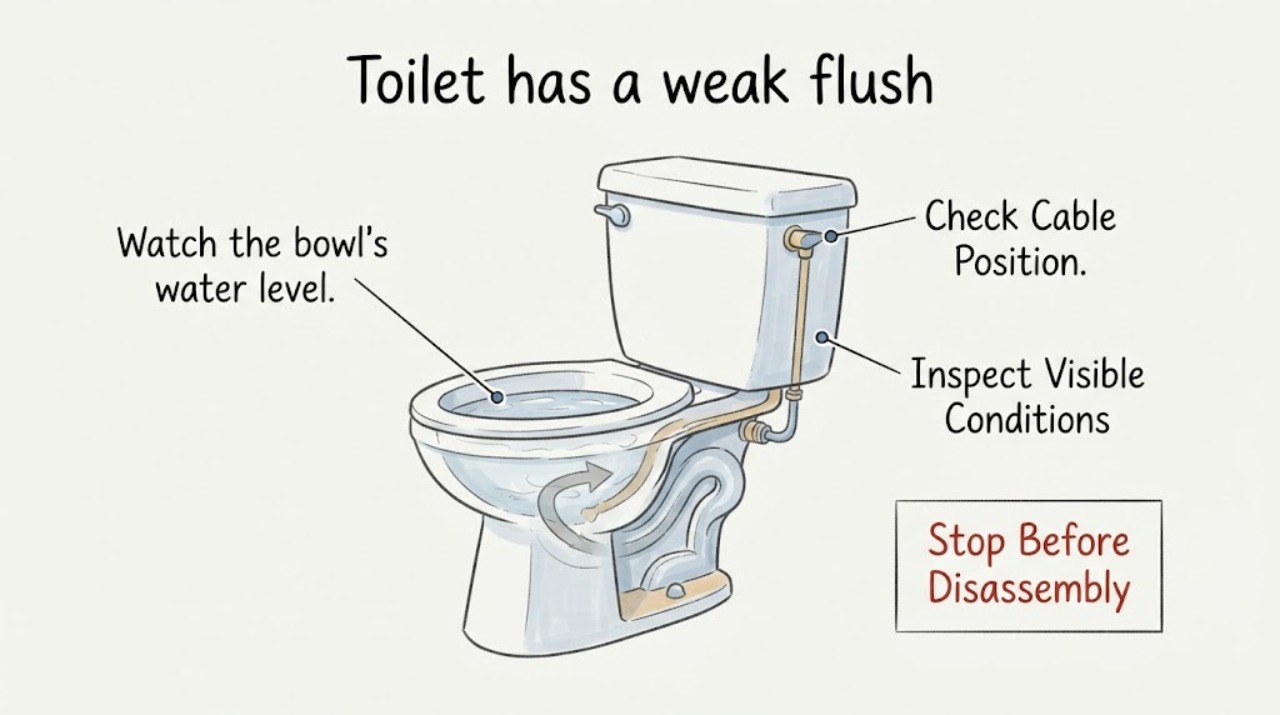
Before another flush, watch the bowl's water level and locate the toilet supply shut-off. If the bowl is already high, close the shut-off and remove the tank lid so the flush valve cannot release another full tank while you assess the symptom.
Expected result: The bowl rises toward the rim, drains very slowly, spills, or wastewater appears in another fixture; or the level remains stable and there is no backup.
Next step: Do not keep flushing or add chemical drain opener. If water is overflowing, sewage is backing up, or the shut-off will not stop the flow, contain the area and arrange urgent qualified plumbing help; otherwise continue with the tank check.
Why this matters
Why: A rising bowl or wastewater backup makes an active restriction more likely and creates an overflow risk. A stable bowl permits limited non-invasive checks, but it does not prove the drain is clear.
-
Check 2
With the tank lid off, compare the resting tank water with the manufacturer's marked waterline, then operate the normal handle or button once while watching the chain, cable, flapper, or flush valve release and close.
Expected result: The tank level is below its mark, the flush valve opens only partly or closes immediately, the handle must be held down, or the water level and valve movement look normal.
Next step: Use the toilet's model instructions to make only the intended float or linkage adjustment. If the flapper, seal, chain, cable, or flush valve is damaged, misaligned, or repeatedly fails to close, stop repeated testing and plan an exact replacement or plumber diagnosis.
Why this matters
Why: Low stored water or incomplete valve travel can reduce flush volume. A correct level and full release make a local passage restriction or waste-line issue more likely, though a hidden valve fault remains possible.
-
Check 3
Confirm the toilet's supply shut-off is open and observe a complete refill; inspect the flexible supply line from outside for a visible kink or damage without disconnecting it.
Expected result: The shut-off is partly closed, the refill is unusually slow or never reaches the marked level, the line is kinked, or refill and supply appear normal.
Next step: Open the shut-off gently if it is designed to turn and the area stays dry; do not force, disassemble, or disturb a valve that leaks. Straighten only an accessible line if it can be done without stressing fittings, then retest once; persistent slow refill needs plumbing service or an exact fill-valve diagnosis.
Why this matters
Why: Restricted supply or a malfunctioning fill valve can leave too little water for the next flush. Normal refill shifts attention toward the flush path rather than the incoming supply.
-
Check 4
Inspect the accessible bowl rim holes and jet with the toilet idle and the water level controlled, using only a gentle cleaning method that the toilet manufacturer's care instructions allow.
Expected result: Mineral scale or debris is visible at several rim holes or the jet, the openings look clear, or cleaning does not change the swirl or bowl clearance.
Next step: Clean only accessible deposits with a product and tool approved for the fixture; do not drill, use abrasive tools, or pour corrosive drain chemicals into the toilet. Retest once after cleaning, and use service if the weak flush persists.
Why this matters
Why: Blocked bowl passages can weaken the directed water that starts the siphon. Clear-looking openings or no response to safe surface cleaning makes a trapway, waste-line, tank-valve, or design-specific problem more likely.
-
Check 5
If the bowl is not near overflowing and no chemical drain product has been used, place a flange-style toilet plunger over the outlet and make controlled plunging strokes with a good seal.
Expected result: The bowl level drops, the obstruction clears and the next flush is strong, there is no change, or the symptom returns soon after a temporary improvement.
Next step: Rinse and retest without repeated flushing. Stop if the bowl rises, the plunger cannot seal, wastewater backs up elsewhere, or chemical residue is present; arrange a plumber to clear and inspect the line safely.
Why this matters
Why: A lasting improvement supports a local partial trapway obstruction. No change or rapid recurrence suggests a deeper or persistent restriction, an object, or a separate flush-volume fault.
-
Check 6
Check for a silent tank leak by following the dye-test method in the toilet or water-efficiency guidance, then flush promptly after the test; also note whether the tank runs between flushes.
Expected result: Color reaches the bowl, the flapper does not seat, the tank runs into the overflow, or no leak is found and the tank holds its level.
Next step: Replace or adjust only the identified tank seal or mechanism using the exact toilet's instructions and compatibility information. If the leak persists, the tank overflows, or the part is inaccessible or damaged, shut off the supply as needed and call a plumber.
Why this matters
Why: A leaking flapper or valve can consume stored water and leave a weak next flush. A stable tank makes a silent leak less likely and keeps the focus on valve travel, bowl passages, or the drain path.
-
Check 7
Run one controlled retest and compare this toilet with nearby fixtures: note whether the bowl clears, whether the drain gurgles, and whether another toilet, sink, or tub is also slow or backing up.
Expected result: Only this toilet remains weak, several fixtures share slow drainage or gurgling, or wastewater returns in a fixture after the toilet is flushed.
Next step: Limit water use and arrange plumbing service for multiple affected fixtures, recurring backup, or a symptom that remains after the safe checks. Give the plumber the fixture pattern and what changed after plunging or tank adjustments.
Why this matters
Why: An isolated symptom favors the toilet's tank, passages, trapway, or immediate branch. A shared pattern or wastewater return makes a common drain restriction or main-line issue more likely.
Use your observations
Decision map
Find the observation that best matches what you see, then follow the next safe action.
-
PATH 01Next step
What you see
The tank is below its marked waterline, refill is incomplete, or the flush valve closes before a full release.
Do this next
Follow the exact toilet instructions for the float, fill valve, handle, chain, cable, flapper, or flush valve. If the level cannot be restored or a part keeps running or sticking, use a plumber for diagnosis and an exact replacement.
Why this path and its safety boundary
Why it matters: Insufficient available flush water or a tank mechanism that is not opening and closing correctly is more likely than a primary waste-line obstruction.
-
PATH 02Next step
What you see
Tank level and valve travel are normal, the bowl swirls weakly, and scale or debris is visible at the rim holes or jet.
Do this next
Use only a manufacturer-approved gentle cleaning method on accessible openings and retest once. Do not drill or use corrosive chemicals; persistent weakness needs model-specific plumbing service.
Why this path and its safety boundary
Why it matters: A fixture-level passage restriction is more likely, although a hidden trapway restriction can produce a similar weak swirl.
-
PATH 03Next step
What you see
The bowl rises or drains slowly, controlled plunging improves it only temporarily or not at all, or an object may be lodged in the trapway.
Do this next
Stop repeated flushing and arrange a plumber to clear and inspect the obstruction without adding chemicals. Keep the shut-off available if the bowl starts rising again.
Why this path and its safety boundary
Why it matters: A local trapway obstruction or a restriction farther in the waste line is more likely than a simple low tank level.
-
PATH 04Next step
What you see
Another toilet, sink, tub, or floor drain is also slow, gurgling, or receiving wastewater.
Do this next
Limit water use and call qualified plumbing service. Report every affected fixture, when the pattern began, and whether the toilet's bowl level changes after other fixtures drain.
Why this path and its safety boundary
Why it matters: A shared branch or main drain restriction is more likely, and additional water use could spread the backup or cause damage.
-
PATH 05Next step
What you see
The flush remains weak after the tank, supply, accessible passages, leak, and controlled plunger checks, or the toilet has a crack, leak at its base, an unreliable shut-off, or repeated overflow.
Do this next
Stop hands-on troubleshooting and arrange qualified plumbing service. Avoid lifting or rocking a toilet, opening concealed connections, or repeatedly flushing to force a result.
Why this path and its safety boundary
Why it matters: The remaining possibilities include an inaccessible obstruction, concealed valve or installation fault, damaged fixture, or drain problem beyond safe homeowner access.
Helpful context
Understand the symptom
What a partial clear tells you
A strong flush needs the tank or supply to release enough water quickly and the bowl to direct that water through open rim passages, the jet, the trapway, and the waste line. A weak swirl with a normal tank level points in a different direction from a bowl that rises and drains slowly. Treat the symptom as a decision point: first separate a water-delivery problem from a restriction, then decide whether the obstruction is local to this toilet or farther down the shared drain.
Start with the tank and supply
Remove the tank lid carefully and compare the resting water level with the manufacturer's marked waterline. Check whether the fill valve completes its refill and whether the flush handle, button, chain, or cable opens the flush valve fully and lets it close normally. Confirm the toilet's supply shut-off is fully open without forcing an old or leaking valve. Manufacturer guidance identifies these basic water-level, valve, and supply checks as first steps for poor flushing.
Separate fixture deposits from a drain restriction
With the bowl at a safe level, look at the accessible bowl rim holes and jet for mineral scale or debris. Do not drill, poke deeply into the porcelain, or use harsh chemicals that can damage fittings or leave a hazard for later work. If water swirls weakly but does not rise, deposits or a valve problem become more plausible. If the bowl rises, drains slowly, or improves temporarily after plunging, a partial trapway or waste-line obstruction deserves more attention.
Use a toilet plunger only when the water level is controlled
A flange-style toilet plunger can be used for a suspected local partial clog when the bowl will not overflow and no chemical drain product has been added. Keep a good seal over the outlet and use controlled strokes rather than repeated flushing. Improvement that lasts through a retest supports a local restriction, while no improvement, recurrence, or backup in another fixture points beyond a simple plunger job.
Do not mistake a silent leak for a weak flush
A worn or poorly seated flapper can let tank water seep into the bowl and leave the toilet under-filled for the next flush. A dye test in the tank can reveal silent leakage; follow the product or agency instructions and flush afterward to avoid staining. If the flapper does not seal, the tank runs, or the fill valve never reaches its normal level, correct or replace the identified tank part only after matching the exact toilet design.
When the pattern is bigger than one toilet
Notice whether sinks, tubs, or another toilet also drain slowly, gurgle, or show wastewater. One toilet with a repeatable partial clear is more likely to have a fixture-level issue; several affected fixtures make a shared branch or main waste-line problem more likely. Keep water use low and call a plumber if the wider pattern appears, because repeated flushing can turn a partial restriction into an overflow.
Safety boundary
Stop conditions
- Stop flushing immediately if the bowl rises toward the rim, overflows, drains very slowly with wastewater backup, or another fixture receives sewage; close the toilet supply shut-off if it can be operated safely and arrange qualified plumbing help.
- Do not pour chemical drain opener into a toilet, especially before plunging or service. Do not drill porcelain, use corrosive cleaners, reach into an unknown obstruction, or disconnect a supply line that is leaking.
- Stop and obtain service for a cracked bowl or tank, water leaking at the base or fittings, a shut-off that will not stop flow, an object suspected in the trapway, or a recurring weak flush after a temporary plunger improvement.
- Limit water use and call a plumber when multiple fixtures are slow or gurgling, wastewater backs up, the tank continues to run, or safe tank and accessible-opening checks do not restore a normal flush.
Only after diagnosis
Potential parts
- toilet flapper or flush-valve seal
Consider this only when the dye test or direct observation shows seepage, poor seating, or incomplete flush-valve operation; a weak flush can instead come from a blocked passage or drain.
Match the exact toilet model, valve style, dimensions, and manufacturer instructions before selecting a seal or flapper. - toilet fill valve
Consider this only when the tank refills slowly, does not reach its marked level, runs continuously, or the valve is confirmed faulty after checking the supply and linkage.
Confirm the exact toilet design, inlet arrangement, adjustment range, and replacement instructions; do not infer fit from appearance alone. - toilet supply shut-off or flexible supply line
Consider this only when the shut-off or supply line is visibly damaged, restricted, or leaking; it is not a general cure for a partially clearing bowl.
Use a qualified plumber when the valve will not close, fittings are corroded, or the line must be disconnected. Confirm connection type and local requirements.
When checks do not resolve it
Need a professional?
Safety scope: A plumber can safely inspect the flush valve and fill mechanism, clear the trapway or waste line, check for a lodged object or concealed installation issue, and address damaged shut-offs or porcelain. Keep homeowner checks to settings, visual inspection, approved surface cleaning, and a controlled flange-plunger attempt.
Common questions
FAQ
Why does my toilet flush but leave some waste in the bowl?
The tank may not be releasing enough water, the bowl rim holes or jet may be restricted, or a partial obstruction may be limiting the trapway or waste line. Compare the tank to its marked waterline, watch the flush-valve movement, inspect accessible passages, and use a controlled flange plunger only when the bowl is not near overflowing.
Can a low tank water level cause a weak flush?
Yes. A tank-type toilet needs its stored water at the manufacturer's recommended level, and a fill valve or linkage problem can leave too little water or release it incompletely. Correct only the adjustment described by the toilet's instructions and investigate a running or faulty valve rather than repeatedly flushing.
How can I tell whether the toilet is partially clogged?
A bowl that rises, drains slowly, improves temporarily after plunging, or causes gurgling is more consistent with a restriction than with a simple low tank level. If more than one fixture is slow or receives wastewater, limit water use and arrange plumbing service for a shared drain problem.
Should I pour drain cleaner into a weak-flushing toilet?
No. Chemical drain opener can create a hazard for you or a plumber and can damage toilet components. Use only a toilet plunger when the water level is controlled and no chemical residue is present; persistent or recurring restrictions need safe mechanical clearing by a qualified plumber.
When should a plumber handle a weak toilet flush?
Call when the bowl overflows or backs up, multiple fixtures are affected, the toilet leaks or is cracked, the shut-off will not operate, an object may be lodged, the tank keeps running, or the flush remains weak after safe tank, supply, passage, and controlled plunger checks. Provide the technician the fixture pattern and what each check changed.
Read the exact guide
Official sources
- Best Management Practice #6: Toilets and UrinalsU.S. Department of Energy · General tank-toilet maintenance; individual toilet manuals govern model-specific mechanisms and adjustments
- Home MaintenanceU.S. Environmental Protection Agency WaterSense · General residential toilet maintenance; a specific toilet's manual and a qualified plumber govern repair details
- Installation and Care Guide: Dual Flush Two-Piece ToiletKohler Co. · Kohler dual-flush two-piece toilet guide; the exact adjustment and parts vary by toilet model
Community feedback
Share a repair observation
Share a plain-text repair observation. Accepted observations are published automatically; this page may take a moment to update.