
On this page
Start here
Quick answer
When the tank and bowl water levels are already correct, a weak toilet flush is more likely to come from incomplete flush-valve opening, a partially closed supply valve, mineral buildup in the rim or jet passages, an obstruction in the trapway, or a restricted waste vent than from the water level itself. First note whether the bowl rises and drains slowly, bubbles, needs the handle held down, or has weak rim flow. Check that the accessible shutoff valve is fully open and that the handle, chain, button rods, flapper, or canister visibly open and close as the model allows. Clean only accessible rim passages with a method approved for the toilet, never mix cleaners or use in-tank chlorine products. If the bowl threatens to overflow, multiple fixtures gurgle, frequent clogs continue, sewage backs up, or the weak flush remains after safe checks, stop and arrange qualified plumbing or drain service.
Before you begin
Safety first
- This article supports observing one flush, checking accessible water level and supply-valve position, inspecting user-accessible flush linkage, cleaning accessible rim passages with an approved method, and making a cautious flange-plunger attempt when water is safely below the rim. It does not authorize chemical drain treatment, live or concealed plumbing work, toilet removal, roof-vent access, aggressive descaling, or continued use during overflow or sewage backup.
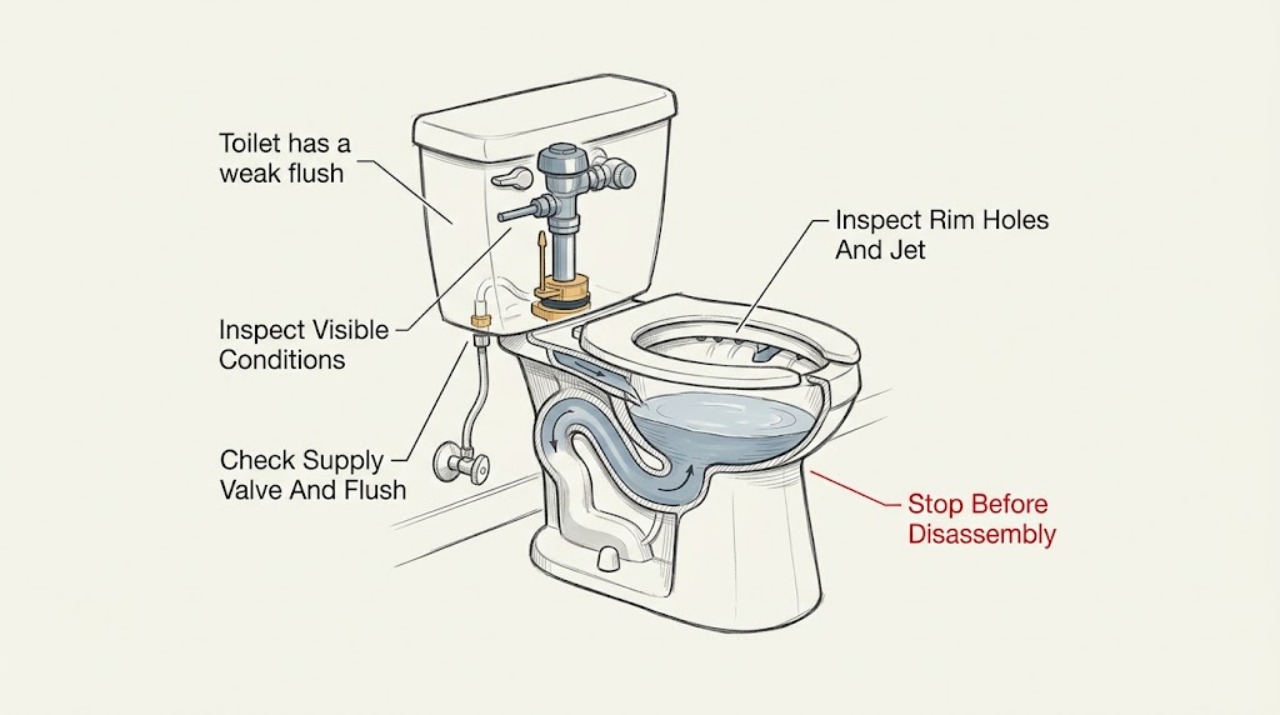
Work through in order
Diagnostic checks
Use only checks that match the exact appliance or system and its official guide.
-
Check 1
Flush once while watching from the side, keeping the handle or button untouched after the normal flush begins. Note the rim wash or jet action, how high the bowl water rises, how quickly it drains, whether the bowl swirls, and whether bubbles or sounds come from the trapway or nearby drains. Do not flush again if the bowl is still rising.
Expected result: Classify the pattern as weak water entering but normal drainage, strong water entering but slow drainage, water rising near the rim, bubbles or gurgling, a flush that improves only when the handle is held, or a normal flush with poor bowl cleaning.
Next step: Use the flow-path branch that matches the pattern. If the bowl approaches overflow, stop flushing, close the toilet shutoff valve, and arrange plumbing or drain service if the condition does not clear safely.
Stop if: Do not keep flushing an obstructed bowl, plunge against a rising overflow, or use chemical drain opener in a toilet.
Why this matters
Why: Weak incoming flow makes the flush valve, rim holes, jets, handle or button linkage, or supply path more likely. Strong flow followed by slow drainage makes a partial trapway, soil pipe, or vent obstruction more likely. A bowl that rises, bubbles, or makes other drains gurgle is a blockage or vent warning rather than a water-level adjustment problem.
-
Check 2
Remove only the tank lid if it lifts safely and the toilet model permits user inspection. Confirm the accessible shutoff valve is fully open, then operate the handle, button, or lever once and observe whether the flapper, canister, or flush valve opens fully and closes without catching. On a button model, look for rods that do not move the valve through its full travel. Keep fingers and tools clear of moving parts and do not remove the valve.
Expected result: Look for a partly closed supply valve, a loose or binding handle, a chain that prevents full lift or catches, a flapper or canister that opens only slightly or closes too soon, or button rods that do not engage. Note whether the flush improves after correcting only an obvious user adjustment allowed by the manual.
Next step: Follow the exact toilet manual for a simple handle, chain, or button adjustment. If the valve seal, lift mechanism, or tank fitting is damaged, leaking, or inaccessible, close the lid and arrange plumbing service rather than forcing it.
Stop if: Do not overtighten tank hardware, remove a flush valve, reach into contaminated water without protection, or make an adjustment that could leave the valve running.
Why this matters
Why: A restricted supply or incomplete valve opening can reduce the volume and speed of the flush even when the final tank water level looks correct. A linkage that closes the valve early can shorten the flush. If the mechanism opens fully and the flush remains weak, mineral-restricted passages or a drain-side obstruction become more likely.
-
Check 3
With the supply shut off and the bowl flushed down to a safe level, inspect the visible rim holes for scale, debris, or uneven flow. Clean accessible openings only with the toilet manufacturer's approved method and a non-damaging tool, then rinse and restore the supply. If the chosen cleaner requires soaking in the rim chamber, follow its label and the exact toilet instructions, provide ventilation, and never mix products.
Expected result: Look for hard-water crust, debris, a blocked jet, or rim flow that is weak only at certain sections. After cleaning, note whether the water enters the bowl more evenly and the flush improves while drainage remains normal.
Next step: If flow improves, monitor the toilet and use only manufacturer-approved cleaning practices. If deposits are deep, the passage cannot be reached safely, or the flush remains weak, arrange plumbing service for disassembly or inspection.
Stop if: Do not use mixed acids or bleach, pour chemical drain opener into the bowl or tank, chip porcelain, drill passages, or remove internal parts without the model instructions and proper plumbing knowledge.
Why this matters
Why: Deposits or debris in the rim holes and jet passages can reduce the water's entry speed and swirl, producing a weak or lazy flush despite a correct tank level. No improvement after accessible cleaning makes an incomplete flush-valve opening, trapway obstruction, vent issue, or damaged internal passage more likely.
-
Check 4
If the bowl rises quickly and drains slowly, use the toilet's normal obstruction response only while the water level is safely below the rim. A correctly sized flange plunger may be used with controlled strokes; stop if water threatens to overflow, another fixture backs up, or the obstruction does not release. Do not use chemical drain opener or force an object through the trapway.
Expected result: Note whether the bowl drains normally after the attempt, remains slow, repeatedly clogs, bubbles, or causes nearby fixtures to gurgle. Record whether a weak flush occurs only when waste is present or on every empty test flush.
Next step: If drainage remains slow or symptoms spread to other fixtures, stop using the toilet as needed and arrange qualified drain or plumbing service. If drainage is normal but the flush remains weak, return to the valve and rim or jet path rather than repeated plunging.
Stop if: Do not continue plunging toward an overflow, use a caustic or acid drain product, push a rigid object into the trapway, or remove the toilet as a first homeowner test.
Why this matters
Why: Improvement after a controlled obstruction attempt supports a partial trapway blockage. Persistent slow drainage, repeated clogs, bubbles, or gurgling suggests a deeper trapway, soil pipe, or vent restriction that a bowl-level adjustment cannot correct. A weak empty flush with normal drainage points back toward the flush path rather than the drain.
-
Check 5
Arrange qualified plumbing or drain service when the water level is correct but the flush remains weak after safe valve, linkage, rim, and drainage checks, or when there are frequent clogs, bubbles, nearby drain sounds, sewage backup, porcelain damage, or a leak. Provide the toilet model if known and the exact flow and drainage pattern.
Expected result: The remaining possibilities include a concealed rim or jet restriction, worn flush-valve or seal components, a trapway or soil-pipe obstruction, inadequate venting, a structural pipe problem, or a design or installation issue.
Next step: Have the professional inspect flush-valve travel, rim and jet passages, trapway, venting, and downstream drainage before approving a part or removing the toilet. Keep the toilet out of service if it is overflowing or backing up.
Stop if: Do not remove the toilet, open a wall or floor, clear a vent from the roof, use aggressive chemicals, or continue operation during sewage backup without appropriate professional help.
Why this matters
Why: The same weak flush can be produced by bowl-side flow loss or drain-side resistance. Without model-specific access and plumbing inspection, selecting a fill valve, flush valve, or drain part from the water level alone is uncertain.
Use your observations
Decision map
Find the observation that best matches what you see, then follow the next safe action.
-
PATH 01Safety boundary
What you see
The tank and bowl levels are correct, the bowl drains normally, but rim or jet flow is weak and the handle, button, flapper, or canister does not appear to open fully.
Do this next
Check the accessible shutoff valve and follow the exact model instructions for a simple handle, chain, or button adjustment. Inspect and clean accessible rim passages using an approved method. Arrange service if the valve or fitting is damaged or the flush remains weak.
Why this path and its safety boundary
Why it matters: An incomplete flush-valve opening, linkage problem, supply restriction, or blocked rim or jet passage is more likely than a downstream drain obstruction.
Safety stop: Do not force or remove tank components, use mixed cleaners, or chip deposits from porcelain.
-
PATH 02Safety boundary
What you see
The toilet sends water into the bowl with reasonable force, but the bowl rises quickly, drains slowly, bubbles, or repeatedly clogs.
Do this next
Stop repeated flushing, use only a controlled flange-plunger attempt while the level is safe, and arrange qualified drain or plumbing service if slow drainage, bubbles, gurgling, or backup persists.
Why this path and its safety boundary
Why it matters: A partial trapway, soil-pipe, or vent restriction is more likely than incorrect water level or a weak flush valve. A vent restriction is especially plausible when nearby drains gurgle or the bowl bubbles.
Safety stop: Do not use chemical drain opener, force an object through the trapway, remove the toilet, or climb to a roof vent as a first check.
-
PATH 03Safety boundary
What you see
The water level and drainage are normal, visible rim or jet holes show scale or debris, and the flush improves after an approved accessible cleaning method.
Do this next
Use only manufacturer-approved cleaning practices and monitor the flush. If deposits recur quickly or some passages remain blocked, arrange service to inspect the rim chamber, jet, or flush valve.
Why this path and its safety boundary
Why it matters: Mineral deposits or debris were restricting the entry flow; a water-level adjustment was not the needed fix.
Safety stop: Do not mix cleaners, use chlorine in-tank products that the manufacturer warns against, or drill or chip the passages.
-
PATH 04Safety boundary
What you see
The tank and bowl levels are correct, the supply valve and flush linkage operate normally, drainage is not obstructed, and accessible rim cleaning does not restore flush strength.
Do this next
Keep the toilet out of service if it overflows, backs up, or repeatedly clogs, and arrange qualified plumbing inspection of the flush path and drainage system.
Why this path and its safety boundary
Why it matters: A concealed flush-valve or passage fault, trapway or vent restriction not reached by the checks, structural drainage issue, or model-specific installation problem is more likely. The symptom does not identify a replacement part.
Safety stop: Do not keep flushing to force a diagnosis, remove the toilet, open walls, clear roof vents, or pour aggressive chemicals into the system.
Helpful context
Understand the symptom
Correct water level does not rule out a weak flush
A toilet can have the expected tank and bowl water levels and still move too little water through the bowl. The flush valve may not open fully, the supply valve may restrict refill, rim or jet passages may be narrowed by deposits, or a partial obstruction may slow the trapway. A vent or downstream drain restriction can also make a flush look weak, especially when the bowl rises, drains slowly, bubbles, or makes nearby drains gurgle.
Separate bowl flow from drainage
Watch the bowl during one flush from a safe position. Strong rim flow with slow bowl drainage points toward the trapway, soil pipe, or vent. Weak rim flow with normal drainage points toward the flush valve, rim holes, jets, or supply path. Do not keep flushing a bowl that rises toward the rim; shut off the supply if it is about to overflow.
Use cleaners carefully around toilet parts
Mineral deposits can obstruct rim holes and trapways, but toilet materials and tank fittings can be damaged by the wrong chemical. Use only a product and method approved for the exact toilet and cleaner label, provide ventilation, and never mix cleaners. Do not use chlorine in-tank cleaners unless the toilet manufacturer specifically permits the product; a professional is safer when deposits are extensive or access requires removing a valve.
Safety boundary
Stop conditions
- Stop flushing and close the toilet's accessible shutoff valve if the bowl rises toward the rim, overflows, backs up with sewage, or another fixture begins to overflow.
- Arrange prompt plumbing or drain service for repeated clogs, bubbles, gurgling at nearby drains, slow drainage, suspected vent or soil-pipe restriction, or sewage backup.
- Do not pour chemical drain opener into the toilet, mix cleaners, use unapproved chlorine in-tank products, chip porcelain, or force rigid objects through the trapway.
- Do not remove the toilet, open walls or floors, clear a roof vent, remove a flush valve, or alter supply plumbing as a first homeowner check.
- Arrange qualified service when safe checks of the valve, linkage, rim or jet passages, and drainage do not restore a strong flush despite correct water levels.
Only after diagnosis
Potential parts
- toilet flush valve, flapper, or canister seal
Consider this category only when inspection confirms incomplete valve travel, a valve that closes too soon, a worn seal, or a model-specific flush-valve fault after water level and drainage have been checked.
Match the exact toilet model and flush-valve design; do not substitute a visually similar seal or valve without confirming fit and instructions. - toilet handle, chain, or push-button linkage
Consider this category only when the user control does not lift or open the flush valve fully, catches, or has damaged or missing linkage confirmed by inspection.
Confirm the toilet's handle or button arrangement, rod or chain travel, and model-specific adjustment before replacing a component. - toilet rim or jet passage service component
Consider this category only after a qualified inspection confirms a concealed or damaged rim, jet, or flush-passage component that cleaning cannot restore.
Verify the exact toilet design and approved service method; do not drill, chip, or use unapproved chemical treatments to make a part fit.
When checks do not resolve it
Need a professional?
Arrange qualified plumbing or drain service when the toilet remains weak after safe checks of the supply valve, flush linkage, rim or jet passages, and drainage; when it rises and drains slowly; or when it bubbles, gurgles, frequently clogs, backs up, or shows a concealed leak. Stop immediately for overflow, sewage backup, a cracked bowl or tank, or water escaping around the base. A professional should distinguish bowl-side flow loss from trapway, vent, soil-pipe, or installation problems before selecting parts.
Safety scope: This article supports observing one flush, checking accessible water level and supply-valve position, inspecting user-accessible flush linkage, cleaning accessible rim passages with an approved method, and making a cautious flange-plunger attempt when water is safely below the rim. It does not authorize chemical drain treatment, live or concealed plumbing work, toilet removal, roof-vent access, aggressive descaling, or continued use during overflow or sewage backup.
Common questions
FAQ
Why is my toilet flush weak when the water level is correct?
A correct tank and bowl level does not rule out incomplete flush-valve opening, a partly closed supply valve, mineral deposits in rim or jet passages, a partial trapway obstruction, or a vent or downstream drain restriction. Watch whether incoming water is weak or whether the bowl drains slowly; those patterns lead to different checks.
Can blocked rim holes cause a weak toilet flush?
Yes. Hard-water deposits or debris can restrict rim holes and jet passages, reducing the flow and swirl even when the tank level is correct. Shut off the supply and use only a manufacturer-approved, non-damaging cleaning method. Do not mix cleaners, use unapproved in-tank chemicals, or chip the porcelain.
What does a toilet that rises and drains slowly indicate?
Strong water entering the bowl followed by slow drainage suggests a partial trapway, soil-pipe, or vent restriction rather than a simple water-level problem. A blocked vent is more plausible when the toilet bubbles or nearby drains gurgle. Stop repeated flushing and arrange plumbing or drain service if the condition persists or the bowl approaches overflow.
Should I hold the toilet handle down to get a stronger flush?
If holding the handle is required, the handle, chain, button rods, flapper, or canister may not be opening the flush valve fully during a normal press. Inspect only accessible linkage and follow the exact toilet manual for a simple adjustment. If the valve or seal is damaged or the weak flush remains, arrange plumbing service rather than holding the handle as a permanent workaround.
When should I call a plumber for a weak toilet flush?
Call when safe supply, linkage, rim or jet, and drainage checks do not restore the flush, or sooner for repeated clogs, bubbles, gurgling, slow drainage, overflow, sewage backup, a crack, or a leak around the base. A plumber can distinguish a concealed flush-path restriction from a trapway, vent, soil-pipe, or installation problem before selecting parts.
Read the exact guide
Official sources
- Poor toilet rim washKohler Assist · Kohler consumer guidance; cleaning access and products must follow the exact toilet and cleaner instructions.
- Sterling Care and Cleaning / Troubleshooting GuideSterling Plumbing, a division of Kohler Co. · Official Sterling toilet guide; use it for general diagnostic categories only and follow the assigned toilet's exact manual for component procedures.
- Poor FlushKohler Assist · Kohler consumer troubleshooting guidance; toilet designs and local drain layouts vary.
- BlockagesUisce Éireann · Irish public-water utility guidance; responsibility and sewer arrangements vary by location.
Community feedback
Share a repair observation
Share a plain-text repair observation. Accepted observations are published automatically; this page may take a moment to update.